Seen from the surface of Mars, the larger of its two moons behaves like nothing in our own sky. It rises in the west and sets in the east, twice a day, racing across the heavens in a little over four hours from horizon to horizon. It is a lumpy, cratered body only about 26 kilometres long, so close to the planet that from the polar regions it never rises at all. The astronomers who named it took the name from Greek myth. It is Phobos, Fear.
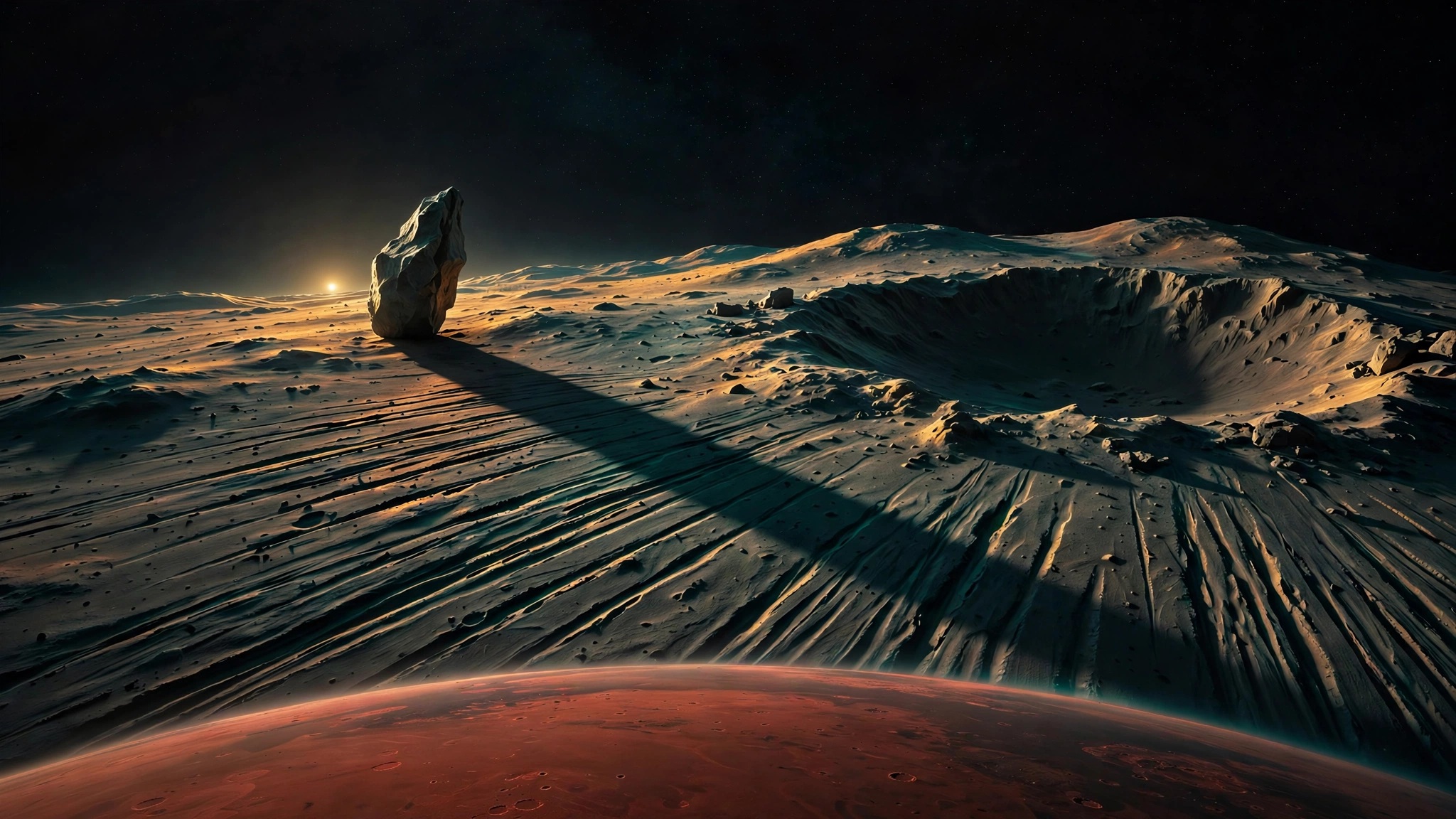
On that small, dark moon, near the rim of a vast crater, a single boulder casts a long shadow. It stands perhaps 90 metres tall, and in the grainy images that first showed it, it looked unnervingly like an upright block, a tower standing alone on an empty plain. For more than twenty-five years it has been called the Phobos monolith. An Apollo astronaut said people would one day ask who put it there.
On 20 October 2026, Japan time, an H3 rocket lifted off from the Tanegashima Space Center carrying a spacecraft bound for Phobos. It is due to reach Mars in 2027, set down on the moon’s surface, scoop up its soil and bring it back to Earth in 2031. For the first time, a machine is on its way to touch the moon of fear.
From the ground, the moon has already been watched in a way that feels almost intimate. NASA’s rovers on Mars have filmed Phobos passing in front of the Sun, a dark potato-shaped shadow sliding across the solar disc in under a minute, an eclipse no human eye has seen.
The Moon Called Fear
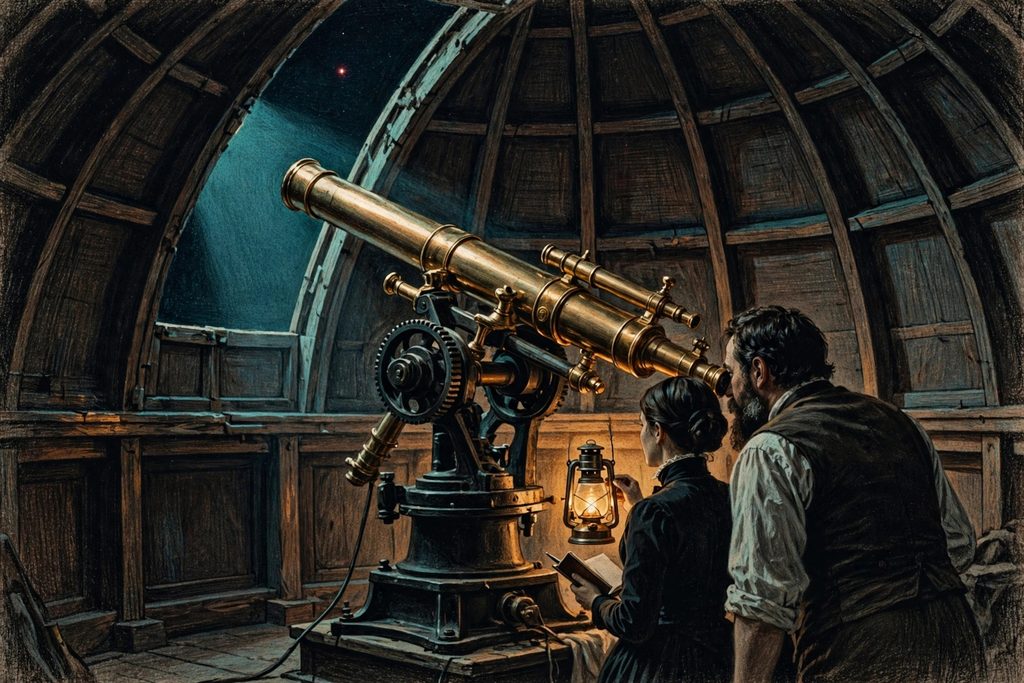
Phobos was found in August 1877 at the US Naval Observatory in Washington. The astronomer Asaph Hall had been searching for moons around Mars during an unusually close approach of the planet and was close to giving up, when his wife, Angeline Stickney, urged him to keep going. On 12 August he glimpsed the outer moon, and on 18 August the inner one. They were named Phobos and Deimos, Fear and Dread, after the sons of Ares, the Greek god of war, whom Homer describes in the Iliad yoking the horses of their father’s chariot. The largest crater on Phobos now bears Angeline Stickney’s name.
Their discovery had a strange prelude. In 1610 Johannes Kepler, puzzling over an anagram Galileo had sent him, read it as an announcement that Mars had two moons, which it did not say. In 1726 Jonathan Swift, in Gulliver’s Travels, had the astronomers of the flying island of Laputa discover two small moons of Mars, one circling in ten hours. Voltaire repeated the idea in 1752. A century and a half after Swift, Hall found two small moons, and the inner one circled the planet even faster than Swift had guessed.
The modern Phobos is one of the oddest objects in the solar system. It orbits only about 6,000 kilometres above the Martian surface, closer to its planet than any other known moon, and goes round once every 7 hours and 39 minutes, faster than Mars itself turns. Its surface is scored by long parallel grooves, and one side is dominated by Stickney, a crater 9 kilometres wide, gouged by an impact that very nearly shattered the moon. Its density, about 1.9 grams per cubic centimetre, is so low that it cannot be solid rock. Scientists think it is a rubble pile, perhaps 30 percent empty space, a loose heap of fragments held together by its own weak gravity.
A Moon Too Strange to Be Natural
That low density once led a famous scientist to an extraordinary conclusion. In 1945 the American astronomer Bevan Sharpless, at the Naval Observatory where Phobos had been found, reported that the moon seemed to be speeding up in its orbit, spiralling slowly inward. Around 1958 the Soviet astrophysicist Iosif Shklovsky, one of the founders of the scientific search for extraterrestrial life, calculated what that acceleration would mean. If the drag of the thin upper Martian atmosphere was slowing Phobos enough to pull it inward that fast, the moon would have to be astonishingly light, so light that it could only be hollow, a thin shell. A hollow moon, he suggested, might be an artificial satellite, built by a Martian civilisation.
The idea caught fire in the press of the space age, and it has never entirely gone out. But it rested on a number that turned out to be wrong. Later measurements showed that the inward drift was much smaller than the early estimates, and that it is caused not by atmospheric drag but by the tides Phobos raises on Mars, the same kind of gravitational exchange that is slowly pushing our own Moon away from Earth. Phobos is falling, by about two metres every century. In 30 to 50 million years it will cross the point where Mars’s gravity tears it apart, and its fragments may spread into a ring around the planet. Spacecraft have since flown close enough to weigh it. In March 2010 the European Space Agency’s Mars Express passed just 67 kilometres from Phobos, and the tug of the moon’s gravity on the spacecraft gave the most precise measurement of its mass yet. It is not hollow. It is a porous moon, not an empty one.
The Shadow That Ended Phobos 2
The Soviet Union tried twice to reach Phobos in 1988. The first probe, Phobos 1, was lost on the way after a faulty command switched off its orientation system. The second, Phobos 2, arrived in orbit around Mars in January 1989 and began studying the moon, photographing about 80 percent of its surface. In late March, as it manoeuvred toward a close pass that was meant to drop two landers onto Phobos, contact was lost. The cause was traced to failures in its onboard computers, which had been malfunctioning since before its arrival.
Then a picture began to circulate. Among the final images transmitted by the probe was a thermal frame of the Martian surface showing a long, thin, dark ellipse with sharp edges. In the early 1990s it was presented at UFO conferences as the shadow of a cigar-shaped mothership near Phobos, and the probe’s silence as the result of an encounter with it. The Soviet test pilot Marina Popovich, a record-setting aviator and longtime enthusiast of UFO research, helped bring it to the West.
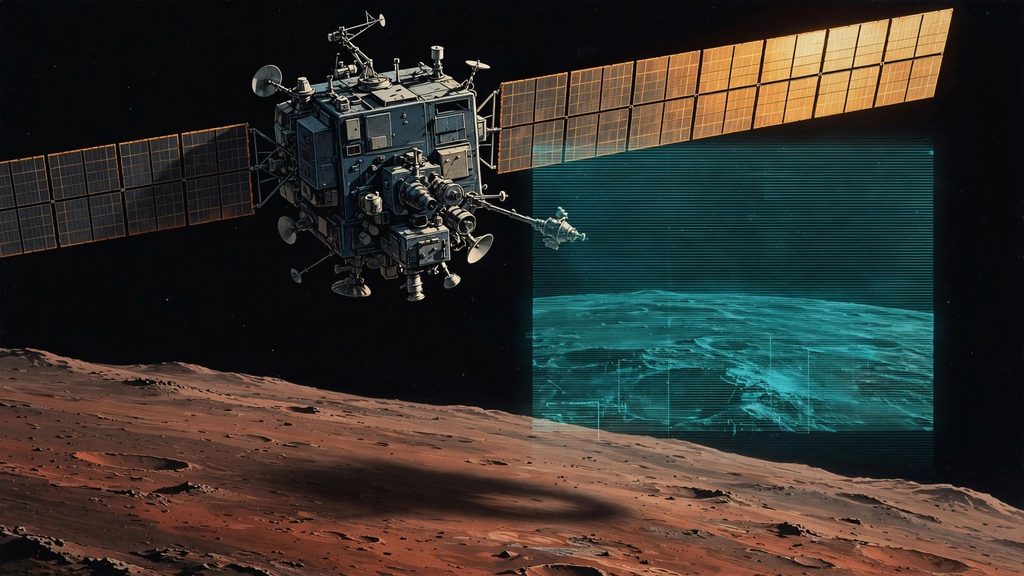
The usual explanation is less dramatic and fits what the instrument was. The image was made by a scanning instrument that built its pictures line by line over many seconds, while the probe and the moon were moving. The shadow of Phobos itself, falling on Mars, was drawn out by that slow scan into a long, smooth ellipse. The probe was already failing for reasons its engineers had recorded before it reached Mars, and nothing in its last data required a second object.
The Stone Near Stickney
The monolith arrived with the next generation of spacecraft. In 1998 NASA’s Mars Global Surveyor, orbiting Mars, turned its camera toward Phobos and captured a series of images of its surface. Years later Efrain Palermo, an independent researcher combing through the archive, noticed something in them, a single bright object casting a long shadow across the plain near Stickney crater. In 2000 Lan Fleming, an imaging specialist working as a contractor at NASA’s Johnson Space Center, examined the frames and estimated the object’s size from its shadow. It appeared to be about 85 metres across and around 90 metres tall, the height of a large office building, standing almost alone.
On 22 July 2009, two days after the fortieth anniversary of the first Moon landing, Buzz Aldrin appeared on the American public affairs network C-SPAN to argue for a mission to the moons of Mars. He described the monolith on Phobos. “When people find out about that, they’re going to say, ’Who put that there?’” he said. “Well, the universe put it there, if you choose, God put it there.” Aldrin was making a case for exploration, not a claim about aliens, but the clip has been shared ever since as an astronaut’s confession.
The word itself does much of the work. Before 1968 a monolith was simply a single great stone. After Stanley Kubrick and Arthur C. Clarke’s 2001: A Space Odyssey, it became a black slab left on the Moon by an alien intelligence, waiting to be found. Any upright rock on another world now arrives with that image already attached.
The scientific reading is simpler. Phobos is covered in boulders, many of them flung out by the impact that made Stickney. A 2018 study even proposed that the moon’s famous grooves were carved by boulders from Stickney rolling and bouncing across its surface in the low gravity. A large block of ejecta, landed on its end, lit from a low angle so that its shadow stretches far across the plain, would look exactly like the monolith. The same happened on Mars itself. In 2008 NASA’s HiRISE camera photographed a rectangular boulder on the Martian surface that the internet promptly called a Mars monolith. Jonathon Hill, a mission planner at Arizona State University, explained that it had most likely broken off a nearby cliff and tumbled to the bottom, its height exaggerated by the long shadow of the low sun.
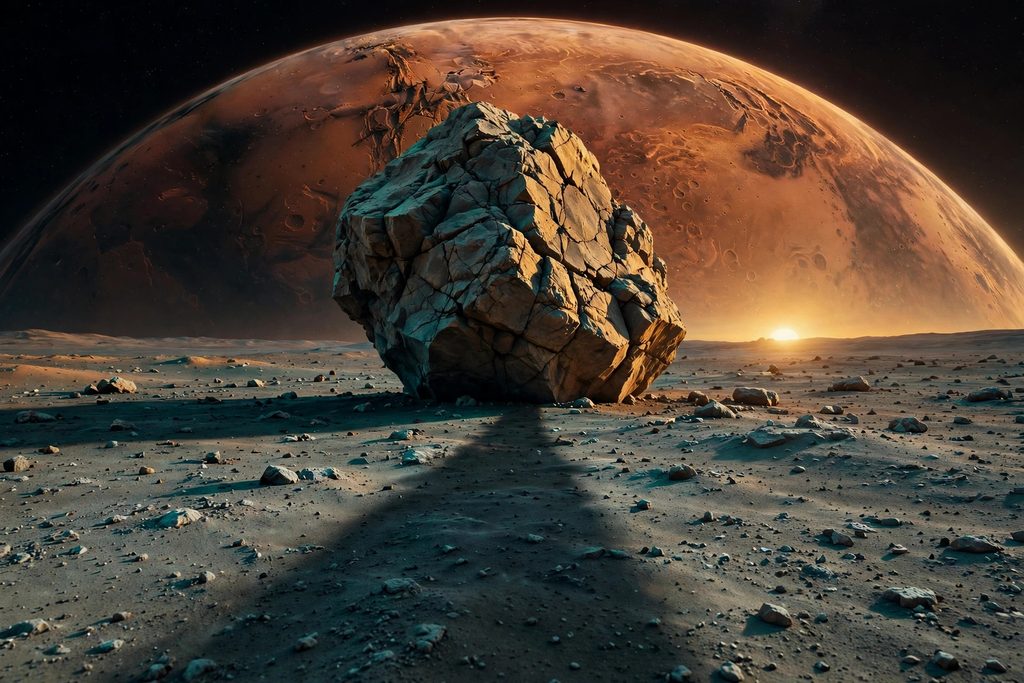
That reading is a strong one, and it has never been tested up close. No spacecraft has imaged the Phobos monolith at high resolution, from a low angle, or from the side. The Canadian-led PRIME proposal, a mission planned by the company Optech and the Mars Institute, named the area around it as a possible landing site, but the mission has never been funded. For now, the tower on the moon of fear is a pixel cluster and a shadow, which is exactly what makes it so easy to fill with stories.
What Phobos Is Made Of
The larger mystery of Phobos is not one rock but where the whole moon came from. Its dark, carbon-rich surface looks like a type of asteroid common in the outer asteroid belt, which suggests that Mars might have captured it. But a captured asteroid should travel in a tilted, stretched orbit, and Phobos circles almost exactly over Mars’s equator in a nearly perfect circle. Infrared measurements have also found minerals on its surface that look more like the rock of Mars itself.
Its partner deepens the puzzle. Deimos, Dread, is smaller still, about 12 kilometres across, orbits much farther out, and has a smoother surface blanketed in dust. Any theory of where Phobos came from has to explain Deimos too.
That has made another idea popular, that Phobos and Deimos formed from debris thrown into orbit when something huge struck Mars billions of years ago, the same kind of collision that is thought to have made our own Moon. A third proposal, published in 2021, suggests the two moons are fragments of a single earlier moon that broke apart. Each theory makes predictions about what the moon’s soil contains, and no one has ever held a grain of it.
The Spacecraft Now on Its Way
That is what Japan’s Martian Moons eXploration mission, MMX, was built to change. It launched on 20 October 2026, Japan time, from Tanegashima on an H3 rocket and is due to arrive at Mars in August 2027. Rather than orbiting the planet, it will settle into a looping path around Phobos itself, studying both moons with thirteen instruments, among them a NASA spectrometer that will map the moon’s elements and cameras that will chart its surface in detail.

No earlier than December 2028 it will land. A small four-wheeled rover called Idefix, built by the German and French space agencies, will scout the ground first. Then the spacecraft will gather samples in two ways, a NASA device on one landing leg that collects surface material in seconds, and a JAXA corer that digs deeper. The sample capsule is due to land in Australia in 2031, bringing home at least ten grams of Phobos. Laboratories on Earth will be able to tell, from the minerals and isotopes in that soil, whether the moon was born from Mars or captured from elsewhere.
MMX will not necessarily fly anywhere near the monolith, and its landing site will be chosen for safety and science, not legend. But it will photograph Phobos more closely than any spacecraft before it, and some of those images may include the plain near Stickney where the long shadow falls.
The Verdict | Unresolved
The Phobos monolith exists. It is a large boulder, about 90 metres tall by the best estimate from its shadow, seen in Mars Global Surveyor images from 1998, standing near the crater Stickney. Nothing about it suggests it was built. The moon’s surface is littered with boulders flung out by the Stickney impact, the Soviet “hollow moon” calculation was based on a mistaken orbital figure, and the Phobos 2 “mothership” is best explained as the moon’s own stretched shadow. But no instrument has ever looked at the monolith closely, and the moon it stands on is still being argued over. The verdict is Unresolved.
The stories that grew around Phobos tend to follow the pattern of other “artificial satellite” legends, such as the Black Knight, built from several unrelated observations. The surface of Mars has its own gallery of unusual structures, and a serious version of the question behind them, whether earlier civilisations could have lived on other planets and left traces we would recognise, has been asked in print by a Penn State astrophysicist, as set out in our file on civilisations before humanity.
For how this verdict sits beside the rest of the archive, see the Verdict Index.