Narmer, a pivotal figure in Egyptian history, is widely regarded as the founder of Dynasty I and the first pharaoh to unify Ancient Egypt.
His reign, dating back to approximately 3050 BCE, marks a transformative era that laid the foundation for one of the world’s most enduring civilizations.
Narmer’s Historical Significance
Narmer’s reign length is estimated at around 60 years in some later ancient chronicles, including Syncellus, though this needs a precise correction: Herodotus’s surviving Histories never actually mention Narmer by that name, he discusses a king called Menes, whom most modern Egyptologists identify as the same historical figure Narmer represents, though the identification itself remains a matter of ongoing scholarly discussion rather than settled fact. This distinction matters for accurately tracing which ancient source said what about this pivotal figure. As the first pharaoh of a unified Egypt, Narmer bridged the prehistoric period and the Early Dynastic Period, establishing the political and cultural framework that defined pharaonic rule for millennia. His leadership unified two distinct regions, Upper Egypt and Lower Egypt, into a single kingdom, creating a centralized government that became the hallmark of Ancient Egyptian civilization.
Upon ascending the throne of Upper Egypt, Narmer adopted the throne name Menes, a name often used interchangeably with Narmer in historical records. The use of throne names was a common practice among Egyptian pharaohs, symbolizing their divine authority and connection to the gods. While some scholars debate whether Narmer and Menes were the same individual, the consensus leans toward their identity as one, with Menes being the ceremonial title Narmer assumed as ruler.
The Unification of Upper and Lower Egypt
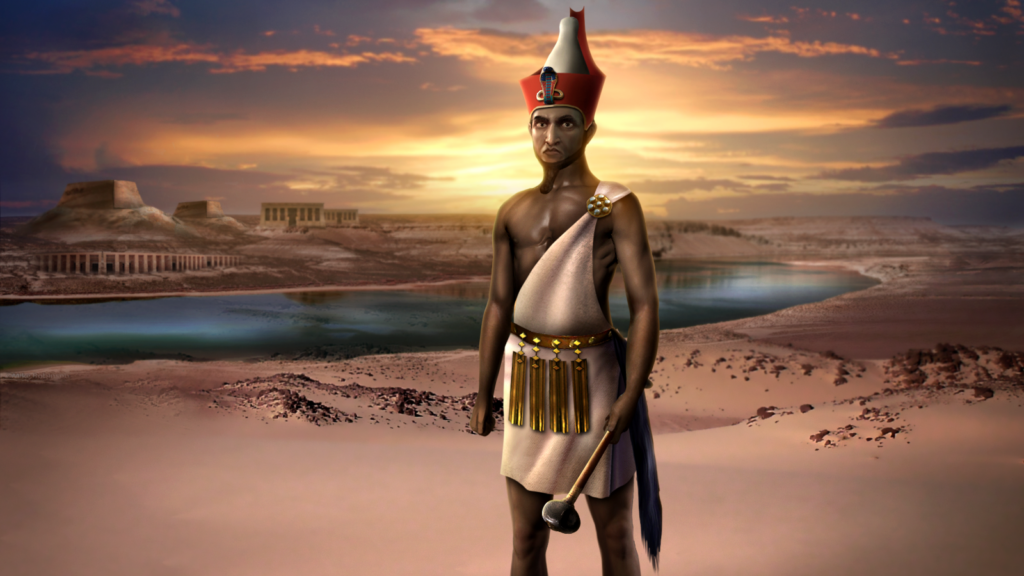
Narmer’s most celebrated achievement was the conquest and unification of Upper and Lower Egypt, a feat that established him as the first ruler of a cohesive Egyptian state. This unification, achieved through military campaigns, is vividly recorded in the Narmer Palette, a significant archaeological artifact discovered in Hierakonpolis. The palette, a ceremonial slate slab, depicts Narmer as a powerful warrior-king, wearing the White Crown (Hedjet) of Upper Egypt on one side and the Red Crown (Deshret) of Lower Egypt on the other. This dual imagery symbolizes his dominion over both regions, marking the birth of a unified Egypt.
The Narmer Palette also portrays Narmer striking down a defeated enemy, likely a representative of Lower Egypt or a foreign adversary. The imagery underscores the military force employed during the unification process. Scenes of bound prisoners and Narmer’s triumphant procession further emphasize his authority and the subjugation of rival territories. The palette, now housed in the Egyptian Museum in Cairo, remains one of the most iconic artifacts of early Egyptian history, offering invaluable insight into Narmer’s reign and the socio-political dynamics of the time.
Following his conquest of Lower Egypt, Narmer established Ineb Hedy (later known as Memphis) as the capital of his unified kingdom. Strategically located at the mouth of the Nile Delta, Memphis served as a political, economic, and cultural hub, facilitating trade and governance across Upper and Lower Egypt. The choice of Memphis as the capital reflects Narmer’s foresight in creating a centralized administrative center that would endure as Egypt’s capital for centuries.
Architectural and Engineering Achievements
Narmer’s reign was not only defined by military conquest but also by significant architectural and engineering contributions that shaped the early Egyptian landscape. One of his most remarkable projects was the construction of a dike to manage the flooding of the Nile River in the region of Ineb Hedy. By redirecting the Nile’s course to drain into a nearby lake, Narmer transformed the marshy, flood-prone area into arable land suitable for urban development. This ambitious engineering feat highlights Narmer’s understanding of hydraulic management and his commitment to fostering a sustainable capital.
In addition to the dike, Narmer oversaw the development of Memphis itself, laying the groundwork for its emergence as a major city. Among the city’s notable structures was a temple dedicated to Ptah, the creator god and patron deity of craftsmen. This temple, associated by Herodotus with Vulcan (the Greek equivalent of Ptah), underscores Narmer’s devotion to religious institutions, which played a central role in legitimizing pharaonic authority. The construction of such monumental architecture reflects the growing sophistication of Early Dynastic Egypt and Narmer’s role in promoting cultural and religious unity.
Narmer’s architectural legacy extends beyond Memphis. His reign saw the establishment of administrative buildings, storage facilities, and possibly early palaces, though many of these structures have not survived due to the perishable materials used in early Egyptian construction. Nevertheless, the urban planning and infrastructure projects initiated under Narmer set a precedent for the monumental architecture of later dynasties, such as the pyramids of the Old Kingdom.
The Mystery of Narmer’s Tomb
The location of Narmer’s tomb remains a subject of fascination and debate among Egyptologists. The prevailing theory places his burial site at Umm el-Qaab, a royal necropolis near Abydos, one of Egypt’s oldest and most sacred cities. Specifically, archaeologists associate Narmer with Tombs B17–B18, a complex of mudbrick chambers containing artifacts bearing his name. These tombs, excavated in the late 19th and early 20th centuries, include pottery, ivory labels, and seals that link them to Narmer’s reign, supporting the hypothesis that this was his final resting place.
However, alternative theories propose other possible burial sites. Some scholars suggest Narmer may have been interred at Saqqara, a major necropolis near Memphis, or Tarkhan, another early Egyptian cemetery. These competing hypotheses stem from the discovery of monuments and artifacts bearing Narmer’s name at these locations. However, many experts argue that these structures are likely cenotaphs, symbolic tombs or memorials, rather than actual burial sites. Cenotaphs were common in ancient Egypt, serving as honorary monuments to commemorate pharaohs in multiple locations.
The uncertainty surrounding Narmer’s tomb reflects the challenges of interpreting archaeological evidence from the Early Dynastic Period. Many early tombs were constructed with mudbrick, which deteriorated over time, and looting in antiquity further complicates efforts to identify definitive burial sites. Ongoing excavations and advances in archaeological technology, such as ground-penetrating radar, may eventually provide clarity on this enduring mystery.
Narmer’s Legacy and Cultural Impact
Narmer’s contributions to Egyptian civilization extend far beyond his lifetime. By unifying Upper and Lower Egypt, he established a political model that endured for over 3,000 years, characterized by centralized authority, divine kingship, and a strong bureaucratic system. His reign also laid the cultural and religious foundations that shaped Egyptian identity, from the veneration of gods like Ptah to the symbolic use of royal iconography.
The Narmer Palette, in particular, serves as a testament to his legacy, offering a glimpse into the artistry, symbolism, and ideology of early Egypt. Its detailed carvings and narrative style foreshadow the sophisticated artistic traditions of later dynasties. Similarly, Narmer’s engineering projects, such as the Nile dike and the development of Memphis, demonstrate his role as a visionary leader who prioritized the long-term prosperity of his kingdom.
In modern times, Narmer’s story continues to captivate historians, archaeologists, and enthusiasts of ancient history. His reign is a focal point for understanding the transition from prehistoric tribal societies to a unified, state-level civilization. Museums worldwide display artifacts associated with Narmer, and ongoing research at sites like Abydos and Saqqara sheds new light on his era.
The Narmer Palette | What Credentialed Archaeologists Actually Know
It’s worth going deeper into the Narmer Palette’s actual archaeological context, since it remains one of the most extensively studied artifacts from this period. Credentialed archaeologists James Quibell and Frederick Green excavated the palette in 1898 at Hierakonpolis, discovering it alongside other significant ceremonial objects in what’s now called the “Main Deposit.” Credentialed Egyptologists have long noted that while the palette’s imagery is widely interpreted as commemorating military unification, some scholars caution against reading it as a literal historical record in the modern sense, arguing it may instead represent a more symbolic or ceremonial statement of royal authority and divine kingship, a genuinely ongoing academic debate rather than a fully settled question. This distinction matters: the palette is unquestionably genuine and unquestionably significant, but exactly how literally to interpret its narrative scenes remains an active area of Egyptological discussion.
Narmer’s Place in the Naqada III Period
It’s worth situating Narmer within the broader archaeological period credentialed Egyptologists call Naqada III, the final phase of Egypt’s Predynastic period immediately preceding Narmer’s own reign. Archaeological evidence from this period shows increasing social stratification, the emergence of hieroglyphic writing, and growing trade networks extending into Canaan and the Levant, evidence supported by pottery and inscriptions bearing serekhs, the early royal name-symbols, found well beyond Egypt’s borders. Credentialed archaeologists studying this transitional period generally understand Egyptian unification not as a single, sudden conquest but as the culmination of a longer, gradual process of political consolidation among competing regional centers, with Narmer’s reign representing the decisive final stage of this process rather than its sole origin point.
A unified Egyptian state
Narmer, the first pharaoh of Ancient Egypt, stands as a towering figure in human history. His unification of Upper and Lower Egypt around 3050 BCE marked the dawn of one of the world’s greatest civilizations. Through military conquest, innovative engineering, and monumental architecture, Narmer laid the foundations for a unified Egyptian state that thrived for millennia. While the exact location of his tomb remains uncertain, his legacy endures in the artifacts, structures, and cultural traditions he left behind. By exploring Narmer’s life and achievements, we gain a deeper appreciation for the origins of Ancient Egypt and the enduring impact of its first pharaoh.
For further information on Narmer and early Egyptian history, visit trusted resources such as the Egyptian Museum in Cairo or explore academic publications on Egyptology.