




The Valkyrie most people know was largely invented after the Viking Age was over. The older sources describe something considerably stranger: women who choose the dead, stand inside the machinery of fate, and sometimes appear alongside ravens and battlefields rather than heavenly horses and heroic romance. Then, nearly a thousand years later, a German opera designer gave them wings, and the modern world never quite stopped seeing them that way.
The archaeological record complicates the picture further.
At Birka, Sweden, a richly equipped Viking Age grave long assumed to belong to a male warrior was found to contain the remains of a woman. The genetic identification is not seriously in dispute. What remains disputed is what her weapons meant, what role she occupied, and whether the grave can legitimately be used to illuminate the mythology of the Valkyries at all.
That distinction matters.
The evidence does not give us a secret history in which archaeologists have discovered the women who became the Valkyries. It gives us something more interesting: two independent bodies of evidence that refuse to fit neatly inside the sanitized image modern culture inherited.
The Word “Valkyrie” Is More Violent Than the Image
The Old Norse word valkyrja is unusually explicit. It combines valr, referring to the slain on the battlefield, with kjósa, “to choose.”
Chooser of the slain.
That is not a modern poetic interpretation imposed on an otherwise mysterious word. The violence is already inside the name.
And the surviving literature makes the active role difficult to miss. The Poetic Edda, Snorri Sturluson’s Prose Edda, and other medieval sources describe valkyries in connection with battle, death, fate, and the selection of warriors who will die. They are not simply celestial nurses waiting at the edge of the battlefield to escort whoever happens to fall. They participate in determining the outcome.
The Darraðarljóð, preserved within Njáls saga, provides perhaps the most disturbing image. Twelve valkyries sit at a loom before a battle. But this is no ordinary loom. Human entrails become the threads. A man’s head serves as a weight. Arrows form the loom’s machinery. Swords become the beater. They weave the fate of men who are about to die.
Whatever one makes of the mythology, this is not the imagery of passive heavenly maidens. The Valkyrie is not merely waiting for death. She is inside it.
Before the Wings, There Were Ravens
The older material becomes even more interesting when the Valkyrie is placed beside the raven.
Þorbjörn Hornklofi’s Hrafnsmál, generally dated to around the late ninth century, presents a dialogue involving a valkyrie and a raven. The raven speaks of battle and slaughter, describing the aftermath in the language of carrion and blood.
That pairing is important. Ravens were not decorative accessories in Norse imagination. They belonged directly to the battlefield ecosystem, feeding on the dead and serving as powerful mythological companions of Odin.
So when valkyries appear in this environment, the oldest imagery does not naturally point toward the later fantasy of an armored angel descending gracefully from the clouds. It points toward death, selection, carrion, Odin, and fate.
Scholars including Rudolf Simek and Britt-Mari Näsström have therefore emphasized aspects of the Valkyrie’s earlier and darker character, including possible connections with supernatural beings associated with death rather than the later romantic image of the noble warrior maiden.
But even here, restraint matters. There is no single archaeological or textual document that lets historians draw a clean evolutionary line from “demon of the dead” to “Valkyrie.” Nor is every early valkyrie passage reducible to a single original conception.
The sources are messier than that. And that messiness is precisely what makes them useful.
The Valkyries May Have Been Closer to Fate Than to Heaven
One of the most revealing complications is a name. Skuld.
Skuld appears among lists of Valkyries, but Skuld is also one of the three Norns, the female figures associated with fate and the cosmic order surrounding Yggdrasil.
That overlap does not prove that Valkyries and Norns were originally the same beings. It does, however, make the modern separation between neat mythological “categories” look less secure.
Later systematization encourages us to imagine Norse mythology as a perfectly organized supernatural bureaucracy: gods here, Norns there, Valkyries somewhere else, each with a clean job description. The surviving tradition doesn’t always behave that way. Names overlap. Functions overlap. Death, fate, battle, prophecy, and supernatural female power bleed into one another.
The Valkyrie therefore becomes harder to understand as simply an angel of Valhalla. She belongs to a much darker conceptual territory: the machinery by which death becomes destiny.
The Winged Valkyrie Came Later
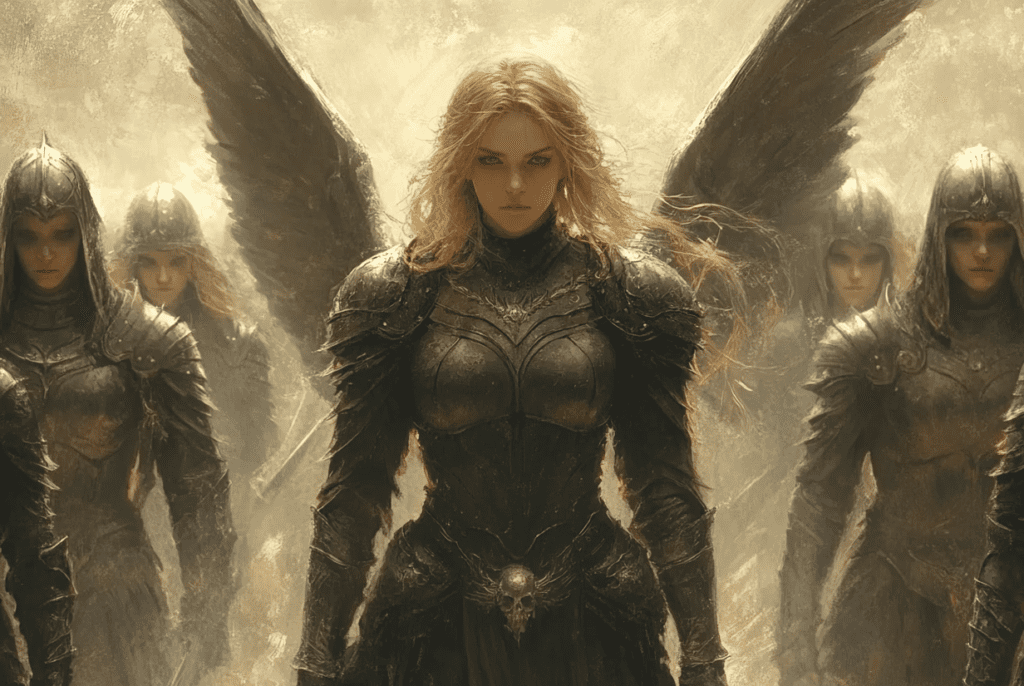
Then came Wagner. And with him came the image that effectively conquered the modern imagination.
Richard Wagner’s Ring cycle premiered in its complete form at Bayreuth in 1876. For the stage, costume designer Carl Emil Doepler gave the Valkyries the now-famous winged headgear.
The choice was enormously influential. The problem is that it is also enormously anachronistic.
There is no Viking Age tradition of Valkyries wearing the familiar winged helmets that have become almost inseparable from the word. The image belongs to 19th-century Romantic visual culture, not to a surviving medieval Norse costume tradition.
That distinction sounds trivial until it becomes clear how completely the later image replaced the earlier one. Today, ask someone to picture a Valkyrie and they are likely to imagine a winged helmet, shining armor, long blonde hair, a beautiful face, a heroic horse, a dramatic sky. Ask what the oldest sources actually emphasize and the answer becomes much less comfortable: battle, death, selection, ravens, fate, blood.
The popular Valkyrie was not simply preserved from antiquity. She was redesigned. And the redesign worked.
Then Archaeology Produced a Very Different Woman
The mythology is one thread. Birka is another.
In 1878, Swedish archaeologist Hjalmar Stolpe excavated grave Bj 581 at the Viking Age settlement of Birka. It was an unusually prestigious burial. Inside were weapons including a sword, axe, spear, shield and arrows, along with two horses and a set of gaming pieces. The combination strongly suggested military status and strategic authority.
For decades, the skeleton was simply assumed to be male. That assumption was understandable given the grave goods. It was also wrong.
A 2014 osteological analysis by Anna Kjellström suggested that the individual was female. A subsequent genomic study led by Charlotte Hedenstierna-Jonson and published in 2017 found no Y chromosome and mitochondrial DNA consistent with a single individual.
The skeleton was female. That part of the discovery is considerably firmer than the popular headlines sometimes imply.
The harder question is what happened next. Was she actually a warrior?
The weapons certainly make that interpretation plausible. The gaming pieces have also been interpreted as evidence consistent with strategic or command responsibilities. But plausibility is not proof.
Critics have raised questions about the original excavation and the possibility of skeletal disturbance or mixing. Others have questioned whether weapons in a grave necessarily demonstrate that the deceased personally fought.
The research team defended the warrior interpretation in subsequent work, pointing out an uncomfortable feature of the earlier scholarship: when archaeologists believed the skeleton was male, the weapons were readily treated as evidence of a warrior. Once the skeleton became female, the meaning of those same objects suddenly became more controversial.
That is not proof that the woman was a battlefield commander. But it is an important reminder that archaeology is interpreted by human beings, and human beings bring assumptions with them.
What Bj 581 Does, and Does Not, Prove
This is where the temptation becomes almost irresistible. A female Viking burial. A supernatural tradition of female figures selecting warriors for death. A culture famous for warfare. The conclusion seems to write itself: female warriors became Valkyries.
But the evidence does not permit that confidence.
No surviving source says that Viking women who fought in battle were transformed into Valkyries in mythology. No archaeological discovery identifies a Valkyrie. No medieval author explains the mythology as a supernatural memory of historical female commanders. And the Valkyrie tradition has its own textual history, linguistic history, and religious context that cannot simply be collapsed into one archaeological grave.
The responsible conclusion is narrower. Bj 581 provides evidence that a woman could be buried with an extraordinary assemblage of weapons and symbols of status in Viking Age Scandinavia. Whether that means she personally fought, commanded, represented an elite social role, or occupied some combination of these categories remains debated.
It does not prove where the Valkyrie myth came from. But it does make one thing harder to dismiss: the Viking world had more room for armed female status than the old assumption of a uniformly male warrior culture allowed.
Two Mysteries, Not One Convenient Answer
The mythology and the archaeology should therefore be allowed to remain separate. That actually makes both more interesting.
The Valkyries are real as a documented feature of Norse mythology. Their name associates them directly with the choosing of the slain. Their surviving stories place them inside warfare and fate. Some of the oldest imagery surrounding them is brutal enough to make the later angelic version look almost unrecognizable.
Bj 581 is real archaeology. The individual buried there was female. The grave contained an extraordinary collection of military equipment. Whether she was a warrior is still debated.
And Wagner’s Valkyrie is real cultural history. She simply belongs to 1876.
That last fact may be the strangest of the three. Because the image that now feels ancient, the winged helmet, the armored maiden, the heroic horse, was not handed down unchanged from Viking Scandinavia. It was manufactured by a 19th-century European opera production and then mistaken, by generations of popular culture, for the original.
What the Valkyrie Actually Leaves Behind
The evidence does not reveal a suppressed civilization of female warriors. It does not prove that mythology preserves literal historical events. And it does not allow a single grave at Birka to solve a question that the medieval sources themselves never answer.
What it does reveal is considerably more compelling.
The original Valkyrie was not a sanitized symbol of feminine beauty floating above the battlefield. She was a chooser. A figure associated with the dead. A supernatural agent standing at the intersection of battle and fate.
Then centuries passed. Christianization transformed the cultural landscape. Medieval writers preserved fragments of an older mythology. Later scholars reorganized them. Romantic Europe rediscovered the Norse past. Wagner put wings on the Valkyries. And eventually the costume became more familiar than the source.
That is the real historical transformation. The Valkyrie did not become less strange because the Vikings made her simpler. She became less strange because modern culture made her prettier.
The older sources give us something darker: a female supernatural power that does not merely comfort warriors after death, but participates in deciding who reaches it. And archaeology gives us a separate, unresolved question: what kinds of women actually occupied positions of martial power in the world that produced those stories?
We do not yet know whether those two worlds ever touched. But we do know something important. The sanitized Valkyrie is not the ancient one. The ancient one was stranger.