




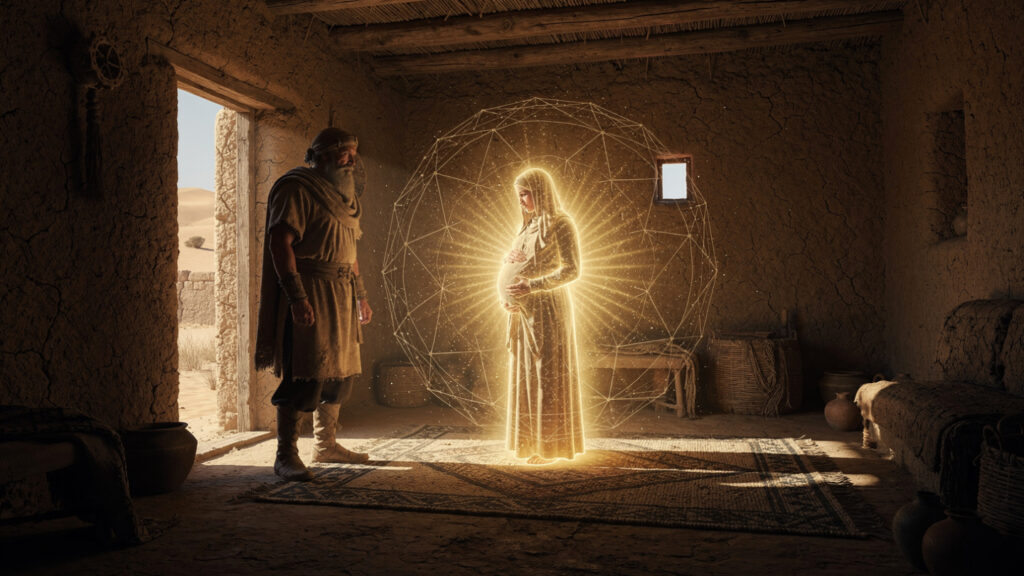
Lamech came home and his wife was pregnant.
He had been away for months. The child was not his. Bathenosh swore that no man had touched her, but Lamech did not believe her and went to his father Methuselah. Methuselah could not explain it and went to his own father, the patriarch Enoch, who had been taken to walk with God and had access to knowledge that ordinary men could not reach.
Enoch told Methuselah what had happened. The child in Bathenosh’s womb had been placed there by the Watchers, the beings the Book of Enoch calls the sons of God who had descended from heaven, taken human wives, and were producing the hybrid offspring the biblical tradition calls Nephilim. Lamech should accept the child, because this child would be the father of the post-flood human generation.
The child was Noah.
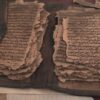
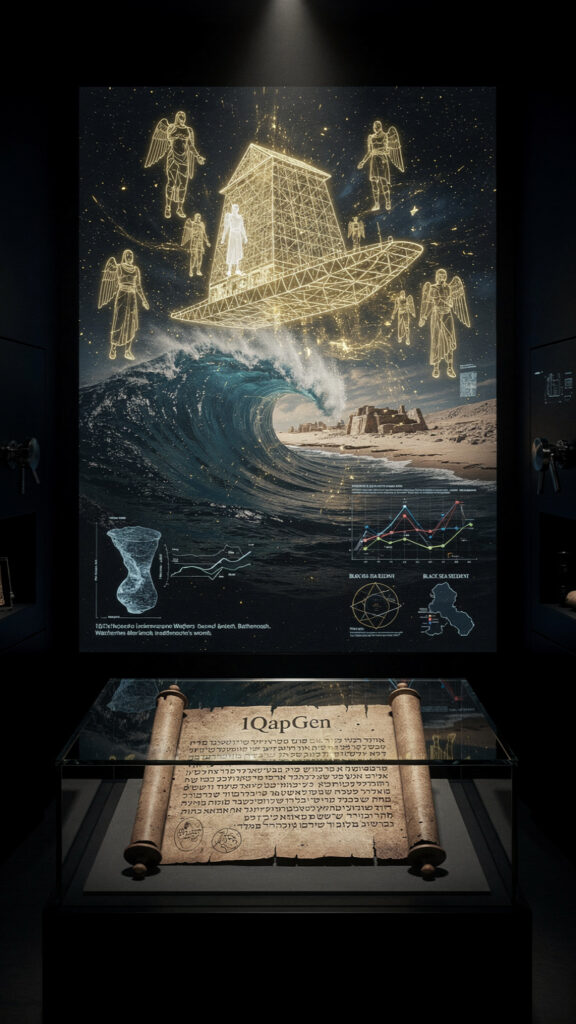
This is not a fringe interpretation of the flood narrative. It is the content of the Genesis Apocryphon, one of the original seven Dead Sea Scrolls discovered in Cave 1 at Qumran in 1947, now catalogued as 1QapGen in the Dead Sea Scrolls scholarship, whose Aramaic text was partially translated by Nahman Avigad and Yigael Yadin and published by the Hebrew University of Jerusalem in 1956. The Genesis Apocryphon is in the Israel Museum’s Shrine of the Book. Its content regarding Noah’s paternity appears in the peer-reviewed scholarship on the Dead Sea Scrolls.
Whether the Genesis Apocryphon’s account reflects genuine historical memory of Noah’s anomalous conception, a theological elaboration of the Genesis text that developed in the Second Temple period, or a deliberate encoding of a theological position about Noah’s nature and function in the post-flood world, is a question that the text raises without resolving. What the text establishes is that the tradition of Noah’s Watcher-involved paternity existed in a documented form that was preserved among the Dead Sea Scrolls community, suggesting that this interpretation of Noah’s origin was not an isolated innovation but a maintained tradition within the ancient Jewish textual culture.
The Watchers, the Corruption, and the Genetic Logic
The Book of Enoch’s account of the Watcher descent, covered across this library’s Nephilim and Watchers pieces, describes a sequence of events whose logic connects directly to the flood’s function in the Genesis narrative.
The Watchers descended, took human women, produced the Nephilim, and transmitted forbidden knowledge to humanity. The knowledge they transmitted, as documented in 1 Enoch 6-11, included metallurgy, cosmetics, enchantments, the cutting of roots, and astrology. Whether this knowledge transmission represents the acceleration of human technological development beyond the pace that the divine plan intended, or the introduction of capabilities that were incompatible with the human developmental stage at the time, is the theological question that the Enochic tradition explores.
The result of the Watcher intervention, in the Enochic account, was a corruption that was both moral and biological: the Nephilim were violent, consumed everything the humans produced, and then turned on the humans themselves. The Earth was filled with violence and injustice. The divine council decided to cleanse it.
The Hebrew phrase used to describe Noah in Genesis 6:9 is the crux of the genetic interpretation: tamim hayah be’dorotav, rendered in most English translations as perfect in his generations or blameless in his generations, uses the word tamim, which in the Hebrew agricultural and sacrificial context means unblemished or without defect, the requirement for an animal suitable for sacrifice. Whether this word in the context of Noah’s description means morally upright, as the conventional translation implies, or genetically unblemished, meaning that Noah’s lineage had not been affected by the Watcher hybridization that had contaminated the broader human population, is the interpretive question that the word’s agricultural meaning makes genuinely open.
Michael Heiser, whose The Unseen Realm, published by Lexham Press in 2015, is the most rigorously documented recent treatment of the divine council theology in the Hebrew Bible, argues for the genetic purity interpretation on the grounds that the flood’s function in the narrative is not simply punishment for moral wickedness but the elimination of the Nephilim corruption that the Watcher descent had introduced. Under this reading, the flood serves a genetic function: it removes the corrupted hybrid lineages and resets the human population from the one family whose genetic heritage was unaffected by the Watcher hybridization.

Whether this reading is correct depends on whether the Genesis author’s use of tamim in this context was intentionally genetic rather than moral. The word’s use in both contexts within the Hebrew Bible makes the ambiguity genuine rather than forced. The fact that the Watcher narrative immediately precedes Noah’s introduction in the Genesis text, with the connection between the Watcher corruption and the flood decision explicitly drawn in the narrative sequence, makes the genetic interpretation contextually coherent rather than arbitrary.
The Black Sea and the Physical Event
Before examining the Ark’s described function, the physical basis of the flood narrative deserves development that the source handles in a single paragraph.
Geologists William Ryan and Walter Pitman at Columbia University’s Lamont-Doherty Earth Observatory published their Black Sea flood hypothesis in a 1997 paper in Marine Geology and developed it in their 1998 book Noah’s Flood: The New Scientific Discoveries About the Event That Changed History. Their finding: geological evidence from the Black Sea floor shows a clear sedimentary boundary that marks a moment when the Black Sea transformed from a freshwater lake to a saltwater sea connected to the Mediterranean.
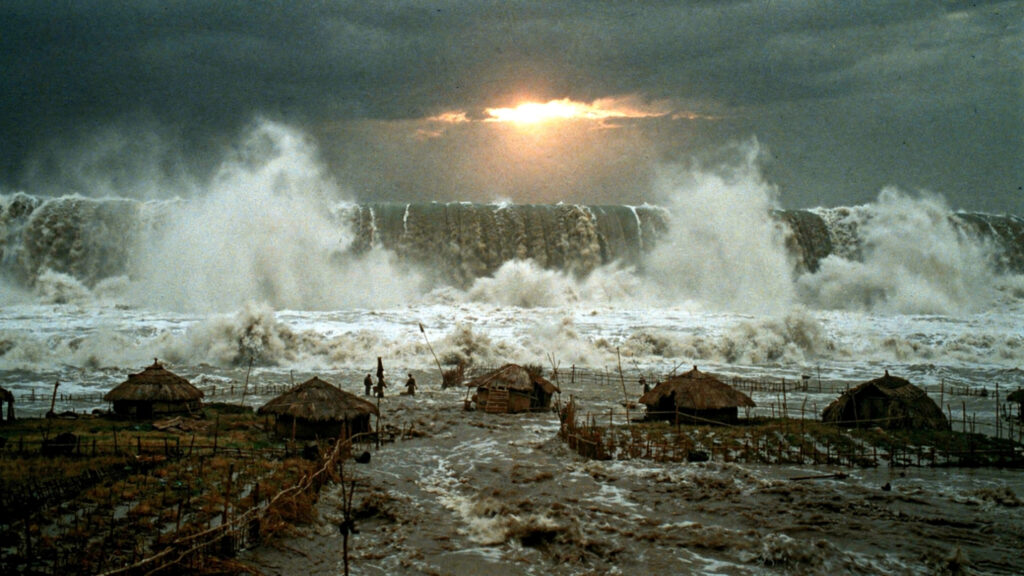
Their proposed mechanism appears in the geological record: the natural dam at the Bosphorus, which had been holding back the post-glacial rise of the Mediterranean Sea level, was breached approximately 7,600 years ago, releasing a catastrophic inflow of saltwater into the Black Sea basin. The inflow’s rate, which Ryan and Pitman calculated at approximately two hundred times the current flow of Niagara Falls, would have raised the Black Sea level at approximately fifteen centimeters per day in the initial phase.
The inhabited shoreline of the pre-flood Black Sea freshwater lake was the most agriculturally productive region in the Near East at the time: the flat, well-watered, warm lowland around the lake’s shore was exactly the kind of prime agricultural land that Neolithic farming communities preferred. The sudden and permanent inundation of approximately 93,000 square kilometers of this land, with shoreline retreat of kilometers per week at the flood’s peak rate, would have been the most catastrophic event in the human experience of the region’s Neolithic population.
Whether the Ryan-Pitman Black Sea flood is the event preserved in the Noah narrative is contested by archaeologists and biblical scholars who raise objections: the flood in Genesis is described as global, covering all mountains, while the Black Sea flood was regional. The Genesis chronology places Noah approximately 2,300 BCE by strict biblical calculation while the Black Sea flood occurred approximately 7,600 years ago, and the cultural details of the Noah narrative, the ark’s construction, the raven and dove testing, the covenant afterward, do not obviously map onto the circumstances of the Black Sea inundation.
The parallel traditions that appear in the Sumerian King List’s flood narrative, the Epic of Gilgamesh’s Utnapishtim, and the Hindu Manu tradition’s flood story all describe the same general event from different cultural perspectives and all originate in the general Near Eastern cultural sphere that the Black Sea’s shores define. Whether they all preserve memory of the same physical event or of different events in the same geographic memory tradition is a question the existing evidence does not definitively answer.
What Ryan and Pitman established is that a catastrophic flood of sufficient scale to transform a civilization’s landscape permanently occurred in the Near East within the timeframe of human cultural memory, and that the geological evidence for this flood is preserved in the Black Sea sediment record.
The Ark’s Described Function
The conventional reading of the Ark narrative presents it as describing a wooden boat large enough to contain pairs of all living species. The biological and engineering problems with this reading have been extensively documented: the Ark’s described dimensions in Genesis 6:15, 300 cubits long, 50 cubits wide, and 30 cubits high, correspond to approximately 137 by 23 by 14 meters in modern measurements, producing a vessel whose volume is approximately 43,000 cubic meters.
The number of species that would need to be housed in this volume has been variously calculated by biblical literalists and critics. The most conservative estimates, limiting the category to air-breathing land animals, produce numbers in the tens of thousands of species. The most comprehensive estimates, including insects and other invertebrates, produce numbers in the millions. Neither estimate is obviously compatible with the described ark volume under any reasonable packing density for living animals.
Whether this incompatibility means the narrative is not literal history, means the narrative describes technology whose actual character is different from the conventional wooden boat reading, or means the flood was not global in the sense of covering every species’ habitat, is the interpretive fork that the DNA bank hypothesis occupies.
The DNA bank hypothesis proposes that the Ark narrative describes a biological preservation technology rather than a physical animal transport operation. Under this reading, Noah was directed not to collect living pairs of every species but to collect genetic material from every species, sufficient to reconstruct the populations from the stored material after the flood. The described command, two of every kind, would in this reading refer to the minimum genetic sample required for viable population reconstruction: a paired sample preserving both alleles of each locus in a diploid species.
Whether the technology required for this operation, the collection, preservation, and storage of viable genetic material from tens of thousands of species across a period of a year, was available in the period the Genesis narrative describes depends entirely on what technology was available in that period and who provided it.

The Enochic framework’s answer is direct: the Watchers who had transmitted metallurgy and other advanced technologies to humanity before the flood were the same beings whose intervention in the divine plan produced the need for the flood. Whether they also provided the technology that allowed the genetic preservation to be accomplished is not specified in the surviving texts, but the narrative’s framing, God directing Noah in the construction and operational details of the Ark, is consistent with a technological transfer from a non-human intelligence to a human operator.
The Svalbard Comparison
The DNA bank hypothesis’s plausibility depends partly on whether comparable genetic preservation programs have been considered or implemented by technologically advanced civilizations.
The Global Seed Vault at Svalbard, Norway, established in 2008, is the closest contemporary analogue: a facility designed to preserve the genetic heritage of the world’s crop plants against catastrophic loss, storing seed samples from virtually every country’s agricultural heritage in conditions that would preserve viability for centuries or millennia. The Svalbard vault is explicitly designed for exactly the scenario the DNA bank hypothesis proposes: a catastrophic civilizational disruption that destroys the world’s existing genetic diversity, after which the vault’s contents would allow reconstruction of the biological heritage.
The contemporary human motivation for the Svalbard vault is precisely the motivation that the DNA bank hypothesis attributes to the Ark: preservation of biological diversity against catastrophic loss. Whether ancient technological civilizations facing a known catastrophic event would have developed a comparable program, and whether the Noah narrative preserves the memory of exactly such a program, is the question that the Svalbard parallel makes more cognitively accessible.
The detail in the Genesis narrative that the Ark was designed to specifications provided by God rather than by Noah himself is the element that the ancient technology interpretation treats as most significant: Noah did not design the preservation technology. He executed a design whose specifications came from a source with the knowledge to calculate what would be required. Whether that source was the divine council’s response to a situation of its own inadvertent creation, an advanced non-human intelligence managing the consequences of the Watcher intervention, or the theological encoding of a human engineering achievement whose actual methodology the tradition did not preserve, is the interpretive question.
What the Lamech Scroll Implies
Returning to the Genesis Apocryphon’s claim about Noah’s paternity: if the Watcher tradition’s account is accurate and Noah’s genetic constitution was specifically arranged rather than conventionally inherited, then the narrative’s genetic logic becomes more than the general purity claim suggests.
A child whose genetic constitution was specifically arranged by beings with the technological capability to conduct artificial insemination would have a genetic profile that was not simply uncontaminated by the Nephilim hybridization but was specifically designed for a purpose. The purpose that the Enoch tradition identifies is post-flood human population reconstruction: Noah is specifically the genetic template from which the new human population would be developed.
Whether this template function required Noah’s genetic constitution to include particular characteristics that the post-flood human population was intended to carry, and whether the differences between the pre-flood and post-flood human populations that various traditions describe reflect this intentional redesign, is the question that the Genesis Apocryphon’s paternity narrative makes genuinely interesting rather than simply anomalous.
The flood in the Enochic framework was not simply punishment or cleansing. It was a reset whose parameters were controlled by the beings who implemented it. The Ark was the technology that carried the selected genetic heritage across the reset. Noah was the individual whose genetic constitution was arranged to serve as the post-flood template.
Whether this reading is literal history, theological encoding of a genuine ancient cosmological understanding, or something whose character neither framework fully captures, is the question that the Genesis Apocryphon sitting in the Israel Museum’s Shrine of the Book raises for anyone who reads its Aramaic text.
Lamech came home and his wife was pregnant. Enoch told him the Watchers had done it.
He accepted the child.
The child was Noah.
The flood came.
The Ark preserved what it was designed to preserve.
What that was exactly is the question that the Dead Sea Scrolls, the genetic purity claim, and the DNA bank hypothesis approach from three different directions and none of them fully answers.
Whoever Noah’s actual father was, the text that names him has outlasted the tradition that tried to simplify it.