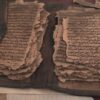





In December 1945, a farmer digging for fertilizer near the Egyptian town of Nag Hammadi struck a sealed earthenware jar. Inside were thirteen leather-bound codices containing fifty-two texts, preserved in Coptic and ultimately derived from Greek originals dating from the second to fourth centuries CE. Among them were the Apocryphon of John, the Hypostasis of the Archons, the Gospel of Philip and the Tripartite Tractate.
These were not books about extraterrestrials, consciousness technology or a hidden civilization behind ordinary reality. They were products of the religious world of late antiquity, and their authors belonged to traditions that Christianity would eventually classify as heretical. Yet the cosmology they preserve contains an idea that has proved extraordinarily durable: that the visible world may not be the highest level of reality, that its apparent ruler may itself be ignorant of something greater, and that human beings may carry within themselves a form of awareness capable of recognizing the difference.
That idea has since been rediscovered, reinterpreted and attached to remarkably different bodies of thought. Some of those comparisons are intellectually illuminating. Others go much further than the evidence permits. The distinction matters. The Nag Hammadi texts are historical evidence for what certain ancient communities believed. They are not evidence, by themselves, that Archons exist, that the physical universe is a prison, or that modern reports of non-human intelligence describe the same beings.
What makes the material worth examining is therefore not that it secretly proves a modern theory. It is that an ancient theory of reality survives in unusually concrete form, and that parts of its structure continue to reappear in very different attempts to explain consciousness, suffering, deception and the possibility that ordinary human perception does not tell the whole story.
The Demiurge and the Archons
These four texts, the Apocryphon of John, the Hypostasis of the Archons, the Gospel of Philip and the Tripartite Tractate, are only part of a much larger find. The Nag Hammadi collection contains fifty-two texts in total, including the Gospel of Thomas, a real, extensively studied collection of sayings attributed to Jesus that lacks any narrative frame at all, and the Gospel of Truth, a meditative homily some scholars attribute to Valentinus himself. The collection is not uniform in genre or theology. It includes cosmological treatises, dialogues, homilies, and at least one text, the Exegesis on the Soul, that reads closer to a psychological allegory than a cosmology. That variety is itself worth noting, since popular retellings of Nag Hammadi often flatten fifty-two genuinely different texts into a single unified “Gnostic gospel,” when the actual collection preserves real disagreement among the communities that produced it.
The Gnostic cosmological framework begins with an account of how the material world was created and by whom. The highest divine reality in the Gnostic system is the Pleroma, the divine fullness, an infinite and unknowable divine presence whose relationship to the material world is one of radical distance. The material world was created by the Demiurge, a lesser being who came into existence through a process of divine emanation the texts describe variously across different traditions. The Demiurge is not evil in the simplest sense. He is ignorant, creating the material world while believing himself the highest divine reality, unaware of the Pleroma above him.
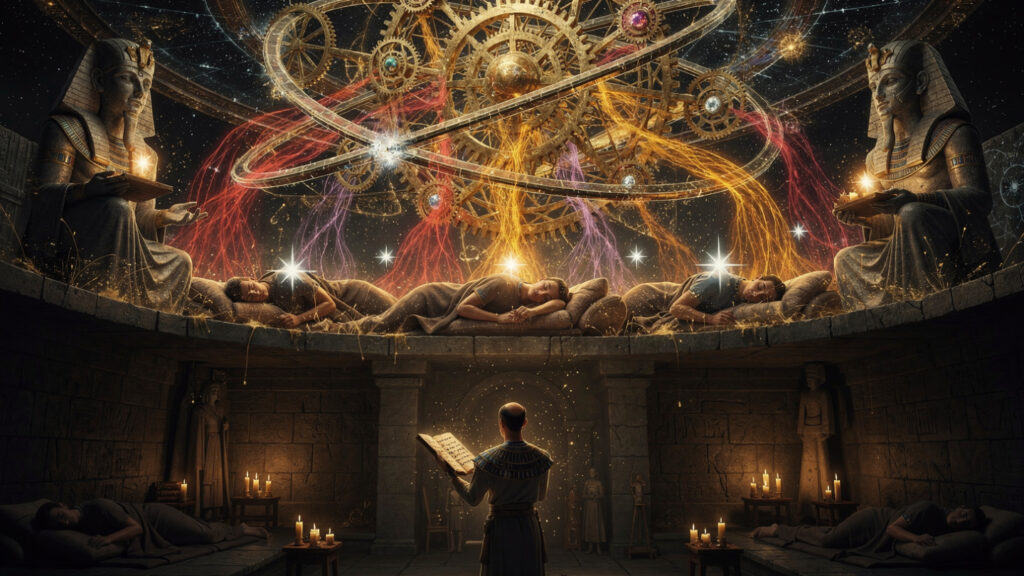
In the Apocryphon of John, the Demiurge is identified with the creator God of the Old Testament through the figure of Yaldabaoth. That text’s argument is that the God of Genesis, who creates the world and declares himself a jealous God, forbids knowledge and requires obedience, is not the highest divine reality but the Demiurge, whose jealousy and prohibition of knowledge reflect his ignorance of the Pleroma rather than his identity with it. This is the theological move that made this strand of Gnostic thought intolerable to the early Church, not a rejection of God in general but an identification of the Church’s God with a lesser, ignorant creator. In this cosmology, the Archons are the Demiurge’s subordinates, the entities through whom he maintains the material world and through whom human souls are kept from recognizing their true origin. The word Archon is Greek for ruler.
The Hypostasis of the Archons
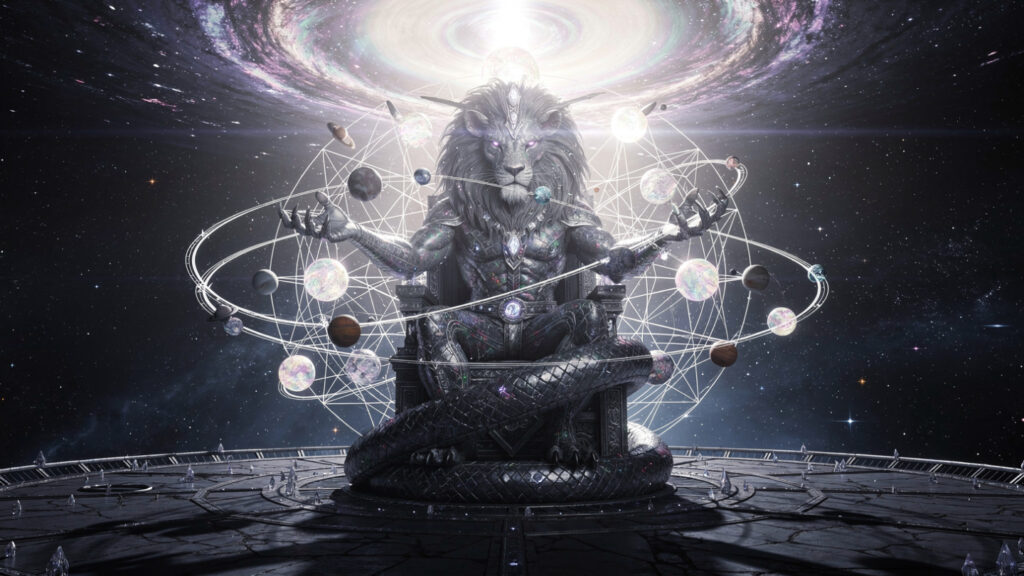
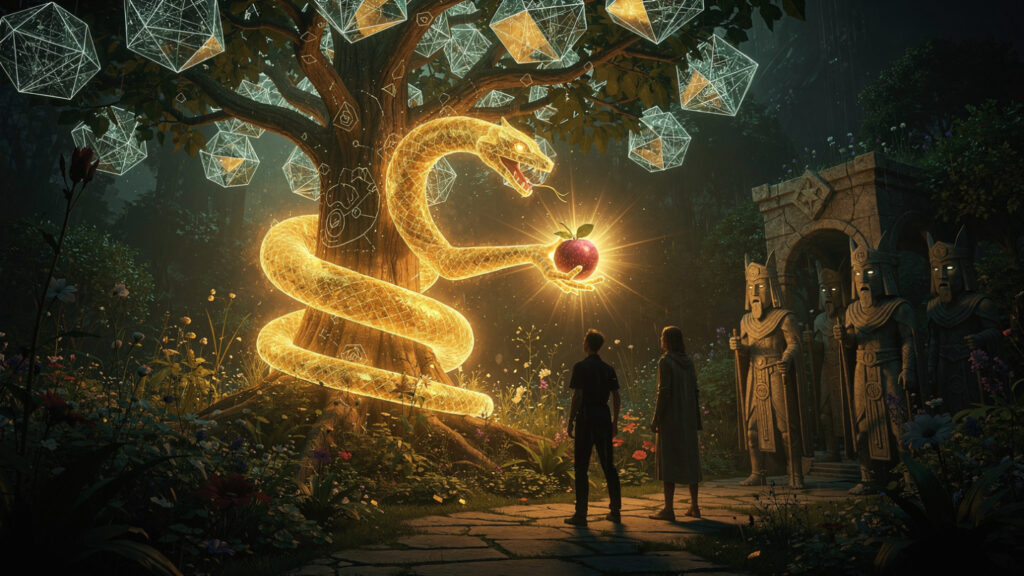
The Hypostasis of the Archons, one of the Nag Hammadi texts, provides the most direct description of the Archons’ characteristics. The text describes them as having psychic substance but lacking pneuma, the divine spirit, a kind of intelligence and life without the genuine divine consciousness the humans they oversee possess in latent form. That asymmetry is central to the framework: the Archons, despite their power over the material world, are in a fundamental sense inferior to the humans they control, because the humans carry divine sparks the Archons lack. The text describes the Archons responding to this with fear and a desire to prevent the human sparks from recognizing their nature, maintaining ignorance through a world absorbing enough to hold attention, false beliefs about the creator, and prohibitions on the knowledge that would allow recognition. The prohibition on the Tree of Knowledge in Genesis 2-3, reinterpreted through the Gnostic lens, becomes specifically the Demiurge’s attempt to prevent Adam and Eve from acquiring the gnosis that would let them recognize their situation, with the Serpent read as the Pleroma’s agent rather than humanity’s enemy. That reinterpretation is among the most radical features of the cosmology preserved in these texts, and it helps explain why such writings were fundamentally incompatible with the theology that became dominant within orthodox Christianity.
What Irenaeus Said They Believed
The Church Father Irenaeus of Lyon wrote his Against Heresies around 180 CE specifically to catalog and refute Gnostic beliefs. His account, written by an opponent for the purpose of refutation, is the primary source for many Gnostic doctrines whose original texts did not survive, and it’s more vivid than anything in the surviving Nag Hammadi material precisely because he was writing to explain clearly what he was condemning. It’s worth being precise about what Irenaeus is actually a source for: he describes Valentinian Christians, a related but distinct second-century movement, not the Nag Hammadi codices directly, which were copied more than a century later and represent overlapping but not identical traditions. His account nonetheless provides valuable comparative evidence for the broader family of cosmologies these texts belong to.
The movement’s namesake, Valentinus, was a real historical figure with a documented biography rather than a legendary founder. Born in Egypt around 100 CE and educated in Alexandria, he arrived in Rome around 136 to 140 CE during the episcopate of Pope Hyginus, where he taught for two decades and built enough of a following that, according to Tertullian, he was a genuine candidate for bishop of Rome around 143 CE, narrowly losing to the man who became Pius I. Only after that loss did Valentinus break from the mainstream Christian community. It is a real, striking historical detail that the tradition later condemned as a dangerous heresy came within one election of leading the Church in Rome itself. His students, including Ptolemy and Heracleon, went on to produce their own commentaries and letters, meaning “Valentinian” describes a real school with real, named successive teachers, not a single fixed doctrine handed down unchanged.
According to Irenaeus’s description of Valentinian belief, the Archons created the human body specifically to trap the divine spark within it: the psychic elements of the soul are Archonic creations, while the pneumatic spark was inserted by the Pleroma without the Archons’ knowledge. Recognition that the pneuma is distinct from the Archonic soul and body, achieved through gnosis, is liberation, not after death but within the current existence.
Where the Framework Has Been Asked to Do More Than It Can
Robert Monroe’s out-of-body experience research produced what he called the Loosh framework: the idea that Earth might function as a system producing emotional energy from human experience, with the beings who benefit not identified with certainty in his accounts. The functional shape, a system designed for the benefit of something other than the beings within it, resembles the Demiurge-Archon relationship. That resemblance is worth naming honestly for what it is: a structural parallel between two frameworks, neither of which is independently established. Monroe’s own accounts include a second, more reassuring interpretation of what he encountered, and noting that the Gnostic tradition would read reassurance itself with suspicion is an interesting observation about how these frameworks interpret evidence, not confirmation that either framework is correct. Monroe’s out-of-body experiences began in the 1950s, and he documented the early period in his real 1971 book Journeys Out of the Body. He went on to found The Monroe Institute in 1974, a real, still-operating research and education organization in rural Virginia that continues to run experiential programs based on his methods. Whether the resemblance between his framework and the Gnostic cosmology reflects something genuinely shared, unconscious transmission of Gnostic ideas through the Western esoteric tradition Monroe was embedded in, or simply the fact that “a system extracting something from unwilling participants” is a recurring human fear with many independent expressions, is a real, open question the resemblance itself does not settle.
Carlos Castaneda’s don Juan described “flyers,” non-physical predatory intelligences that installed a foreign framework in human minds to keep consciousness contracted and extract the energy that contraction produces. Castaneda’s credibility needs stating plainly rather than assumed: anthropologists who examined his claims, most thoroughly Richard de Mille, concluded the books are best read as fiction presented as fieldwork, and no independent evidence for don Juan’s existence has ever surfaced. That doesn’t make the structural parallel meaningless as literature, but it means this is a literary correspondence, not a second independent witness in the way the Nag Hammadi texts and Irenaeus’s account are. It shouldn’t be weighted as though it were.

Where the Comparison Stops
The temptation to extend the Archon framework into modern contact and abduction literature is obvious. Accounts involving manipulation, loss of agency, or apparently non-human intelligence can resemble parts of the ancient cosmology at a structural level. But resemblance is not identification, and reported anomalous experiences are not historical evidence for a second-century theological system.
The comparison is therefore useful only as a question: why do such different traditions sometimes describe consciousness in terms of intrusion, constraint, deception and liberation? Whether those similarities reflect cultural transmission, recurring psychological patterns, independent religious imagination, or something about the underlying phenomena themselves remains unresolved.

The Suppression, Stated Precisely
The Gnostic texts were not simply neglected. The Council of Nicaea in 325 CE was convened primarily to resolve the Arian controversy, a dispute over the nature of Christ’s relationship to God the Father, not to establish a scriptural canon or catalog heretical texts as such. The document more directly responsible for that function is Bishop Athanasius of Alexandria’s Festal Letter of 367 CE, the earliest surviving document to list the 27 books of the New Testament in their current form and explicitly instruct that other, “apocryphal” writings be rejected. The reason the codices were buried remains uncertain. One influential interpretation is that they were hidden by Christians associated with the nearby Pachomian monastic community as competing writings became increasingly difficult to possess openly. Whatever the precise circumstances, their survival depended on concealment rather than continued public circulation.
What was specifically threatening about the Archon cosmology, compared to the Church’s other theological disputes over Christology or apostolic succession, is that it identifies the Church’s own God with a lesser, ignorant creator rather than the highest divine reality. That’s a real, serious theological claim embedded in a real, accurately documented ancient text tradition. Whether the claim is true is a separate question from whether the text tradition and its suppression history are real, and this piece can responsibly stand behind the second without asserting the first.
The farmer traditionally credited with the find, Muhammad Ali al-Samman, hesitated before breaking the jar open in December 1945, concerned it might contain a jinn. His caution about spirits wasn’t misplaced, even if what he actually found wasn’t one. His mother, Umm Ahmad, later admitted to researcher James Robinson that she burned some of the loose papyrus, likely from what scholars now catalog as Codex XII, as kindling for the household oven before anyone understood its significance, a real, corroborated detail and an almost unbearable irony given what survived elsewhere in the same jar. Some of the more dramatic elements that later attached themselves to the discovery story, a family blood feud, a graphic act of revenge, have been questioned by scholars including Martin Krause and Rodolphe Kasser, who noted that Robinson’s own retellings of the story shifted across multiple tellings, sometimes describing two people present at the dig, sometimes seven or eight. The burned papyrus, admitted directly by the person who did it, rests on firmer ground than the more colorful surrounding narrative. What the jar held, regardless of exactly how many people stood around it that morning, was a different kind of danger than a spirit, an argument serious enough that an empire’s worth of institutional authority had, centuries earlier, judged it necessary to bury.
The jar did not contain proof that the Gnostics were right. It contained something more historically certain and, in its own way, more interesting: a record of human beings who had already asked whether the reality surrounding them was the highest reality, whether the powers governing it could themselves be mistaken, and whether consciousness might contain a way beyond the limits imposed upon it. Sixteen centuries later, those questions have not disappeared. They have simply acquired new languages.
The Gnostic Archon idea did not need aliens or lost civilizations to survive this long. It only needed people willing to ask the question again.