




Plato was about dimensions.
In the Critias, written approximately 360 BCE, he describes the central island of Atlantis as a circular formation approximately five stades in diameter, surrounded by alternating rings of land and water, the outermost water ring approximately three stades wide, with the entire inhabited structure spanning approximately twenty-three stades from center to outer edge. He describes the city as positioned on a coastal plain, accessible from the sea through a canal whose dimensions he gives, surrounded by mountains to the north, and located in the direction of the Atlantic from the Pillars of Hercules.
These are not mythological vagueries. They are architectural specifications from a writer who explicitly claimed to be transmitting historical information received from Egyptian priests through the Athenian statesman Solon. Whether Plato’s account is historical transmission or philosophical invention is the foundational question that every Atlantis location hypothesis must ultimately address. The Richat Structure hypothesis addresses it by proposing a geographic match whose dimensional correspondence to Plato’s specifications is the most precise of any currently proposed Atlantis location candidate.
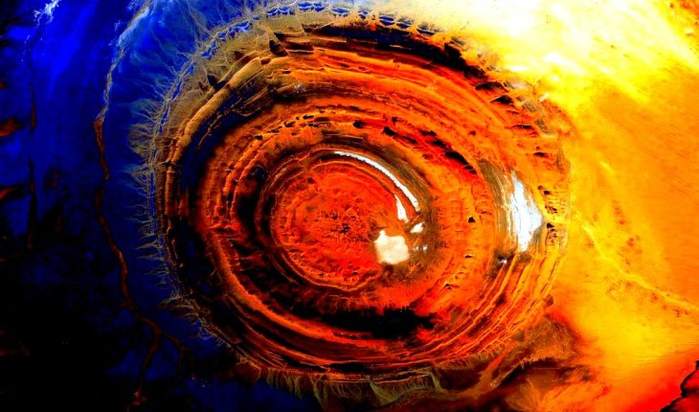
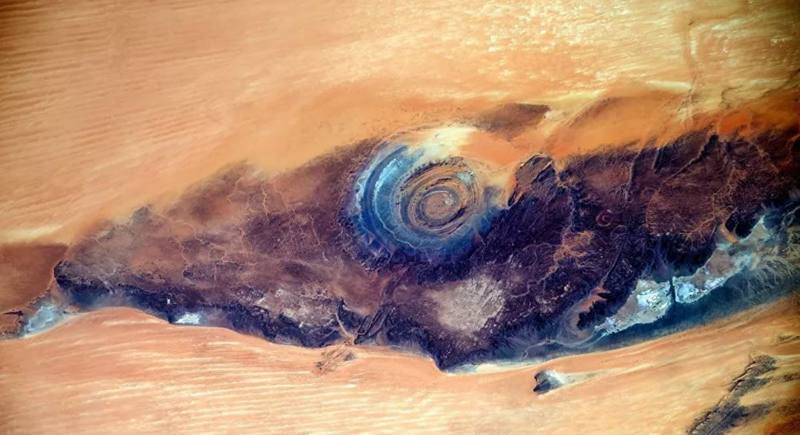
The Richat Structure, located near Ouadane in north-central Mauritania at approximately 21 degrees north latitude, is a geological formation whose aerial and satellite appearance gives it its popular name: the Eye of the Sahara. Viewed from orbit, it presents a series of concentric rings of alternating resistant and eroded rock, approximately 50 kilometers in diameter, whose visual precision suggests artificial construction despite a formation mechanism that the mainstream geological literature attributes to natural dome uplift and differential erosion over geological timescales.
James McDivitt and Ed White, piloting the Gemini IV spacecraft in June 1965, were among the first humans to observe it from orbit. White’s spacewalk during the same mission was the first American extravehicular activity. What they saw looking down through the porthole was a perfect set of concentric rings in the middle of the world’s largest desert, visible from 160 miles up with a clarity that made subsequent astronauts use it as a navigational landmark.
The geological explanation for what created this precision is well established and not seriously contested: the Richat Structure is a deeply eroded symmetrical anticline, a dome of uplifted rock whose concentric exposure of alternating resistant quartzite layers and easily eroded limestone and dolomite layers produced the ring pattern as billions of years of erosion worked differentially on the different materials. The oldest exposed rocks at the structure’s center are estimated at approximately 2.5 billion years. The domed structure was probably fully formed hundreds of millions of years ago.
Whether the geological explanation accounts for everything about the Richat Structure that makes it significant for the Atlantis hypothesis is the question the hypothesis requires examining.
Plato’s Dimensions and the Richat Structure
The Atlantis correspondence argument developed by multiple researchers, most accessibly by the channel Bright Insight in 2018 and subsequently by geologist Jimmy Corsetti, begins with Plato’s dimensional description and works outward.
Plato’s central island: approximately five stades in diameter. Using the standard ancient Greek stade of approximately 185 meters, five stades equals approximately 925 meters, or just under one kilometer. The Richat Structure’s innermost ring, the elevated central plateau whose diameter varies depending on how its boundaries are defined, is in the range of approximately one to three kilometers in diameter. Whether this constitutes a match depends on the stade measurement used and the boundary of the innermost ring.
Plato’s overall structure: approximately twenty-three stades from center to outer edge. Using 185-meter stades, this produces approximately 4.25 kilometers for the full inhabited structure. The Richat Structure’s full diameter is approximately 50 kilometers, which is substantially larger than 4.25 kilometers by any measurement conversion.
Whether the dimensional mismatch can be reconciled by using a different stade measurement, by identifying rings within the 50-kilometer structure that correspond to Plato’s described rings rather than the full structure, or by accepting that Plato’s dimensions are approximate rather than architectural specifications, is the quantitative challenge the Richat Structure hypothesis faces.
The qualitative correspondences are more compelling than the dimensional ones. Plato describes a circular structure of concentric rings. The Richat Structure is circular and concentric. Plato describes alternating rings of land and water. The Richat Structure shows alternating elevated ridges and lower valleys that, during the Green Sahara’s well-watered period, would have been alternating ridges and water-filled channels. Plato describes mountains to the north. The Atlas Mountains are to the north of the Richat Structure. Plato places Atlantis in the direction of the Atlantic from the Pillars of Hercules. Mauritania is in the direction of the Atlantic from Gibraltar.
Each individual correspondence has an alternative explanation. The collection of correspondences in a single geographic location is the argument’s strength.
The Green Sahara and the Water Question
The most significant objection to the Richat Structure as an Atlantis candidate is geographic: it is currently in the middle of the Sahara Desert, approximately 500 kilometers from the Atlantic coast. Plato’s Atlantis was accessible from the sea.
The African Humid Period recorded across multiple pieces in this library provides the paleoclimatological context that addresses this objection. Between approximately 11,000 and 5,000 years ago, the Sahara was not a desert. Paleoclimatological evidence from lake sediment cores, pollen records, and the fossil river systems visible in satellite imagery under the current desert surface establishes that the Sahara during this period was a green, well-watered landscape with rivers, lakes, and extensive savannah vegetation. The African Humid Period ended as the Saharan monsoon system retreated southward, transforming a habitable landscape into the world’s largest hot desert over a period of centuries to millennia.
During the African Humid Period, the Richat Structure was not in a desert. It was in a landscape with recorded river systems whose courses can be partially reconstructed from satellite imagery of the subsurface. Whether these river systems connected the Richat Structure to the Atlantic coast, and whether the structure was on or near a lake or coastal body during the period of maximum Atlantic proximity, is the hydrological question that the hypothesis requires and that the available paleoclimatological data partially addresses.

The timing of the African Humid Period’s peak, approximately 9,000-7,000 years ago, overlaps with Plato’s dating of Atlantis’s destruction to approximately 9,000 years before Solon’s time, which places the destruction at approximately 9,600 BCE. Whether this correspondence reflects a genuine connection between the end of the Green Sahara and the submersion or destruction of a civilization in the Richat Structure region, or is a coincidence of approximate dating, is the question that the two timelines raise together.
The African Humid Period’s end was not a sudden event but a progressive desiccation that may have included catastrophic episodes as the monsoon system retreated. Whether this progressive desiccation, which transformed the landscape around the Richat Structure from a well-watered region accessible via river systems to an increasingly hostile desert, is what Plato’s sources encoded as Atlantis’s submersion under water, is the interpretive question that the paleogeographic evidence motivates.
The Geological Anomalies
The mainstream geological explanation for the Richat Structure as a deeply eroded anticline is well-established and not seriously contested in the peer-reviewed geological literature. The absence of shocked quartz, impact melt rocks, and other diagnostic impact indicators rules out the meteorite hypothesis. The dome uplift and differential erosion explanation accounts for the concentric ring structure through known geological mechanisms.
Whether this explanation accounts for everything about the Richat Structure that makes it geologically unusual is a question that aspects of the structure’s geology raise.
The kimberlite pipes. Researchers examining the Richat Structure have recorded the presence of kimberlite pipes in and around the structure. Kimberlite is the volcanic rock most commonly associated with diamond deposits and is produced by deep mantle volcanic activity. The presence of kimberlite in the Richat Structure appears in geological surveys of the region. Whether the kimberlite activity was connected to the dome uplift mechanism and what it implies about the geological history of the structure is a question that the mainstream literature has addressed but not comprehensively.
The hydrothermal activity. The Richat Structure shows evidence of extensive hydrothermal alteration, the chemical modification of rock by hot water and gases from depth. Hydrothermal activity implies the presence of a heat source and fluid pathways that could have maintained the structure as a thermally active geological environment for extended periods. Whether this hydrothermal activity has any connection to the water availability implied by Plato’s alternating water rings is speculative but the geological basis for hydrothermal water sources in the structure is well established.
The symmetry. The Richat Structure’s geometric precision is unusual even for an eroded dome. Structural domes typically show some asymmetry reflecting the original stress field and the variation in rock properties across the dome. The Richat Structure’s near-perfect circular symmetry, visible from space with enough regularity to serve as an astronaut navigational landmark, is at the upper end of what geological dome erosion typically produces.

Whether this symmetry reflects exceptional geological uniformity in the original rock, an unusual combination of uplift mechanism and erosion history, or something whose full geological explanation has not been published in the accessible literature, is a question that the mainstream explanation acknowledges without fully resolving.
The Plato Problem
Any serious treatment of the Richat Structure Atlantis hypothesis must engage honestly with the foundational question whose answer determines whether any geographic search for Atlantis is warranted.
Plato’s Atlantis account appears in two dialogues, the Timaeus and the Critias, both written approximately 360 BCE. The Timaeus presents the account as a historical record transmitted from Egyptian priests to Solon approximately 200 years earlier, and subsequently passed through a chain of oral tradition to Plato’s time. The Critias provides the detailed description of Atlantis’s geography, architecture, and political organization.
Whether the account is historical transmission or philosophical invention is the question that has divided scholarly opinion since ancient times. The ancient Greek philosophical tradition itself included writers, including Aristotle, who apparently treated the account as Plato’s invention. The Egyptian transmission claim, involving records maintained for 9,000 years before Solon’s visit, stretches the known record-keeping capability of any ancient institution.
The institutional context of Plato’s account, the Egyptian priests at Sais whose documentation traditions and library holdings in the sixth century BCE are partially documented, is the element whose examination would most directly address the historical transmission question. Whether the Saite priests maintained historical records of a civilization destroyed 9,000 years before Solon’s time, and whether any such records survived to Plato’s day, is not established by the available Egyptian historical record.
What the Richat Structure hypothesis proposes is not that Plato’s account is accurate in every particular, but that it encodes a genuine geographic and historical memory whose content was transmitted, with distortion and elaboration over thousands of years of oral tradition, from a real civilization in a real location. The hypothesis does not require Plato’s dimensions to be architectural blueprints or his nine thousand years to be precise calendar dating.
It requires only that the core geographic correspondence is real: a circular concentric ring structure, accessible from the Atlantic, in the direction of Mauritania from the Pillars of Hercules, surrounded by the mountains that are the Atlas range, whose civilization ended approximately when the African Humid Period ended and whose memory was preserved in the Egyptian tradition for long enough to reach Solon in the sixth century BCE.
Whether this requirement is met by the Richat Structure is the question that the hypothesis is asking. The dimensional correspondence is imprecise. The qualitative correspondence is specific. The paleogeographic timing is suggestive.
What Has Been Found and What Has Not
The Richat Structure Atlantis hypothesis has generated substantial popular interest since 2018 and has been examined by multiple researchers with varying levels of geological and archaeological expertise.
What has been found: the geological composition and history recorded in the mainstream geological literature, the paleoclimatological evidence for the Green Sahara’s timing and character recorded in the paleoclimatology literature, and the dimensional and qualitative correspondences with Plato’s description recorded in the hypothesis literature.
What has not been found: systematic archaeological survey of the Richat Structure and its surroundings at the depth required to identify sub-surface architectural remains from a potential ancient civilization. The Green Sahara’s end would have buried or destroyed surface structures through desiccation, sand deposition, and erosion. Whether sub-surface remains exist and whether they show evidence of organized human construction is not established by the available survey data.
The standard methods that have identified structures in comparable contexts, LIDAR survey for above-ground features and ground-penetrating radar for subsurface investigation, have not been systematically applied to the Richat Structure with the objective of testing the Atlantis hypothesis.

The Eye of the Sahara has been visible from space since 1965. The hypothesis that it corresponds to Plato’s Atlantis description has been publicly discussed since at least 2018. The systematic ground-penetrating survey that would either find the sub-surface architectural evidence the hypothesis predicts or rule it out through its absence has not been conducted.
Whatever is under the sand around the Richat Structure, the 50-kilometer eye in Mauritania, has not been fully looked for.
Plato said it was there.
The concentric rings are there.
The mountains to the north are there.
The Atlantic is in the right direction.
The Green Sahara was real.
Whether the civilization Plato described was also real, and whether it left something in the ground that the georadar has not yet been pointed at, is the question that the Eye of the Sahara keeps open every time another satellite passes over Mauritania and photographs the most geometrically precise natural formation in the world’s largest desert.