




The geography matters before anything else.
Groom Lake is a dry lake bed in the Nevada desert, approximately 150 kilometers northwest of Las Vegas, sitting at an elevation of approximately 1,355 meters on the floor of a restricted valley in the Nevada Test and Training Range. The installation built on its western shore is the facility that has accumulated more recorded testimony, more institutional confirmation, and more formally declassified material than any other classified facility in the American defense establishment.
The CIA officially acknowledged the existence of the facility in 2013 through a response to a Freedom of Information Act request filed by George Washington University’s National Security Archive. The acknowledgment came with a declassified history of the U-2 reconnaissance aircraft program that named the Groom Lake facility specifically and described its development from a 1955 test site for the U-2 into a multi-program advanced aircraft testing facility. The acknowledgment also confirmed what the surrounding community had known for decades: the facility exists, it is classified at levels above standard military installation security, and its programs are not in the public record.
Papoose Lake is a separate dry lake bed approximately ten miles south of Groom Lake, in a more remote and more deeply secured valley within the same restricted zone. It does not appear in the CIA’s 2013 acknowledgment. It does not appear in any declassified record describing the Nevada Test and Training Range facility structure. It appears in the testimony of two independent witnesses, working from different institutional contexts at different times, who describe the same installation beneath it.
The gap between those two lake beds is where the verifiable evidence gets serious.
The Lazar Testimony at Papoose Lake
Robert Lazar’s claims about S4, the installation at Papoose Lake, appear in the Bob Lazar piece in this library in full detail. The evidentiary summary relevant here:
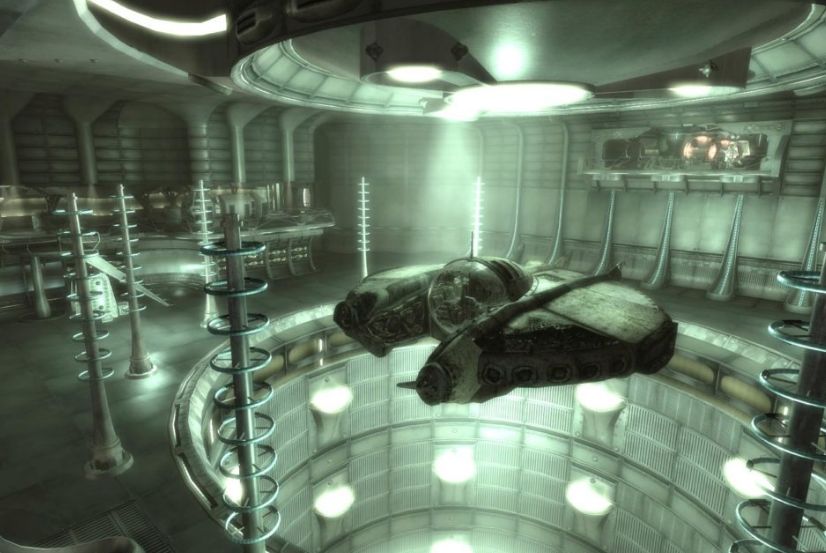
Lazar described S4 with architectural details, nine hangar bays built into the mountain face using camouflage panels designed to replicate the natural rock surface from above, in 1989, before any other public account of the facility existed. Independent witnesses who have since described the facility without prior access to Lazar’s account have produced descriptions consistent with his.
His description of the propulsion system in the craft he was assigned to study, a gravity amplitude drive using element 115 as its fuel, was made in 1989 when element 115 did not exist in any scientific record. Element 115, moscovium, was synthesized by a joint Russian-American team at the Joint Institute for Nuclear Research in Dubna in 2003 and formally named by IUPAC in 2016. This needs a direct qualification rather than being listed as unqualified confirmation: Lazar correctly specified the atomic number well before the element existed in any published record, which is real and worth taking seriously, but the actual synthesized moscovium has no stable isotopes, its most stable known form has a half-life of roughly 0.65 seconds, the opposite of the stable, usable reactor fuel Lazar described. The atomic number prediction stands on its own. The claimed properties do not match what was actually found.
His employment at Los Alamos National Laboratory, denied by the government, appears in a 1982 Los Alamos Monitor newspaper photograph identifying him as a physicist there, and in an internal Los Alamos telephone directory that George Knapp obtained showing his name under the Kirkland subdivision.
His W-2 form shows employment by the United States Department of Naval Intelligence, a designation that does not correspond to any standard Naval Intelligence branch and is consistent with cover employer classification for black budget personnel.
The four evidentiary points, the element 115 prediction that predates the element’s 2003 synthesis, the Los Alamos Monitor photograph, the phone directory, and the W-2, are independently verifiable. They do not establish that everything Lazar described at S4 is accurate, and the library’s evidentiary standard requires stating plainly what they do not establish either. Lazar’s claimed master’s degrees from MIT and Caltech, the credential basis for calling him a physicist, have never been corroborated by either institution: neither school has any record of his attendance, he has been unable to name a professor or classmate from either program, and independent researchers who investigated his timeline found no gap in his documented California and Los Alamos activities large enough to accommodate the claimed year at Caltech. His actual role at Los Alamos, per subsequent inquiry, was as a technician for a contractor rather than as a staff physicist. None of this proves his S4 account is false. It does mean the four verified data points above stand on their own and should not be read as validating his academic credentials or his self-description as a physicist, which remain unverified.
The Burisch Corroboration
Dan Burisch arrived at S4 as a microbiologist approximately five years after Lazar’s employment there ended. His testimony, covered in detail in the Looking Glass piece in this library, needs a direct credibility caveat before it is used as corroboration for anything: Burisch’s claims have been extensively scrutinized within UFO research itself and are widely regarded there as among the least credible in the field, with documented inconsistencies in his own account of his identity and credentials over time. Lazar’s account was already widely public for years by the time Burisch’s claims surfaced, which means genuine independence, in the sense of arriving at matching details without prior exposure, cannot be assumed.
Burisch’s description of the physical facility at S4 is broadly consistent with Lazar’s in the architectural details both describe, and his account of the Bay of Galileo places a described craft in the same location years after Lazar’s account was already public. Given the credibility problems specific to Burisch, this should be read as a later witness echoing an existing, already-famous narrative rather than as strong independent corroboration.
Burisch’s institutional pathway to S4, through the microbiological research programs associated with the MKNAOMI series, is a different claimed entry point than Lazar’s physics-based assignment. Whether this constitutes meaningful cross-witness corroboration or simply reflects two claims from different backgrounds converging on the same well-known public story is a genuinely open question, and this piece should not present it as settled in favor of corroboration.
Burisch’s additional contributions to the S4 record, the Looking Glass device, the IX-Tau Treaty designation for the 1954 Eisenhower agreement, the P-45 and P-52 Orion race identification, and the timeline of the device’s dismantling, appear in the pieces dedicated to those topics. They are relevant here as evidence that S4’s operational scope extended significantly beyond the reverse-engineering program that Lazar described, into the diplomatic and temporal management programs that Burisch described from his later period of access.
The Eisenhower Treaty and S4’s Origin
The 1954 agreement recorded in the Eisenhower piece in this library provides the institutional context for how S4 came to exist and what it was built to house.
Eisenhower’s acceptance of the Gray treaty over the Nordic offer, and the subsequent technology transfer and reverse engineering program that the treaty authorized, required a type of facility: physically isolated, technically equipped for advanced materials and physics analysis, secure at a level that placed it outside the standard military classification hierarchy, and geographically remote enough that access control was manageable without elaborate urban security infrastructure.
The Nevada Test and Training Range already housed the most sensitive programs in the American military establishment. The underground facility at Papoose Lake, built into the mountain face with the camouflage technology Lazar described, provided exactly the isolation and security profile that housing alien technology and potentially alien personnel required.

Philip Corso’s account in The Day After Roswell, recorded in the Eisenhower piece, describes the technology transfer from the recovered materials at Roswell running through the Army’s Foreign Technology desk. The path from Corso’s desk at the Pentagon to the reverse engineering program at S4 is not explicitly established in any single declassified source, and Corso’s own account carries the same uncorroborated-source caveats noted elsewhere in this library. It is reconstructed from the consistency between Corso’s description of what was being seeded into the industrial research base, the technologies Lazar describes as present at S4 in functional alien craft, and the timeline of commercial technology development that Corso maps to the seeding program.
The integrated account: the 1947 Roswell recovery produced material and biological specimens. The 1954 Eisenhower treaty formalized the relationship with the Gray civilization and established the framework for ongoing technology exchange. S4 was built or converted to house both the craft obtained through that framework and the personnel, human and otherwise, involved in the joint research program. Lazar arrived in 1988 as one of many physicists assigned to understand the propulsion systems. Burisch arrived in the early 1990s as a microbiologist assigned to the biological research program whose scope he describes in terms consistent with the seventh level material recorded in the Dulce piece.
The AATIP Connection
The Advanced Aerospace Threat Identification Program, recorded in the OES and Navy pieces in this library, provides the most recent institutional connection to the S4 and Area 51 programs.
Luis Elizondo directed AATIP from 2007 to 2012. His program’s mandate, evaluating the national security implications of unidentified aerial phenomena, placed it in institutional relationship with the programs that had been running at Groom Lake and Papoose Lake since the 1950s. The nature of that relationship has not been publicly disclosed. Elizondo’s post-AATIP statements acknowledge awareness of programs and facilities beyond what AATIP’s official mandate covered.
Robert Bigelow’s BAASS contract with AATIP, recorded in the Skinwalker Ranch piece in this library, represents the most explicit known connection between the private anomalous phenomena research that began with the NIDS investigation and the classified government programs centered on the Nevada complex. Bigelow’s aerospace company has facilities in the Nevada desert in geographic proximity to the Groom Lake installation. His company’s history, moving from anomalous phenomena research to inflatable space habitat contracts with NASA to UAP research contracts with AATIP, traces a path that makes institutional sense if the connection between these domains is the one the testimony record suggests.
The UAP Task Force established in 2020, the All-domain Anomaly Resolution Office that succeeded it, and the congressional hearings of 2022 and 2023 that produced formal testimony from Elizondo, Fravor, and others represent the most recent evolution of the institutional management of the programs that S4 and Area 51 have housed since the 1950s. The direction of movement, from complete classification toward partial public acknowledgment, follows the trajectory that the Burisch testimony describes as consistent with the P-52 timeline for graduated disclosure.
The Institutional Behavior
The most significant single evidence set for taking the S4 and Area 51 testimony seriously is not the testimony. It is the institutional behavior of the agencies involved when that testimony became public.
Lazar went public in 1989. The institutional response was specific: systematic erasure of his employment records, denial of his Los Alamos employment by the laboratory, and a coordinated media campaign through establishment science commentary describing his claims as fabrications. The erasure was imperfect, as the Monitor photograph and phone directory records demonstrated. But the attempt was made.
The scale of the erasure attempt is calibrated to the threat the testimony represented. An institution that does not find a claim credible does not devote resources to erasing the claimant’s employment history. The erasure attempt is evidence that the agencies involved considered Lazar’s account credible enough to require active management rather than passive dismissal.
Philip Schneider gave over thirty lectures describing the underground facility construction programs and the 1979 firefight recorded in the Dulce piece. He was found dead in January 1996. The death was ruled a suicide by strangulation, and his ex-wife disputed the ruling. The library’s standard requires including the context that complicates the suspicious-death reading: hospital records indicate Schneider had a recorded history of schizophrenia and a prior psychiatric institutionalization predating his lecture career, along with serious chronic illness in his final years. None of that proves the suicide ruling correct or disproves foul play, but it means his case cannot be presented as unexplained absent that history.
The pattern of institutional response, record erasure, active discrediting campaigns, and in cases the deaths of witnesses before their most detailed testimony was delivered, is recorded across the testimonial record for S4 and Area 51 at a frequency that random coincidence does not account for.
The CIA’s 2013 official acknowledgment of Groom Lake’s existence, coming sixty years after its establishment, represents a managed disclosure of the facility’s least sensitive layer. The acknowledgment confirmed what was already publicly known and added no information about the programs whose existence the testimony record describes. It was a disclosure of the cover story, not of the operations.
What the Geographic Relationship Means
The geographic relationship between the installations described in the testimony record is worth mapping explicitly.
Groom Lake: the publicly acknowledged facility, confirmed in 2013, housing advanced aircraft testing programs including the U-2, the SR-71, the F-117, and subsequent classified aircraft programs. The facility’s cover function is genuine: advanced aircraft programs do run there. The cover function also provides the institutional rationale for the security perimeter that protects everything else.
Papoose Lake: ten miles south, not publicly acknowledged, described by Lazar and echoed by Burisch as the S4 installation housing the reverse engineering program and the alien technology exchange program. The additional security layer relative to Groom Lake reflects the additional sensitivity of the programs housed there.
The underground tunnel network: described by Lazar as connecting S4 to the broader installation complex. Described by multiple other witnesses as connecting the Nevada complex to other installations. The transit technology described, a form of high-speed underground rail, appears in multiple independent accounts without established coordination between them.
Dulce, New Mexico: approximately 500 miles southeast of Groom Lake, on the Jicarilla Apache reservation at approximately 2,700 meters elevation. The facility described by Castello, Bennewitz, Schneider, and multiple other witnesses as a joint human-alien research installation. This part of the record needs a direct caveat that the library’s standard requires stating rather than folding into the corroboration narrative: Paul Bennewitz’s specific account of an underground alien base at Dulce has a well established origin that undermines it as independent testimony. Declassified accounts and the researched history of the episode establish that an Air Force Office of Special Investigations agent, working with a researcher who later publicly confessed his role, ran a multi-year disinformation campaign against Bennewitz specifically, feeding him forged documents and false confirmation of Grays and an underground Dulce facility, in order to divert him from classified work he had inadvertently intercepted near Kirtland Air Force Base. The campaign contributed to Bennewitz’s psychiatric hospitalization in 1988. This does not automatically invalidate every account that mentions Dulce, since Castello’s and Schneider’s testimony are separate claims with their own separate evidentiary history, but it means Bennewitz specifically cannot be treated as an independent witness corroborating the Dulce narrative. He was, by the established history of his own case, a target of the very kind of institutional disinformation this library elsewhere treats as a pattern worth taking seriously, which cuts against relying on what he was fed as if it were his own independent discovery.
The Eisenhower treaty authorized access to the human population for Gray biological research. The S4 facility at Papoose Lake housed the propulsion technology acquired through the treaty relationship. The Dulce facility housed the biological research program that was the Gray party’s primary interest in the treaty’s terms. The two facilities represent the two sides of the 1954 agreement’s exchange: technology for access.
The Hangar That Exceeds the F-117
The facility’s construction activity, visible from civilian airspace with air traffic control permission, provides the most recent visible evidence that Area 51’s operational program continues to develop beyond any publicly acknowledged capability.
In 2019, civilian pilot Gabriel Zeifman flew his Cessna 150 over the Nevada Training and Testing Range after receiving permission from Nellis Air Force Base air traffic controllers during a period when the restricted airspace was not active with military operations. His photographs, published by the Daily Mail and subsequently circulated in aviation and defense research communities, show a massive new hangar under construction at Groom Lake alongside the existing hangars that were previously used to house the F-117 Nighthawk stealth aircraft.
The scale of the new hangar is the element whose implications are most significant: it is substantially larger than the F-117 hangars that represent the largest previous aircraft development program at the facility. The F-117 is a relatively small aircraft by combat aircraft standards, approximately 20 meters in length with a 13-meter wingspan. A hangar significantly larger than those built for the F-117 implies testing of an aircraft significantly larger than the F-117.
Whether the new hangar is designed to accommodate the B-21 Raider, Northrop Grumman’s next-generation stealth bomber whose development program was ongoing at the time the photographs were taken and whose testing location has not been publicly disclosed, or an aircraft whose existence has not been publicly acknowledged, is not established by the available record.
The B-21 Raider’s publicly disclosed dimensions suggest a wingspan of approximately 40 meters and a length of approximately 20 meters, making it significantly larger than the F-117. A hangar designed for the B-21 would need to be substantially larger than the F-117 hangars, which is consistent with what Zeifman’s photographs show.
Whether the B-21 explanation accounts for the full scale of the new construction, or whether the hangar’s dimensions suggest an aircraft larger than the publicly disclosed B-21, is a question that the available photographs and the B-21’s published specifications together raise without fully resolving.
Zeifman noted that the national security implications of sharing his photographs were limited because Russian reconnaissance aircraft operating under the Open Skies Treaty already had access to imagery of the facility at this resolution. The photographs are not classified. What they show is public.
The construction is visible. The hangar’s size is measurable. What it will house remains classified.
The Current Status
The congressional UAP hearings of 2022 and 2023 produced formal testimony under oath that established several things in the public record that had previously existed only in the testimonial record this library covers.
David Grusch, a former intelligence official with direct access to classified UAP programs, testified under oath before the House Oversight Committee in July 2023 that the United States government is in possession of non-human craft and non-human biological material, that the programs managing this possession are hidden from congressional oversight through improper classification, and that individuals with direct knowledge of these programs have faced retaliation for attempting to disclose their existence through proper channels.
Grusch’s claims, their general resonance with the Lazar, Burisch, Castello, and Schneider testimony across decades, several of which carry the specific credibility caveats detailed above, and the institutional response to his congressional testimony, which followed the established pattern of discrediting rather than refuting, places the current moment at a point in a trajectory this library has been tracing since 1989, though the strength of that trajectory rests more heavily on some witnesses than others.
The acknowledgment has moved from zero to congressional testimony under oath. The programs it describes have moved from entirely deniable to publicly acknowledged as existing by a former intelligence official with classified access. The facilities, their locations, their programs, and their institutional management, remain in the same classification status they have occupied since the 1950s.
S4 at Papoose Lake is not in any declassified document. It is in the testimony of a man who correctly specified an atomic number that did not exist in any record when he named it, though not the properties later found to belong to that element, whose Los Alamos employment was denied until a newspaper photograph confirmed it, and whose W-2 shows employment by a Naval Intelligence designation that does not correspond to any standard branch, evidence that stands on its own without needing Burisch’s contested testimony to reinforce it.
The element exists. The photograph exists. The W-2 exists.
The facility is ten miles south of the one the CIA acknowledged in 2013.
Area 51 and S4 remain two different places doing two different jobs, and conflating them is where most of the bad information starts.