




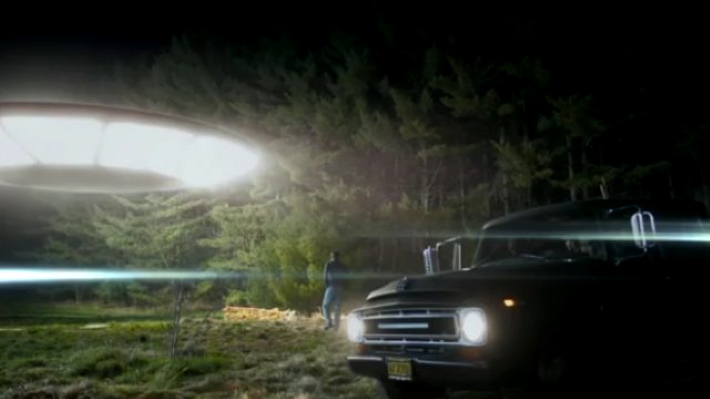
Six men saw it.
On the evening of November 5, 1975, a wood-cutting crew was driving through the Apache-Sitgreaves National Forest in the mountains of central Arizona when they observed a large disc-shaped object hovering approximately 30 meters above the ground near the forest road. The object was described as approximately 6 meters in diameter, luminous, and stationary.
Travis Walton got out of the truck and approached it.
What happened next was witnessed by all six of his coworkers from the truck: a beam of energy struck Walton and threw him backward approximately ten feet. His coworkers, in recorded accounts given to Navajo County Sheriff Marlin Gillespie that night, described Walton as being struck and collapsing. They fled in the truck in evident panic and subsequently returned to find Walton gone.
He was missing for five days.
On November 10, 1975, Walton called his brother-in-law Grant Neff from a telephone booth in Heber, Arizona, approximately fifteen miles from the abduction site. He was found disoriented, dehydrated, and wearing the same clothes he had been wearing five days earlier. He had lost approximately ten pounds.
The evidentiary quality of the Travis Walton case rests on elements that distinguish it from the majority of abduction accounts in the UAP research literature: six named witnesses who independently gave consistent accounts to law enforcement on the night of the disappearance, confirmed polygraph examinations of both the witnesses and Walton himself, and a 2017 physical trace analysis of the abduction site that produced confirmed soil anomalies.
The pattern was already established. Betty and Barney Hill had set the template fourteen years earlier: missing time, hypnotic recall, and physical claims that would prove far harder to verify than the initial sighting.
Whether these elements collectively establish what Walton and his coworkers reported, or whether they are consistent with an elaborate hoax of a type that has never been similarly recorded in the UAP research record, is the question that the case’s forty-eight-year recorded history has raised without producing consensus.
The Witnesses and Their Recorded Accounts
The six witnesses who were present when Walton was struck and disappeared are the foundational evidentiary element of the case and the element that most distinguishes it from single-witness abduction accounts.
Mike Rogers, Dwayne Smith, John Goulette, Allen Dallis, Steve Pierce, and Ken Peterson were the crew members confirmed as present. Their accounts were given independently to Navajo County law enforcement on the night of November 5, 1975 before they had time to coordinate a fabricated story. The consistency of their accounts across the key elements, the object’s appearance, its altitude, the beam that struck Walton, and his disappearance, appears in the law enforcement records from the night.
Whether the consistency of the accounts reflects genuine shared experience or coordinated fabrication is the question that the polygraph examinations were designed to address.
Examiner Cy Gilson of the Arizona Department of Public Safety administered polygraph examinations to five of the six crew members on November 15, 1975, ten days after the incident. His stated conclusion was that five of the five examined showed truthful responses to questions about what they had witnessed. The sixth crew member, Allen Dallis, was not examined at that time due to recorded complications related to his personal circumstances.
A subsequent examination of Dallis, conducted later, produced an inconclusive result that has been cited by skeptics as evidence of deception and by proponents as evidence of a different kind of psychological response to the questions asked.
Whether polygraph results constitute reliable evidence of truthfulness is the methodological question that makes the examination results’ significance contested. The established scientific consensus is that polygraphs have significant false positive and false negative rates. Whether the examinations in the Walton case were conducted with sufficient methodological rigor to produce reliable results is the question that the examination records allow to be addressed but do not fully resolve.
Five Days: What Walton Said
Travis Walton’s account of the five days of his disappearance, recorded in his 1978 book The Walton Experience and updated in subsequent publications, describes a sequence of events whose content has been consistent across four decades of interviews, lectures, and recorded examinations.
He described regaining consciousness inside a facility where he was examined by beings he described as approximately five feet tall, smooth-skinned, large-eyed, and wearing orange coveralls. He subsequently encountered beings of different appearance, taller and more humanoid, who did not communicate with him. He described a tour of the facility and eventually being returned to a location near Heber, Arizona where his brother-in-law’s call found him.
The details of his account, the beings’ physical descriptions, the facility’s interior, and the sequence of events, are consistent with the recorded abduction phenomenology reported across independent cases in John Mack’s Harvard research and David Jacobs’s Temple University case archive. Whether this consistency reflects genuine shared experience with a real phenomenon or reflects the cultural contamination of a human individual’s traumatic experience with the existing abduction narrative tradition, is the question that the case’s 1975 timing raises: the Hill abduction account, the first widely publicized abduction case, was published in 1966, nine years before Walton’s experience.
Walton’s own statement about his polygraph results spans multiple examinations: five examinations conducted by three different examiners over the subsequent decades. His own claim that all five produced truthful results is consistent with the examination records available in the UAP research literature, though the methodology and complete results of all five are not uniformly recorded in accessible published sources.
The Budinger Soil Analysis
The most specifically novel evidentiary element in the Travis Walton case’s record is the 2017 soil analysis conducted by Phyllis A. Budinger for Frontier Analysis Ltd.
Budinger is a recorded analytical chemist whose published work includes multiple peer-reviewed studies and institutional reports on physical trace analysis at UAP encounter sites. Her report on the Walton site, dated April 4, 2017, records the collection and analysis of soil samples from the location where Walton was struck and from the surrounding area, with control samples taken from nearby locations showing similar surface characteristics.
The findings recorded in the report are two anomalies whose significance the report explicitly qualifies.
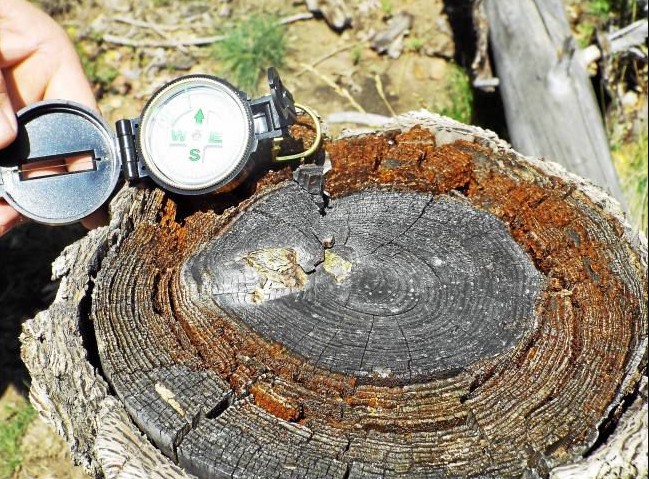
The first anomaly is elevated iron particulate content in the surface soil at the abduction site compared to the control samples. The iron particles are recorded as present at higher concentrations in surface soil than in subsurface soil at the site, which is the distribution pattern that Budinger notes as consistent with electromagnetic concentration rather than geological deposition: naturally occurring iron deposits would typically show higher concentrations at depth rather than at the surface.
The second anomaly is elevated levels of exchangeable cations, specifically calcium, magnesium, and potassium, in the site soil compared to controls. Budinger’s report notes that cationic anomalies can have natural explanations including clay deposits generating chemical changes, but notes that the magnitude and distribution of the anomalies at the site are outside the normal range for the surrounding geology.
The report’s qualification is important for the library’s evidentiary standard: Budinger does not claim that the anomalies prove UAP activity. She confirms that the anomalies exist, that they are inconsistent with the normal geological and chemical profile of the surrounding area, and that the electromagnetic concentration hypothesis for the iron distribution is consistent with the reported event while not being the only possible explanation.

Whether the anomalies reflect the forty-year-old electromagnetic effects of a genuine UAP propulsion system, natural geological variation that sampling identified without reflecting any event, or contamination introduced during the 2002 forest fire that the report acknowledges affected the area, is the question that the analysis raises without fully resolving.
What the analysis establishes is that soil samples from the confirmed location of the Walton abduction show measurable chemical differences from surrounding control samples whose character is consistent with the electromagnetic effects that UAP propulsion would be expected to produce, and whose distribution in the surface versus subsurface is inconsistent with natural geological deposition.
This is physical trace evidence at a named and well established abduction site analyzed by a credentialed chemist forty-two years after the event. It is not proof. It is a confirmed anomaly.
The Physical Trace Tradition
The Budinger analysis places the Walton case within the established physical trace research tradition whose most systematic practitioner was Ted Phillips, whose Center for Physical Trace Research catalogued more than 5,000 recorded cases globally over four decades of investigation.

Phillips’s catalogue reveals a pattern across multiple UAP encounter sites: the same combination of elevated iron deposits and altered soil chemistry that Budinger found at the Walton site appears across multiple independent physical trace cases whose geographic distribution and witness independence argues against simple contamination or geological coincidence as a complete explanation.
Whether the pattern reflects a genuine common cause, the electromagnetic effects of whatever is producing the recorded UAP encounters at these sites, or reflects the site selection bias of physical trace investigation, whose practitioners tend to sample at locations where striking events have been reported and therefore where human activity including the events themselves may have altered the soil chemistry, is the methodological question that the physical trace research tradition has not fully resolved.

The comparison Budinger’s report makes between the Walton site and other physical trace cases in her own research archive is the most context for interpreting the Walton findings: the iron distribution pattern at the Walton site matches patterns recorded at other cases she has investigated, which is the cross-case consistency that reduces the likelihood of site-geological coincidence as the sole explanation.
The Case’s Recorded Longevity
The Travis Walton case has been examined, investigated, debated, and recorded for forty-eight years without producing either a definitive debunking or a definitive confirmation.
The debunking attempts have focused primarily on the polygraph results, the timing of the case relative to the cultural availability of abduction narratives, and the fact that Walton and his coworkers were behind schedule on their forest service contract and might have had a financial motivation for a fabricated explanation for incomplete work. Whether these alternative explanations account for the combination of six independent witness accounts, consistent polygraph results across multiple examiners, physical trace anomalies confirmed by an independent chemist, and Walton’s own consistent account across four decades, is the question that the skeptical literature has not fully addressed.
The confirmation attempts have focused on the witness polygraph results, the physical trace analysis, and the consistency of Walton’s account with recorded independent abduction phenomenology. Whether these elements establish genuine non-human contact or constitute an unusually well-sustained hoax whose perpetrators have maintained consistency across five decades, is the question that the case’s longevity has not resolved.
What the case shows beyond the resolution of the UAP question is the profile of an abduction case that meets a higher evidentiary standard than the majority of the abduction literature: multiple named witnesses, law enforcement involvement from the first night, confirmed physical trace analysis, and polygraph examinations whose methodology and results are in the available record.

Whatever happened in the Apache-Sitgreaves National Forest on the evening of November 5, 1975, six people saw it. Five days later, one of them came back.
The soil at the site still shows anomalous iron concentrations forty-eight years later.
Whatever produced those concentrations, it left something behind.