




A retired U.S. Navy rear admiral really did tell Congress that he believed elements of the government were withholding information about unidentified anomalous phenomena, and that a meeting with the Pentagon’s anomaly office felt to him like an “hours-long influence operation.” A U.S. Navy ship really did record footage of a spherical object that appeared to descend into the Pacific. Cold War Soviet submariners really did report strange sonar contacts they called “Quakers.”
Those are the parts of the underwater-anomaly story that have somewhere to stand.
The problem begins when a much larger mythology is built around them: a spectacular 1969 encounter that cannot be traced to a naval record, a supposedly authoritative military expert whose identity leads nowhere, percentages presented as established statistics without an underlying dataset, and scientific credentials reassigned to a real researcher who never held the job attributed to him.
The USO story does not need those additions. The documented record is strange enough.
The 1969 Sargasso Sea Story Has a Problem
The most dramatic story in this particular version of the USO mythology is also the one that collapses first under scrutiny.
According to the account, a roughly 10-kilometer object was detected in the Sargasso Sea in 1969, moving at extraordinary speed and triggering a major alert involving the American East Coast fleet. The story is accompanied by another remarkable statistic: that somewhere between 50 and 60 percent of underwater detection cases remain unexplained.
It sounds exactly like the kind of classified historical incident that ought to sit at the center of the USO phenomenon.
There is a problem. The account does not come with the documentation such a claim would require.
Its supposed authority is a person identified as “Roman Lingrem,” described as a military expert with more than twenty years of Navy experience. But the identity cannot be independently established through the normal historical trail: no verifiable service record, no institutional biography, no identifiable career history, no primary document, and no independent source establishing that this person actually made the claims attributed to him.
That matters because an impressive statistic without a dataset is not evidence, and a dramatic military incident without a traceable primary source is not transformed into history merely by being repeated often enough.
There may be something interesting behind the story. But the story itself has not established that. That distinction is the entire point.
What Tim Gallaudet Actually Told Congress
Here the record becomes much more substantial.
Tim Gallaudet is a real retired Navy rear admiral with a Ph.D. in oceanography who served as commander of the Naval Meteorology and Oceanography Command and later as acting administrator of NOAA. His credentials are not invented, and neither is his appearance before Congress.
On November 13, 2024, Gallaudet testified before the House Oversight Committee’s joint hearing on unidentified anomalous phenomena. Asked about his claim that government elements were engaging in a disinformation campaign, he described a meeting with the Department of Defense’s All-domain Anomaly Resolution Office, or AARO, earlier that year.
What he expected to be a roughly 90-minute meeting, he testified, became what he characterized as an “hours-long influence operation.”
According to Gallaudet, AARO personnel attempted to persuade him that the agency’s historical-records report was valid, encouraged him to question well-known UAP cases including the Navy’s Tic Tac encounter, and raised the possibility that the Tic Tac could have been American technology.
That is an extraordinary allegation. But it remains an allegation by a witness, not an independently established finding that a government disinformation operation occurred.
That distinction should not weaken the story. It makes the story more credible.
The congressional record gives us something unusually valuable in this subject area: a named former senior official, speaking publicly, making a specific claim about a specific meeting at a specific government agency, with the testimony preserved in the official record.
Whether his interpretation of that meeting is correct is a separate question. The meeting itself is not hypothetical.
The Scientist Who Was Given the Wrong Biography
The same problem appears in the scientific material surrounding the USO story.
A version of the narrative attributes a set of hypotheses about underwater anomalies to “Harry Nolan,” described as a Harvard professor of oceanography.
There is a real scientist behind part of that name. His name is Garry Nolan.
Nolan is the Rachford and Carlota A. Harris Professor in the Department of Pathology at Stanford University School of Medicine. His documented scientific career is in molecular biology, immunology, cancer research, single-cell analysis, and related fields, not oceanography at Harvard. Stanford’s own biography records his extensive research career, patents, and work in high-dimensional cellular analysis.
And Nolan’s name genuinely does appear in the UAP record. He was among the signatories of a 2024 letter urging Congress to strengthen oversight and disclosure mechanisms concerning UAP programs. The same letter was signed by Gallaudet and Harvard astronomer Avi Loeb, among others.
That makes the misattribution more interesting, not less.
There is a real scientist. There is a real UAP connection. There is a real Harvard astronomer involved in the same broader research ecosystem.
But those facts do not turn “Harry Nolan, Harvard oceanographer” into a real biography.
When a source gets the person’s name, discipline, and institution wrong, the correct response isn’t to preserve the authority of the claim because its conclusion is interesting. It is to stop and ask what else has been altered along the way.

The USS Omaha Incident Happened. The Interpretation Is Another Matter.
The strongest visual case in the USO narrative is the 2019 USS Omaha footage.
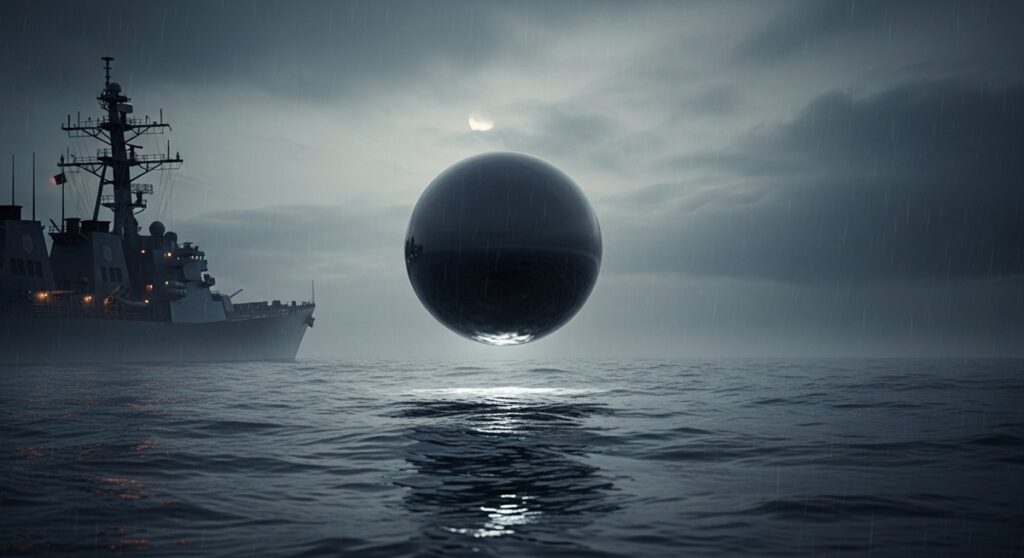
On July 15, 2019, Navy personnel aboard the USS Omaha recorded infrared footage showing a spherical object over the Pacific near San Diego that appears to descend toward the water and disappear. The Pentagon subsequently confirmed that the footage had been recorded by Navy personnel and that it had been included in ongoing UAP examination.
That gives the event genuine provenance. It does not tell us what the object was.
The footage is visually strange. The object is difficult to identify from the released material. That is precisely what makes it useful as a case study: the observation can be accepted without accepting the most dramatic explanation for it.
Much of the additional detail surrounding the incident, including claims about the number of objects involved, their estimated size and speed, the extent of radar correlation, and the search for the object afterward, comes through Jeremy Corbell’s published account of the event and associated released material. Those claims can be reported, but they should not quietly become equivalent to findings formally established by the Navy.
That distinction is particularly important here.
“The Navy recorded an unidentified object.” That is one claim.
“The Navy recorded an advanced transmedium craft of unknown origin.” That is another.
The first is supported by the provenance of the footage. The second requires an explanation the footage itself does not provide.
The Soviet “Quakers” Were Reported by Submariners
The Cold War adds another layer to the story.
Soviet submariners reported strange underwater acoustic contacts that became known as “Quakers,” apparently named for their distinctive frog-like or croaking sounds. Accounts attributed to Soviet naval personnel describe contacts detected in different ocean regions and, in some cases, apparent changes in the signals when submarines approached or transmitted active sonar.
Again, the testimony is interesting. Again, testimony is not the same thing as identification.
Some Soviet officers reportedly interpreted the contacts as possible Western surveillance systems. Others entertained different explanations. The very fact that experienced submariners encountered signals they could not immediately identify is worth preserving in the historical record.
But an unknown sonar contact does not automatically become an unknown vehicle. An unexplained acoustic signal is not automatically an intelligent signal. And a contact that appears to react to a submarine is not automatically a technological civilization living beneath the ocean.
The evidence permits the word unidentified. It does not, by itself, permit the word extraterrestrial.
The Ocean Is an Especially Difficult Place to Know What You Saw
There is an additional reason the USO question deserves more caution than many UFO narratives receive.
The ocean is an extraordinarily hostile observational environment.
Sound propagates through water differently depending on temperature, salinity, pressure, and depth. Sonar systems produce complicated returns. Biological organisms create acoustic signatures. Underwater structures, thermoclines, ships, submarines, geological formations, and atmospheric conditions can all complicate interpretation.
And unlike an object photographed against a clear sky, an underwater contact is often detected through an indirect measurement whose relationship to the physical object has to be reconstructed.
That does not make anomalous contacts imaginary. It makes sensor interpretation part of the mystery.
A strange signal is the beginning of an investigation, not the conclusion.
What the Invented Material Was Trying to Do
This is where the 1969 story, the invented expert, the distorted biography, and the genuine cases all fit together.
They perform the same rhetorical function.
The real cases establish that unidentified observations occur. The invented cases then make the pattern look much larger, older, and more technologically specific than the evidence actually demonstrates.
That is how a mystery becomes a mythology.
And once the mythology has accumulated enough details, people begin citing the mythology as though every component had the evidentiary status of the original event.
The 1969 object becomes “documented.” The 50-to-60-percent statistic becomes “Navy data.” The invented expert becomes an authority. Garry Nolan becomes a Harvard oceanographer. A Navy recording becomes proof of a transmedium vehicle. A Soviet sonar anomaly becomes evidence of an underwater civilization.
The transitions happen so gradually that the distinction between observation and interpretation disappears.
That is precisely the distinction that needs to be restored.

What Actually Survives
Strip the mythology away and the subject becomes smaller. It also becomes much more interesting.
A retired rear admiral went before Congress and made a specific allegation about his treatment by a Pentagon anomaly office. That testimony is preserved in the congressional record.
A Navy ship recorded an unidentified object that appeared to descend into the Pacific, and the Pentagon confirmed that Navy personnel recorded the footage.
Soviet submariners reported anomalous acoustic contacts during the Cold War and gave them a name that survived in the literature surrounding the phenomenon.
And there are scientists and former officials, Garry Nolan, Avi Loeb, Tim Gallaudet and others, who have publicly argued that the UAP question deserves greater scrutiny and government transparency.
None of those facts establishes an underwater civilization. None establishes extraterrestrial technology. None establishes a fleet of transmedium craft operating beneath the Pacific.
But none needs to.
The strongest version of the USO mystery is not the one with the biggest object, the most impossible speed, or the most dramatic statistic.
It is the one where every piece of the evidence survives the question: where did this come from?
Because the real mystery begins precisely where the invention stops.