






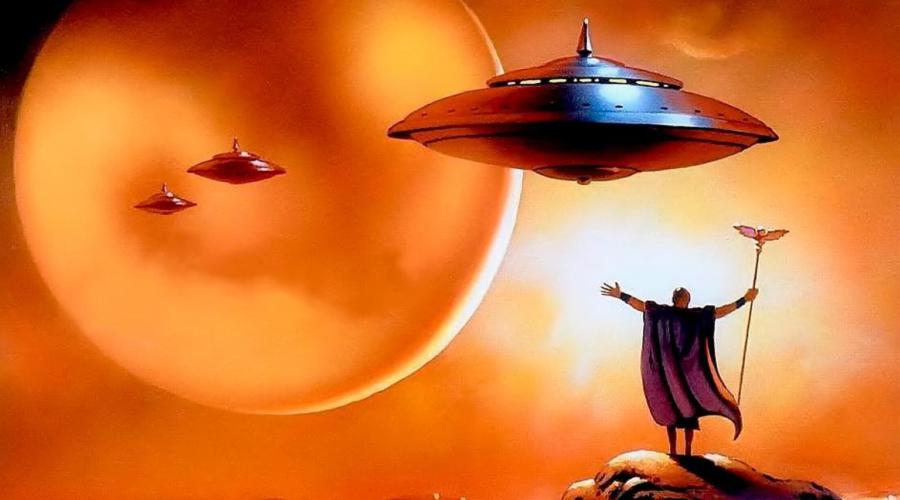
Few ancient civilizations have inspired more modern speculation than the Sumerians. Their surviving cuneiform texts are among humanity’s oldest written records, yet many of the extraordinary claims associated with them today trace not to the tablets themselves, but to twentieth-century reinterpretations. Untangling the two reveals a story that’s different from the popular version, and arguably just as fascinating.
The Anunnaki entered mainstream awareness through a traceable chain of books, documentaries, and cable television, and it’s worth tracing that chain before going anywhere near a clay tablet. But the question underneath all of it is simple and answerable: what do the tablets actually say? Mesopotamia left behind hundreds of thousands of inscribed clay tablets, a written record stretching back further than any other civilization’s, and for more than a century, trained specialists have been reading them directly. That work is public, checkable, and considerably stranger and more interesting than most of what gets attributed to it secondhand.
The Discovery of Sumer
Cuneiform sat unread for well over a thousand years before anyone in the modern world could make sense of it. The breakthrough came from a cliff face in western Iran: the Behistun Inscription, carved around 515 BCE on the orders of the Persian king Darius I, recording the same triumphant proclamation in three languages, Old Persian, Elamite, and Babylonian cuneiform, stacked on a sheer rock wall roughly 1,700 feet up a mountainside. British officer Henry Rawlinson spent over a decade, from 1835 to 1846, scaling the cliff repeatedly to copy the inscription by hand, at genuine physical risk each time. Working from the already partially understood Old Persian text as a key, Rawlinson and a handful of fellow philologists, including Edward Hincks and Jules Oppert, cracked Babylonian cuneiform by the early 1850s. It was Egyptian hieroglyphics and the Rosetta Stone all over again, except the script itself had to be reconstructed from nothing rather than compared against a single known translation.
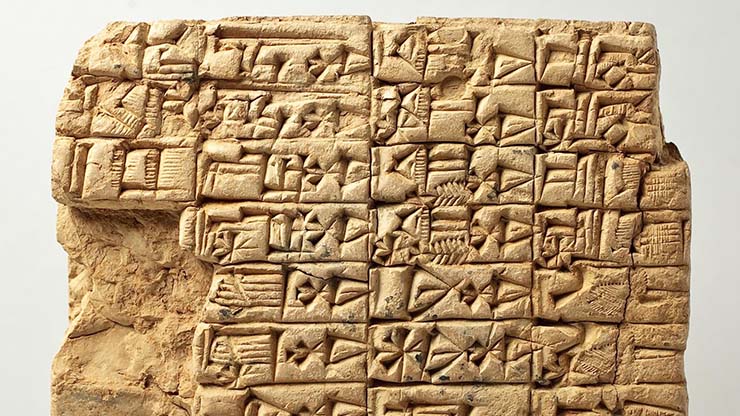
The most dramatic single moment in the field’s early history belongs to George Smith, a working-class bank-note engraver from a London slum with no formal education past the basics. Smith spent his lunch breaks at the British Museum studying newly arrived tablets from Nineveh, taught himself cuneiform entirely on his own initiative, and eventually impressed Rawlinson enough to be hired as an assistant. In 1872, sorting through fragments in the museum’s back rooms, Smith found and translated a portion of the Epic of Gilgamesh describing a catastrophic flood, and by his own later account, jumped up and rushed around the room in excitement upon realizing what he was holding. His public reading of the translation later that year reshaped how Victorian Britain understood the relationship between biblical narrative and older Mesopotamian literature. Smith also went on to piece together the Enuma Elish, the Babylonian creation epic at the center of this entire story.
What survives from ancient Mesopotamia is vast, hundreds of thousands of tablets held in museums and collections worldwide, and only a fraction have been fully translated and published even now. What’s lost is harder to quantify: entire libraries burned or scattered, tablets broken into fragments now held in different countries, texts that exist only as partial copies with gaps scholars can’t always fill. The Enuma Elish itself survives across multiple incomplete copies from different periods, pieced together like a puzzle with several pieces still missing. This is the actual state of the field: an enormous, only partially explored written record, read by specialists trained in dead languages most people will never encounter, working from physical objects anyone can, in principle, go examine for themselves in a museum collection.
Who the Anunnaki Actually Were
The term itself likely derives from Sumerian for something close to “princely offspring” or “princely seed,” though its precise etymology remains debated among specialists in the field, a small, honest gap worth naming upfront. In the earliest Sumerian sources, the Anunnaki are described as descendants of An, god of the heavens, and Ki, goddess of the earth, a broad collective term for the highest tier of the Mesopotamian pantheon rather than a fixed list of named individuals. Exactly which gods counted as Anunnaki, and how many there were, varied by city and by period: one text refers to “the fifty Anunna of Eridu,” while other sources link the term to individual city pantheons at Lagash and elsewhere. Among the deities most consistently included are Enlil, god of air and storms and the executor of An’s will, and Enki, god of water, wisdom, and crafts, whose rivalry and occasional cooperation drives a large share of Sumerian mythology.
Their role shifted meaningfully as political power moved across Mesopotamia. In the earliest Sumerian material, the Anunnaki are primarily heavenly beings whose central function, according to the myth Enki and the World Order, was to decree the fates of humanity and the natural world. By the Neo-Assyrian period, roughly 911 to 612 BCE, texts increasingly describe the Anunnaki as judges of the dead in the underworld, a documented theological shift rather than a contradiction, reflecting how Mesopotamian religious thought evolved over close to two thousand years of continuous use. The most specific number attached to them comes directly from the Enuma Elish itself: in Tablet VI, the god Marduk, having defeated Tiamat and risen to supremacy, is described dividing authority among exactly six hundred Anunnaki, three hundred assigned to the heavens and three hundred to the earth. That’s a specific, textually precise detail, and it’s worth sitting with as an example of what the actual cuneiform record offers when you go looking: not vague gestures at “the gods,” but a specific administrative structure a Babylonian scribe felt was worth writing down.
Enter Zecharia Sitchin
The modern Anunnaki-as-astronauts narrative has an identifiable point of origin, and it’s worth knowing the actual person behind it. Zecharia Sitchin was born in Baku in 1920 and raised in Mandatory Palestine. He earned a degree in economics from the University of London, worked for years as a journalist and editor in Israel, and eventually settled into a long career as a shipping company executive in New York. Sometime during that career, without formal academic training in Akkadian, Sumerian, or Assyriology at any institution, he began teaching himself cuneiform and working directly with Mesopotamian texts on his own.
That self-directed study became the seven-volume Earth Chronicles series, beginning with The 12th Planet in 1976. Sitchin’s claim was bold and audacious: that Sumerian and Akkadian texts, correctly translated, describe extraterrestrials called the Anunnaki, arriving from a planet named Nibiru on a 3,600-year orbit, engineering humanity as a labor force to mine gold, and leaving behind a body of scientific knowledge that modern astronomy, genetics, and planetary science have only recently caught up to. The books sold millions of copies across more than two dozen languages and remain, to this day, one of the most commercially successful popularizations of ancient Mesopotamia ever published, arriving eight years before von Däniken’s own ancient-astronaut bestseller had run its course and giving the wider genre a textual foundation it hadn’t had before.
Where Sitchin diverged from every other translator working with the same source material was in his individual word-for-word readings. In 2001, biblical scholar Michael S. Heiser, who holds a PhD in Hebrew Bible and Ancient Near Eastern studies, issued a public challenge to debate Sitchin directly on individual translation questions, arranged for the radio program Coast to Coast AM. Sitchin never engaged with the points raised. Heiser subsequently published detailed, line-by-line rebuttals of Sitchin’s core etymological claims, checkable against the same standard reference works any interested reader can consult, including the Chicago Assyrian Dictionary and the Pennsylvania Sumerian Dictionary. Across the field, Assyriologists, Sumerologists, and Near Eastern archaeologists who examined Sitchin’s readings arrived at the same conclusion Heiser did.
What the Enuma Elish Actually Says
The text at the center of the entire dispute is a remarkable piece of ancient literature on its own terms. The Enuma Elish opens before the universe has any form, in a time “when the heavens above were not yet named, and the earth below had not yet been called by name,” strikingly evocative language for describing formlessness prior to creation. What follows is a combat myth. Tiamat, the primordial goddess of the salt sea, and Apsu, god of fresh water, produce the first generation of gods, whose noise and disorder eventually provokes conflict. After Apsu is killed by the younger gods, Tiamat prepares for war, and the gods turn to Marduk, a rising storm-deity, offering him supreme authority in exchange for defeating her. Marduk kills Tiamat in single combat, then splits her enormous body in two, using one half to form the sky and the other to form the earth.
The political context matters as much as the plot. The Enuma Elish was Babylon’s foundational religious text, composed to justify Marduk’s supremacy over the older Sumerian pantheon precisely as Babylon itself rose to political dominance over the older Sumerian city-states. Scholars studying the text overwhelmingly read it as cosmological and political mythology: an account of order emerging from chaos that doubles as a theological argument for why Babylon, and Marduk, deserved to rule. That’s the actual scholarly interpretation, arrived at through the ordinary methods of comparative religion and Near Eastern history, not a dismissal of the text’s importance. If anything, reading the Enuma Elish as a straightforward description of planetary mechanics undersells what it actually is: one of the oldest surviving arguments for why political power is cosmically justified, dressed in some of the most vivid theological imagery Mesopotamia ever produced.
The Claims, Checked One by One
Each specific claim in the popular account can be traced back to a primary source, or the absence of one, and checked against what’s actually been established since. Here’s what that tracing turns up.
The universe is 13.7 billion years old. No published Akkadian edition of the Enuma Elish, or any other Sumerian or Babylonian text, contains a numerical figure for the age of the cosmos. This isn’t a matter of competing translations. The specific number doesn’t appear in the primary sources at all. Modern cosmology’s 13.7-billion-year figure comes from an entirely separate, twentieth and twenty-first century body of evidence, cosmic microwave background data from WMAP and Planck, redshift measurements building on Hubble’s original 1920s work, and stellar age-dating in globular clusters, converging independently on the same number. What remains uncertain: nothing, on the textual side. There’s no ambiguous passage to interpret here, only an absence.
The Giant Impact. The Enuma Elish describes Marduk defeating Tiamat in combat and splitting her body to form sky and earth. It does not describe an oblique-angle collision, orbital debris, or a moon coalescing from ejected material, the specific mechanics of the actual Giant Impact Hypothesis, developed by Caltech astronomer William Hartmann and Donald Davis in 1975 and refined by Alastair Cameron and William Ward the following year. The mythological shape, violence produces the world as we know it, is present in the ancient text. The specific astrophysical mechanism is a twentieth-century addition, not a translation.

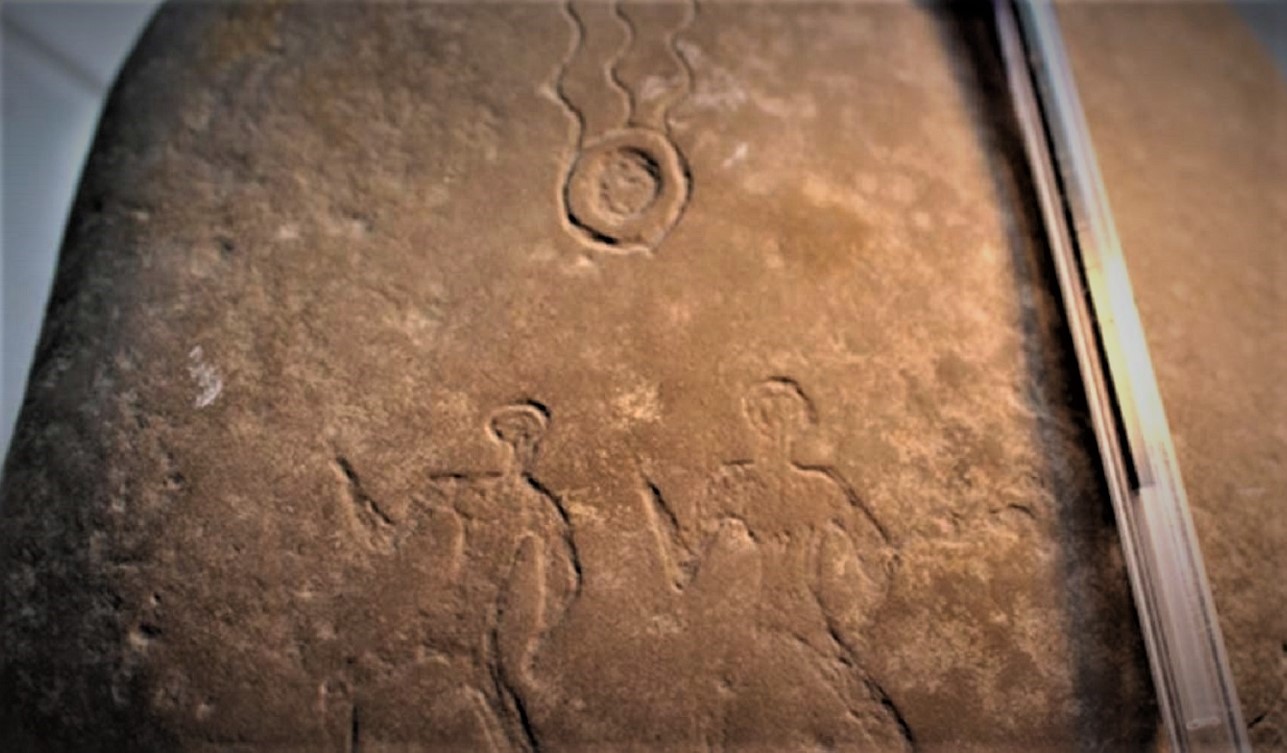
Nibiru. This is the rare case where the primary sources contain considerably more than the popular version acknowledges, just not what that version claims. Nibiru is a well-attested term in Babylonian astronomy, appearing directly in the Enuma Elish itself, in Tablet VII, where it’s named and celebrated as Marduk’s own star. The astronomical compendium MUL.APIN identifies Nibiru explicitly with the planet Jupiter, describing it as “one big star” that “divides the sky in half,” an equinox marker. A smaller number of later texts associate the name with Mercury instead. The word itself derives from an Akkadian root meaning “crossing” or “point of transition,” originally used for river crossings and ferry points before being applied to the sky. What the primary sources do not contain, anywhere, is a description of Nibiru as a distant, undiscovered planet on a 3,600-year orbit populated by an alien civilization. That specific claim has no cuneiform source at all. It’s an ancient name, attached to a specific visible planet, describing an ordinary astronomical phenomenon, repurposed for a claim the actual texts never make.
The outer planets. No cuneiform text names or describes Uranus, Neptune, or Pluto. Ancient Mesopotamian astronomy, extensively documented and translated, tracked five visible planets, Mercury, Venus, Mars, Jupiter, and Saturn, the naked-eye limit for any observer without a telescope. Uranus was identified as a planet in 1781, Neptune in 1846, Pluto in 1930 and later reclassified as a dwarf planet. The claim that Sumerian texts accurately described a complete outer solar system rests on no specific citable tablet or passage.
Mars and the mining operation. No Sumerian or Akkadian text describes Mars’s gravity, a staging base there, or an engineering rationale connected to it. Actual measurements of Martian gravity, about 38 percent of Earth’s, came from twentieth-century spacecraft. No passage in the Atrahasis or any related text describes gold mining as the Anunnaki’s objective, let alone gold’s specific atmospheric applications. That detail doesn’t trace to any primary source either.

The Atrahasis and humanity’s creation. The Atrahasis Epic, an Akkadian flood and creation narrative drawing on older Sumerian sources, genuinely does describe a labor dispute among the gods: the Igigi, a class of lesser deities assigned to hard physical labor, go on strike, and the senior gods respond by having Enki and the birth-goddess Nintu create humanity from clay mixed with the blood of a slain god, specifically to take over that labor. That much is a documented, if mythological, account of why the gods needed workers. The popular version’s leap from there, reading this passage as a literal description of genetic engineering rather than as origin mythology, doesn’t come from anything in the text itself. The Atrahasis also contains the oldest known written flood narrative predating the biblical account, later echoed closely in the Gilgamesh flood story George Smith translated in 1872, itself a serious and separate scholarly subject worth knowing about entirely apart from any Anunnaki claim.
The South African stone circles. Author Michael Tellinger has spent decades documenting tens of thousands of circular stone structures in South Africa’s Mpumalanga region, proposing they functioned as an ancient acoustic and energy network tied to Anunnaki gold extraction. The structures themselves exist and are genuinely numerous. Conventional archaeology dates their construction to roughly 200 to 2000 CE, attributing them to the region’s Bantu-speaking peoples as part of a well-documented broader tradition of stone-walled cattle enclosures and settlement boundaries found across southern Africa from this period. No peer-reviewed archaeological, geological, or acoustic engineering study has validated Tellinger’s proposed function or his considerably older construction date.
Chromosome 2. Human chromosome 2 is indeed a fusion of two chromosomes that remain separate in other great apes, cited as evidence of directed genetic modification in the popular account. The actual genetic evidence points the other way. A 1991 study in the Proceedings of the National Academy of Sciences identified vestigial telomeric repeat sequences, DNA markers normally found only at chromosome ends, sitting in the middle of chromosome 2 exactly where two ancestral chromosomes would have joined, alongside a second, inactive vestigial centromere. Multiple independent dating methods since have placed the fusion between roughly 900,000 and 4.5 million years ago, well within the ordinary human evolutionary timeline. It’s one of the more direct, physically observable pieces of evidence for human-ape common ancestry that exists, not a gap in the record.
Rh-negative blood. Rhesus-negative blood has an identified, mapped genetic cause, identified gene deletions on chromosome 1, with its uneven distribution across populations explained by ordinary founder effects and genetic drift, the same population-genetics mechanisms behind distinctive allele frequencies in many long-isolated human groups worldwide. It’s a well-studied, unremarkable finding in population genetics rather than an open question.
Twenty-two amino acids. This claim contains a factual error at its foundation. The standard genetic code encodes exactly 20 amino acids, not 22, a number settled since the genetic code was worked out in the 1960s and taught in introductory biology courses worldwide. Any numerological correspondence built on “22 amino acids” starts from an incorrect count.
The Sefer Yetzirah. The Kabbalistic Book of Creation does describe the universe forming through the twenty-two letters of the Hebrew alphabet, treating language itself as a creative force, and it’s a historically significant, centuries-deep work of Jewish mysticism worth reading on those terms. Its connection to genetics depends entirely on the amino acid count above being correct. It isn’t, which means the numerical correspondence the theory rests on doesn’t hold, whatever the Sefer Yetzirah’s own considerable merits as a work of religious philosophy.
Why These Ideas Spread
The ancient astronaut genre predates Sitchin by nearly a decade. Erich von Däniken, a Swiss hotel manager with no academic background in archaeology, published Chariots of the Gods? in 1968, arguing that numerous ancient structures and artifacts were too sophisticated for the civilizations conventionally credited with them, implying extraterrestrial involvement across dozens of unrelated cultures and sites. The book sold more than 60 million copies worldwide and established the commercial template Sitchin’s more textually detailed work would follow eight years later. History Channel’s Ancient Aliens, premiering in 2010 and still airing, took the genre fully mainstream, pairing von Däniken and Sitchin’s ideas with a recognizable cable-television aesthetic and figures like Giorgio Tsoukalos, whose enthusiastic delivery became its own internet phenomenon independent of the show’s actual claims.
The appeal isn’t hard to understand on its own terms. Ancient astronaut narratives offer a unified, singular explanation across geography and time, connecting Egyptian pyramids, Mesopotamian myth, and Andean stonework into one continuous story, where mainstream archaeology offers a more fragmented picture of independent human societies solving similar problems in different ways. They also flatter the reader with a sense of secret knowledge, insight that “they” don’t want you to have, while requiring no specialized language training to access, unlike the actual cuneiform record, which remains difficult to read without years of dedicated study. That combination, a single explanatory thread, a sense of exclusive insight, and low practical barriers to entry, explains a great deal about why the genre keeps finding new audiences regardless of how thoroughly its claims have been addressed by the field it draws its raw material from.
What Remains Mysterious
None of this means Mesopotamian civilization has given up all its secrets. Open questions remain, the kind actual specialists spend careers investigating rather than resolving in a single popular book. Babylonian astronomers tracked planetary movements and predicted eclipses with an accuracy that took the mathematics of the Hellenistic world centuries to match again, using observational methods that are still being fully reconstructed from fragmentary tablets. How writing itself first emerged in Sumer around 3400 to 3200 BCE, seemingly independently of the handful of other places writing was separately invented, remains an active area of research without a fully settled answer. The relationship between the Sumerian language, a linguistic isolate with no confirmed relatives anywhere else in the world, and the peoples who spoke it before recorded history begins is still being pieced together. And archaeologists continue to excavate new sites and tablets across Iraq and the wider region, meaning the actual body of evidence is still growing, not fixed. These are the actual mysteries: not manufactured ones requiring an invented visitor from beyond the solar system, but honest gaps in a still-unfolding historical record that professional archaeology is actively working to close.
The Record Without the Additions
The authentic Mesopotamian textual record doesn’t need any of the unsupported additions layered onto it since 1976 to be worth taking seriously. It’s the oldest substantial body of writing humanity has, deciphered through a remarkable nineteenth-century detective story, describing gods with distinct personalities and politics, a creation myth built to justify one city’s rise over its neighbors, and specific administrative details, six hundred Anunnaki, three hundred assigned to heaven and three hundred to earth, that a Babylonian scribe felt were worth recording precisely. Literature, religion, history, and one twentieth-century author’s specific, individually checkable reinterpretation are four different things, and they’re worth keeping separate. The tablets themselves remain available to anyone willing to go looking. They’re just saying something different from what secondhand retellings usually claim.







Its all true. The globalists dont want us to know. Its all about control. The Earth is far bigger than they tell us