Budd Hopkins was a New York abstract expressionist painter, exhibited at galleries including the Betty Parsons Gallery, with no prior interest in UFO research when a 1964 sighting on Cape Cod, a silent, disc-shaped object he watched hover and depart, began a twenty-year investigation that produced one of the most extensive case records of the alien abduction phenomenon in the published literature. He didn’t begin taking the abduction question seriously until years later, after encountering other witnesses whose accounts of missing time led him toward hypnosis as an investigative tool.
His methodology was regression hypnosis: identifying individuals who reported unexplained time loss or disturbing dreams, conducting hypnotic sessions to recover memories from those periods, and comparing the resulting accounts across cases from people with no knowledge of each other’s experiences. Hopkins recorded his findings in his 1981 book Missing Time and developed them further in his 1987 book Intruders, arguing that the consistency he found across independently collected accounts, paralysis preceding the experience, transport to an enclosed space with diffuse lighting, examination by small beings with large dark eyes, and in a subset of cases, procedures the experiencers described as reproductive in character, was too specific for random confabulation to explain on its own.
That claim rests entirely on one methodological pillar, and it’s worth stating plainly, and early, exactly how strong the science on that pillar actually is, because the rest of this piece can’t be evaluated honestly without it. Regression hypnosis as a memory-recovery technique isn’t a contested method with researchers on both sides. Cognitive psychologist Elizabeth Loftus, whose decades of research on memory reliability made her one of the most cited psychologists of the twentieth century, and whose findings have been repeatedly replicated by independent labs, found no controlled scientific support for the idea that hypnosis reliably recovers accurate memories of real past events, and real, documented harm followed from treating it as though it did. In 1997, a Wisconsin nurse’s aide named Nadean Cool won a $2.4 million malpractice settlement after a therapist used hypnosis to help her “recover” memories of satanic ritual abuse, over a hundred personalities, and events that never happened. Separately, hypnotically influenced eyewitness identification has been directly implicated in real wrongful convictions overturned by later DNA evidence. None of that proves every hypnotically recovered abduction account is false. It does mean that cross-case consistency recovered through this specific method isn’t the strong evidence it’s often treated as, since the method itself is independently documented to generate detailed, confident, false memories, especially when a researcher is actively looking for a particular pattern across sessions, which is exactly the situation Hopkins, and every researcher who followed him, was in.

David Jacobs and the Structured Account
David Jacobs is a historian at Temple University, where he taught for over three decades, whose academic specialty before his involvement in abduction research was the history of the UFO controversy in America. His 1975 book The UFO Controversy in America, based on his own doctoral dissertation, traces the subject’s institutional history from the 1940s through the Condon Committee, and is treated by other historians of the field as a serious, credentialed academic work in its own right, which is part of why his later shift into hypnosis-based case research drew particular attention. His engagement with the abduction phenomenon began in the early 1980s, when he trained in regression hypnosis and began his own case investigations, recorded in his 1992 book Secret Life and his 1998 book The Threat. His methodology was more systematic than Hopkins’s, a structured session protocol, audio recordings of every session, and a case archive large enough for comparative analysis. What that added rigor changed was the documentation trail, not the underlying reliability problem. A more consistent, better-recorded interview protocol produces more consistent, better-recorded hypnotic sessions. It doesn’t address whether the memories those sessions produce are accurate, since the confabulation risk Loftus’s research identifies comes from the suggestive structure of hypnotic questioning itself, a structure that a tighter protocol can make more uniform without making more reliable.
Jacobs’s account of the hybridization hypothesis is more specific than Hopkins’s: an ongoing, multi-generational program, hybrid individuals already present in the current population, and an agenda the accounts partially reveal. That specificity is worth noting honestly as a feature, not a strength. A hypothesis this elaborate, developed entirely from a methodology already known to generate detailed false narratives under suggestive questioning, is a case where more detail should raise more caution rather than less.
John Mack and the Harvard Perspective
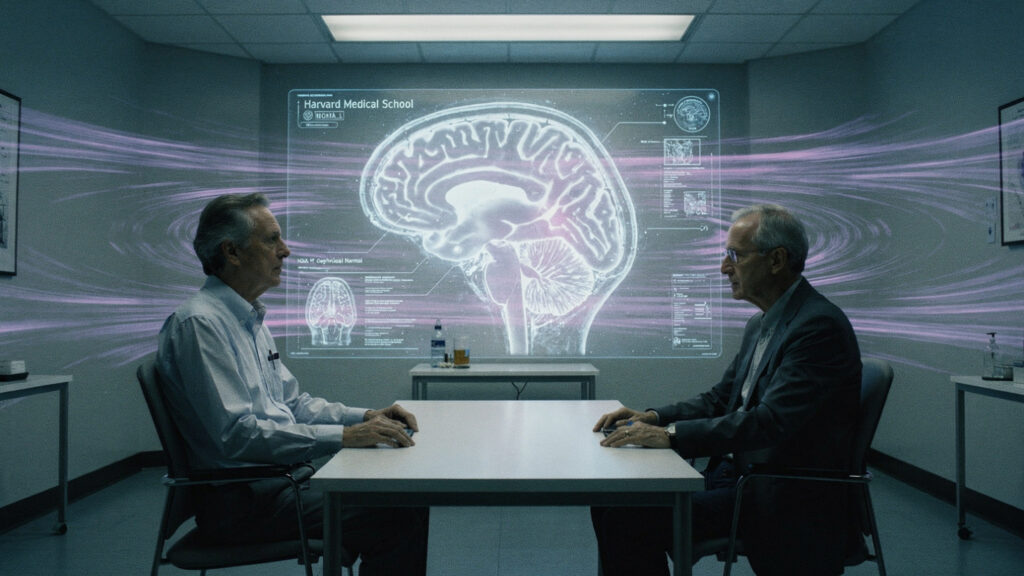
John Mack was Professor of Psychiatry at Harvard Medical School, a Pulitzer Prize-winning biographer, and founder of Harvard’s Program for Extraordinary Experience Research when he began investigating abduction claims in the late 1980s. His institutional standing gave the subject a credibility no previous researcher had brought to it. His 1994 book Abduction: Human Encounters with Aliens recorded case material from over a hundred individuals, applying his clinical training to evaluate their psychological profiles.
His notable finding was that the people he interviewed showed no evidence of the psychological disorders or fantasy-prone personality traits a purely psychopathological explanation would predict. That finding deserves to be stated precisely rather than stretched. Ruling out clinical pathology narrows the space of explanations. It doesn’t narrow it down to “the events happened as described,” because ordinary, non-pathological psychological processes, exactly the kind Loftus’s research documents, can produce vivid, sincerely held false memories in people with no diagnosable disorder at all. Mack himself was careful about this distinction in a way his work is sometimes credited for and then not actually followed on: he explicitly avoided asserting the experiences were objectively real in the conventional physical sense, describing them instead as real to the experiencers in a way conventional explanations didn’t fully capture, a considerably more modest and more defensible claim than the hybridization program his colleagues built on similar material.
Mack’s Harvard position made him a target for institutional scrutiny. Harvard Medical School convened a faculty committee to review his clinical and scholarly practices in 1994, an unusual step for the university to take against a tenured professor, and the review continued into 1995 before concluding he hadn’t violated professional standards and that his academic freedom to pursue the research remained intact. The review itself, its very existence rather than its outcome, is evidence of how much institutional anxiety a credentialed researcher taking the subject seriously provoked. Mack died in 2004, struck by a drunk driver in London. The Program for Extraordinary Experience Research he founded continues through the John E. Mack Institute.
Roger Leir and the Physical Evidence
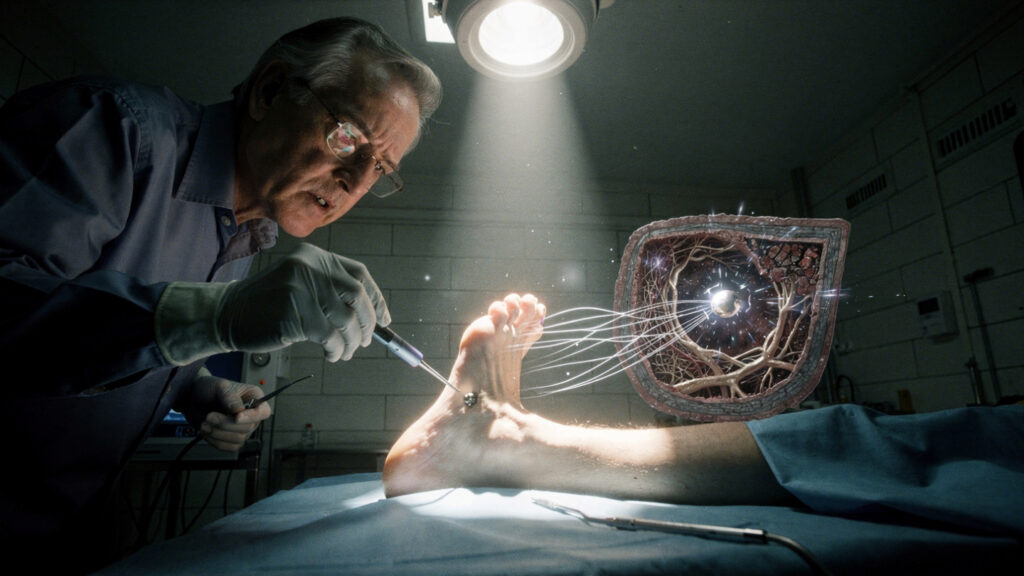
The most specifically testable element of the hybridization hypothesis is the physical evidence claim: that some abduction experiences leave objects in the body that weren’t there before. Roger Leir was a podiatric surgeon in Thousand Oaks, California, with an established conventional medical practice before his involvement began in 1994, after attending a Hopkins lecture, when he agreed to examine a patient who believed she had an implant in her toe, a small, hard object she said had appeared without any surgical history to explain it. Over roughly fifteen years, Leir removed approximately sixteen such objects from self-described abductees, several of the removals filmed and later featured in television documentaries, and described the results in his 1998 book The Aliens and the Scalpel. His reported findings included objects surrounded by a dense membrane that prevented the normal inflammatory response foreign material produces in human tissue, unusual magnetic or radio-frequency properties in some objects, and metallurgical analyses he described as inconsistent with human manufacture, including isotopic ratios he interpreted as non-terrestrial. Isotopic ratio analysis really is the standard method for establishing where a material originated, which is exactly why this specific claim is checkable in a way most abduction evidence isn’t, and exactly why what happened when it actually got checked matters.
It has been checked. Objects from two of Leir’s early patients were independently analyzed by the New Mexico Institute of Mining and Technology, which found them composed of ordinary terrestrial elements, including iron and aluminum. Separately, an implant associated with fellow abduction researcher Derrel Sims underwent scanning electron microscopy and X-ray analysis and was found to be composed of mercury, tin, and silver, the specific composition of dental amalgam. Chain of custody for several extracted objects has also been questioned, with some stored without sterile protocol or documented provenance between removal and analysis. None of this proves every claimed implant has an equally mundane origin. It does mean the one part of this entire tradition that offered a genuinely falsifiable physical claim has already been tested, and what came back points toward ordinary materials rather than anomalous ones. That result deserves to be reported here as plainly as the claim itself was. Leir died in 2014. His case archive is held by the Foundation for Research into Extraterrestrial Encounters.
The Watchers Parallel
The Book of Enoch’s Watchers tradition, expanding on the brief reference in Genesis 6 to “sons of God” taking human wives, describes two hundred angelic beings who descended to Earth, took human women as partners, and produced hybrid offspring called the Nephilim, whose great size and unusual characteristics distinguished them from ordinary humans. The structural resemblance to the modern hybridization hypothesis, non-human beings, a program of genetic mixing, offspring carrying traits from both lineages, is worth noting honestly.
What it doesn’t do is establish that both traditions are describing the same real, ongoing phenomenon across three thousand years, and that conclusion shouldn’t be allowed to sit at the end of this piece as though the comparison had settled it. A hybrid-ancestry narrative, an outside intelligence altering a human bloodline, is one of the most widely recurring story structures in world mythology generally, appearing across cultures with no plausible contact between them, for the same reason ghost stories and flood myths recur: it’s a powerful, broadly available way for a culture to explain why some people seem different, or why the world contains beings that don’t fit ordinary categories. Regression-hypnosis subjects in the twentieth century, immersed in a culture where the Watchers, the Nephilim, and decades of prior UFO literature were already widely circulating, absorbing that narrative shape unconsciously during suggestive questioning is at least as plausible an explanation for the resemblance as independent contact with the same real phenomenon millennia apart. The resemblance is genuinely interesting as intellectual history. It isn’t evidence that either account is literally true.
What the Method Explains Without the Explanation Being True
Hopkins, Jacobs, and Mack produced, between them, more than thirty years of systematic case documentation, and their subjects do, by clinical measures, show normal psychological profiles rather than diagnosable pathology. Both of those things are worth taking seriously. What doesn’t survive examination is the inferential leap built on top of them: that cross-case consistency recovered through hypnosis demonstrates a real hybridization program, rather than demonstrating what the memory-science literature already predicts a suggestive, expectation-driven interview method would produce across researchers who were, from the start, looking for exactly this kind of pattern.
The one piece of this tradition that offered genuinely independent, falsifiable physical evidence, Leir’s implants, has been tested by outside laboratories, and the results were ordinary. The one ancient parallel repeatedly cited as corroboration, the Watchers tradition, is better explained as a widely available narrative structure than as a millennia-spanning eyewitness record. What remains, honestly, is a body of sincere, consistent, clinically unremarkable testimony produced by a method independently documented to generate exactly that kind of testimony regardless of whether the underlying events occurred. That’s not the same as proving nothing happened. It’s a considerably narrower, more honest place to leave the question than three decades of research were sometimes credited with reaching.
Alien hybridization testimony remains sincere, consistent, and produced by a method that reliably generates exactly that kind of testimony either way.