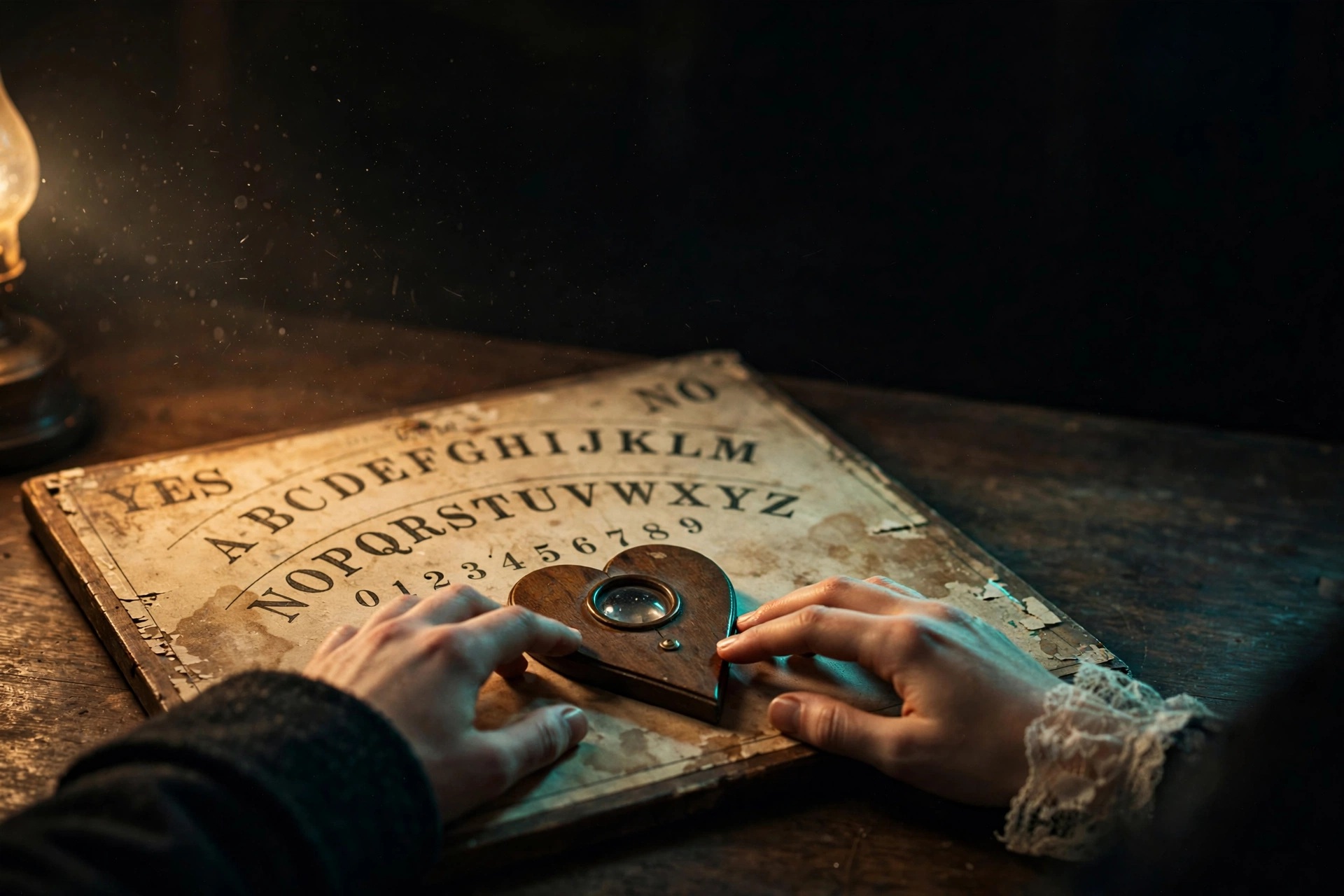
In 1890, a Baltimore attorney named Elijah Bond took a flat wooden board to the United States Patent Office in Washington. It was printed with the alphabet, the numbers and the words yes and no, and it came with a small sliding pointer. By the story the company told for years afterward, the chief patent officer would grant nothing until the board proved it could do what its makers claimed. So Bond sat down with his sister-in-law, Helen Peters, a woman he described as a strong medium, and the two of them rested their fingertips on the pointer. It slid across the letters and spelled out a name. The name was the patent officer’s own, and nobody at the table was supposed to know it.
On February 10, 1891, Bond was granted U.S. Patent 446,054 for a “toy or game.” The document explains how the board is built. It never explains how it works, and the first advertisements turned that silence into a selling point. A New York ad promised a board that was “interesting and mysterious,” and “proven at Patent Office before patent was allowed. Price, $1.50.” That contradiction became the product’s genius. On paper, the Ouija was a toy. In the minds of the people who bought it, it might be something else entirely.
More than 130 years later, the Ouija board still sits in toy aisles and is still kept out of some homes as a door nobody should open. It has been blamed for a shooting, credited with novels, painted by Norman Rockwell and tested in a psychology lab with blindfolds. The spirits do not survive the tests very well. Something else does, and it is stranger than anything the board’s makers ever advertised.
The Alphabet in the Dark
The board did not invent the idea of spelling messages out of the dark. When the Fox sisters set off modern Spiritualism with raps in a Hydesville farmhouse in 1848, sitters soon learned to call out the alphabet aloud and wait for a knock at the right letter. It worked, after a fashion, but it was slow. A single sentence could take most of an evening.
Spiritualists spent the next forty years looking for something faster. Around 1853 a device called the planchette appeared in séance circles in Paris, a small heart shaped platform on two casters with a pencil fixed through its point. Several hands rested on it, and it wrote, or seemed to write, on its own. Then in 1886 newspapers reported something new spreading through the Spiritualist camps of Ohio, a board printed with letters and numbers and a pointer that travelled between them. The talking board joined the alphabet of the rapping circle to the gliding hand of the planchette. It could be played at a kitchen table, by anyone, without a medium in the room.
The Name the Board Chose
Charles Kennard, a Baltimore businessman, saw a product. In 1890 he formed the Kennard Novelty Company with four other investors, among them Elijah Bond and Washington Bowie, a surveyor, and set out to make nothing but talking boards. What they did not have was a name.
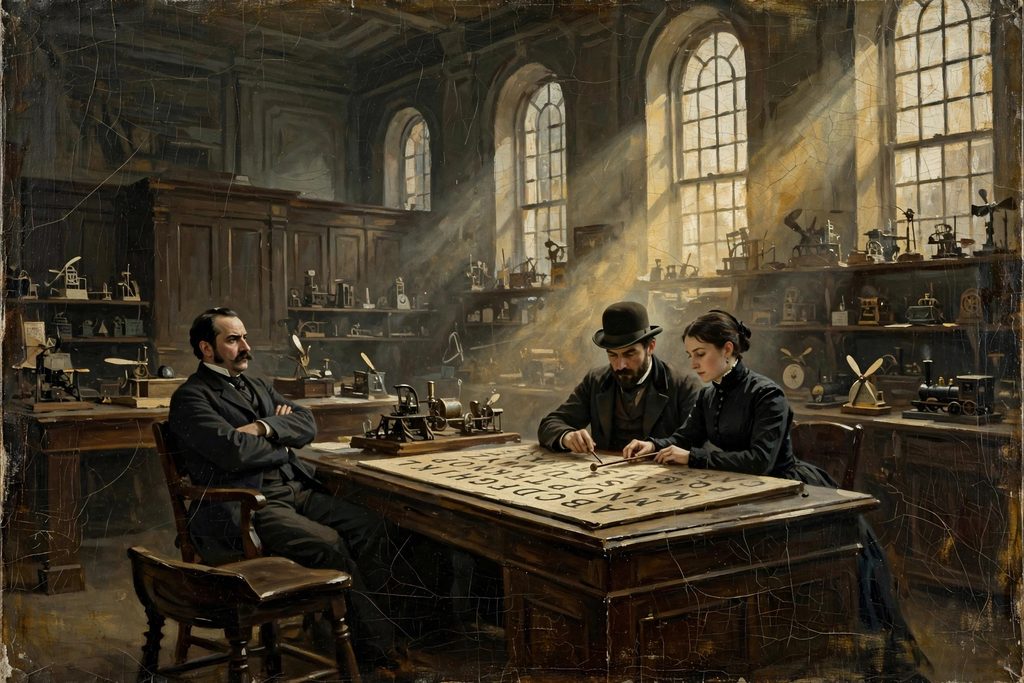
According to the company’s own story, the name came from the board. Helen Peters asked it what it wanted to be called, and the pointer spelled O-U-I-J-A. Asked what that meant, it answered “good luck.” Historians have been pulling at a loose thread in that story ever since. Peters was reportedly wearing a locket that night with a picture of a woman inside and the name “Ouija” above her head. The likeliest explanation is that the name had been misread and belonged to Ouida, the pen name of an English novelist whose books were everywhere at the time. Kennard later claimed that Ouija was the ancient Egyptian word for good luck. It is not. William Fuld, the man who would end up owning the business, offered the explanation most people still repeat, the French oui and the German ja, a board that says yes twice.
The patent office story has a loose thread too. Robert Murch, who has researched the board’s history since 1992, has pointed out that Bond may simply have known the officer’s name before he walked in. The board passed its first public test. Whether the board was the one that passed it is another matter. The origin story never needed to be true in every detail to do its work. It only needed to make a customer wonder whether it might be.
The Varnisher Who Ran the Company
The founders did not last long. William Fuld had started at Kennard Novelty as a varnisher and worked his way up to foreman, and by 1892 he was supervising production. By the same year the company had factories in Baltimore, New York, Chicago and London. Fuld’s name ended up printed on the board itself, and his obituary in The New York Times would later credit him with inventing it, which he had not.
Success did not keep the family close. By 1901 William and his brother Isaac were locked in a bitter feud. Isaac went on making his own near copies, sold as the Oriole talking board, and the legal fight between them dragged on until 1919. The board, meanwhile, kept giving William business advice. On the eve of the First World War, he said, it told him to “prepare for big business.” It was right. As men left for the front, mothers and wives bought boards in record numbers, hoping to hear from sons and husbands they could not reach any other way. In 1920 Fuld claimed the board had made him more than a million dollars in profit.
He also said the board told him to build a new factory. He built it, three stories tall. On February 24, 1927, Fuld climbed to its roof to supervise the installation of a flagpole. The railing he leaned against gave way, and he fell. A broken rib pierced his heart on the way to the hospital, and he died there. His family kept the company, and the Fulds went on making boards for almost forty more years.
The Decade the Board Learned to Write
The board’s strangest years came when it stopped being a parlor game and started producing literature. On the evening of July 8, 1913, a St. Louis housewife named Pearl Curran sat at a board with her mother and her friend Emily Grant Hutchings, and the pointer introduced someone new. “Patience Worth my name,” it spelled. Over the next twenty-four years, Patience Worth would dictate novels, poems and plays through Curran, some four million words in all, and critics with no interest in ghosts praised the writing.
Emily Grant Hutchings wanted a voice of her own. She and a friend, Lola V. Hays, announced that the board had put them in touch with Mark Twain, who had died in 1910, and that he had dictated a new novel to them. Mitchell Kennerley published Jap Herron in 1917. The reviews were brutal. The New York Times called its humor “a feeble attempt at imitation,” and the Oakland Tribune said plainly that “the style is not Mark Twain’s.” On June 8, 1918, Twain’s daughter Clara Clemens sued Hutchings and her publisher. The suit was dropped after Hutchings agreed to destroy every existing copy. She never took the claim back.
Read side by side, the two cases make an odd pair. The same kind of board, in the same city, with one of the same women at the table, produced a voice that critics admired and a voice that critics laughed at. Whatever the board was doing, it seemed to depend entirely on who sat down at it.
By then the board was everywhere. On May 1, 1920, Norman Rockwell’s cover for The Saturday Evening Post showed a young couple with a Ouija board balanced across their knees. That same year Thomas Edison, who said he was working on an apparatus delicate enough to register any personality that survived death, went out of his way to ridicule the idea that spirits would spend eternity tipping tables or pushing a little wooden indicator around a Ouija board. The most famous inventor in America wanted a better machine. The public was content with the one on the kitchen table.
When the Board Went to Court
On November 18, 1933, at the family home in Apache County, Arizona, a fifteen year old girl named Mattie Turley shot her father, Ernest, twice in the back. He died of his wounds about six weeks later. Mattie first said she had tripped while aiming at a skunk. Questioned by the sheriff, she told a different story. Her mother, Dorothea, had ordered the shooting, she said, because a Ouija board had told them Ernest had to die so that Dorothea could marry a younger cowboy named Kent Pearce. Her mother, Mattie said, had promised her she could not be arrested for it.
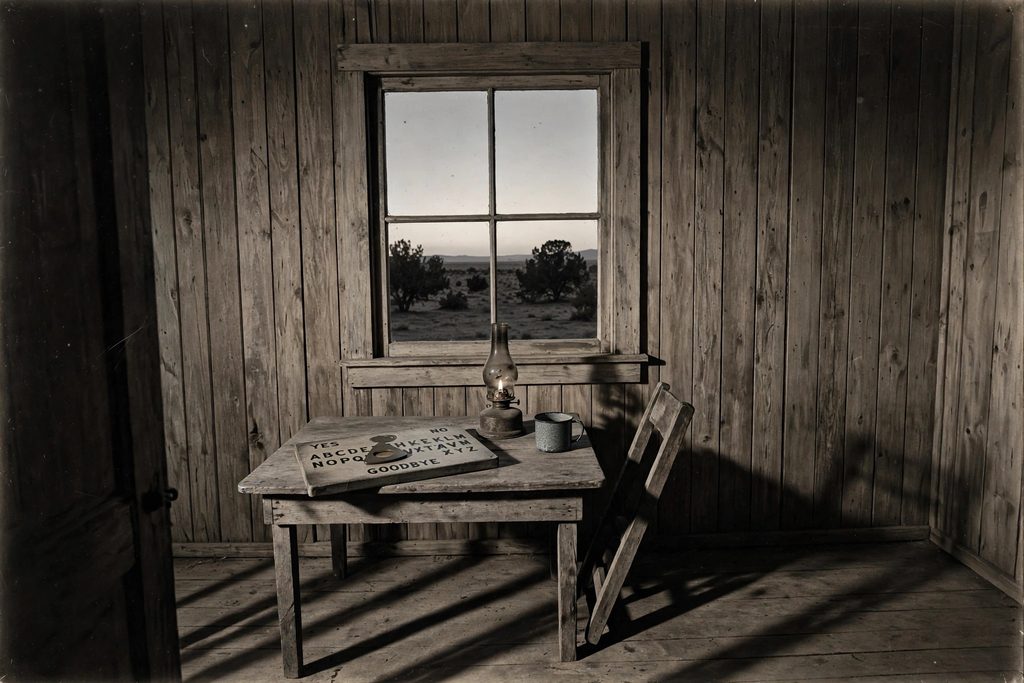
The story went around the country as the Ouija murder, and it is still told that way. The court record is less tidy. Dorothea denied ever consulting the board about her husband and said her daughter had shot him in anger over his rules. Mattie pleaded guilty and was sent to the state school for girls. Dorothea was convicted in June 1934, largely on her daughter’s testimony, and sentenced to ten to twenty-five years. About three years later, the Arizona Supreme Court found that the trial judge had wrongly shut out evidence bearing on Mattie’s credibility. The conviction was reversed, the charges were dismissed, and today the National Registry of Exonerations lists Dorothea Turley among its cases. None of that tells us everything that happened inside the Turley house. It does mean that the most notorious crime in the board’s history rests on a message that nobody but a frightened fifteen year old ever claimed to have seen.
The board met the courts in quieter ways too. In 1956 a woman named Helen Dow Peck left most of her estate, about $180,000, to a John Gale Forbes, a name the board had given her decades earlier. Her nieces and nephews objected. A judge threw out the will, because John Gale Forbes could not be found. Once again the question in court was not whether a pointer had moved, but whether a message from it could establish a fact in the world.
From Parlor Game to Open Door
The board kept selling. During the Second World War, one New York department store sold 50,000 boards in five months. In 1966 Parker Brothers bought the Fuld company and everything it owned, and in 1967 the Ouija board sold two million copies, outselling Monopoly. The trademark now belongs to Hasbro, which still sells it as a game.
What changed was the fear. For most of its first eighty years, the board was a novelty, a courtship prop and a comfort to the grieving. Then in 1973 The Exorcist suggested that a twelve year old girl had become possessed after playing with a Ouija board alone. Murch has said the film “actually changed the fabric of pop culture.” From then on, the board carried a reputation its makers never sold, as an open door for something that does not leave once it has been invited in. The fear itself was far older. People had been explaining possession for thousands of years before anyone printed an alphabet on a board. The board simply gave the old fear a new doorway, and a price tag. After 1973, the question at the table was no longer only “Will it answer?” It was also “What if it does?”
Not everyone who kept using it was frightened. Over more than twenty years, the poet James Merrill and his partner David Jackson sat at a homemade board with an upturned teacup for a pointer and recorded the voices that came through. Merrill shaped the transcripts into The Changing Light at Sandover, published complete in 1982. Parts of it won the Pulitzer Prize and the National Book Award. Like Patience Worth seventy years earlier, the board produced something that people who did not believe in it still wanted to read.
What Moves the Planchette
The answer to the board’s oldest question was published before the board existed. In 1852 the English physiologist William Carpenter described how a strongly held idea can produce small muscular movements without any conscious decision to move. He called it ideomotor action. The next year Michael Faraday turned to the table turning craze then sweeping Britain. Sitters swore the table moved first and dragged their hands along with it. Faraday stacked thin layers of card, held together with a soft cement, under the sitters’ hands. When the tables moved, the shifted layers showed that the hands had pushed first and the table had followed. When Faraday gave the sitters a small indicator that let them see their own pressure, the table stopped turning.
The planchette is the same experiment in miniature. Several people rest their fingers on a pointer that moves at the lightest touch. Each one feels it move and assumes that someone else is moving it, or that no one is. A person can honestly feel that they are not pushing the pointer and still be helping to push it. Chris French, an anomalistic psychologist at Goldsmiths, University of London, has put it simply. The ideomotor effect “can generate a very strong impression that the movement is being caused by some outside agency, but it’s not.”
The cleanest test is the blindfold. If something outside the table is steering, it should not matter whether the people at the board can see the letters. The test has been run many times, including on National Geographic’s Brain Games in 2015. With their eyes open, sitters spell out answers. Blindfolded, the pointer still moves, but the spelling falls apart. Whatever moves the planchette needs to see the board.
What the Blindfold Does Not Explain
That might have been the end of it, except for an experiment at the University of British Columbia. In 2012 Hélène Gauchou, Ronald Rensink and Sidney Fels published a study in Consciousness and Cognition that put a twist on the blindfold. Participants answered yes or no questions of general knowledge, sometimes out loud and sometimes through a Ouija board. For the board, each participant was blindfolded and told they would be answering together with a partner. Once the session began, the partner quietly took their hands away. Every movement of the pointer came from the participant alone.
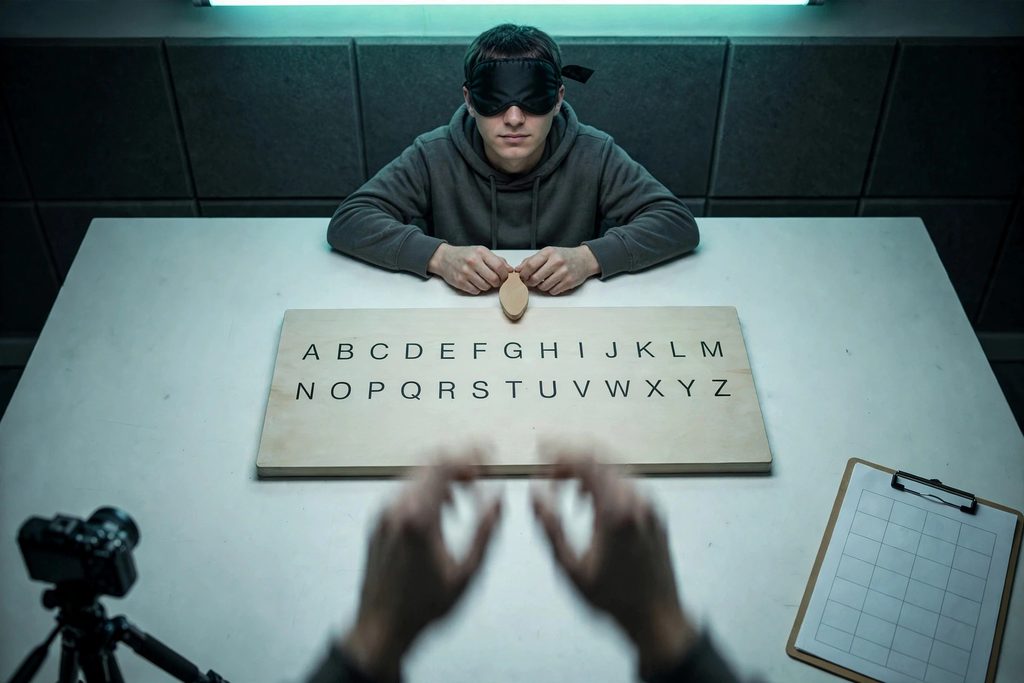
On questions the participants were confident about, the two methods did about equally well. The surprise came on the questions they believed they could not answer. When participants said they were only guessing, their spoken answers were right about half the time, which is exactly chance. When questions of the same kind went through the board, they were right about 65 percent of the time. The hand knew something the speaker did not. “You need to be able to park your conscious system and allow yourself to act through your zombie system,” Rensink said. The researchers did not conclude that anyone was talking to the dead. They concluded the board might be a way of reaching memory that people hold but cannot call up on purpose. It is one study, and 65 percent is not a property of every board on every night. But memory is not a filing cabinet that is either open or empty. Some of what we know can steer a choice before we can say why we made it.
Decades of laboratory parapsychology, from J.B. Rhine’s card trials at Duke onward, went looking for a signal coming into the mind from outside. The Vancouver study found a signal coming out of the mind from somewhere inside it. It was the same question the Society for Psychical Research had wrestled with for decades in automatic writing. Not whether the hand moved, but where the words came from.
A Door, but Into Where
The spirit story fails its simplest test. Cover the sitters’ eyes and the messages stop making sense, which is not what anyone would expect from a visitor who can see the board on its own. The ideomotor story explains how the pointer moves, and it has been on the record since before Elijah Bond carried his board to Washington. What it does not fully explain is what the pointer carries. A housewife with little schooling produced four million words through it. A frightened girl in Arizona said it told her to kill. A blindfolded student in Vancouver, guessing, got the answers right more often than chance allows. The board does not have to be a doorway to the dead to make a room feel haunted. It only has to show that part of us is already moving in the dark.
Every message the board has ever spelled has come through the hands of the people at the table. That is the debunking, and it is also the mystery. Bond and Peters may well have known the patent officer’s name before they sat down. The more unsettling possibility is that they did not know they knew it, and the board found it anyway.