




The archaeologists who opened Tutankhamun’s tomb in 1922 found more than three thousand objects.
Howard Carter and his team spent ten years cataloguing them. The pectoral breastplate now designated as Carter object 261p is among the most elaborate pieces in the collection: a gold and inlaid jewel whose iconographic program is dense enough that Egyptologists have spent a century unpacking its symbolic layers without reaching complete agreement on every element.
The standard interpretation situates the pectoral within the well established Egyptian solar-lunar cosmology of the New Kingdom period. The scarab beetle at the piece’s center represents Khepri, the form of the sun god at dawn, whose hieroglyphic name is written with the scarab sign. The lunar crescent at the top represents Khonsu, the moon deity. The heavenly bark below the crescent is the solar vessel whose journey through the underworld constitutes the sun’s nightly passage. The figures flanking various elements are standard divine attendants whose iconographic conventions are recorded across dozens of New Kingdom funerary objects.
This interpretation is well established, consistent with the broader Egyptian religious iconographic tradition, and represents the consensus of a century of specialized scholarship.
The alternative interpretation is also on the record, proposed by researchers including Soviet physicist Matest Agrest and subsequent alternative Egyptologists, and it proceeds from a question: what would this object look like to someone who had never encountered the Egyptian religious iconographic tradition and was simply describing what they saw?
What they would see is a three-level cosmological diagram. At the bottom, Earth. In the middle, a large winged object with a circular element at its center. At the top, a crescent body with figures on it.
Whether this visual reading encodes genuine ancient knowledge of a three-body Earth-Moon orbital system, or accurately represents the Egyptian solar-lunar-underworld cosmological framework in the visual vocabulary of New Kingdom jewelry, is the question that the pectoral’s iconographic precision raises.
Both readings are looking at the same object. The question is which one the makers intended and whether intention exhausts meaning.
What the Pectoral Actually Shows
The pectoral’s iconographic program deserves examination in detail because the alternative interpretation’s claims rest on elements that are visually present in the object regardless of their intended meaning.
The three-level structure. The pectoral is organized in three distinct horizontal registers. The lowest register contains figures that the standard interpretation identifies as Earth-level divine attendants. The middle register contains the scarab with outstretched wings flanked by solar discs, whose horizontal position between the upper and lower registers gives it a transit character in the object’s visual organization. The upper register contains the lunar crescent with figures standing within or on its interior curve.
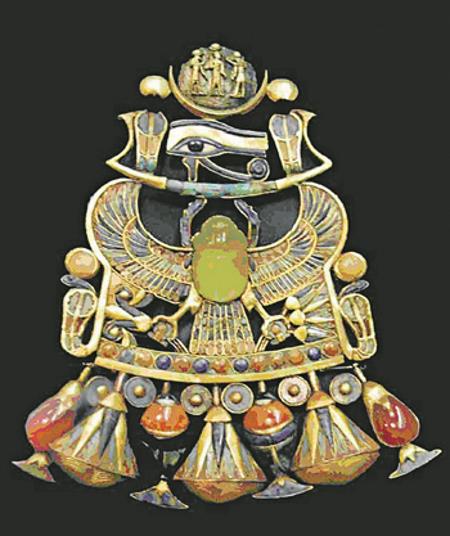
The scarab’s placement. In standard Egyptian iconographic practice, the scarab represents the sun’s movement through the sky and the transformation from one state to another. Its placement in the pectoral’s middle register, between the lower earth-level figures and the upper lunar element, gives it a directional quality that the solar mythology framework interprets as the sun’s upward movement through the day sky. The alternative interpretation reads the same directional quality as a vehicle moving from lower to upper register, from Earth level to Moon level.
Whether the Egyptian artists intended both readings simultaneously, as Egyptian religious art frequently encodes multiple layers of meaning in single visual programs, is the question that the density of the pectoral’s iconographic program makes genuinely interesting. The Egyptian religious tradition recorded in the Pyramid Texts and the Book of the Dead is not a simple one-to-one symbol system but a multivalent tradition in which the same image carries multiple simultaneous meanings.
The heavenly bark. The solar bark that the standard interpretation identifies below the crescent is one of the most frequently depicted elements in New Kingdom funerary art. It represents the vehicle of the sun god’s nightly journey through the underworld, emerging at dawn. In the context of the pectoral’s three-level structure, its placement immediately below the lunar crescent gives it a spatial relationship with the Moon that the standard solar mythology framework interprets as coincidental to the mythological narrative but that the alternative interpretation reads as describing a spatial relationship between the vehicle and the Moon.
The figures on the crescent. The small figures visible within or on the lunar crescent are the most visually striking element of the pectoral for the alternative interpretation. The standard framework identifies them as divine attendants in the conventional Egyptian divine figure tradition. The alternative reading notes that their placement on or within the lunar crescent, rather than flanking it from the sides or below, gives them a relationship to the Moon’s physical surface that the standard solar-boat context does not fully account for.
Whether these figures are standing on the Moon, within the crescent as a boat or vessel, or flanking the lunar disk in a conventional divine attendant arrangement, depends on the iconographic reading of the pectoral’s spatial organization. The photograph of the object, available in the Egyptian Museum’s own published record, allows independent assessment.
Matest Agrest and the Paleocontact Tradition
Matest Agrest published his 1960 article in the Soviet literary magazine Literaturnaya Gazeta under the title Dosledy vedut v Kosmos, roughly translatable as Do the Traces Lead to Space. He was a doctor of physical and mathematical sciences at the Soviet Academy of Sciences, and his institutional credentials made his engagement with the paleocontact hypothesis more consequential than the same argument would have been from a researcher without scientific standing.
Agrest’s argument was not that ancient mythology contained spacecraft imagery but that physical evidence, particularly the megalithic construction achievements at sites including Baalbek, could not be adequately explained by the conventional historical framework for ancient technology and therefore suggested the assistance of intelligences with significantly more advanced technological capabilities.
The Baalbek trilithon, three foundation stones at the Temple of Jupiter in Baalbek, Lebanon, each weighing between 800 and 1,000 tons, represent the largest precisely cut and placed stones in any known ancient construction. The conventional engineering history of the Roman period, which built the Temple of Jupiter above the Hellenistic and even earlier foundations, cannot account for these stones: they are beneath the Roman construction, are incorporated into a foundation platform whose engineering purpose required exactly their massive size, and were quarried from a site approximately one kilometer away whose geology and the toolmarks on the quarried surface appear in the archaeological record.
How the Baalbek trilithon stones were quarried, transported one kilometer, and placed with the precision their current position shows, is a question that the mainstream archaeological literature acknowledges without providing a fully satisfying mechanical answer using the tools and techniques recorded in the Roman period’s engineering record.
Agrest’s argument was that the gap between established ancient engineering capability and the achievements at Baalbek and other megalithic sites was large enough that the hypothesis of assistance from more technologically advanced beings deserved serious scientific consideration rather than dismissal.
Whether Agrest’s argument is correct is a question that the physical evidence of the sites makes genuinely open. The Baalbek stone whose current position in the quarry is still partially cut, nicknamed Hajar el-Hibla, the Stone of the Pregnant Woman, weighs approximately 1,000 tons and was never fully quarried or moved. Its current position in the quarry is the physical evidence that whatever process was being used to move these stones, it was interrupted before completion.
The Egyptian Astronomical Framework
The mainstream Egyptological interpretation of the Tutankhamun pectoral situates it within a well established Egyptian astronomical and cosmological tradition whose sophistication has been increasingly recognized in the scholarly literature.
The ancient Egyptians recorded their astronomical knowledge in multiple forms: the astronomical ceilings of New Kingdom tombs, the alignment of major temples to solar and stellar events, the Dendera zodiac whose configuration has been analyzed for its encoded astronomical data, and the mathematical and observational astronomy recorded in the administrative papyri of the Old and Middle Kingdom periods.
Whether this astronomical sophistication implies the kind of direct observation and measurement that could have produced knowledge of the Earth-Moon-space relationship that the pectoral’s alternative interpretation reads from its iconography, is the question that the Egyptian astronomical tradition’s established scope makes worth examining.
The Egyptians tracked the Moon’s phases and orbital period in their lunar calendar. They understood the relationship between the Moon’s position and the tidal patterns of the Nile. They aligned major New Kingdom temples including the Temple of Luxor and the Abu Simbel complex to astronomical events with a precision that required systematic long-term observation and geometric calculation.
Whether this recorded observational tradition was sufficient to produce the cosmological understanding that the pectoral’s three-level structure might encode, or whether that encoding represents mythological symbolism rather than astronomical data, is the question that its established scope motivates rather than resolves.
The Giza pyramid electromagnetic piece in this library covers a peer-reviewed physics finding that the Great Pyramid focuses electromagnetic energy at frequencies. The Egyptian astronomical knowledge piece covers knowledge claims in the Egyptian corpus that predate their conventional discovery dates. Whether the pectoral represents the same tradition of sophisticated technical knowledge encoded in religious symbolic form is the interpretive question that the object’s iconographic precision raises.
The Khepri Question
The scarab beetle’s identification as Khepri in the mainstream interpretation is the element that most directly addresses the alternative spacecraft reading, because Khepri’s mythological function is the most precise parallel to the alternative interpretation’s shuttle hypothesis.
Khepri, the scarab-headed form of the sun god at dawn, is specifically the deity of transformation and motion, the force that rolls the sun across the sky as the physical scarab rolls its dung ball. The metaphor is movement from one state to another, from darkness to light, from below to above, from one realm to the next.
Whether this mythological function, transformation and transit between cosmic levels, is the Egyptian religious tradition’s way of encoding a genuine ancient contact memory of a vehicle that moved between cosmic levels, or is a purely terrestrial metaphor for the sun’s daily journey drawn from the observation of a dung beetle’s behavior, is the interpretive question that Agrest’s framework and the alternative Egyptological tradition approach from a direction.
The question is not whether the Egyptians knew what a spacecraft was. The question is whether the imagery they used to represent cosmic transit was informed by genuine observation of cosmic transit technology that they subsequently encoded in the divine-mythological framework that was their standard mode of knowledge preservation.
This is the same question that the Ezekiel wheel-within-wheel piece in this library asks about the Hebrew prophetic tradition, that the Oannes fish-people piece asks about the Sumerian aquatic teacher tradition, and that the Wandjina piece asks about the Australian sky being tradition.
The Egyptian tradition’s sophistication in astronomical and architectural knowledge gives the question a weight in the Tutankhamun pectoral context that it carries in fewer other cases.
Carter Object 261p and What It Does Not Say
The honest evidentiary position on the Tutankhamun pectoral is this: the object appears in the Egyptian Museum. Its iconographic elements appear in the Egyptological literature. Its standard interpretation within the New Kingdom solar-lunar cosmological tradition is well-established and accounts for every element the alternative interpretation proposes as spacecraft imagery through well established Egyptian religious symbolism.
The alternative interpretation proposes that the same visual program encodes a different and additional layer of meaning whose content reflects genuine ancient contact with beings who operated between Earth and the Moon. Whether this additional layer was consciously encoded by the artisans who made the pectoral, unconsciously preserved from a cultural memory of genuine contact events, or is a modern reading imposed on ancient symbolism by the cultural context of the space age, is the question that iconographic analysis alone cannot resolve.
Matest Agrest raised the paleocontact question in 1960 with institutional scientific credentials and physical evidence. The Baalbek stones are still in the ground. The Tutankhamun pectoral is still in the museum.
What the pectoral shows is three cosmic levels, a winged object in transit between them, a heavenly vehicle beneath a crescent body, and figures on the crescent.
The Egyptologists say these are gods.
The alternative tradition says that is what they called them.
Whether the gods in the pectoral traveled to the Moon on the vehicle depicted between the Earth level and the lunar crescent, or whether the vehicle is the sun’s mythological bark and the Moon is Khonsu’s theological domain, is the question that three thousand three hundred years of time and the death of everyone who knew the answer have made permanently interesting.
The pectoral is in Cairo. The Moon is where it has always been.
Whatever the relationship between them, the artisan who made the pectoral knew which level each belonged to.