In 1139, the Irish bishop Malachy of Armagh traveled to Rome to receive papal confirmation of his appointment as Archbishop of Armagh. According to the account preserved in his subsequent biography, he received a prophetic vision during this journey that showed him every pope who would reign from his contemporary Celestine II until the final pope of history.
He encoded this vision in 112 Latin mottos, each a brief phrase whose words described some characteristic of the corresponding pontiff, and deposited the text in the Vatican archives.
Whether this account is accurate is the foundational question that determines everything else about the Malachy prophecy’s significance. The text exists. It is in the Vatican archives. It was first published in 1595 by the Benedictine monk Arnold Wion in his Lignum Vitae, more than four hundred years after Malachy’s death in 1148. Whether Wion discovered a genuine twelfth-century text or produced a sixteenth-century composition attributed to Malachy is the authenticity question that scholars have debated since the publication without reaching consensus.
The strongest argument against authenticity is the prophecy’s accuracy pattern: the mottos for popes before 1595, who reigned before the document’s publication, show significantly better correspondence to their subjects than the mottos for popes after 1595. If the prophecy were a genuine twelfth-century vision, its accuracy should be consistent across all popes. The pre-1595 accuracy suggests the text may have been written in the sixteenth century by someone with historical knowledge of the earlier popes and prophetic knowledge of none.
The strongest argument for authenticity, or at least for genuine prophetic content regardless of its exact origin, is what the text says about the final pope, and what has happened since.
The 112th Motto
The final entry in the Malachy prophecy is the most extensive and the most dramatic. Where most of the 111 preceding mottos are two to five words, the final entry is a complete sentence.
In Latin: In persecutione extrema S.R.E. sedebit Petrus Romanus, qui pascet oves in multis tribulationibus, quibus transactis civitas septicollis diruetur, & Judex tremendus iudicabit populum suum. Finis.
In English: In the final persecution of the Holy Roman Church, Peter the Roman will sit, who will feed the sheep amid many tribulations, after which the seven-hilled city will be destroyed and the terrible judge will judge his people. The end.
The structure is specific: a final pope identified as Peter the Roman, a period of persecution of the Church, a feeding of the sheep amid tribulations, followed by the destruction of Rome and the final judgment.
Tom Horn and Cris Putnam, who co-authored Petrus Romanus: The Final Pope Is Here in 2012, one year before Jorge Bergoglio’s election as Pope Francis in March 2013, laid out the reasoning that connects Bergoglio to the Petrus Romanus identification. Francis of Assisi, whose name Bergoglio chose at his election, was baptized Giovanni di Pietro di Bernardone. His father subsequently renamed him Francesco, but his baptismal name included Pietro, the Italian form of Peter. The identification chain is thus: Pope Francis took his name from Francis of Assisi, who was born Giovanni di Pietro di Bernardone, whose middle name Pietro means Peter, and who was Italian, making him Roman in the geographic sense.
Whether this chain constitutes a genuine prophetic identification depends on how loosely the prophecy’s words are read. Petrus Romanus as a description of a pope named after a saint whose birth name included Pietro, which is the most common Italian name in the medieval record, is a tenuous identification by strict standards.
What was not tenuous, at the time this connection was first drawn, was the number: Pope Francis was the 112th pope following Celestine II in the Malachy sequence, which is the exact number the prophecy assigns to Petrus Romanus. What has happened since is addressed directly below.
The Third Secret of Fatima
The three secrets of Fatima are recorded as the content of visions experienced by the three shepherd children, Lúcia dos Santos, Francisco Marto, and Jacinta Marto, at Cova da Iria near Fátima, Portugal, on July 13, 1917. Lúcia eventually became a Carmelite nun and was the sole surviving witness to the visions until her death in 2005.
The first secret was a vision of hell. The second was a prophecy about World War II and Russia. The third was sealed by Lúcia in 1944 at the instruction of her bishop and held by the Vatican with instructions that it should be read after 1960.
Pope John XXIII read the Third Secret in 1960 and chose not to publish it. It remained sealed through the subsequent pontificates until June 2000, when the Vatican published the text in conjunction with the beatification of Francisco and Jacinta Marto.
The published text describes a vision whose narrative is specific: a bishop dressed in white, who we had the impression was the Holy Father, climbs a steep mountain at whose summit stands a large cross, passing through a great city half in ruins, praying over the dead bodies he encounters. He reaches the cross, kneels, and is killed by soldiers who shoot him with firearms and arrows. Dead bishops, priests, religious, and lay people fall with him.
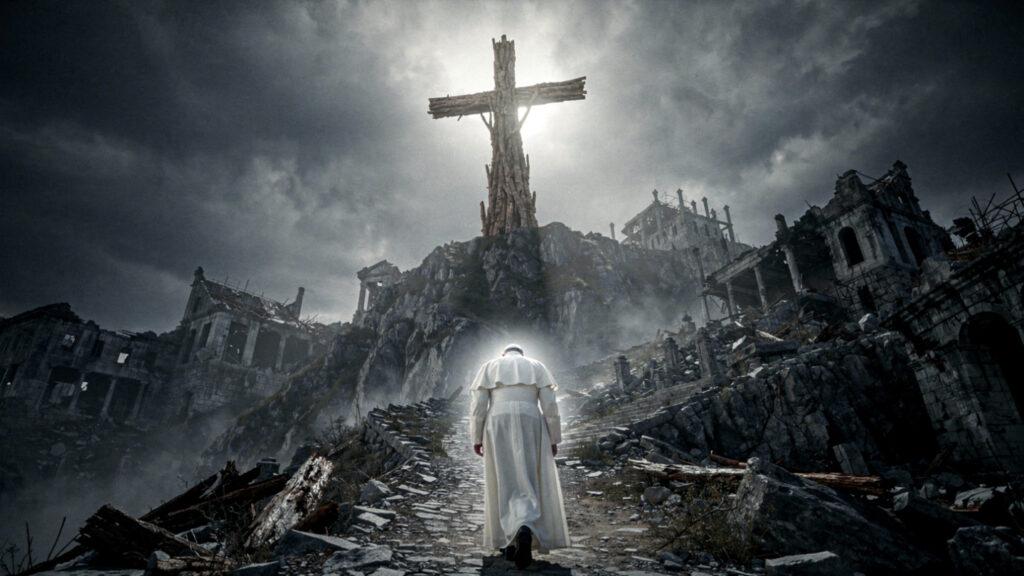
The Vatican’s official interpretation, announced by Cardinal Angelo Sodano at the beatification ceremony and developed in the theological commentary published with the text, identified the vision’s fulfillment as the May 13, 1981 assassination attempt on John Paul II. The pope in white who is shot but does not die is John Paul II, who survived the attack, and the subsequent years of the pontificate are the period of tribulation and renewal that the vision’s aftermath describes.
This interpretation has been contested by researchers and by elements within the Church since its publication.
The Contested Fulfillment
The contestation of the Vatican’s 1981 interpretation rests on several well established points.
John Paul II did not die. The vision in the Third Secret describes a pope who is killed. John Paul II survived the assassination attempt, recovered, and reigned for twenty-four more years, dying of natural causes in April 2005. Whether a failed assassination attempt constitutes the fulfillment of a vision describing a pope’s death requires either accepting that the vision shows a near-death that was prevented by divine intervention, or accepting that the vision has not yet been fulfilled.
The June 2000 publication date raised the question of completeness. Cardinal Joachim Meisner of Cologne and several other senior Catholic figures expressed concerns that the published text did not appear to constitute the entire Third Secret as described by those who had seen it. Sister Lúcia herself, who was interviewed by Cardinal Tarcisio Bertone in 2003 and 2004, confirmed that the published text was the complete Third Secret. Whether those confirmations, obtained from an elderly nun in restricted monastic conditions, adequately address the completeness question is a matter that continues to be debated in the relevant theological literature.
Sister Lúcia’s 1982 correspondence. The piece’s claim that Lúcia wrote to John Paul II in 1982 stating that the Third Secret had not been fulfilled by the 1981 assassination attempt is the most contested element. If this correspondence exists and contains this statement, it directly contradicts the Vatican’s official interpretation. Whether the correspondence exists and what it says is a question that the Vatican’s archives would resolve if the relevant documents were accessible.
Whether the Third Secret describes a future event involving a current or future pope, rather than a past event involving John Paul II, is the question that the combination of the unfulfilled death, the completeness concerns, and the Lúcia correspondence claim keeps genuinely open in the ongoing theological discussion.
Anne Catherine Emmerich and the Parallel Church Vision
Blessed Anne Catherine Emmerich, the German Augustinian mystic beatified by John Paul II in 2004, is credited with an extensive series of prophetic visions recorded by the Romantic poet Clemens Brentano between 1818 and her death in 1824. The published Brentano transcriptions, whatever their reliability as records of her actual visions, contain detailed descriptions of threats to the Church that have been discussed in Catholic prophetic tradition for two centuries.
The vision relevant to the current discussion describes two popes, one false and one true, operating simultaneously, with the false church gradually undermining the true one through internal infiltration. Whether this vision describes a schism, a period of confusion in Church governance, or something whose character the available Brentano text does not fully convey, is a question that the Church’s ongoing internal discussions about doctrinal direction have made more specifically relevant to contemporary observers than they might have been in previous pontificates.
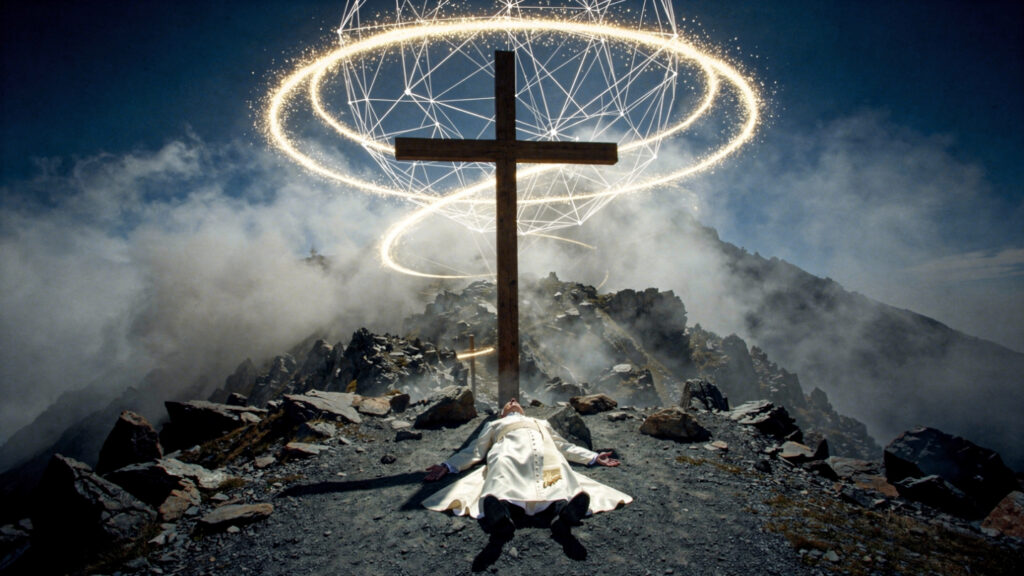
Emmerich’s recorded visions intersect with the Malachy prophecy tradition through the imagery of persecution and division: both traditions describe a final period of Church tribulation that involves external attack and internal betrayal simultaneously. Whether these parallel descriptions reflect genuine convergent prophetic insight, the common influence of apocalyptic biblical imagery on Catholic visionary tradition, or something else whose character the available texts do not clarify, is the question that their correspondence raises.
The Convergence and What It Implies
Three independent prophetic traditions converged on Pope Francis’s pontificate with a specificity that the previous one hundred and eleven Malachy popes did not produce, and what happened next deserves honest treatment, since the events described above are no longer in the future.
Pope Francis died on April 21, 2025, of a stroke followed by heart failure, at the age of 88, in his residence at the Vatican’s Casa Santa Marta. He was not shot. There was no persecution of the Church that ended in his death, no soldiers, no arrows, no climb toward a cross through a ruined city. He died of natural causes after a period of declining health that had been publicly reported for weeks beforehand, following his own established pattern of illness and hospitalization in his final years.
The College of Cardinals convened a conclave in the ordinary, established way the Church has used for centuries. On May 8, 2025, they elected Cardinal Robert Francis Prevost, an American-born Augustinian friar who had spent much of his ministry in Peru, as the new pope. He took the name Leo XIV. He is not named Peter. He is not Roman by origin, though he has strong ties to Rome through his religious order. Rome was not destroyed. The papacy did not end. As of this writing, in the summer of 2026, Pope Leo has completed his first full year in office, traveled to Turkey, Lebanon, Monaco, Algeria, Cameroon, and Spain, and continued the ordinary business of the papacy.
The most straightforward reading of the Malachy prophecy, that the list of 112 mottos ends with the final pope of the Church’s history, did not hold. The list continued. There is a 113th pope, whatever number the Malachy tradition would assign him, and by the Church’s own official count Leo XIV is the 267th successor of Peter. The Petrus Romanus identification built on Francis’s baptismal connection to the name Pietro was, at best, a loose interpretive reach even before his death. What has happened since removes even that reach as a live possibility for Francis specifically, since the sequence the prophecy claimed would terminate did not terminate.
The Third Secret of Fatima’s vision of a pope killed while climbing toward a cross remains where it was before Francis’s death: contested, unresolved, and not obviously fulfilled by any single event since 1917, including this one. Francis’s death by natural causes does not match the vision’s imagery any more than John Paul II’s survival of a shooting did. Emmerich’s two-popes vision remains a matter of interpretation rather than confirmed correspondence to any specific verified event.
What the internal caution about the tenuousness of the Petrus Romanus identification was already gesturing toward, from the start, is that the convergence of these three traditions on one specific pontificate was a pattern of interpretation applied by observers who wanted to find one, not a confirmed prophetic fulfillment in progress. That is not a dismissal of the underlying documents, the Malachy list is a genuine historical curiosity regardless of its authorship, and the Fatima secret is a genuine sealed document with a real, still-debated publication history. It is a statement about what happens when a specific, falsifiable prediction meets an actual subsequent event: the event either matches or it does not, and this one did not.
The city of seven hills is still standing. The terrible judge has not appeared. The papacy did not end with the 112th pope. It continued, in the ordinary way it always has, to a 113th.