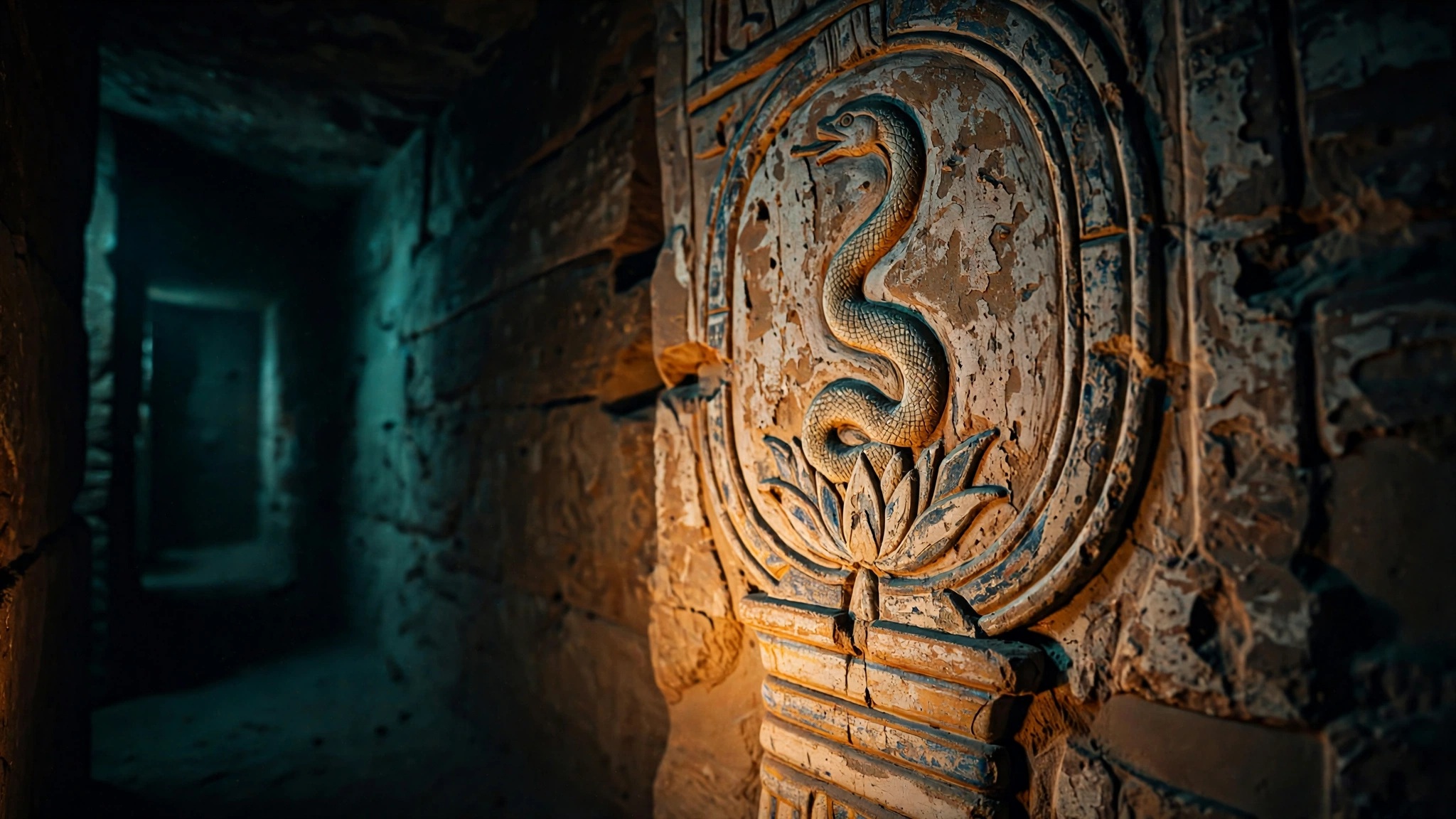
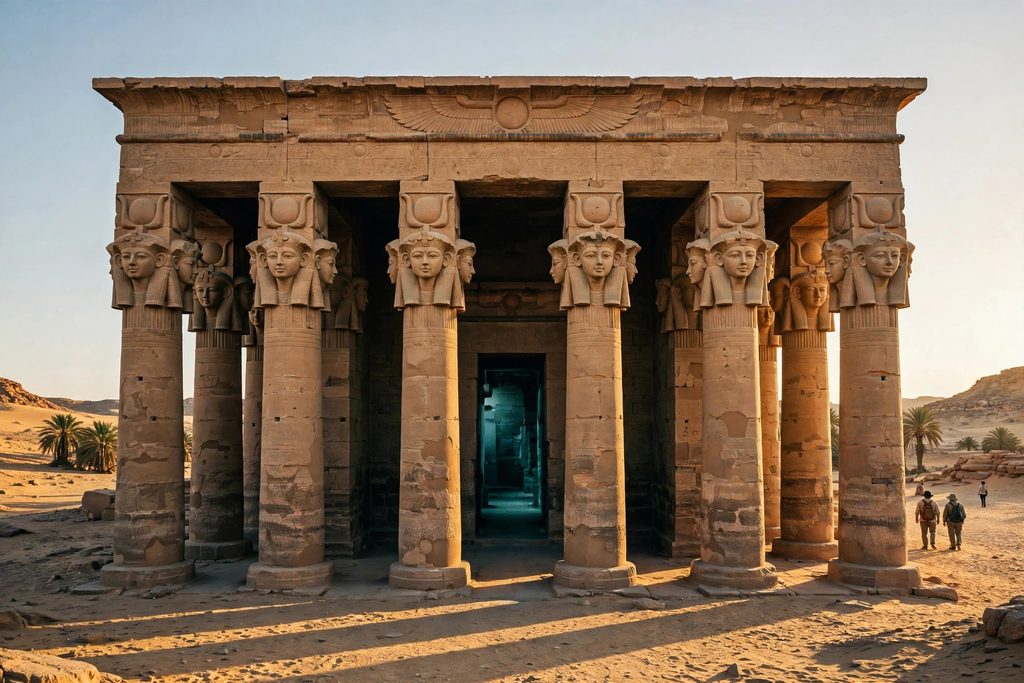
On the west bank of the Nile, some sixty kilometres north of Luxor, the Temple of Hathor at Dendera rises out of the desert edge almost whole. Its façade is a wall of columns, each topped with the face of the goddess, cow-eared and calm, staring out across the fields. Inside, the hypostyle hall is so tall that the light from the doorway fades before it reaches the back, and the ceiling, painted blue and gold with vultures, stars and the sky goddess Nut, still carries the smoke of centuries.
Below the floor, reached through narrow openings in the walls, are the crypts. They are tight stone corridors, barely wide enough to turn in, where the temple’s most precious objects were once kept. Visitors squeeze through them in single file. On the walls of one of them, carved in delicate low relief, are the images that brought Dendera a second fame. A huge elongated bulb, with a wavy line running inside it like a filament. At one end, what looks like a socket. A cable trailing from it to a box. A pillar holding it up like an insulator.
Since the 1980s these carvings have been known around the world as the Dendera light, and the claim attached to them is direct. The ancient Egyptians, it says, knew electricity, lit their temples and tombs with electric lamps, and recorded the technology in stone. The carvings exist, and so do the questions they raise. The answer is written right beside them.
The House of Hathor
The temple that stands today is young by Egyptian standards. Work on it began around 54 BCE, under Ptolemy XII, the father of Cleopatra VII, on a site that had been sacred to Hathor for thousands of years, and decoration went on into the reigns of Roman emperors. On the outer rear wall, Cleopatra herself is carved making offerings, with her son by Julius Caesar, Caesarion, beside her.
Hathor was among the oldest and most beloved of Egyptian goddesses, a deity of love, music, joy, motherhood and drunkenness, and also of the sky and the stars, a story told in our file on Hathor, the Mistress of the Stars. Each year her statue was carried in procession down the Nile to the temple of Horus at Edfu for a festival of reunion with her divine husband. The temple at Dendera was her house, and its crypts were its treasury.
The Images in the Crypt
The reliefs that became the Dendera light appear in the southern crypts, in a sequence of scenes repeated with variations. In the most famous of them, a large lotus flower opens at one end of the elongated shape, and from the heart of the lotus rises an upright snake, its body undulating along the length of the “bulb.” The shape itself is an oval envelope that surrounds the snake. In some scenes it is held up by a djed pillar, the ancient Egyptian symbol of stability, associated with the god Osiris. In others it is held up by a small kneeling figure with raised arms and a sun disc on his head, and Heh, god of infinity, appears nearby. The lotus sits on a barge, and its long stem trails back to the base of the scene.
To a modern eye the whole composition can look uncannily like a lamp. The oval resembles a glass bulb, the snake a glowing filament, the lotus a socket, the stem a cable, the djed an insulator, and the box at the end of the stem a power source. Beside the “bulb” stands a baboon-like figure holding two knives, which some readers have interpreted as a warning of danger.
What the Walls Say
The Egyptians who carved the scenes left captions, and the captions say what they show. The German Egyptologist Wolfgang Waitkus, who published a full study of the texts in Dendera’s lower crypts, showed that the scenes depict cult statues, physical objects once stored in the crypts and made of gold and precious stones, each described with its material and its height, four palms, three palms, a cubit. The snake is Harsomtus, “Horus who unites the Two Lands,” the divine son of Hathor and Horus, worshipped at Dendera and sometimes merged with the sun god Ra. The scene is a creation story. At the beginning of the world, the Egyptians believed, a lotus rose from the waters of chaos, opened, and from it the young sun god emerged into the light. Here Harsomtus rises from the lotus as a serpent within the oval envelope, which may stand for the womb of the sky goddess Nut.
The captions name the barges of the sun that he rides and the figures around him. The “baboon with knives” is a protective guardian of a kind found throughout Egyptian sacred art, armed to keep evil away from the newborn god. The “cable” is the stem of the lotus. And the details that look most electrical turn out to undercut the idea. The snake is attached to the lotus only by its tail. Its head floats free, with eyes and a mouth. A filament that is connected at only one end would not light.
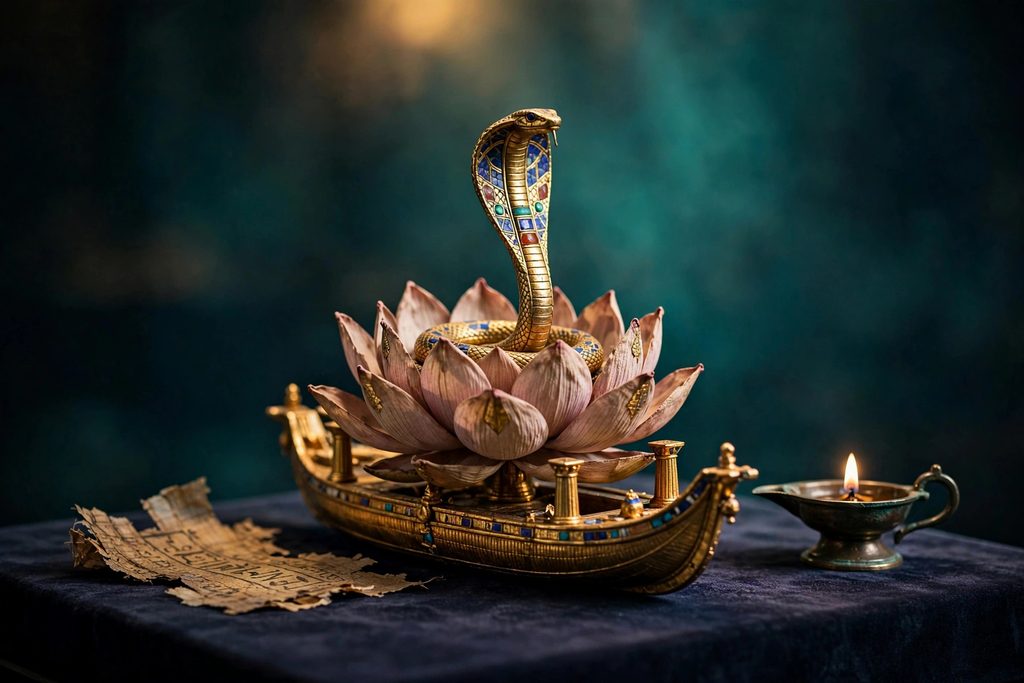
The setting matters too. Egyptian temples treated their crypts as a version of the underworld, the hidden place through which the sun passes at night before being reborn at dawn. The precious statues kept there were thought of as the bodies of the gods, revived each year when they were carried up to the temple roof to be touched by the light of the rising sun. A scene of the sun god emerging from the lotus, carved in the dark beneath the temple, is exactly what Egyptian theology would lead anyone to expect.
The Lamp That Was Built
The electrical reading has a definite history. In 1982 the Austrian writers Peter Krassa and Reinhard Habeck published Das Licht der Pharaonen, The Light of the Pharaohs, arguing that the reliefs showed working lamps. The Austrian electrical engineer Walter Garn built a model based on the carvings, a glass envelope with electrodes, and showed that when connected to a high voltage it glowed, much like the gas discharge tubes of the nineteenth century. The model was offered as proof that the design could work. It showed that a modern engineer could build a glowing tube shaped like the relief. It did not show that anyone in Ptolemaic Egypt had.
Supporters added two further arguments. The first concerns soot. If the Egyptians decorated the dark interiors of tombs and temples by lamplight, the argument goes, the ceilings should be black with lampblack, and many are not. The idea goes back to a remark by the English astronomer Norman Lockyer, who in the 1890s reported a colleague’s joke that electric light would explain the clean ceilings. The second concerns a text describing tall poles topped with copper set up before temple gateways, which some read as lightning conductors. The German scholar Bolko Stern examined those texts as early as 1896 and found that the poles were flagstaffs, lower than the gateways themselves, and that their purpose in the inscriptions was magical protection from storms rather than any electrical function.
Light Without Electricity
The Egyptians had several ways to light dark spaces, and archaeologists have found the evidence for them in quantity. Oil lamps survive by the thousand, simple bowls of pottery or stone with a floating wick. Oils such as castor oil burn relatively cleanly, and the archaeologist Kenneth Feder has pointed out that the Egyptians knew adding salt to their torches reduced the soot. Polished bronze mirrors could carry sunlight deep into corridors. And the ceilings are not always clean. The great hall at Dendera was once heavily blackened with soot, much of it left by later inhabitants, Christian hermits and villagers who sheltered in the temple and lit fires there, and by European travellers with torches. Restorers have spent years cleaning it back to its blue and gold.
What has never been found is any trace of electric lighting itself. A civilisation that lit its temples with electric lamps would have left glass envelopes, metal fittings, wire, filaments, generators and the workshops that made them, in a country where dry sand preserves papyrus, linen and wood for thousands of years. None has turned up, in any tomb, temple, town or rubbish heap. The nearest candidate, the so-called Baghdad battery, comes from Mesopotamia, not Egypt, and is itself best explained as a storage jar.
The Zodiac on the Ceiling
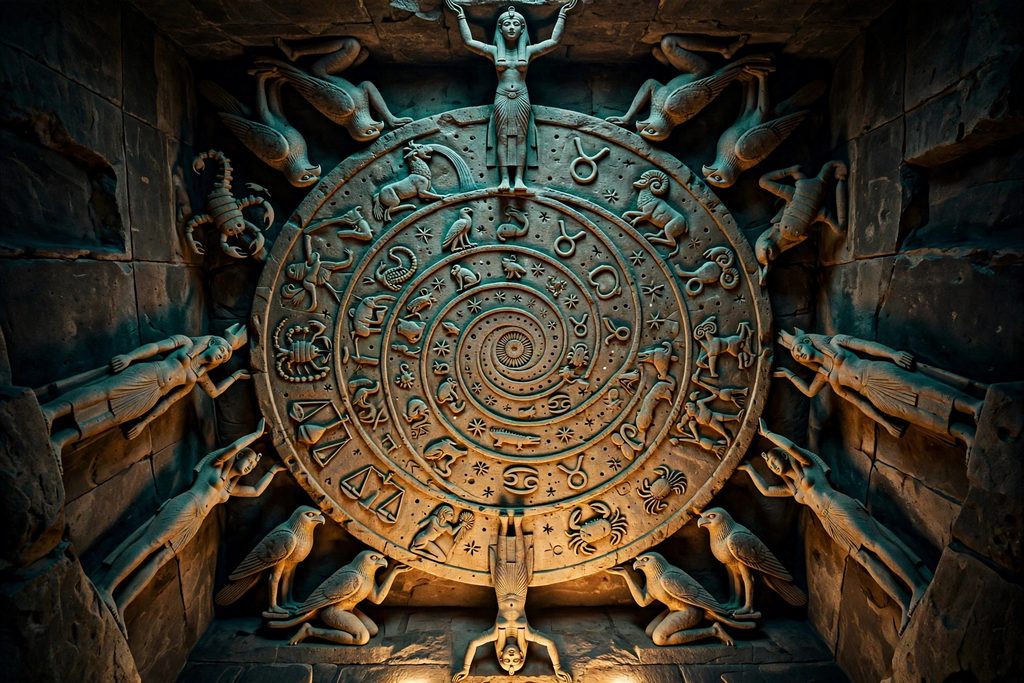
Dendera has another celebrated image overhead, and its story shows how hard ancient art can be to read. In a small chapel to Osiris on the temple roof, the ceiling once held a circular map of the sky, the Dendera zodiac. The constellations of Egyptian tradition circle it alongside the twelve signs of the zodiac borrowed from Babylon and Greece, held up by four goddesses and eight falcon-headed spirits. Napoleon’s expedition saw and drew it in 1799. In 1821 the French antiquities dealer Sébastien Saulnier had the engineer Claude Lelorrain cut it out of the ceiling with saws and gunpowder and ship it to Paris. It hangs in the Louvre today, and a cast fills its place at Dendera.
In Paris the zodiac caused a sensation. Some scholars, reading the positions of its constellations, argued that it recorded the sky of thousands of years ago, far older than the biblical chronology allowed, and it was drawn into the arguments over religion and science of the day. The debate began to turn when Jean-François Champollion, the decipherer of hieroglyphs, read a cartouche nearby containing a Greek title used by the rulers of Egypt in Roman times, showing that the carving was late, not prehistoric. Modern analysis has narrowed it further. The astrophysicist Éric Aubourg and the Egyptologist Sylvie Cauville matched its planetary positions and two eclipses it depicts, a solar eclipse of 7 March 51 BCE and a lunar eclipse of 25 September 52 BCE, and dated it to about 50 BCE. The zodiac is a true astronomical record, carved in the age of Cleopatra.
Why the Light Shines On
The Dendera light endures because it rewards a quick look. Seen in a photograph, cropped from its captions and its context, it looks like something it is not. The same habit of mind is at work across ancient astronaut writing, where a single feature that resembles modern technology is lifted out of an artwork and the meaning carved beside it is set aside, a pattern traced in our file on the god from the machine.
The true ingenuity of the ancient world is easy to underrate in comparison. The Greeks built a geared astronomical computer, the Antikythera mechanism, around the same era that Dendera’s builders were carving their crypts. The Egyptians tracked the stars well enough to place two eclipses on a temple ceiling. The light at Dendera was the light of the sun, and the Egyptians who carved it believed it was born each morning from a flower.
The Verdict | Debunked
The Dendera reliefs are beautifully made, and they show a scene the Egyptians themselves explained in the captions carved beside them, the sun god Harsomtus rising as a serpent from a lotus at the creation of the world. They depict cult statues of gold and precious stones, with their sizes recorded. The snake is attached at one end only, the “cable” is a lotus stem, and no trace of electrical equipment has ever been found in Egypt. As evidence of ancient electric lighting, the Dendera light is debunked.
For how this verdict sits beside the rest of the archive, see the Verdict Index.