


The Tuatha Dé Danann are real figures in the history of Irish literature. Their stories were preserved in medieval manuscripts, their name is genuinely ancient, their connection with the Irish Otherworld is genuine, and their afterlife helped shape the European imagination of elves and fairies. What they are not is a disguised branch of the Sumerian Anunnaki, a lost Israelite Tribe of Dan, or a linguistic bridge between Mesopotamia and Tolkien.
The temptation to connect them is understandable. The Tuatha Dé Danann arrive in Ireland from a mysterious northern world, possess extraordinary knowledge and magical abilities, fight supernatural enemies, and eventually retreat into the hills to become the hidden síde of Irish tradition. Their name contains Danann, which resembles “Dan,” while the word Dé can be translated as “god” or “divine.” Add the Mesopotamian Anunnaki, the biblical Tribe of Dan, and the Germanic word elf, and the whole thing can be made to look like fragments of one enormous prehistoric story.
But resemblance is not genealogy. Languages don’t establish relationships because words happen to sound alike, and myths don’t establish common ancestry merely because different cultures describe supernatural beings as beautiful, powerful, or mysterious. The real history is more complicated than the internet version, and once the pieces are put back where they belong, considerably more fascinating.
The People Who Arrived in Dark Clouds
The principal medieval source is the Lebor Gabála Érenn, usually translated as The Book of the Taking of Ireland or Book of Invasions. It’s not a single pagan manuscript preserved unchanged from prehistoric Ireland. It’s a medieval Christian compilation that organizes Irish origin traditions into a history of successive peoples who arrive, conquer, settle, and disappear. The Tuatha Dé Danann form the fifth major wave in that sequence, arriving after the Fir Bolg and before the Milesians, the ancestors of the Gaels.
Their entrance is one of the most memorable scenes in the entire tradition. The Lebor Gabála says the Tuatha Dé Danann came “in dark clouds,” landed on the mountains of Connacht, and brought darkness over the sun for three days and three nights. They then challenged the Fir Bolg for the kingship of Ireland, fought the First Battle of Mag Tuired, and took control of the island.
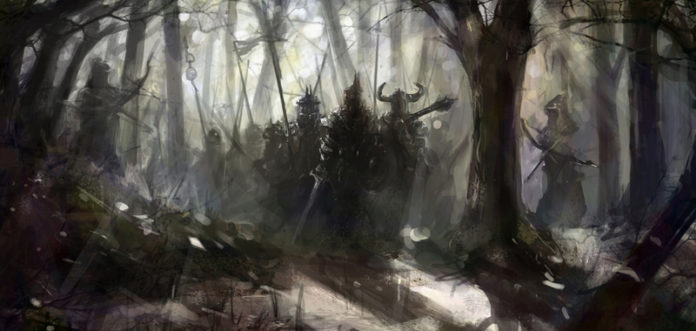
That sounds remarkably like a description of something arriving from the sky if it’s stripped from its context. But the same textual tradition provides another explanation. In one version of the arrival story, the Tuatha Dé Danann burn their ships after reaching Ireland specifically so they can’t think of retreating to them, and the smoke and mist from the burning vessels fills the surrounding land and air, which is exactly why later tradition remembered them as having “arrived in clouds of mist.” The medieval tradition therefore contains its own ambiguity: the supernatural reading survives, but so does an euhemerizing explanation that turns the “clouds” into an atmospheric consequence of ships and smoke.
That matters because it demonstrates something modern ancient-astronaut readings routinely erase. Medieval Irish writers themselves were already negotiating between myth and history. They were trying to fit supernatural traditions into a narrative that looked like the history of a real country, while simultaneously explaining how divine or magical beings could belong inside that history.
The Tuatha Dé Danann are therefore not mysterious because the text secretly describes spacecraft. They’re mysterious because Irish tradition preserved them in the unstable space between gods, legendary ancestors, supernatural rulers, and a supposedly historical population.
They Were Not Simply “Irish Elves” Either
Before getting to their name, another popular assumption needs to be dismantled. The Tuatha Dé Danann are often described today as though they were simply the ancient Irish equivalent of Tolkien’s Elves. That’s backwards. The medieval Irish tradition predates Tolkien, but the Tuatha Dé Danann were not originally a fantasy “elf race” in the modern sense. They occupy several overlapping categories: divine beings, supernatural people, legendary inhabitants of Ireland, and, in later tradition, the síde or fairy people associated with mounds and the Otherworld.
After the Milesians defeat them, the Tuatha Dé Danann don’t simply vanish. They withdraw into the síde, the supernatural dwellings associated with hills and ancient monuments. This is one of the most important transitions in the tradition, because it helps explain how an older mythology became entangled with later Irish fairy belief. The old gods do not necessarily disappear, they become the hidden people of the landscape.
What Does “Tuatha Dé Danann” Actually Mean?
The first two elements are comparatively straightforward. Old Irish tuath, plural tuatha, means a people, tribe, territory, or community. Dé is the genitive of día, “god” or “deity.” So Tuatha Dé can naturally be understood as “people of the god” or “people of the gods,” depending on grammatical and textual context. Early Irish writers also used related expressions such as fir dé, “god-men,” for these supernatural figures.
And this is where the real linguistic mystery begins, not with Sumer, but with the final word. Danann is not as simple as popular mythology websites often make it sound. The usual translation “people of the goddess Danu” assumes a reconstructed name Danu lying behind the attested form Danann. But the subject form Danu is not straightforwardly preserved in the medieval Irish texts the way the modern popular tradition implies. What the medieval sources actually give us is a collection of related forms, Danann, Danand, Anu, Ana, Anann, and Anand, whose relationships have been debated by Celtic scholars for generations. That’s a genuine scholarly problem, and it’s exactly where the internet tends to replace uncertainty with certainty.
The Goddess Danu Is Not as Simple as the Internet Says
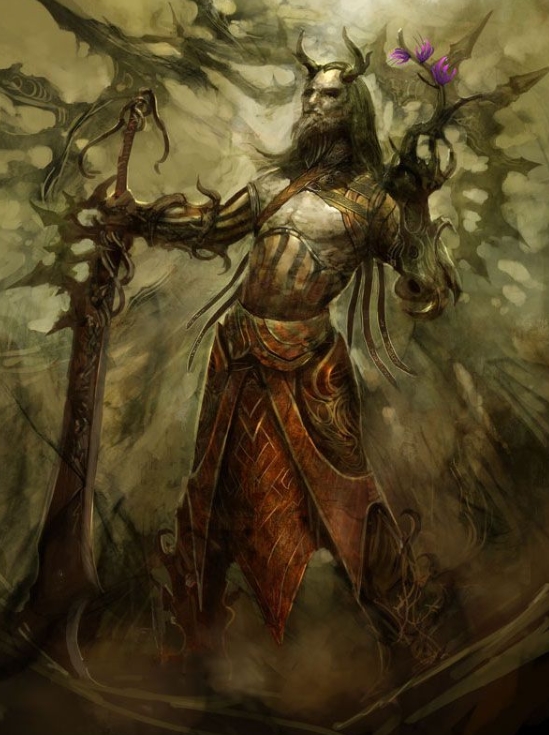
There really is an Irish goddess associated with the relevant tradition, but the surviving evidence is remarkably thin. The ninth-century Sanas Cormaic, or Cormac’s Glossary, contains an entry for Ana identifying her as the mother of the gods of Ireland and saying that she fed or nourished them well. The same tradition associates her with the famous Paps of Anu in County Kerry, two striking mountains whose names preserve an old association with the goddess.
That gives us something much firmer than the popular Danu mythology often suggests: an early medieval text attests Anu as a mother of the Irish gods, and the landscape itself preserves her name. But it doesn’t give us a long mythology about a goddess called Danu ruling a divine pantheon. There’s no surviving medieval epic in which Danu performs the elaborate role later summaries often assign to her.
Some scholars have connected Anu and Danann, and the possibility is serious. The forms are close, their functions overlap, and later Irish traditions sometimes treat related names as interchangeable. Other explanations propose that Danann developed differently, including the possibility that it relates to the language of craft and skill. John Carey, for example, examined the possibility of a connection with the trí dé dáno, the “three gods of craft,” a group associated with Brian, Iuchar, and Iucharba.
There’s even a broader textual complication: the medieval tradition doesn’t always agree with itself about these figures. Danand, Anand, Anu, and the Morrígan become entangled in different genealogical and mythological passages. That’s exactly what we should expect from a literary tradition assembled over centuries from different sources, but it makes the confident modern sentence “Danu was the mother goddess of the Tuatha Dé Danann” much less secure than it sounds.
The honest answer is therefore not “we know exactly who Danu was.” It’s that Danann has a genuinely disputed etymology, while Anu is an independently attested Irish divine figure with a real textual and geographical footprint.
And No, This Does Not Lead to the Tribe of Dan
The next leap is the biblical Tribe of Dan. It sounds tempting because Danann contains Dan, and medieval Irish writers really did love constructing elaborate genealogical connections between Ireland and biblical history. But that’s precisely why the theory needs evidence rather than phonetic resemblance.
The problem is that “Dan” is not a universal linguistic building block. A word containing dan does not automatically descend from Hebrew Dan. To establish a historical relationship, comparative linguists need evidence of chronology, geographical transmission, intermediate forms, and regular sound correspondences. None of that exists for a supposed connection between the Irish Danann and the biblical tribe.
John MacKillop, in the Oxford Dictionary of Celtic Mythology, has specifically noted that the Tribe of Dan explanation is a theory propagated mainly on the internet rather than one established in scholarly Celtic mythology. That doesn’t mean no one has ever proposed it. It means the proposal doesn’t have the evidentiary status its online presentation often implies.
And there’s a wonderfully ironic problem with the theory. Medieval Irish Christian writers were perfectly capable of making biblical connections when they wanted to. The Lebor Gabála itself repeatedly places Irish history inside a biblical chronology and connects Irish peoples with figures and events from Scripture. If the Tuatha Dé Danann were literally the lost Tribe of Dan, the medieval authors who constructed elaborate biblical genealogies would have had every reason to say so.
They didn’t.
The Anunnaki Connection Is Even More Remote
The proposed connection with the Sumerian Anunnaki is weaker still. The Anunnaki are a genuine group of deities in ancient Mesopotamian texts. The Tuatha Dé Danann are a genuine group of supernatural beings in medieval Irish literature. But establishing that both are groups of supernatural beings is not evidence that one tradition descended from the other.
There’s no established linguistic chain from Anunnaki to Danann. There’s no documented migration carrying the name from Mesopotamia into Ireland. There’s no intermediate form showing how a Mesopotamian divine name could have undergone the necessary changes to become an Old Irish ethnonym. And there’s no ancient Irish text saying that the Tuatha Dé Danann came from Mesopotamia.
What we have instead is a phonetic resemblance assembled after the fact: two unfamiliar ancient words, both associated with divine beings, made to look connected because they sound sufficiently exotic to modern ears.
That’s not comparative linguistics. It’s word association.
And “El” Does Not Become “Elf”
The final link in the popular chain is usually the easiest to dismantle. El is a genuine Northwest Semitic divine term, attested across the ancient Near East and famously preserved in Hebrew biblical names and expressions. Elf, by contrast, belongs to the Germanic linguistic world, with Old English ælf and related forms in other Germanic languages tracing back to a Proto-Germanic word conventionally reconstructed as albiz or a closely related form.
These words don’t become related merely because both can be associated with supernatural beings. They belong to different language families and different historical trajectories. The fact that El can mean “god” in Semitic and elf can mean a supernatural being in Germanic tells us something about the vocabulary of religion and folklore in two different linguistic traditions. It doesn’t demonstrate a lost word shared by Mesopotamian gods, Israelites, Irish gods, and Germanic elves.
The mistake is especially revealing because it reverses the direction of actual historical evidence. Instead of starting with documented contact and tracing words across languages, the theory starts with words that sound vaguely similar and then invents the contact that would be necessary to connect them.
The Strange Thing Is That the Elves Really Are Connected
And here the story takes a remarkable turn.
There really is a historical line connecting the Tuatha Dé Danann to the modern idea of elves. It simply runs through literature rather than genetics, Mesopotamia, or prehistoric migration.
As the medieval Irish tradition developed, the Tuatha Dé Danann became associated with the síde, the supernatural inhabitants of ancient mounds and the Otherworld. They were beautiful, powerful, magical, and difficult to distinguish from the older divine beings from whom their mythology descended. Over time, the distinction between gods, spirits, fairy folk, and supernatural inhabitants of the landscape became increasingly fluid.
That tradition belongs to the same broad European cultural environment in which stories of elves and fairies developed, but the word elf itself has a separate Germanic history. The resemblance is therefore not evidence of a common ancient word. It’s a case of different traditions eventually being grouped together by later European culture under overlapping ideas of supernatural or otherworldly beings.
Then Tolkien Actually Did Connect the Worlds
This is where the story becomes much stronger than the conspiracy theory.
J.R.R. Tolkien didn’t need an ancient alien connection to produce his Elves. He was a philologist who knew the old languages and mythologies of northern Europe intimately. His Elvish languages drew heavily on historical linguistic structures, while his mythology absorbed and transformed material from numerous older traditions.
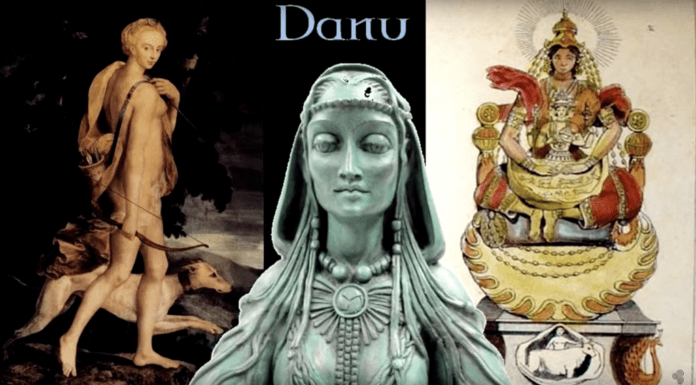
Scholars have identified substantial parallels between Tolkien’s Noldor and the Tuatha Dé Danann. The similarities aren’t merely that both are beautiful supernatural peoples. Both have an exalted origin, both are associated with knowledge and craftsmanship, both enter a new land after leaving an earlier home, both experience internal conflict and exile, and both eventually become diminished or displaced versions of what they once were. There are even more specific parallels: the Tuatha Dé Danann’s Nuada loses a hand and receives a silver replacement, while Tolkien’s own mythology repeatedly uses comparable motifs of mutilation, loss, and restoration among its Elven figures.
Dimitra Fimi and other Tolkien scholars have therefore treated Celtic material as one of the strands worth examining in Tolkien’s mythology, even while acknowledging Tolkien’s own complicated and sometimes dismissive public comments about Celtic literature. The scholarly question isn’t whether Tolkien secretly copied the Tuatha Dé Danann word for word. It’s how older Celtic and Germanic materials were transformed through Tolkien’s own philological imagination.
That’s an actual historical influence. We can trace it through texts, themes, motifs, and Tolkien’s intellectual environment.
Why Do the Tuatha Dé Danann Look Like “Advanced Beings”?
Another recurring argument points to their beauty, stature, intelligence, magical knowledge, and extraordinary craftsmanship. Modern readers sometimes interpret those qualities as descriptions of a technologically or biologically superior race. But this is one of the oldest habits in mythology: gods and supernatural beings are routinely made larger, more beautiful, more powerful, more knowledgeable, and more skilled than ordinary humans.
The Tuatha Dé Danann know magic. They possess extraordinary weapons. They have supernatural craftsmen. They include healers, poets, warriors, and rulers of exceptional ability. None of that requires technology in the modern sense. It’s precisely how a mythological culture signals that its protagonists are more than ordinary people.
The same literary mechanism appears everywhere. Gods are stronger than humans. Heroes are more beautiful. Kings have extraordinary ancestry. Supernatural people possess knowledge unavailable to mortals. If every such description were evidence of a genetically superior population, human mythology would contain thousands of competing species of superhuman beings.
The Four Northern Cities Are Not a Hidden Technology Manual
One of the most alluring details is the claim that the Tuatha Dé Danann came from four northern cities, Falias, Gorias, Murias, and Finias, where they learned knowledge and magic from four sages. They supposedly brought four treasures from those cities: the Stone of Fál, the Spear of Lugh, the Sword of Nuada, and the Dagda’s Cauldron.
Those details are genuinely in the tradition. But again, their mythological structure matters. Four cities, four sages, and four magical treasures form a carefully balanced literary pattern. The objects are not described as pieces of advanced machinery. They’re legendary regalia expressing kingship, warfare, knowledge, and abundance. The tradition is doing mythology, not leaving instructions for reconstructing an extinct technological civilization.
What the Tuatha Dé Danann Actually Tell Us
The most interesting conclusion is therefore almost the opposite of the one the Anunnaki theory proposes.
The Tuatha Dé Danann do preserve something ancient, but what survives isn’t a biological bloodline or a coded memory of extraterrestrial visitors. What survives is a literary transformation of older Irish religious traditions. Divine figures became legendary ancestors. Gods became inhabitants of the síde. Pagan supernatural beings were absorbed into a Christian manuscript tradition that tried to turn mythology into history. Later folklore transformed them again into fairy people. Centuries afterward, Tolkien and other writers drew from that European reservoir to construct entirely new supernatural races.
That’s a genuine chain of cultural transmission. And unlike the Anunnaki theory, it leaves fingerprints everywhere.
We can see the Tuatha Dé Danann in medieval manuscripts. We can trace the síde in Irish folklore. We can identify Germanic elf vocabulary independently. We can compare Tolkien’s mythology with the older traditions he encountered as a philologist. We can watch the meaning of supernatural beings change as pagan traditions were rewritten inside Christian histories.
None of that requires a lost Mesopotamian civilization to explain it.
The Tuatha Dé Danann’s Real Afterlife Runs Through Tolkien, Not Sumer
The Tuatha Dé Danann are not a problem waiting for ancient astronauts to solve. They’re a window into how mythology survives.
A pre-Christian divine tradition became medieval pseudo-history. That pseudo-history became folklore. The supernatural inhabitants of ancient Irish mounds became the síde. European fairy traditions fed later literature. Tolkien transformed those traditions into the Elves of Middle-earth. Modern conspiracy culture then reversed the entire process and proposed that the similarities were not literary inheritance at all, but evidence of a prehistoric civilization whose descendants somehow carried the same story from Mesopotamia to Ireland.
But the direction of the evidence points the other way.
The Anunnaki do not need to become the Tuatha Dé Danann. The Tribe of Dan does not need to become Danann. El does not need to become elf. And Danu does not need to be transformed into a certainty the medieval manuscripts never actually provide.
The Tuatha Dé Danann are stranger than the conspiracy theory because they really existed, as gods in a vanished religious imagination, as legendary people in medieval Irish literature, and eventually as the hidden inhabitants of the Irish Otherworld. Their trail leads not from Sumer to Ireland, but from myth to manuscript, from manuscript to folklore, and from folklore into the modern imagination.
The changeling myth belongs to the same category of genuine folk tradition doing real explanatory work, using supernatural language to describe conditions medicine had no other vocabulary for yet.