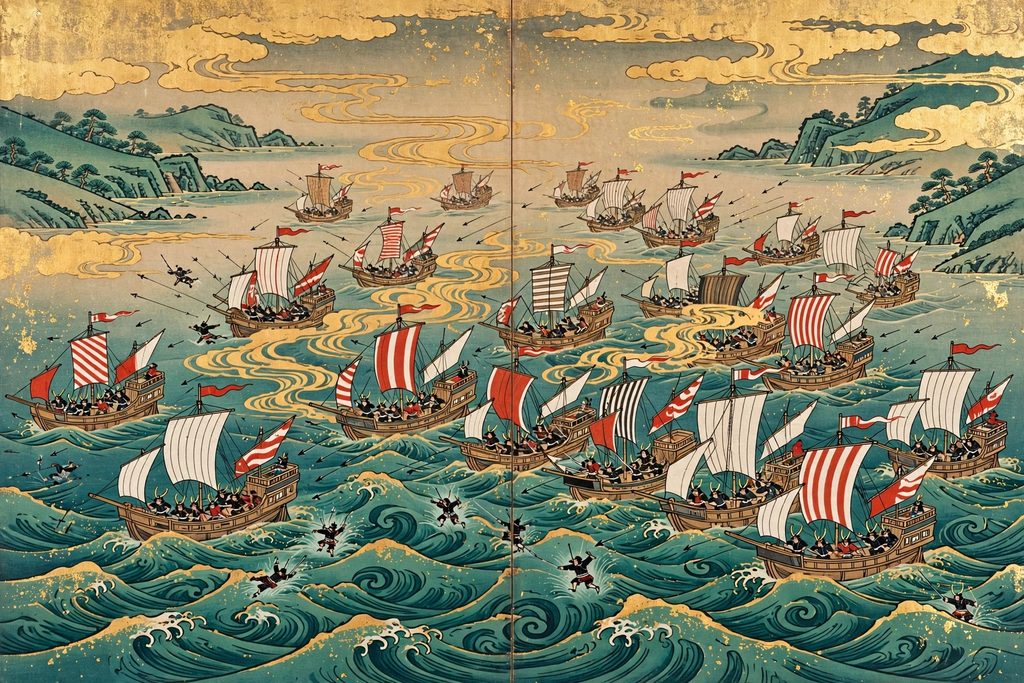
On a spring morning in April 1185, in the narrow strait of Shimonoseki between the Japanese islands of Honshu and Kyushu, two fleets met for the last time. On one side were the Taira, the warrior clan also called the Heike, who had ruled the imperial court for a generation. On the other were their rivals, the Minamoto, or Genji. The Genpei War had raged for five years. At Dan-no-ura it ended.
The tide decided the battle. In the morning it ran with the Heike, and their ships pressed the Minamoto hard. By afternoon it had turned. A Taira commander defected and pointed out the ship that carried the child emperor. The Minamoto archers, the chronicle says, aimed at the Heike oarsmen and helmsmen, and the Heike ships drifted helpless. As defeat came, the women of the court and the warriors began to throw themselves into the sea, weighted with armour and anchors.
On the imperial ship stood Taira no Tokiko, the widow of the great clan leader Taira no Kiyomori, holding her grandson, the Emperor Antoku. He was six years old. In The Tale of the Heike, the great war epic composed from these events, the boy asks where she is taking him. She tells him to bow to the east to take leave of the gods, and to the west to call on the Buddha. Then she says, “There is a capital beneath the waves,” and leaps with him into the sea, carrying the sacred sword of the imperial regalia. Neither the emperor nor the sword was ever recovered.
In the waters of that strait there lives a small crab with a face on its back.
The Crab With a Warrior’s Face
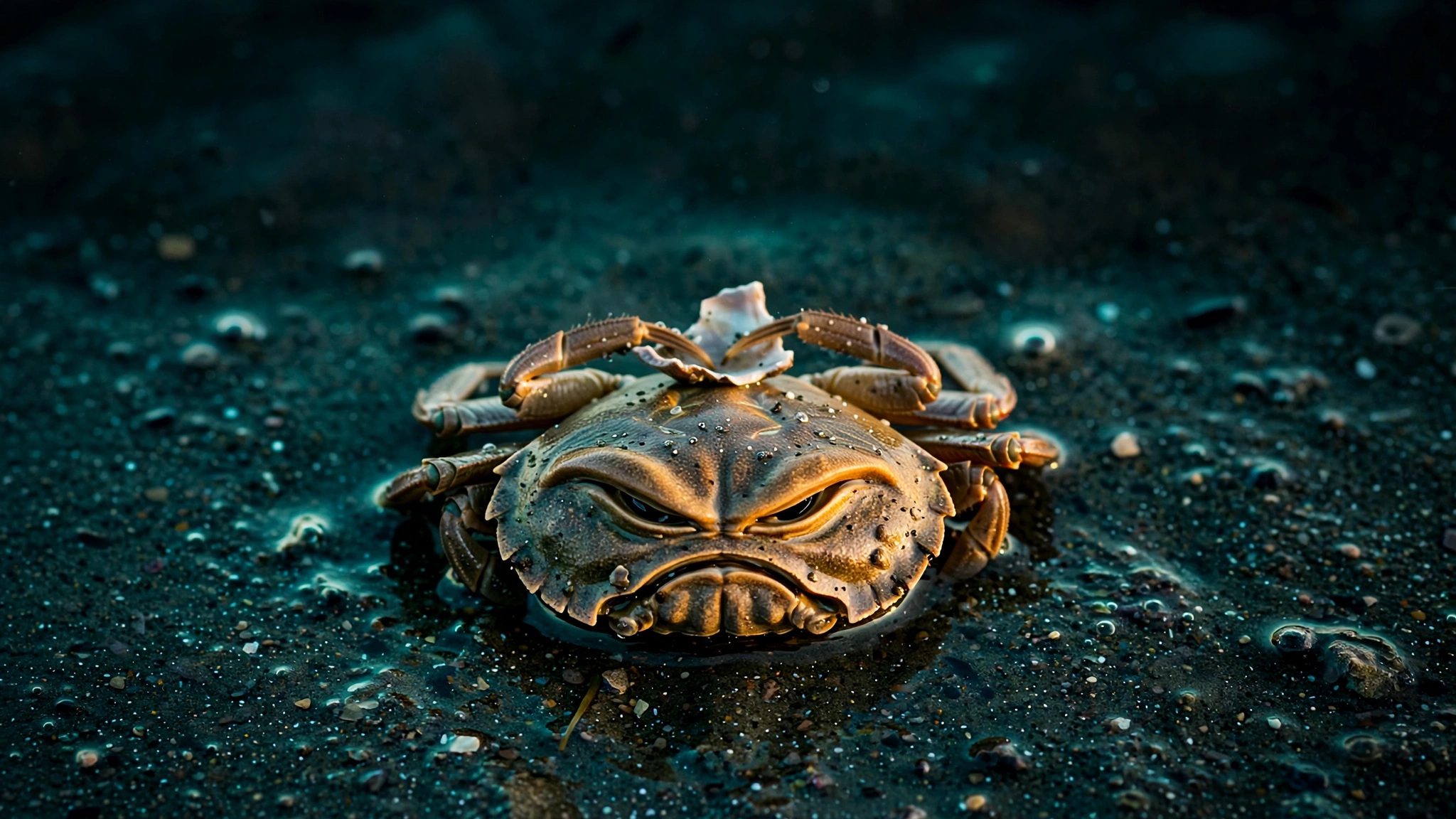
Its Japanese name is heikegani, the Heike crab, and its scientific name is Heikeopsis japonica. It is small, its shell only a couple of centimetres across, and it lives on muddy sea floors around Japan. Turn one over in the hand and the shell is what stops people. Its ridges and grooves form a scowling face, with heavy brows, narrowed eyes, a broad nose and a downturned mouth, the face of a furious warrior in a kabuki mask. Fishermen along the Inland Sea have long called it the samurai crab.
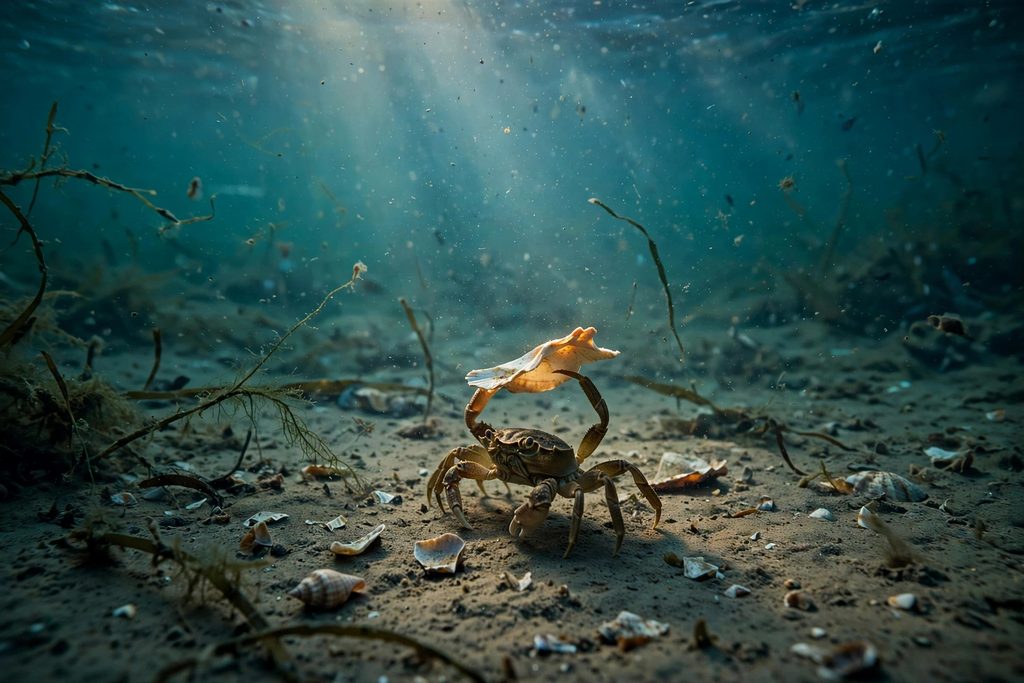
The crab has another habit that only adds to its strangeness. Like its relatives in the family Dorippidae, it uses its last two pairs of legs, which are short and bent upward over its back, to hold objects above its shell, a scrap of shell, a leaf, sometimes a living sea anemone or a jellyfish, carrying them like a shield as it crawls along the bottom. To a fisherman hauling up his net, it is a face that carries a mask.
The legend that attached itself to the crab is simple and enduring. The Heike warriors who drowned at Dan-no-ura did not vanish. Their spirits sank to the bottom of the strait and took the form of crabs, which still wander the sea floor bearing the angry faces of the defeated, searching for their lost emperor. Fishermen who caught one, the story goes, threw it back out of respect.
The Ghosts of Akamagaseki
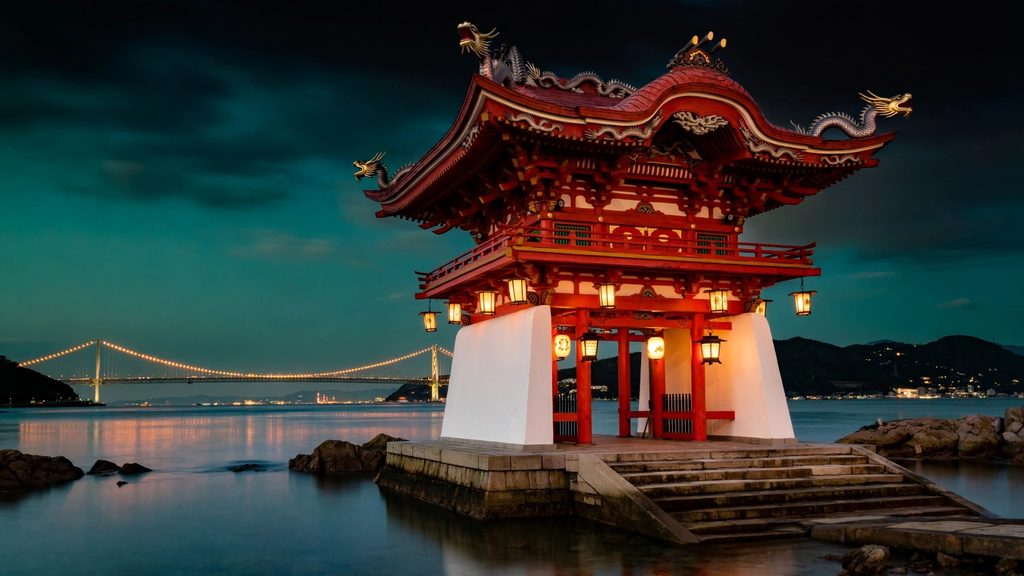
The memory of Dan-no-ura never left the strait. In 1191, just six years after the battle, a Buddhist temple, the Amida-ji, was established on the shore at Shimonoseki to pray for the boy emperor’s soul, and a cemetery for the Heike dead grew beside it. In the Meiji era the temple became a Shinto shrine, the Akama Shrine, dedicated to Antoku. Its gate is painted brilliant red and white and built in the style of Ryugu-jo, the palace of the Dragon King beneath the sea, the capital under the waves that his grandmother promised him. Seven stone mounds in the grounds honour the Heike warriors. Each spring the shrine holds a festival in which women dressed as court ladies of the twelfth century process across a bridge to mourn the emperor.
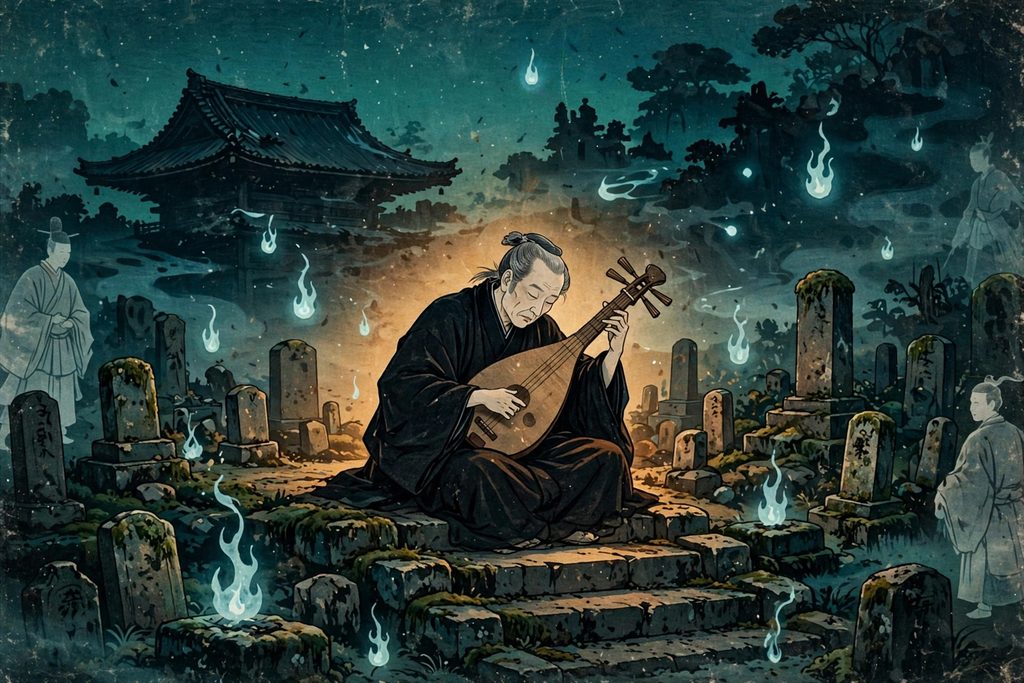
The shrine is also home to a ghost story. In 1904 the writer Lafcadio Hearn, who had settled in Japan and taken a Japanese name, published Kwaidan, a collection of old tales of the supernatural. It opens with “The Story of Mimi-nashi-Hoichi,” Hoichi the Earless, and the story begins at Dan-no-ura. Hearn describes the strait as haunted, with ghost fires flickering over the water on dark nights, and mentions the Heike crabs, whose backs bear human faces, said to be the spirits of the drowned warriors.
Hoichi was a blind musician at the Amida-ji, famous for chanting The Tale of the Heike to the lute called the biwa. One night a samurai summoned him to perform for a noble household. Night after night Hoichi was led to a great hall and played the story of Dan-no-ura to an audience whose weeping filled the room. The priest of the temple discovered that he had been singing among the tombs of the Heike, to the dead themselves. To protect him, the priests painted sacred text over every part of his body, so that he would be invisible to the ghosts. They forgot his ears. When the warrior came for him that night, he found only two ears floating in the dark, and tore them off to bring back to his master. A statue of Hoichi with his biwa sits today in its own small hall at the Akama Shrine.
Huxley’s Idea
In 1952 the British biologist Julian Huxley, grandson of Darwin’s great defender Thomas Henry Huxley and the first director-general of UNESCO, wrote an article for Life magazine called “Evolution’s Copycats.” Among his examples of animals that resemble other things, he offered the Heike crab, and he proposed an explanation that has made the crab famous ever since.
Suppose, Huxley reasoned, that fishermen around Dan-no-ura did throw back crabs whose shells looked like a samurai’s face, out of reverence for the Heike, and ate or discarded the rest. Over many generations, crabs with more face-like shells would survive and breed more often than others. The fishermen would have been breeding the faces without meaning to, just as farmers breed crops and cattle. The crab’s face would be a product of human choices, a legend that had written itself into a living animal.
In 1980 the astronomer Carl Sagan made the idea world famous. In the second episode of his television series Cosmos, he told the story of Dan-no-ura and the samurai crab, describing it as an example of artificial selection, before moving on to the far greater power of natural selection over the history of life. Tens of millions of viewers heard it. Richard Dawkins took up the crab again in 2009, in The Greatest Show on Earth. For a generation, the Heike crab was one of the most beautiful stories in popular science.
The Problem With the Story
In 1993 the American carcinologist Joel W. Martin, a specialist in crabs at the Natural History Museum of Los Angeles County, published a short article called “The Samurai Crab,” and it complicated the picture considerably.
His first point was practical. The Heike crab is tiny and has little meat. People in Japan do not usually eat it. If fishermen were throwing back face-like crabs, they would have had little reason to keep the others either, which leaves no difference in survival for selection to act on.
His second point was anatomical. The ridges and grooves on the crab’s shell are not decoration. They mark the places inside the shell where the crab’s muscles attach, and they follow the layout of its internal organs. Any crab built on this plan will carry a similar pattern of raised areas and furrows. That is why the “face” is so symmetrical and so regular. It is a map of the crab’s own body.
His third point was the decisive one. Similar face-like patterns appear on other crabs in the same family, in other species and genera around the world, including many that live in places with no samurai and no legends, and they appear in fossil crabs as well, some of them far older than any human fishing. The pattern existed long before anyone could have selected it.
What remains is the human part of the story. The face exists in the sense that people see it, immediately and vividly. Our brains are built to find faces everywhere, in clouds, in electrical sockets, in the front of cars, a tendency called pareidolia, examined in our file on how the brain turns random dots into patterns. A small crab whose muscle scars happen to fall into two brows, two eyes and a mouth will look like a face to anyone, anywhere. In a strait haunted by the memory of drowned warriors, it was always going to look like theirs.
Selection Without Fishermen
None of that diminishes what Huxley and Sagan were reaching for. Artificial selection is a powerful force. Every breed of dog, every ear of modern corn and every domestic pigeon is its product, and Darwin built the argument of On the Origin of Species on it. Humans also shape wild species without meaning to, through hunting, fishing and pollution, a process that has made some fish mature smaller and some wild animals change faster than anyone expected, a pattern seen in the wolves of the Chernobyl exclusion zone.
Some biologists have pointed out that the Huxley story is not impossible in principle. Even a small bias, repeated over centuries, could nudge a population. But the evidence that it happened is missing, and the simpler explanation covers everything. The face came first, written into the crab’s body plan long before 1185. The legend came afterwards, finding the face that was already there.
The Legend Lives On
The Heike did not vanish with their emperor. Across Japan, remote mountain villages claim descent from Heike survivors who fled after Dan-no-ura and hid in the valleys, and tell stories of their lost nobility. Even an insect carries their name. Japan’s smaller firefly is called the Heike firefly, the larger the Genji firefly, as if the two clans were still fighting over summer rivers. Antoku’s official tomb, cared for by the Imperial Household Agency like the vast keyhole tombs of Japan’s early emperors, lies beside the shrine at Shimonoseki, though several other places in Japan claim that the boy survived and was hidden away.
And the crab still crawls across the floor of the strait, carrying its scrap of shell above its back, wearing the face of a warrior. It does not need the legend to be remarkable, a creature that walks the sea floor holding a shield, built by its own anatomy into a mask. But the legend does not need the biology either. The people of Dan-no-ura looked at the crab and saw the drowned, and in the story they told, the capital beneath the waves was not empty.
The Verdict | Disputed
The Heike crab is a living species whose shell ridges, formed by its muscle attachments, look strikingly like an angry face. The legend that it carries the spirits of the warriors drowned at Dan-no-ura in 1185 belongs to folklore. The famous scientific explanation, that fishermen bred the face by throwing back the most samurai-like crabs, was proposed by Julian Huxley in 1952 and spread by Carl Sagan, but it is contested by crab specialists, because the crabs are not eaten and the same pattern appears in other species and in fossils far older than human fishing. The verdict is Disputed.
For how this verdict sits beside the rest of the archive, see the Verdict Index.