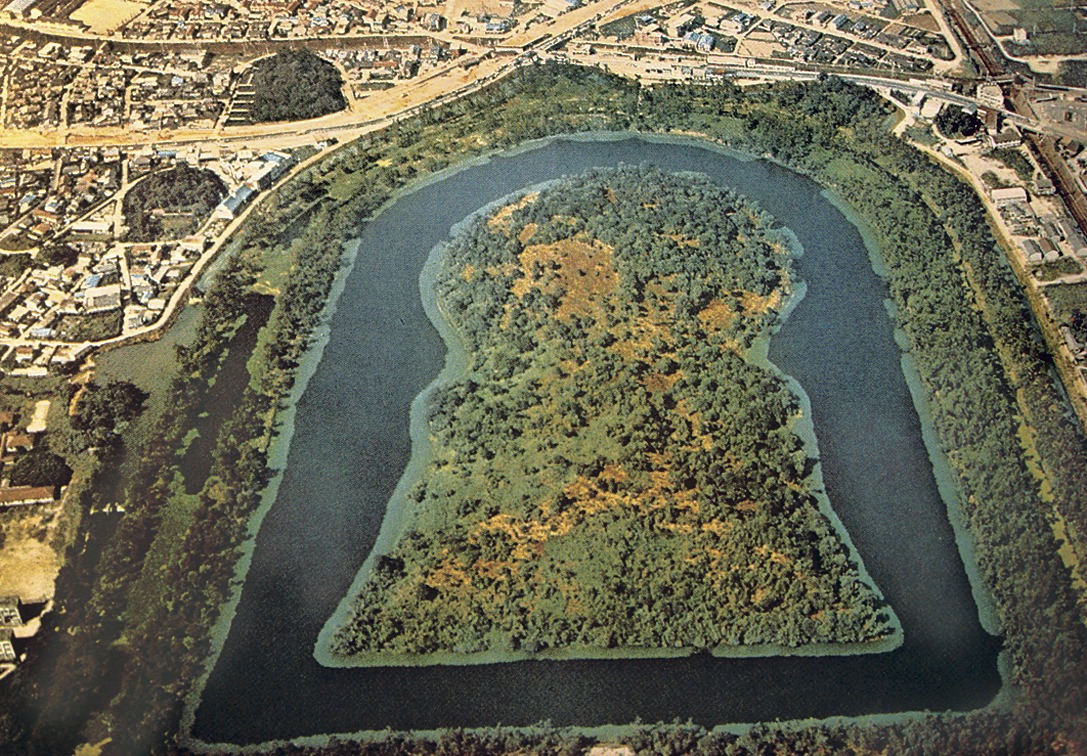
The shape has no precedent anywhere in the world.
More than 160,000 burial mounds dot the Japanese landscape between Osaka and Nara, ranging from modest earthworks a few meters across to monuments whose scale exceeds any other burial structure built by any civilization in human history. Their defining characteristic, the keyhole form that combines a circular rear section with a trapezoidal forward section when viewed from above, appears in the Japanese archaeological record in the third century CE without any known predecessor, spreads rapidly across the Japanese archipelago over the following three centuries, and disappears entirely when the Kofun period ends in the late sixth century.
No other ancient culture built burial mounds in this shape. No transitional forms have been identified that would allow the keyhole design to be traced to an earlier Japanese or continental tradition. The shape arrived, dominated Japanese mortuary architecture for three centuries, and stopped being used. Its symbolic meaning, and the reason it was chosen for the most important burials in Japanese history, is not recorded in the available textual or archaeological record.
The largest of them exceeds the Great Pyramid of Giza in footprint by a factor of more than forty.
The Daisen Kofun in Sakai City, Osaka, attributed by tradition to the Emperor Nintoku, measures approximately 486 meters in length, 305 meters wide at its circular rear section, and 35 meters in height. Surrounded by three concentric moats whose outermost perimeter spans approximately 840 meters, the monument occupies a total area of approximately 2.35 square kilometers. It is one of the three largest burial monuments ever constructed, alongside the Great Pyramid of Giza and the Mausoleum at Qin Shi Huang in China.
Unlike those two monuments, it has never been properly excavated.
The Japanese Imperial Household Agency, which administers properties of the imperial family including the imperial kofun, maintains restrictions on archaeological excavation of the designated imperial tombs. The institutional justification centers on respect for the imperial ancestors’ resting places. The practical effect is that the largest burial monument in Japan, one of the largest in the world, has not been subjected to the systematic archaeological investigation that would determine who is actually buried there and what the burial contains.
Whether the Daisen Kofun contains the remains of Emperor Nintoku, a historical figure whose reign the eighth-century chronicles date to approximately 313-399 CE, or whether the attribution reflects a later imperial household’s decision to associate the monument with a prestigious predecessor whose actual burial location was unknown, is the question that the access restriction prevents addressing.
The Scale Problem
The scale of the largest kofun is the element that the conventional Japanese archaeology framework handles least satisfactorily.
The Daisen Kofun required an estimated 5.9 million man-days of labor to construct. Assuming a workforce of 1,000 people working daily, the construction would have required approximately sixteen years. Assuming 10,000 workers, it would have required approximately eighteen months. The logistics of feeding, housing, and directing a workforce of this size in fourth-century Japan implies a level of centralized administrative organization whose institutional structure the Kofun period’s historical record does not fully document.
The second and third largest kofun in Japan, the Hashihaka Kofun attributed to the shaman-queen Himiko or her successor, and the Misanzai Kofun attributed to Emperor Richū, are comparably scaled. The concentration of three monuments of this size in the Osaka-Nara corridor within approximately two centuries implies a sustained civilizational commitment to mortuary construction whose motivating framework the available textual sources do not fully explain.

The Nihon Shoki and Kojiki, compiled in 712 and 720 CE respectively, are the primary Japanese historical chronicles whose accounts of the Kofun period are the textual foundation for the conventional imperial lineage narrative. Both were compiled more than two centuries after the Kofun period’s end, during the Nara period, for well established political purposes: the Nara court was establishing the legitimacy of the imperial family’s divine descent from the sun goddess Amaterasu. Whether the chronicles’ accounts of the emperors buried in the largest kofun reflect historical record or retrospective construction is the question that the access restrictions prevent archaeology from answering.
Himiko and the Yamataicountry Question
The Hashihaka Kofun, attributed in the Japanese tradition to Yamato Totohimomoso-hime but increasingly proposed by researchers as the burial site of Himiko, the shaman-queen of Yamatai recorded in the Chinese chronicle Sanguo Zhi composed in 297 CE, is the kofun whose identification connects the Japanese monuments to the recorded Chinese historical account.
Himiko is the earliest named Japanese ruler recorded in a foreign primary source. The Sanguo Zhi‘s account describes her as a powerful female ruler who maintained her authority through shamanistic practice, rarely appeared in public, and was buried under a large mound surrounded by grave goods and the bodies of servants. The Chinese chronicle notes that after her death a great mound was raised over her.
Whether the Hashihaka Kofun is Himiko’s burial is the archaeological question whose answer the Imperial Household Agency’s access restrictions prevent definitively addressing. The Hashihaka Kofun’s dimensions, approximately 280 meters in length and 30 meters in height, and its dating to approximately 240-260 CE, which corresponds to the period of Himiko’s recorded death, make it the strongest candidate for her burial in the current archaeological record.
The location of Yamatai, Himiko’s capital, is the most extensively debated question in Japanese historical geography, with the Kinai region near Osaka and the Kyushu region both having sustained scholarly advocates. Whether resolving this question through systematic investigation of the Hashihaka Kofun and its burial goods would settle the Yamatai location debate and consequently alter the conventional narrative of Japanese state formation is the academic stakes that make the access restriction most consequential.
The Haniwa and the Burial Goods
The limited archaeological investigation permitted on smaller, non-imperial kofun has produced recorded findings whose content informs the larger picture without resolving the questions the imperial kofun raise.
Haniwa, hollow clay cylinders and figurines placed in rows on the kofun’s surface, are the most extensively recorded kofun artifacts. The figurines represent humans in social roles, warriors, female attendants, shamanesses, and musicians, and animals including horses whose presence in Japan is recorded only from the Kofun period, suggesting that horses were introduced to Japan during the period when kofun construction was at its peak.
The significance of haniwa for the library’s framework is the category of female shamanic figurines recorded in multiple kofun excavations. The female shamanesses depicted in haniwa, with their distinctive ritual dress and implements, correspond to the role described for Himiko in the Sanguo Zhi and suggest that female religious authority was a significant feature of Kofun-period Japanese society rather than an anomaly associated with a single ruler.

The bronze mirrors recovered from accessible kofun are the artifact category with the most direct continental connections: types of bronze mirrors found in Japanese kofun are identical in design and manufacture to mirrors produced in China during the Three Kingdoms period, approximately 220-280 CE, confirming the direct cultural exchange between Japan and the Chinese states during Himiko’s recorded interactions with the Wei court.
Whether the Daisen Kofun’s burial goods include objects whose character would reveal interactions with continental Asia at a scale and nature that the conventional narrative does not accommodate is the question that no currently permitted investigation can address.
The Institutional Restriction and Its Pattern
The Imperial Household Agency’s restriction on kofun investigation is the institutional element that connects the Japanese monuments to the broader pattern of institutional management of archaeological evidence covered across this library.
The Egyptian government’s well established 1993 ban on geological research around the Sphinx appears in the library’s dedicated piece. The Vatican’s restricted access to archival holdings appears in multiple library pieces. The Smithsonian’s recorded historical management of anomalous skeletal remains appears in the anomalous remains piece. The Japanese Imperial Household Agency’s kofun access restriction is the same class of institutional behavior in a different national context: a government body with authority over archaeological resources limiting the investigation that could produce evidence either supporting or challenging the official historical narrative associated with those resources.
Whether the restriction is motivated by genuine reverence for the imperial ancestors, by institutional concern that excavation would reveal contents inconsistent with the imperial family’s established traditional claims, or by the bureaucratic inertia of an agency whose mandate includes protecting imperial property without reference to archaeological value, is a question that the agency’s recorded institutional history and its responses to research access requests partially address.
Japanese archaeologists have recorded their positions on the access question in academic publications and in public statements. The Japanese Archaeological Association has formally requested access to the imperial kofun for systematic investigation. The agency has consistently declined while permitting limited, heavily supervised site visits that allow surface observation but not subsurface investigation.
The political dimension of the access question appears in Japanese academic and journalistic literature: the imperial family’s constitutionally defined symbolic role in the Japanese state, without governmental authority but with significant cultural prestige, creates a political dynamic in which any investigation that might produce results embarrassing to the imperial narrative would face institutional resistance regardless of its archaeological value.
Whether the Daisen Kofun contains Nintoku or someone else, whether the Hashihaka Kofun contains Himiko or a later attribution, and whether the burial goods in the largest monuments would reveal the Kofun period’s actual political and cultural connections in ways that differ from the Nihon Shoki’s retrospective narrative, are questions that the access restriction keeps permanently open for as long as the restriction is maintained.
The Keyhole Shape and Its Undocumented Origin
The zenpōkōenfun shape’s unexplained origin is the element whose significance for the library’s ancient technology and lost civilizations framework is most direct.
The shape is visible only from the air or from significant elevation. From ground level, a kofun presents as a natural-appearing hill whose geometry is not apparent without perspective that Kofun-period Japanese society did not conventionally have access to. Whether the shape was intended to be seen from the air, implying either elevated observation posts or something whose character the conventional Kofun-period technology inventory does not accommodate, or whether the shape encoded symbolic content that did not require aerial observation for its significance, is the question that the form’s aerial character raises.
The parallel with other ancient earthwork traditions whose geometric precision is apparent only from the air, including the Nazca lines of Peru recorded in the library’s context and the geometric earthworks of the Ohio Hopewell culture, is the element that alternative researchers have found most significant. Whether these traditions share a common ancient origin or reflect independent development of aerial-perspective design in multiple ancient cultures is the question that the geographic separation makes impossible to address through diffusion alone.
Whatever the keyhole shape means, it was considered important enough that the most powerful rulers of Japan built the largest monuments of their civilization in that form for three centuries, and then stopped entirely.
The shape is there. The largest one exceeds the Great Pyramid. Nobody has been inside to find out why.
Japan’s keyhole tombs get their name from that exact shape, a circle fused to a triangle, visible only from above.
A Migration Period Germanic leader’s tomb, found with six women buried radially around him, shows the same instinct to make a burial impossible to misread, even on a far smaller scale.”