




On February 22 and October 22, the sun rises at an angle over the Nile valley. On those two mornings, the light enters the entrance of the temple of Abu Simbel, travels sixty-five meters through solid rock, and falls on three of the four seated statues in the innermost sanctuary. The fourth statue, Ptah, god of the dead and of the underworld, remains in darkness. The two dates are the birthday and the coronation anniversary of Ramesses II, who ordered the temple carved during his reign approximately 1264 BCE.
The precision of this alignment requires knowledge. The architects who designed Abu Simbel needed to know the exact geographic orientation of the site, the exact declination of the sun at those two dates, and the exact angle at which to carve a sixty-five-meter corridor through solid rock such that the light would enter the entrance and reach the statues at the required distance. They needed to know all of this before the first stroke of the chisel, because once the rock is cut, the corridor’s angle cannot be adjusted. The calculation had to be correct from the beginning.
The construction of Abu Simbel required applied astronomy precise enough to produce a solar alignment to within fractions of a degree, applied mathematics capable of calculating the geometry of a sixty-five-meter interior space in solid rock, and the organizational capacity to execute the construction to those specifications. The temple was built in an era that, by the conventional archaeological account, did not have trigonometry, did not have the mathematical tools for precision solar angle calculation, and was working primarily with copper tools and manual labor.
The alignment works. It has worked for three thousand two hundred years. It worked again on February 22 of this year.
The conventional timeline does not fully account for how.
The Pharmacological Record
The Ebers Papyrus is one of the oldest surviving medical texts in the world, dated to approximately 1550 BCE but understood by Egyptologists to copy from source materials significantly older. Its 877 prescriptions cover treatments for conditions ranging from eye disease to intestinal parasites to skin infections, and they use a pharmacological vocabulary that includes compounds, preparation methods, and delivery mechanisms.
Among the treatments for infected wounds: the application of moldy bread.
Alexander Fleming identified penicillin in 1928 after noticing that a Penicillium mold contaminating a petri dish was killing the bacterial colonies around it. He published his findings, they were initially ignored, and the systematic development of penicillin as a clinical antibiotic did not occur until the 1940s. The discovery of antibiotics is dated to the twentieth century and described as one of the most significant medical advances in human history.
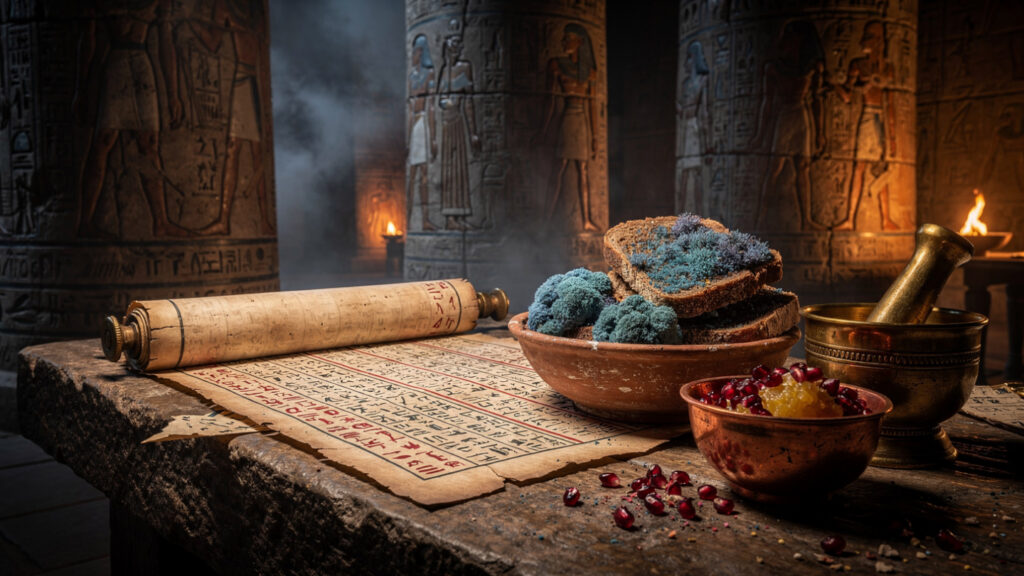
The Egyptian medical tradition recorded the application of a substance that produces penicillin to treat infected wounds approximately 3,500 years before Fleming identified the mechanism by which it works. The Egyptians had no germ theory. They had no concept of bacteria. They had no theoretical framework within which the mechanism of moldy bread treating infection could be explained. What they had was the empirical observation, systematized and transmitted across generations, that moldy bread applied to an infected wound produced better outcomes than no treatment or alternative treatments.
The systematic empirical discovery of an antibiotic effect requires observation, comparison, record-keeping, and transmission across a significant number of cases and a significant period of time. It requires a medical culture sophisticated enough to notice the effect, record it accurately, and teach it to subsequent generations in a form precise enough to be useful. The Egyptian medical tradition produced this level of systematic empiricism at a period when the conventional account of human civilizational development does not fully account for it.
The pomegranate contraception provides a second pharmacological data point of similar significance. Ground pomegranate seeds combined with wax, used as a contraceptive pessary, appears in Egyptian medical texts. Modern pharmacological research has confirmed that pomegranate seeds contain phytoestrogens that reduce progesterone levels and inhibit fertilization. The combination of pomegranate seeds with wax in the Egyptian formulation suggests understanding of the delivery mechanism: the wax serves as a carrier that maintains the active compound in contact with the cervical mucus for an extended period.
The Egyptians did not know about progesterone or phytoestrogens. They knew that the formulation worked. The systematic empirical discovery that a plant seed compound reduces the likelihood of conception, combined with the engineering of a delivery mechanism that optimizes its effectiveness, requires the same quality of systematic empiricism that the antibiotic knowledge demonstrates.
Two pharmacological discoveries that took Western medicine until the twentieth century to formally understand were in systematic clinical use in Egypt three thousand years earlier. The conventional account of how that knowledge was developed, through long empirical tradition extending back to a period before the written medical record, is plausible. It requires a medical culture of extraordinary sophistication operating for an extraordinarily long period before the conventional dynastic timeline begins.
What Kohl Was Doing
The Egyptian use of kohl as an eye cosmetic is one of the most well recorded practices of ancient Egypt. Both men and women applied it daily. The conventional understanding is that it served aesthetic and symbolic purposes and provided protection against the sun’s glare.
Modern chemical analysis of ancient Egyptian cosmetic samples has revealed a more picture. The lead compounds present in kohl, specifically lead chloride and lead carbonate, are not inert pigments. They are antibacterial agents. At the concentrations applied around the eyes, they inhibit the bacterial infections that were endemic in the Nile valley’s environment, particularly the bacterial eye infections that caused chronic ophthalmological disease and blindness in ancient populations.
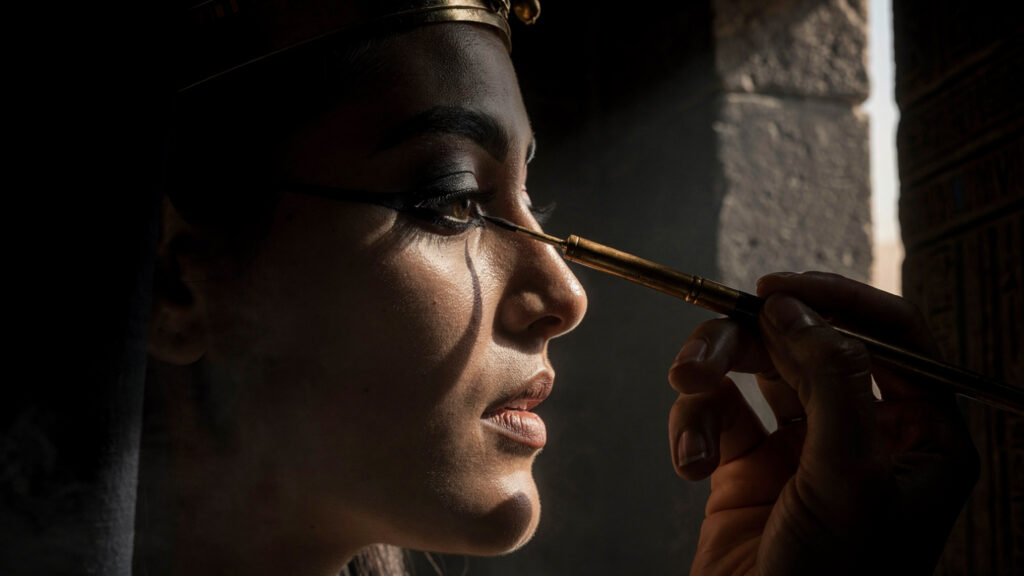
The Egyptians applied an antibacterial compound to their eyes every day in a climate where bacterial eye infections were a leading cause of vision loss. They described the cosmetic as having healing powers and applied it as a medical as well as aesthetic product.
Whether the antibacterial effect was discovered empirically, in the same way the antibiotic and contraceptive effects were discovered, or whether it represents transmission of technical chemical knowledge from an earlier source, the outcome is the same: a population applying a pharmacologically effective treatment to a medical problem three thousand years before the mechanism was formally characterized.
The Geography of the Monument
The piece already in the Egypt cluster on this site covers the Pyramid’s geographic centrality in the context of the speed of light coordinate and the solar eclipse mathematical correspondence. The detail that belongs in this piece is the connection between Abu Simbel’s solar alignment and the pyramid’s cardinal orientation as evidence of a sustained program of precision astronomy and geodesy across the entire recorded span of Egyptian civilization.
The pyramid’s four faces align to the cardinal directions with a precision of approximately three arc minutes of error, about one twentieth of a degree. This precision was not achievable by naked-eye observation of the sun or stars using the construction technology the conventional Egyptian timeline provides. The methods proposed by archaeologists for how the Egyptians achieved the cardinal alignment are disputed among themselves, and no proposed method has achieved consensus.

Abu Simbel’s solar alignment requires similar precision at a different scale: not cardinal orientation but solar declination calculation for two dates, applied to a sixty-five-meter interior space in rock. Both monuments demonstrate precision astronomy applied to architectural problems at a level that implies a mathematical tradition of sophisticated capability.
The monuments are separated by approximately twelve centuries of the conventional timeline. The precision of both implies a continuous transmission of the technical knowledge required to achieve them across that entire period. The earliest surviving text of what that mathematical tradition looked like, the Rhind Mathematical Papyrus dated to approximately 1550 BCE, shows mathematical capability consistent with the pyramid’s construction requirements. The papyrus is explicitly described as a copy of an older text. That older text has not been found.
The Moral Architecture
The Egyptian concept of Maat, goddess of truth, cosmic order, and justice, is the theological framework that organized Egyptian civilizational life for three thousand years with a consistency unparalleled in any other ancient culture.
What Maat represents, beyond its theological content, is an understanding of the relationship between individual moral action and cosmic order: the universe has an inherent structure, that structure is accessible to human cognition, and human moral action either aligns with or violates that structure. Violation has consequences not only social but physical and cosmic.
The Amat, the soul-devouring monster who consumed the hearts of the dead whose weight exceeded that of Maat’s feather in the judgment of the dead, is the practical implementation of this framework in Egyptian theology. The soul’s moral record was weighed literally, and the measure was a feather. The precision of the metaphor implies a civilization that had thought carefully about what morality means and concluded that the truly moral life produces a lightness that is not metaphorical but structural.
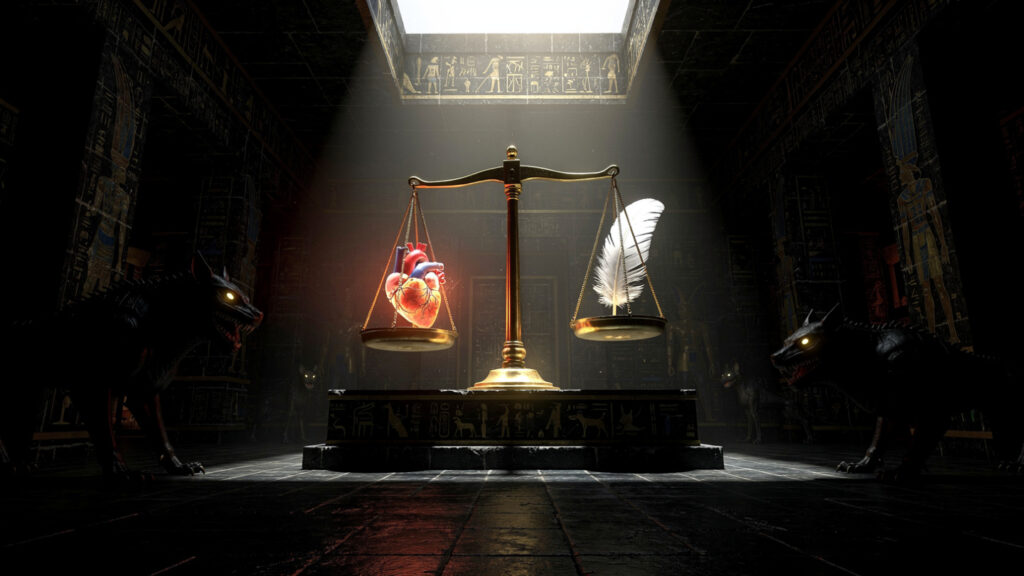
The Egyptian construction of a moral universe governed by measurable cosmic principles rather than arbitrary divine will predates Greek philosophical ethics by more than two thousand years and produces a framework that Greek philosophy would essentially reconstruct from different starting materials. Where the Greeks learned it, through the Pythagorean tradition’s recorded connection to Egyptian priestly education, is a recorded thread whose full extent is not established.
The Long Reign and What It Implies
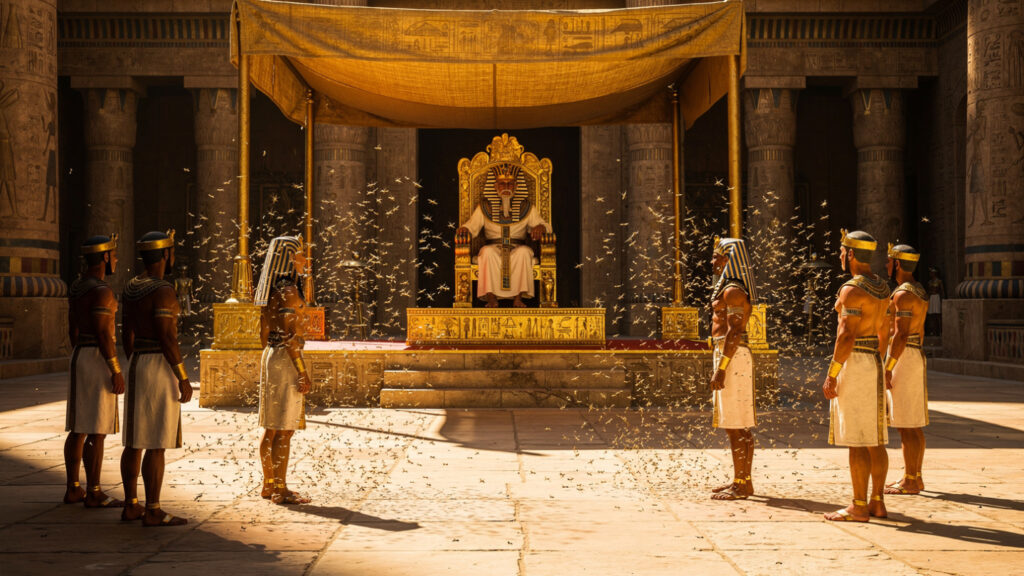
Piopi II’s ninety-four-year reign is the longest recorded in world history. The conventional explanation for his longevity involves careful insulation from disease vectors, specifically the recorded practice of keeping honey-smeared slaves nearby to attract insects away from his person. The explanation is plausible and specific. It is also the kind of targeted public health intervention that implies sophisticated understanding of disease transmission at a period when the germ theory of disease did not exist in any recorded form.
The understanding that insects carry disease, applied to the practical problem of protecting a person from insect-borne illness, requires the empirical observation that insect contact correlates with illness and the systematic implementation of a method for reducing that contact. The Egyptian evidence for systematic insect-borne disease awareness predates the formal discovery of the insect-disease transmission mechanism by three millennia.
The pattern is consistent. The Egyptians knew things that the theoretical framework for understanding those things would not produce until the modern period. They knew them empirically, systematically, and in sufficient detail to apply them effectively.
Where the Knowledge Came From
The conventional account attributes Egyptian technical and medical knowledge to long empirical tradition: generations of observation and systematic recording, producing a body of practical knowledge that exceeded theoretical understanding in domains. This account is more complete than the framing above suggests, and it deserves fuller treatment before turning to the Turin King List.
The Turin King List, the papyrus held in the Egyptian Museum in Turin that records the rulers of Egypt from the pre-dynastic period forward, includes a section listing rulers whose reign lengths are measured in thousands of years before the conventional dynastic period begins. Egyptology treats this section as legendary rather than a literal historical record, and this deserves to be reported as the well-founded conclusion it is rather than as a dismissive convention. The same pattern, king lists that transition from historically verifiable rulers into vastly extended reign lengths for a legendary founding period, appears across the ancient Near East, most famously in the Sumerian King List, whose antediluvian kings are given reigns in the tens of thousands of years. This is a recognized literary and religious convention for establishing a dynasty’s claim to deep antiquity and divine sanction, not a unique Egyptian anomaly requiring a special explanation.
More importantly, the empirical medical and astronomical knowledge this piece has described does not actually require an unrecorded extra civilization to explain it. Egypt’s own conventional, well-attested timeline is already very long: Predynastic Naqada culture in the Nile Valley extends back further than 4000 BCE, meaning well over a thousand years of settled agricultural society existed before the First Dynasty, and the dynastic period itself, from roughly 3100 BCE to the Ebers Papyrus’s composition around 1550 BCE, spans another millennium and a half. That is close to three thousand years of continuous, and in the conventional record entirely real, cultural transmission before the antibiotic and contraceptive knowledge in the Ebers Papyrus was written down. Three thousand years of trial, error, and teaching is a substantial span for empirical medical knowledge to accumulate, and it does not require appealing to the Turin list’s legendary chapter to do the explanatory work.
The knowledge exists and is genuinely impressive. The conventional, well established span of Egyptian civilization is long enough to account for how it developed without needing the Turin King List’s pre-dynastic section to be read literally.
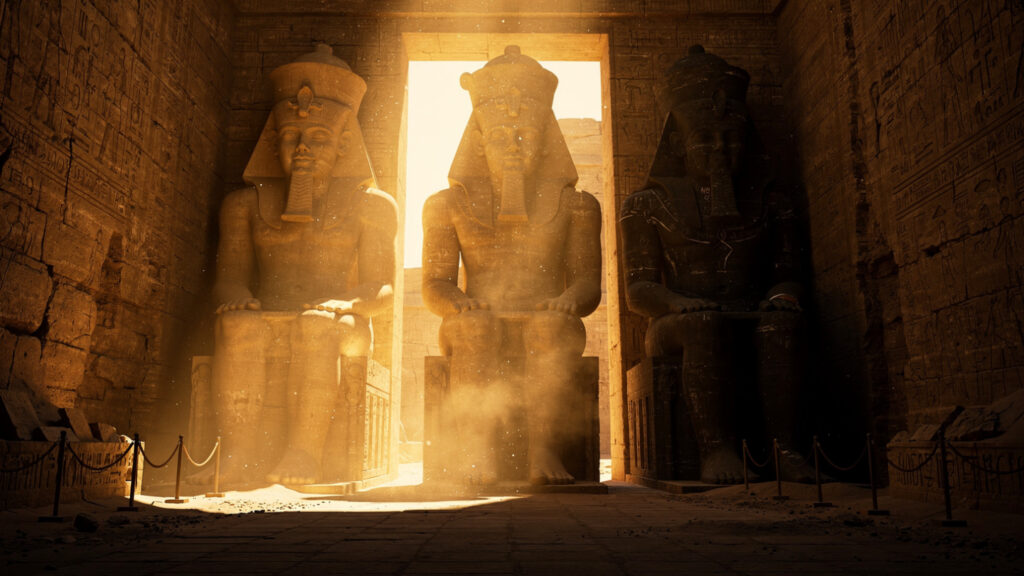
The sun illuminates three statues and leaves one in darkness on the birthdate of a man who has been dead for three thousand years. It will do so again next February 22. The corridor that makes this possible was cut into solid rock before the mathematics required to design it was formally recorded in any surviving Egyptian text.
The mathematics existed before the surviving written record of it. The practical knowledge predates the earliest text that explains the theory behind it, which is a genuinely interesting fact about how craft knowledge and formal theory relate, and not by itself evidence of a hidden earlier civilization.
Egypt’s own long, real, well established history is the more straightforward answer to where that knowledge came from.