


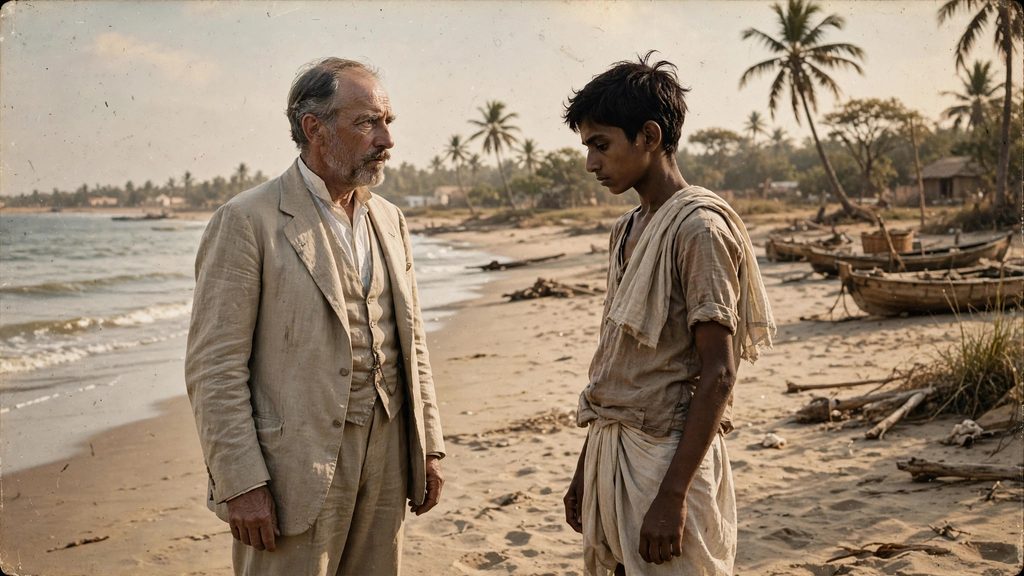
In April 1909, a Theosophical Society clerk named Jiddu Narayaniah brought his sons to live near the organization’s headquarters at Adyar, on the coast outside Madras. One of the boys, fourteen years old, was sickly and slow. He had suffered repeated bouts of malaria as a child, struggled in school, and was beaten regularly by teachers who found him distractible and dull. Ernest Wood, an English Theosophist who tutored him directly, later described him as “particularly dim-witted.” Nobody who met him expected much.
Charles Webster Leadbeater looked at him differently. Leadbeater, one of the Society’s most prominent clairvoyants, claimed the ability to read a person’s aura, and on the beach at Adyar that April he told colleagues he had seen something extraordinary radiating from the boy. Not talent. Not intelligence. A destiny. Within months, Leadbeater and the Society’s president, Annie Besant, had convinced themselves and much of the international Theosophical movement that this particular child, Jiddu Krishnamurti, was the coming vessel for Maitreya, the World Teacher whose arrival Theosophists believed would guide humanity’s next spiritual stage.
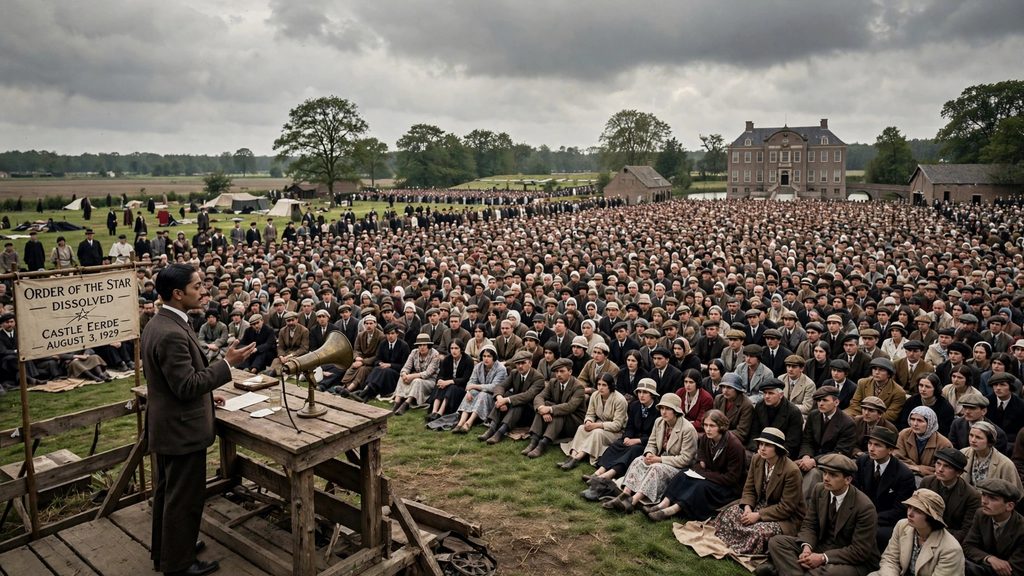
What followed was a twenty-year experiment in building a messiah from scratch, conducted in full public view, funded by an international religious movement, and fought over in the actual courts of British India. It ended in 1929 with the supposed messiah standing in front of three thousand of his own followers in the Netherlands and telling them, in effect, that the entire project had been a mistake. Understanding how that happened, and why it took two decades to get there, means starting with who was doing the building.
The Woman Before Theosophy
Annie Besant was not a credulous eccentric who stumbled into mysticism. Before Theosophy ever entered her life, she had already spent fifteen years as one of the most notorious radicals in England.
Born Annie Wood in London in 1847, she married an Anglican clergyman named Frank Besant in 1867 and left him within six years, unable to reconcile her growing doubts about Christianity with the demands of an evangelical household. The separation cost her custody of her children for a time. It also freed her into a career as a public agitator. She joined Charles Bradlaugh and the National Secular Society, and in 1877 the two of them republished a birth control pamphlet, Charles Knowlton’s Fruits of Philosophy, deliberately courting prosecution to test obscenity law in open court. They were convicted, then cleared on a technicality, and Besant emerged as one of the most recognizable voices in Britain for working class contraception access, a position that scandalized polite society far more than anything she would later be accused of as a Theosophist.
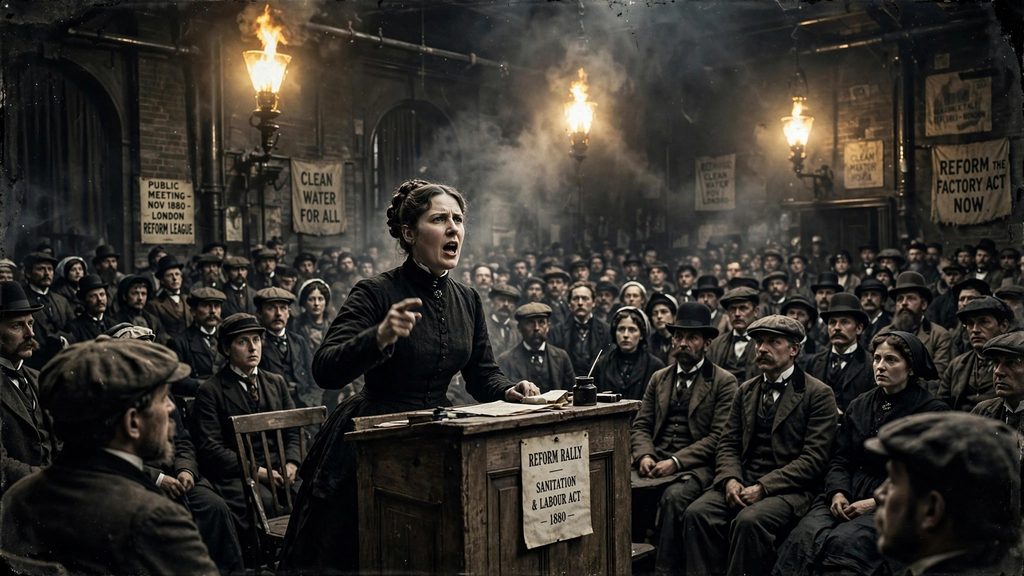
She organized relief for those beaten on Bloody Sunday in 1887. She helped run the London matchgirls’ strike of 1888, investigating the phosphorus poisoning that was disfiguring young factory workers. She sat on the London School Board, topping the poll in an election where almost none of her supporters could vote for her, since most women in her own district still lacked the franchise. She moved through the Fabian Society and the Marxist Social Democratic Federation, one of the sharpest public speakers of her generation.
Then in 1889, asked to review Helena Blavatsky’s The Secret Doctrine for a magazine, she met Blavatsky in person and abandoned secular politics almost overnight. She let her Fabian membership lapse, broke with Bradlaugh, and by 1893 had relocated to India to work at the Theosophical Society’s headquarters. She became the Society’s president in 1907, two years before Leadbeater found the boy on the beach.
This matters for what comes next, because Besant was not a woman easily fooled by other people. She had spent a career testing establishment claims in court and in print. Whatever happened with Krishnamurti, it did not happen to someone naturally credulous. It happened to someone who had already reorganized her entire worldview once, dramatically, and who had built the second half of her life on the conviction that she had found something true the first time she failed to.
A Machine Built Around a Child
The Theosophical Society moved fast. In January 1911, a Theosophist named George Arundale founded a small group called the Order of the Rising Sun. Within months Besant and Leadbeater had absorbed it, renamed it the Order of the Star in the East, and installed Krishnamurti, now fifteen, as its head. Its stated purpose was to prepare the world for the World Teacher’s arrival, and its growth was immediate. By 1924 the Order’s annual gathering at Ommen in the Netherlands, known as the Star Camp, drew somewhere between five hundred and six hundred people. Within a few years attendance reached roughly two thousand. In 1926 the camp held at Besant’s own property in Ojai, California, drew over a thousand more.
Money and land followed the crowds. In 1924 a Dutch nobleman, Philip Baron van Pallandt, deeded his family’s Castle Eerde at Ommen to the movement outright, along with roughly five thousand surrounding acres. Besant purchased additional land at Ojai in 1926 and 1927. An organization that had existed for barely a decade now controlled a European castle and hundreds of acres of California ranchland, all of it held in trust for a teenager most of its own donors had never met.
Krishnamurti, meanwhile, was being shaped for the part. He and his younger brother Nityananda, known as Nitya, were brought to England, tutored privately, dressed and coached for European society, and presented at Order gatherings as evidence that the Teacher was already forming. He picked up English quickly, developed a genuine talent for languages and sport, and by all accounts bore the entire arrangement with more patience than most fifteen year olds would have managed. But the machine built to display him left almost no room for him to be anything other than what it needed him to be.
The Father’s Lawsuit
Not everyone accepted the arrangement, starting with the boy’s own father. Narayaniah had initially consented to Besant’s guardianship, but by 1912 he had turned against it and sued to annul the agreement entirely, seeking custody of both sons back. His grievance was not abstract. He believed his family had effectively been used, that he had been compensated only nominally for what the Theosophists had actually taken, which was his children’s futures and, by extension, a share of the movement’s spiritual authority.
The case went first to the Chingleput District Court, then to the Madras High Court, where Narayaniah’s lawyer, C. P. Ramaswami Iyer, won a ruling on April 15, 1913. Judge Bakewell ordered Besant to hand both boys back to their father. Besant appealed to the Privy Council in London, and in a hearing that October the Council reversed course, directing that the boys remain with her, over Narayaniah’s objection and despite affirming, as a matter of law, that a father’s rights over his children could not simply be signed away by agreement. Krishnamurti himself, by that point a teenager old enough to have an opinion, wanted to stay with Besant, and the ruling effectively let him.
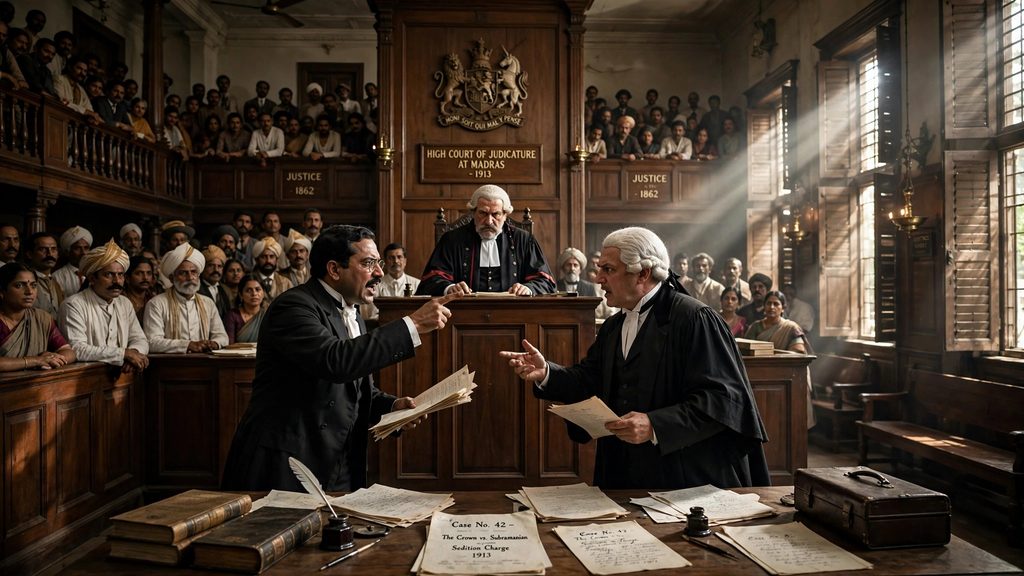
It is worth sitting with what the case actually was. This was not a metaphorical custody battle over a symbol. It was a real dispute, litigated at two levels of the British Indian court system, over an actual child, between his biological father and the religious organization that had reorganized his entire identity around a role he had not chosen.
The Scandal Nobody Fully Resolved
The man who had started it all was already, by the time of the lawsuit, a figure the Society itself had once been forced to disown. In 1906, it emerged that Leadbeater had been advising boys under his private spiritual instruction, including at least one as young as twelve, to masturbate as a way of managing sexual urges, on the theory that the act was less spiritually damaging than either intercourse or unexpressed desire. When parents discovered this, the resulting outcry forced Leadbeater to resign from the Society that June, a resignation the Society’s then president Henry Steel Olcott accepted as necessary to protect the organization’s reputation.
He did not stay gone. Once Besant became president in 1907, she pushed for his return, and by 1909, the same year he discovered Krishnamurti on the Adyar beach, Leadbeater was back inside the Society in good standing. Later biographers, most prominently Gregory Tillett, alleged that the original accusations concealed a broader pattern of abuse, including claims of homosexual conduct with minors. Subsequent scholarship examining Tillett’s own sourcing has pushed back on some of those broader claims, and the specific historical record is that the 1906 accusations centered on the masturbation counseling itself, not on the more serious allegations attached to Leadbeater’s name later. What is not contested is that the man who identified Krishnamurti as the vessel for a World Teacher, and who then spent the next two decades as his primary spiritual handler, had already been forced out of the organization once over his conduct with boys in his care, and that Besant personally championed bringing him back in before giving him unsupervised access to another child as a matter of course.
The Boy Who Stopped Performing
Krishnamurti’s own break from the role assigned to him did not arrive as a single dramatic event. It accumulated.
In 1921 he fell in love with Helen Knothe, an American teenager, in a relationship that had nowhere to go because the life being built for him had no room for an ordinary marriage. The following year, while in Ojai with Nitya, who was being treated there for tuberculosis, Krishnamurti underwent what his circle came to call simply “the process,” a period beginning in August 1922 of intense physical pain in his neck and spine accompanied by what he described as mystical experience, a sense of merging with his surroundings, and what he called encountering “the vibrations of Lord Buddha.” Theosophists around him read this as confirmation that his transformation was underway. Whatever it actually was, the episodes recurred for years and left him describing an ongoing internal state he called “the otherness,” a kind of vast, impersonal presence he said never fully left him again.
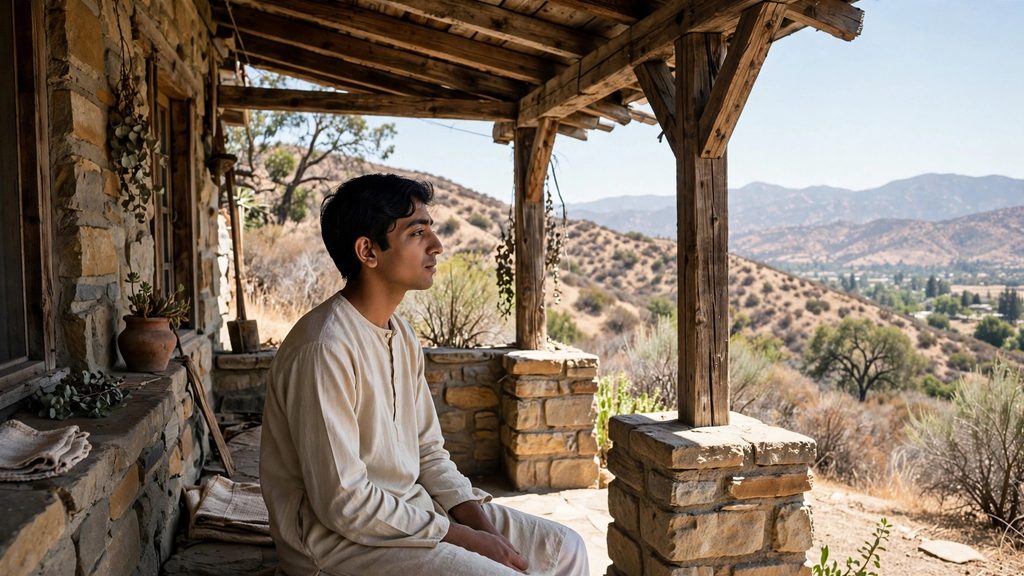
The real rupture came in November 1925, when Nitya died suddenly of tuberculosis and influenza at twenty seven. Krishnamurti had been repeatedly assured by Theosophical leadership that his brother, being essential to his own mission, could not die before it was fulfilled. The promise turned out to be worthless. By every account, the news broke him completely for a period of days. What followed was stranger still. Witnesses described him, less than two weeks later, as unusually calm, radiant, and detached from ordinary grief, a shift that reads either as spiritual breakthrough or as a young man’s mind finding a way to survive an unbearable loss, depending entirely on which framework you bring to it.
What is clear is that something in him stopped believing. Over the following years he abandoned the Theosophical language of hidden Masters directing his path from behind the scenes, and by 1929 he had decided, in his own words, after what he called careful consideration over roughly two years, that the entire structure built around him needed to end.
Ommen, August 3, 1929
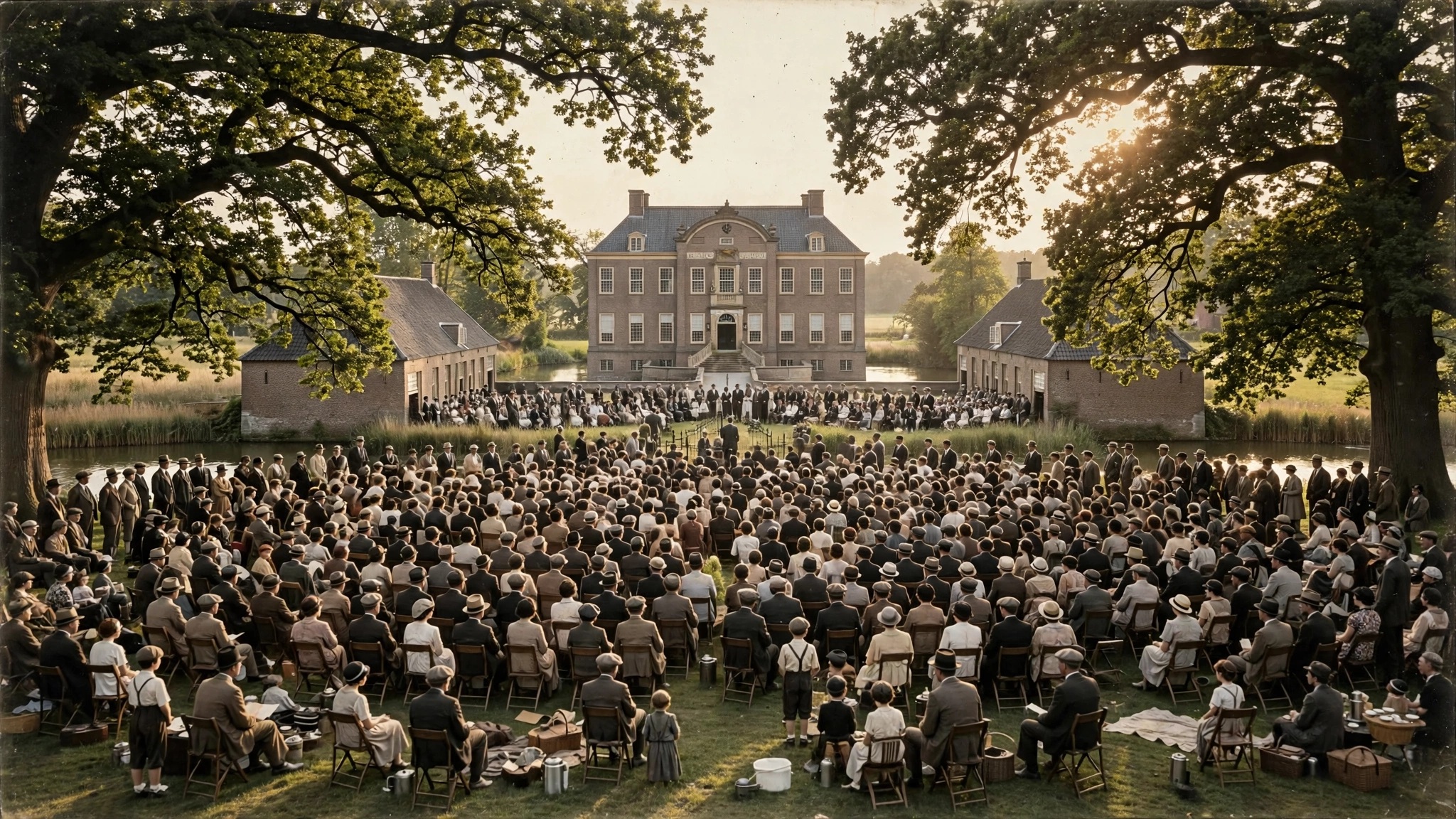
He delivered the news himself, at that year’s Star Camp, in front of the assembled Order at Castle Eerde. “I maintain that Truth is a pathless land,” he told them, “and you cannot approach it by any path whatsoever, by any religion, by any sect.” He argued that any organization built to guide people toward truth necessarily became “a crutch, a weakness, a bondage” instead, and declared his purpose from that point forward to be singular, “to set man free… from all cages, from all fears,” not to found a new religion or a new philosophy to replace the old one. Then he dissolved the Order of the Star in the East outright, and began returning the property that had accumulated around it, Castle Eerde and its five thousand acres among the largest pieces, to the people who had donated it.
Leadbeater’s reported reaction, relayed by those present, was blunt. “The Coming had gone wrong.” Many of the Theosophists who had spent two decades building toward this moment turned against the young man they had spent that same span of time promoting. Krishnamurti, for his part, never explicitly said he was not the World Teacher. When later pressed on the question directly, he tended to call it irrelevant or gave answers he himself described as purposely vague, which is either the mark of genuine humility about a question he considered unimportant, or the one piece of theatrical ambiguity he kept from an act he had otherwise abandoned completely.
Afterward
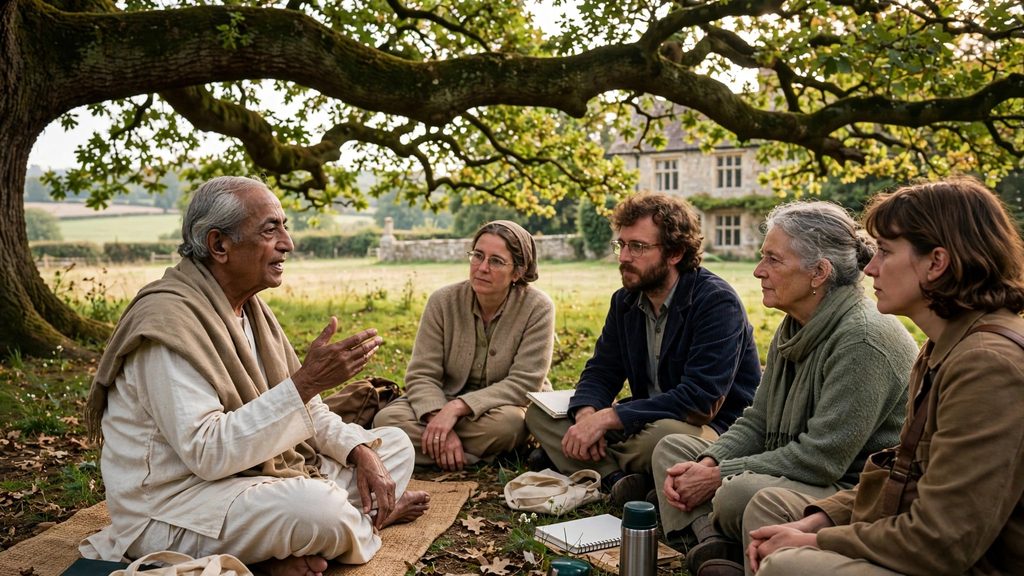
Krishnamurti spent the next fifty-seven years as an independent speaker, entirely outside the organization built to promote him, and by most accounts a far more influential one for it. He toured under a small trust based at Ojai through the 1930s and early 1940s, withdrew from public speaking almost entirely between 1940 and 1944 to work the land there, then returned to touring in May 1944 with new momentum after a friendship with Aldous Huxley connected him to Harper’s publishing house. His 1954 book The First and Last Freedom reached an audience far larger than the Order’s old membership rolls ever had. In the 1960s he began a long series of recorded dialogues with the physicist David Bohm that introduced his ideas to an entirely different audience than the one Theosophy had built. He founded schools, Rishi Valley in India in 1928, Brockwood Park in England in 1969, Oak Grove in California later still, built around an educational philosophy with no trace of the messianic framework he had walked away from at Ommen.
He also carried on a romantic relationship with Rosalind Williams Rajagopal for roughly twenty-five years beginning in the early 1930s, known to only a small circle at the time, even as his public image continued to emphasize celibacy as part of maintaining both his credibility and the donor support his work depended on, a contradiction his closest associates were aware of and his wider public was not. His later years were consumed for over a decade by a bitter legal dispute with Rosalind’s husband, D. Rajagopal, over control of publishing rights and property, a case that was still unresolved when Krishnamurti died of pancreatic cancer at Ojai on February 17, 1986, at ninety years old. He had continued lecturing in Madras just weeks before his diagnosis. He asked for no memorial service. His ashes were divided between Ojai, England, and India, with a portion returned to the Ganges and another scattered on the beach at Adyar, the same stretch of coast where Leadbeater had first noticed him seventy-seven years earlier.
Besant did not live to see most of this. Having devoted the 1910s and 1920s as much to Indian independence politics as to Theosophy, co-founding the All India Home Rule League with Bal Gangadhar Tilak in 1916, enduring internment by British authorities in 1917 over her agitation, and becoming the first woman to serve as president of the Indian National Congress that same December, she remained personally devoted to Krishnamurti even after 1929, purchasing land near Adyar that would later become the headquarters of the Krishnamurti Foundation India. She died at Adyar in September 1933, four years after the dissolution, having spent her final years still supporting the man whose messianic role she had spent two decades constructing and then watched him walk away from in front of three thousand witnesses.
What Actually Happened Here
Strip away the mysticism and what remains is a real, well-documented, and genuinely strange piece of history. An international religious organization identified a specific child as a divine vehicle based on one man’s claimed psychic perception, built a functioning institutional and financial apparatus around that claim for twenty years, fought a real custody battle through two levels of colonial courts to keep control of him, and was ultimately undone not by outside exposure or scandal but by the one person at the center of it deciding, on his own terms and in his own words, that the entire premise was false.

Whatever Krishnamurti experienced in Ojai in 1922, whatever drove the transformation his followers watched happen after Nitya’s death, he is the only person whose testimony about it survives with any real authority, and even he spent the rest of his life declining to say definitively what he had or had not been. The machine had been built to produce a messiah. In the end, the messiah dissolved the machine.