


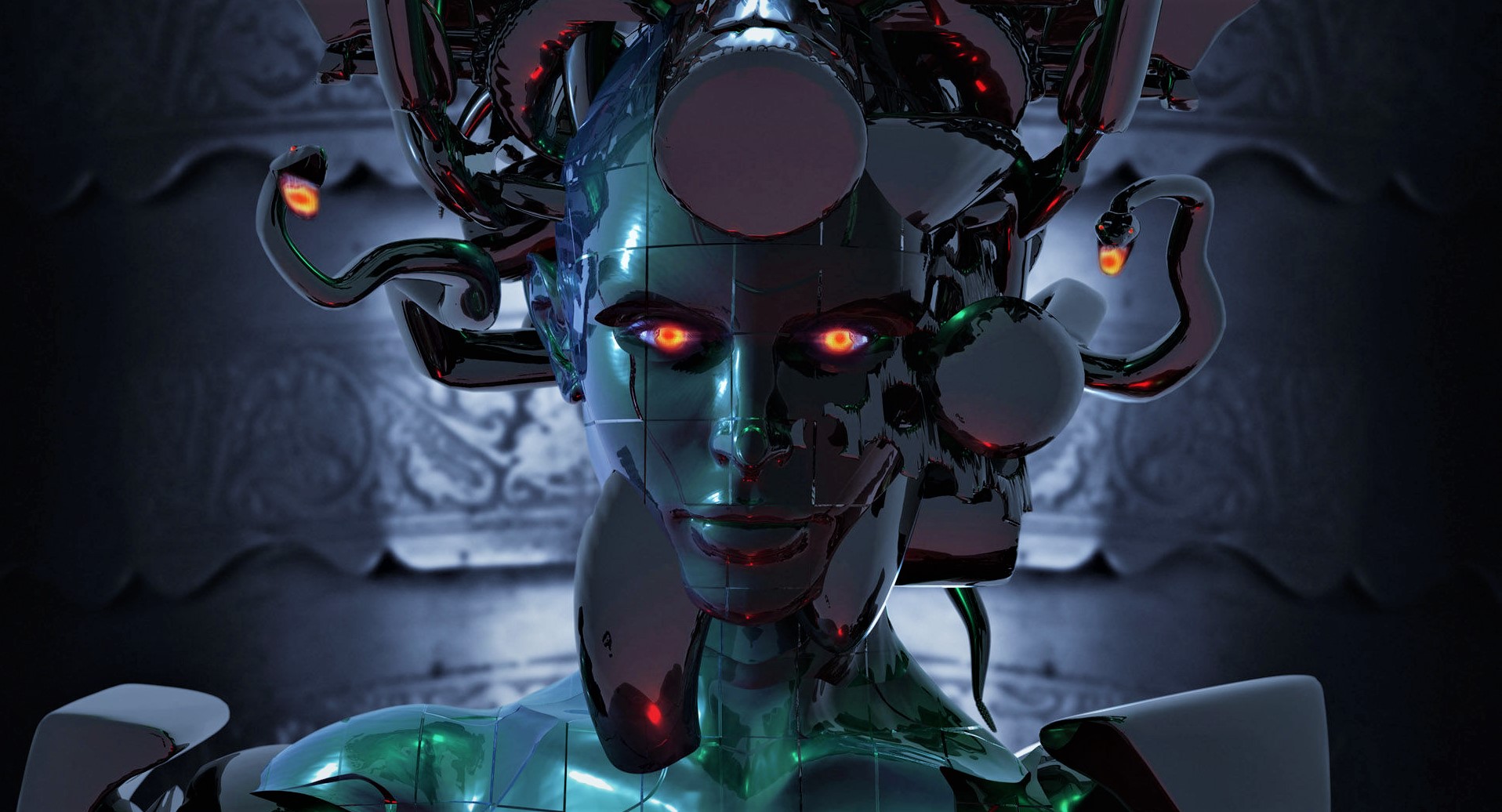
Philip Corso spent years on Eisenhower’s National Security Council staff and subsequently served as Chief of the Pentagon’s Foreign Technology desk under General Arthur Trudeau. In 1997, his book The Day After Roswell, co-authored with William Birnes, presented one of the most consequential versions of the Roswell story: the bodies allegedly recovered from the crash were not conventional extraterrestrial biological beings. Corso said they were androids, manufactured bodies built to perform tasks on behalf of an intelligence whose own physical form had never been observed.
That claim has never been independently established. Corso’s account remains a memoir-based assertion, and the much broader technology-transfer story in The Day After Roswell has been heavily disputed. His military credentials establish that he held the positions he held. They do not establish that the events he later described occurred. That distinction matters because the android hypothesis is interesting for a reason that does not depend on believing Corso: it asks whether some of the beings and objects reported in close-encounter literature might be better understood as manufactured representatives than as biological visitors.
That is a much narrower proposition than saying that aliens are robots. It does not assume that the reports are authentic, that the reported entities are extraterrestrial, or even that the phenomenon has a single explanation. It asks a specific question of the record: when witnesses describe something apparently artificial, procedural or task-oriented, what explanations remain open?
The Corso Claim
Corso’s account is unusually specific. In The Day After Roswell, he described the occupants associated with the alleged 1947 crash as artificial rather than conventionally biological, and connected them to a much larger theory in which recovered extraterrestrial technology was quietly distributed through American research and industry. The book became a major part of the modern Roswell literature, but its extraordinary claims did not acquire independent documentary confirmation.
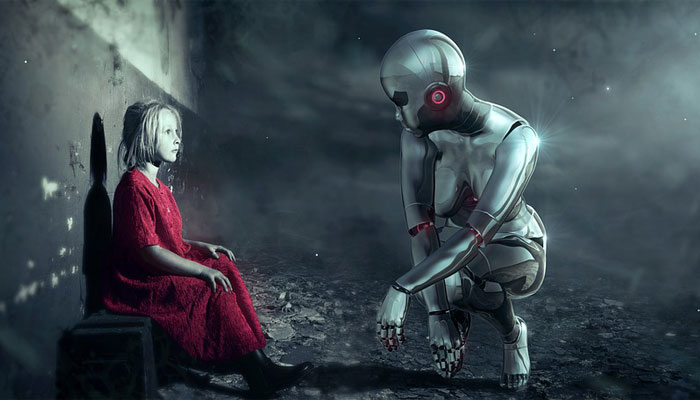
That does not make the account irrelevant. A historical investigation can legitimately ask what a source claimed without treating the claim as established history. Corso’s testimony belongs in that category: a specific account from a real former Army officer whose central allegations remain unverified.
The distinction becomes particularly important when the android idea is connected to other UAP literature. Similarity between two hypotheses is not corroboration. If Corso says the Roswell bodies were artificial and another researcher argues that an advanced extraterrestrial civilization might eventually become post-biological, the two ideas may resemble one another without either providing evidence for the other.
What the Abduction Literature Actually Says
It’s worth stating the actual positions of the researchers sometimes cited to strengthen the android hypothesis, because their real published work doesn’t support it. John Mack’s research treated the experiences reported by his subjects as psychologically and existentially profound. His subjects frequently described fear, violation, transformation, spirituality and a changed relationship with humanity and the natural world. Whatever one thinks of the underlying phenomenon, this is not a body of evidence that straightforwardly describes emotionless machines executing identical programs.
David Jacobs approached the material from a very different direction. His interpretation centered on an alleged long-term breeding and hybridization program and on entities pursuing a coherent objective. Again, that is not the same thing as evidence for interchangeable robotic workers.
That distinction is important because it illustrates a broader problem in anomaly research: once a particular interpretation becomes attractive, almost any unusual detail can begin to look like supporting evidence. The underlying reports may be real reports. The interpretation placed upon them is another matter.
The android hypothesis therefore has to stand on whatever evidence actually bears on it. Mack and Jacobs cannot be recruited as witnesses for a conclusion they did not themselves establish.
Robert Taylor and Dechmont Law
One case deserves separate attention because the record contains considerably more than a witness describing something unusual in the sky.
On November 9, 1979, forestry worker Robert Taylor was surveying woodland at Dechmont Law near Livingston, Scotland. Taylor reported encountering a large spherical object in a clearing, accompanied by two smaller objects. According to his account, the smaller objects approached him, attached themselves to his clothing and pulled him toward the larger object. He subsequently lost consciousness.
When Taylor returned home, his wife contacted a doctor and the police. Investigators examined the location and recorded unusual marks in the ground. His trousers were also examined and contained tears corresponding broadly to the areas where Taylor said the smaller objects had attached themselves. The case subsequently became one of the best-known Scottish close-encounter investigations.

The physical traces are important, but they require careful wording. They establish that investigators found marks and that Taylor’s clothing contained damage. They do not independently establish what caused those marks, nor do they establish that the object Taylor described was extraterrestrial.
There is nevertheless something striking about Taylor’s description. The two smaller objects did not behave like animals or like human beings. They approached, attached themselves to his clothing and exerted force. The description is mechanical in character: an object performing a physical function.
But mechanical-looking behaviour is not the same thing as proof of a machine. An autonomous probe would fit the description. A remotely operated device would fit it. A biological organism with unfamiliar capabilities could also fit some interpretations of the report. So could explanations having nothing to do with an external object at all.
The Taylor case therefore does something more valuable than proving the android hypothesis. It shows why the question is difficult.
A Manufactured Intelligence Is Not the Same as a Biological Visitor
There is a conceptual distinction here that is easy to lose inside the language of extraterrestrial contact.
When people imagine intelligent life elsewhere, they usually imagine something broadly analogous to ourselves: an organism that was born, evolved, developed intelligence and eventually built technology. But there is no scientific reason to assume that every technological civilization would remain biologically embodied indefinitely.
An advanced civilization might theoretically create autonomous machines capable of travelling where biological organisms could not, operating for periods far longer than an individual biological lifetime, or carrying out tasks without requiring the presence of their creators. Whether any civilization has actually done this is an entirely separate question.
Steven Dick and the Post-Biological Universe
A serious version of this idea exists independently of UFO testimony.
Astronomer and historian of space science Steven J. Dick developed the concept of a postbiological universe in his academic work. In his 2003 research article, “Cultural Evolution, the Postbiological Universe and SETI,” published in the International Journal of Astrobiology, Dick argued that long-lived technological civilizations might eventually move beyond biological intelligence toward artificial forms of intelligence. His argument concerns the possible trajectory of technological civilization and the implications for the search for extraterrestrial intelligence. It is not an argument about Roswell or UAP encounters.
This is precisely why Dick’s work is useful here. It gives the android hypothesis a legitimate conceptual framework without pretending to provide evidence that the hypothesis is true.
Corso starts with an alleged event and proposes manufactured beings. Dick starts with cultural evolution and asks what an extremely old technological civilization might eventually become. They arrive near one another conceptually, but their evidentiary foundations are completely different.
That distinction should remain intact. Agreement between an uncorroborated witness account and an academic hypothesis does not turn either into evidence for the other.
The More Interesting Possibility
The most interesting version of the android hypothesis is therefore not the sensational one.
It is not “Corso proved the Roswell occupants were robots.” He did not. Nor is it “Taylor encountered an alien probe.” The available evidence does not establish that either.
The more interesting question is whether the distinction between creator and representative has been underestimated whenever humans imagine contact with another intelligence.
If an advanced intelligence existed somewhere beyond Earth, there is no obvious reason that the first thing to reach us would have to be the intelligence itself. It could be a machine. It could be an autonomous probe. It could be a biological organism. It could be something that does not fit any of those categories.
And if the phenomenon described in some close-encounter reports is genuinely external, that distinction would matter enormously. A probe does not have to possess the psychology, vulnerability or social instincts of its creator. A machine designed to collect information could appear indifferent because indifference is precisely what its function requires. A device designed for a single task could appear strangely repetitive because repetition is what a successful machine does.
But notice the conditional language. If.
The behaviour does not establish the ontology.
Three Claims, No Verdict
Three different things can be said with confidence.
First, Philip Corso really did make the extraordinary claim that the Roswell occupants were artificial beings, and his book remains an important historical source for understanding how that interpretation entered modern UFO literature. His military background is real. Independent confirmation of his central Roswell and technology-transfer claims is not.
Second, Robert Taylor really did report an extraordinary encounter at Dechmont Law in 1979, and investigators documented physical marks at the site and damage to his clothing. Those observations make the case unusually interesting, but they do not identify the cause.
Third, Steven Dick’s post-biological framework is a legitimate academic argument about what very old technological civilizations might become. It makes manufactured intelligence a reasonable subject for speculation about extraterrestrial intelligence, but it does not establish that UAP are artificial probes or that any reported close encounter involved one.
Put those three things together and the conclusion is not that the mystery has been solved.
It is that one of the possibilities worth keeping on the table is stranger than the familiar image of an alien stepping out of a spacecraft.
Perhaps an intelligence capable of reaching another world would not come in person at all. Perhaps what crossed the distance would be something built to observe, measure, interact, retrieve, communicate or simply endure. Or perhaps the mechanical appearance of some encounters tells us nothing about their underlying nature.
The record does not yet allow us to choose between those possibilities. And that is exactly where the question becomes interesting.