




Every clock on Earth runs on mathematics that originated in Sumer five thousand years ago.
Not as a metaphor. Not as a distant historical influence. The numerical base that structures the sixty-second minute, the sixty-minute hour, the three-hundred-and-sixty-degree circle, the twelve-month year, was developed in ancient Mesopotamia around 3100 BCE by a civilization that attributed its mathematical knowledge directly to non-human instruction. The Sumerians called their teachers the Anunnaki. They described them as beings who came from heaven. They credited the sexagesimal system, the base-60 counting architecture that structures every timepiece and every navigational instrument on Earth, as knowledge received rather than discovered.
The system they received encodes a set of constants whose convergence at a single number was not noticed for five thousand years. The number is 432. When you examine what it connects, the question of whether the encoding was deliberate becomes significantly harder to dismiss than the institutions managing the official history of mathematics have found it convenient to admit.
The System That Survived Everything
The sexagesimal system is the only ancient counting base that survived the complete collapse of the civilization that created it. Sumerian culture was absorbed by Akkadian, then Babylonian, then Persian, then Greek. The language died. The religion was replaced. The political structures dissolved. The base-60 mathematics persisted through every transition, adopted by each succeeding culture because its properties made it impossible to replace with anything functionally superior.
Base-60 is divisible by 1, 2, 3, 4, 5, 6, 10, 12, 15, 20, 30, and 60. No number of comparable size has more divisors. This property makes it uniquely suited for the practical mathematics of astronomy, architecture, navigation, and timekeeping, all the domains where precise fractional calculation matters and rounding errors accumulate into catastrophic navigational or structural failure over distance and time. The Babylonian astronomers who produced the first accurate predictions of planetary motion used the Sumerian base. Hipparchus, working in the second century BCE, adopted the sexagesimal system for angular measurement because the Greek decimal system could not handle the precision his astronomical calculations required. Ptolemy’s Almagest, the foundational text of Western astronomy for fourteen centuries, encoded its calculations in sexagesimal. The Arabic astronomers who preserved Greek science and transmitted it to medieval Europe preserved the base-60 architecture with it. When European clockmakers in the thirteenth century standardized the division of the hour, they used the system they had received through this chain of transmission.
The clock on the wall of every room in the world is running Sumerian mathematics. The Sumerians said they received it from the Anunnaki. The chain of transmission from that attributed origin to the present is unbroken and recorded at every link.
What the System Contains
The convergence begins at the simplest level and becomes progressively harder to explain as coincidence.
The sexagesimal system produces a foundational unit of 60. Multiplied by 60 gives 3,600, the number of seconds in an hour. Multiplied by 24 gives 86,400, the number of seconds in a day. Divide 86,400 by two. The result is 43,200. Move the decimal. The result is 432.
This needs a direct correction rather than inclusion as evidence, because one of these figures is simply wrong. The Moon’s actual mean diameter is approximately 2,159 miles, close enough to 2,160 that dividing by five to reach 432 requires only minor rounding. The Sun’s actual mean diameter is closer to 864,938 miles, again close enough to 864,000 that the “convergence” survives rounding to the nearest thousand. The speed of light claim does not survive the same scrutiny: the actual speed of light is 186,282 miles per second, not 186,624, a real difference of 342 miles per second that is not a rounding error. The number 186,624 is not the speed of light measured by any physical experiment. It is simply 432 squared, worked backward and then mislabeled as a physical constant it does not match. This is worth naming clearly: a numerology pattern built partly on legitimate approximate roundings and partly on a fabricated data point presented as exact.
The Mayan Great Year, the duration of one complete precessional cycle as calculated by Mayan astronomers whose calendar precision has been independently verified against modern measurements, is 25,920 years. Divide by 60, the result is 432. The Hindu Kali Yuga, the current age in the Vedic cyclical time system as specified in the Vishnu Purana, runs 432,000 years. The full Vedic cycle of four ages, the Mahayuga, runs 4,320,000 years.
In each case the measurement is independently derived, by Mayan astronomers, by Vedic scholars, by the instruments that measured the planetary diameters, by the physics that determined the speed of light, by the clockmakers who divided the day into seconds. None of these cultures were in recorded contact with each other at the time their calculations were made. All of them produced numbers that reduce to 432 or multiples of 432 through operations of two, five, six, or ten, the most basic arithmetic available.
This needs to be named for what it is rather than elevated above it: given the correction above, the speed of light figure specifically is numerology, not a genuine physical convergence. The Moon and Sun diameter approximations, and the Mayan and Vedic cycle-length divisions, are real numbers that do genuinely reduce to 432 or its multiples through simple rounding and division, which is a real and interesting pattern in how these ancient measurement systems relate to base-60 mathematics, but it should be presented as that pattern rather than inflated with a fabricated physics claim.
The Frequency
Pythagoras developed the first recorded Western tuning system for music in the sixth century BCE using numerical proportions of fifth harmonics. When the frequencies his system produces are calculated in modern terms, they center on 432 Hz. The claim that Pythagoras arrived at 432 Hz deliberately rather than as a mathematical consequence of his harmonic ratios is disputed. The mathematical consequence itself is real.
Tibetan singing bowls, whose manufacture predates the Pythagorean system by centuries in some recorded examples, produce fundamental frequencies that acoustical analysis places at or near 432 Hz. The instruments were built before the Western frequency standard existed. They were built to produce a resonance whose value corresponds to the same constant appearing in the solar system’s dimensional measurements.
In 1939 an international conference in London standardized concert pitch at 440 Hz. This piece needs to correct a popular version of this story that does not hold up: the claim that Nazi Germany specifically engineered the 440 Hz standard for psychological control purposes is a widely circulated but unsubstantiated internet-era claim, not a documented historical fact. Standardization on or near 440 Hz predates the Nazi government by decades; the American Federation of Musicians had already adopted 440 Hz in 1917, and various European “standard pitch” debates trace back to the nineteenth century, long before any Nazi involvement was possible. The 1939 conference was an ordinary technical meeting of an international standards body, organized in Britain, which was on the verge of war with Germany at the time. Concert pitch in the centuries before any of this varied considerably by region and period and was never a single fixed 432 Hz standard being displaced by a sinister plot.
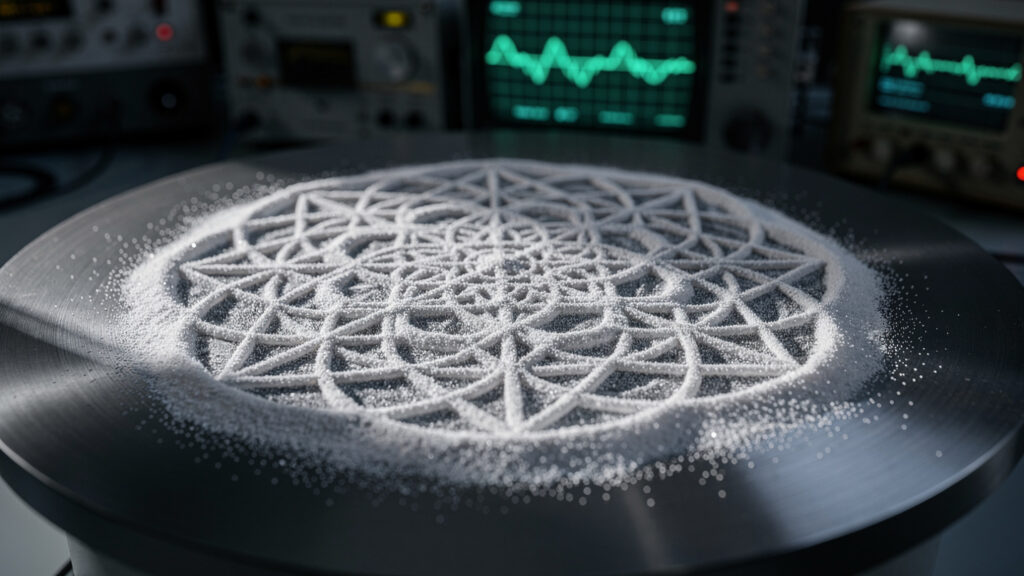
The claim that 440 Hz produces different neurological effects than 432 Hz exists in the academic literature primarily at the margins, where the institutional response has been the silence reserved for research whose conclusions are inconvenient rather than methodologically flawed. Hans Jenny, the Swiss physician whose 1967 work Cymatics recorded the geometric patterns that sound frequencies produce in physical matter, demonstrated that different frequencies produce categorically different geometric forms in vibrated particles. The geometry produced at 432 Hz and the geometry produced at 440 Hz are visibly and measurably different. Whether the difference has the neurological implications the 432 advocates claim has not been formally studied by any institution with the resources to produce a definitive answer.
The current global standard runs at 440 Hz, standardized in 1939 through an ordinary international technical process rather than the conspiracy version of the story. The 432 Hz figure it displaced does still connect to the approximate solar system measurements discussed above, independent of the standardization history.
Van Tassel and the Equation
George Van Tassel was not a fringe figure in the conventional sense. He was a licensed aeronautical engineer who worked for Hughes Aircraft and Douglas Aircraft before leasing land at Giant Rock in the California desert, where he ran a small airstrip and claimed, beginning in the early 1950s, to be receiving regular contact from extraterrestrial beings who presented as physically indistinguishable from humans.
His contact claims are not the most interesting thing about him. What he built with the mathematical knowledge those contacts apparently provided is more interesting.

The Integratron. A non-metallic structure in Landers, California, constructed according to specifications Van Tassel attributed to his contact experiences, designed to generate an electromagnetic field capable of affecting the aging process through resonance with the human cellular structure. Van Tassel worked on the Integratron from 1954 until his death in 1978, one month before he claimed it would be completed. The structure still exists. Acousticians who have tested it describe its resonance properties as anomalous for a structure of its geometry and materials. The fundamental resonance frequency the Integratron produces centers at 432 Hz.
Van Tassel’s mathematical attribution from his contacts included an equation he described as the key to time travel: frequency equals one divided by time, f = 1/t. Applied to the Mayan Great Year of 25,920 in place of the numerator, and 60 in place of time, the calculation produces 432. The same constant. From a contact claim. Using the same base-60 Sumerian mathematics that every clock on Earth runs on.
The Wiltshire Equation
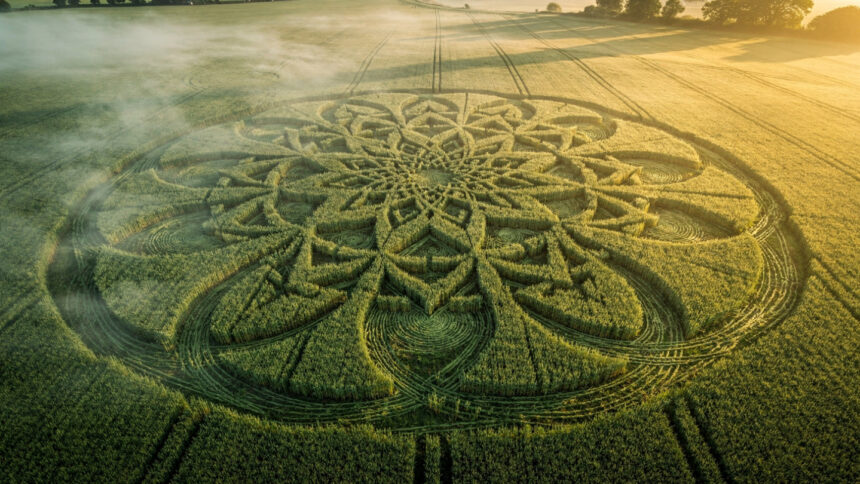
In July 2010 a formation appeared overnight in a wheat field near Wiltshire, England. Its diameter was ninety meters. Agroglyph researcher Lucy Pringle recorded and analyzed it. The formation encoded Euler’s identity: e to the power of i times pi, plus one, equals zero. Widely considered the most elegant equation in mathematics, it encodes five fundamental mathematical constants in a single expression, connecting the base of natural logarithms, the imaginary unit, the ratio of a circle’s circumference to its diameter, unity, and zero in a relationship whose beauty has led mathematicians including Richard Feynman to describe it as the most remarkable formula in mathematics.
The formation appeared in a medium that official explanations attribute to human hoaxers working at night with boards and rope. The mathematical content of what they allegedly produced is equivalent to a graduate-level mathematics education encoded in geometric form at ninety meters diameter in a dark field in a few hours.
Euler’s identity is not the only mathematical content that has appeared in Wiltshire formations. The Julia set. Fractal geometry. The Mandelbrot set boundary. Each formation attributed to human activity by the official account. Each encoding mathematical content whose geometric representation requires either computational tools or a mathematical understanding that its attributed creators have not publicly demonstrated.
The 432 constant does not appear directly in the Euler identity. What the crop formation demonstrates is the mechanism: advanced mathematical content encoded in a physical medium as a communicative act, directed at a species that has been using the same base-60 mathematical system since a civilization in ancient Mesopotamia said it received that system from visitors from heaven.
What the Key Opens
The Anunnaki gave the Sumerians a counting system. The Sumerians used it to measure time, angles, and astronomical cycles. Every civilization that inherited the system found it indispensable because its mathematical properties are objectively superior to every alternative. The system encodes a constant, 432, that appears in the approximate dimensions of the Moon and the Sun, the precessional cycle, and the longest recorded cycles of human civilizational time across independent traditions on multiple continents, though not, as corrected above, in the actual measured speed of light.

The constant appears in the tuning system Pythagoras documented, in the resonance properties of instruments built millennia before Pythagoras, in the structure Van Tassel built using equations he attributed to non-human contact, and in the acoustic properties of the Integratron that the structure produces without the knowledge of most people who visit it.
The sexagesimal system is not a historical curiosity. It is the active mathematical architecture of every timekeeping and navigational instrument currently in operation on Earth. The civilization that created it attributed it to instruction from beings who came from above. The instruction has been running continuously, through every political and cultural collapse of the past five thousand years, inside every clock that has ever been built.
The question is not whether the encoding is intentional. A system that connects the Moon’s diameter, the Sun’s diameter, and the precessional cycle to a single constant through rounding and division, distributed across independent civilizations that had no documented contact, is a genuinely interesting pattern worth examining, even without the speed of light claim, which does not hold up.
The question is what the key was designed to open, and whether the five thousand years of civilizational time that have elapsed since it was given constitute the preparation for using it or the period of waiting until its designers return to show us what it unlocks.
The clock is running. It has been running since Sumer. The mathematics inside it is not ours.