



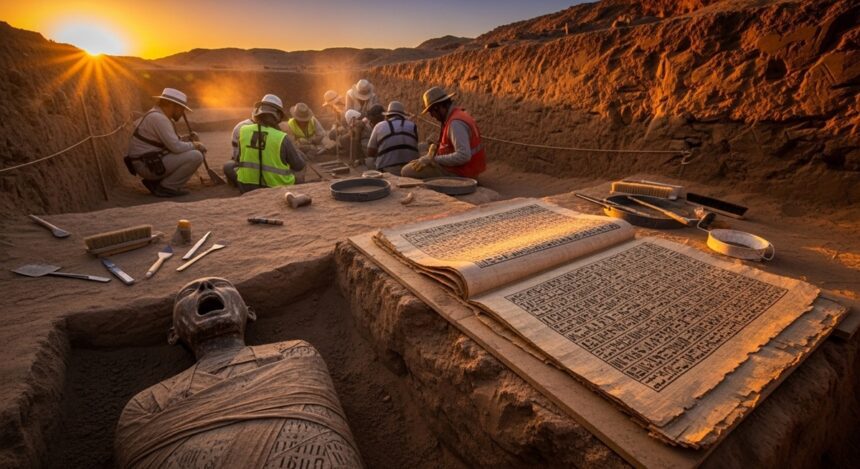
No “Doomsday Manuscript” has ever been discovered at Saqqara or anywhere else in Egypt. That specific claim, and the 2025 discovery it’s attributed to, could not be matched to any archaeologist, institution, or publication.
What’s genuinely fascinating on its own terms is the actual history behind Egypt’s real “Screaming Mummies,” an archaeological mystery solved through forensic science over the past century, and it deserves to be told accurately rather than attached to an invented text.
Saqqara Is Remarkable Enough Already
Saqqara, south of Cairo, is one of Egypt’s most significant archaeological sites, home to the Step Pyramid of Djoser, generally regarded as the earliest large-scale cut-stone building in history, designed by the architect Imhotep in the 27th century BCE. The site’s name does connect to Sokar, an ancient Egyptian funerary deity, often depicted as a mummified falcon-headed figure associated with the necropolis and the afterlife. This is well-established Egyptology, and Saqqara continues to be an active site of ongoing archaeological excavation to this day.
A claimed anagram connection between “Sokar” and “Oscar,” the Academy Award statuette, is worth addressing directly: this is coincidental wordplay between an ancient Egyptian word and a modern English one from an entirely unrelated language family, the kind of surface letter-rearrangement that can be found between countless unrelated words if one searches for it, and it carries no etymological or historical significance.
Where the Screaming Mummies Were Actually Found
This needs a direct correction: Egypt’s actual “Screaming Mummies” were not found at Saqqara, and there are two separate individuals who have carried this nickname, discovered decades apart, with two very different and thoroughly investigated stories.
Unknown Man E | Prince Pentawere
In late June 1886, French Egyptologist Gaston Maspero, then head of the Egyptian Antiquities Service, was unwrapping royal mummies recovered from a cache at Deir el-Bahari, near Luxor, when he found a plain, undecorated coffin containing a young man, bound at the hands and feet, mouth open as if screaming. Unlike the other royal mummies in the cache, this man showed no incision for organ removal, the standard step in proper mummification, and was wrapped in sheepskin, a material ancient Egyptians considered ritually unclean. Maspero himself, in his 1889 published account, wrote that everyone who examined the body firsthand believed he looked as though he had been poisoned.
More than a century later, CT scanning and DNA analysis conducted by Egyptologist Zahi Hawass and his team, published through the Egyptian Mummy Project, identified this individual, previously catalogued only as “Unknown Man E,” as Prince Pentawere, son of Pharaoh Ramesses III. Ancient court documents, including the Judicial Papyrus of Turin, describe the Harem Conspiracy, a plot in which several of the pharaoh’s wives and officials attempted to assassinate Ramesses III to install Pentawere on the throne instead of the legitimate heir. The conspiracy was discovered, and Pentawere was forced to take his own life, likely by hanging, as punishment, denied proper mummification and burial rites as a mark of his disgrace. Forensic analysis of Ramesses III’s own mummy, published in a 2012 study in the BMJ, confirmed the pharaoh’s throat had indeed been cut, corroborating the conspiracy the ancient court records describe.
The Screaming Woman: A Separate Mystery
A second, distinct mummy, discovered in 1935 near Luxor and long held at the Egyptian Museum in Cairo, carries a similar contorted, open-mouthed expression and has separately been called the Screaming Woman. In a 2024 study published in the journal Frontiers in Medicine, radiologist Sahar Saleem and colleagues used CT scanning to examine this mummy in detail, finding she died around age 48, had lost several teeth, showed mild spinal arthritis, and had been embalmed roughly 3,500 years ago using notably high-quality materials, indicating a person of social standing, not disgrace. The researchers concluded her facial expression likely resulted from a well documented natural physiological process called cadaveric spasm, in which muscles contract and lock rigidly at the moment of death under conditions of extreme physical or emotional distress, preserved intact by the embalming process before the muscles ever had the chance to relax.
A separate, earlier mummy from the same 1886 Deir el-Bahari royal cache, inscribed with hieratic text identifying her as “royal daughter, royal sister Meritamun” and studied by Hawass and Saleem, was found through CT analysis to have died of severe coronary atherosclerosis in her sixth decade, a natural cause of death the ancient Egyptian embalming process happened to preserve mid-expression. It’s worth being especially precise here, since sources sometimes conflate this earlier “Unknown Woman A” with the separately studied 1935 discovery. Both carry the same “screaming” nickname. Both cases were resolved through forensic science pointing to natural causes rather than any supernatural or prophetic explanation.
The Harem Conspiracy, in Fuller Detail
The conspiracy behind Pentawere’s death deserves fuller telling, since the Judicial Papyrus of Turin provides detailed, ancient court testimony worth knowing in full. The document records the trial of dozens of conspirators, including Ramesses III’s secondary wife Tiye, Pentawere’s mother, along with harem officials, a butler, army officers, and even individuals who used magic wax figures and spells obtained from a royal library in an attempt to help the plot succeed, according to the ancient testimony itself. Several judges assigned to the case were themselves later tried and punished for improper conduct with some of the accused women during the proceedings, a recorded detail showing the scandal extended beyond the original conspiracy. Most defendants were reportedly executed or forced to take their own lives, and the Egyptian legal tradition of the era avoided directly naming condemned individuals in official records, instead assigning them altered, insulting names, which is part of why Pentawere’s identity remained obscured as “Unknown Man E” for over a century until modern genetic and forensic analysis could connect the body to the historical record.
Ancient Egyptian Views on Cyclical Time
Engaging honestly with the Egyptian religious concept the fabricated manuscript borrows its “cyclical time” framing from matters here, since actual Egyptology has a great deal to say about it. Ancient Egyptian cosmology did center on cyclical renewal, most centrally through the sun god Ra’s nightly journey through the Duat, the underworld, and daily rebirth at dawn, an extensively studied religious concept found throughout genuine funerary texts including the Book of the Dead, the Amduat, and the Pyramid Texts, some of the oldest religious writings in human history. These texts do concern themselves with judgment, moral conduct, and cosmic order, concepts ancient Egyptians called ma’at, and Egyptologists have written extensively about how central these ideas were to Egyptian religious and political life for three thousand years. None of this well established religious tradition describes a single “doomsday manuscript” predicting modern global catastrophe, and readers interested in authentic ancient Egyptian eschatological thought are far better served by the translated corpus of funerary literature than by an invented text with no verifiable provenance, no named excavator, and no institutional record of any kind connecting it to an actual archaeological find.
Why Fabricated “Lost Manuscript” Stories Attach to Real Sites
A small but telling detail explains how this specific fabricated story was likely assembled: the claimed use of “artificial intelligence algorithms” to decipher the manuscript is a recurring, generic feature of many similar internet-native archaeology hoaxes, invoked as a modern, sciencey-sounding explanation for how an otherwise impossible translation was supposedly achieved, without any named research team, published methodology, or peer-reviewed paper actually describing such a process. Digital epigraphy and machine-assisted translation of ancient scripts is an active field of scholarship, with published projects working on genuinely difficult problems like Linear A and various undeciphered scripts, but projects in this field publish their methods, name their researchers, and submit their results for peer review, exactly the trail this specific “AI-deciphered” manuscript claim lacks entirely.
A fabricated “doomsday manuscript” gets attached specifically to a famous site like Saqqara rather than an obscure or invented location for a specific reason worth naming directly. Saqqara’s significance, pyramids, an active excavation history spanning over a century, ongoing discoveries reported in legitimate archaeological press, gives any invented claim attached to it an immediate borrowed credibility. A reader who knows Saqqara is real and genuinely important is more likely to extend that same credibility to whatever specific claim gets attached to it, even when that specific claim, unlike the site itself, has no actual archaeologist, publication, or institution behind it. This is worth recognizing as a general pattern: the legitimacy of a location or institution says nothing about the legitimacy of any specific claim attached to it after the fact, and each claim deserves to be checked against its own evidentiary trail rather than borrowing credibility from the history of the place it’s set in.
Imhotep: The Architect Behind Saqqara’s Most Famous Monument
The historical figure behind Saqqara’s real architectural achievement deserves expanding on, since Imhotep’s own story is remarkable enough without any invented manuscript attached. Imhotep served as chancellor and high priest under Pharaoh Djoser during the Third Dynasty, roughly the 27th century BCE, and ancient inscriptions credit him with designing the Step Pyramid, the earliest known large-scale cut-stone monument in human history, representing a genuine architectural leap from earlier mudbrick mastaba tombs toward the stone pyramid tradition that would culminate centuries later at Giza. Unusually for a non-royal figure of his era, Imhotep was deified after his death, worshipped in later periods as a god of medicine and wisdom, with a documented cult following that persisted for over two thousand years after his actual lifetime, eventually influencing Greek associations between Imhotep and their own healing god Asclepius. This is a remarkable, well-documented case of a historical architect’s reputation growing into full religious veneration over the following two millennia, a transformation from mortal official to worshipped deity that needs no embellishment to be worth knowing.
What Actually Makes These Cases Remarkable
The story here doesn’t need a fabricated apocalyptic manuscript to be worth telling. It’s a genuine, century-spanning detective story: a 19th-century archaeologist’s firsthand observation that something was deeply wrong with one particular mummy, ancient court documents describing a royal assassination plot, and modern CT and DNA technology finally connecting the two, giving a name and a documented fate to a man who had been deliberately erased from his own dynasty’s official history. The separate Screaming Woman cases show forensic radiology solving a different kind of mystery, distinguishing natural cardiac death from the genuine trauma of cadaveric spasm, using nothing more exotic than modern medical imaging applied carefully to ancient remains, science answering a question that had genuinely puzzled observers for well over a century before the technology existed to resolve it properly.
Ancient Egyptian religious texts, including genuine funerary literature like the Book of the Dead and the Pyramid Texts, do contain sophisticated cosmological and ethical content concerning judgment, the afterlife, and cyclical concepts of time and renewal tied to the sun god Ra’s daily journey. This body of literature is worth exploring on its own terms, translated and studied by Egyptologists for well over a century, rather than through an invented text whose supposed content, cosmic doom cycles, AI-assisted decipherment, echoes of the Book of Enoch, doesn’t correspond to anything in the actual, extensively documented corpus of ancient Egyptian religious writing.