



Space exploration has always captured the human imagination, but its practical, real-world benefits are often overlooked entirely.
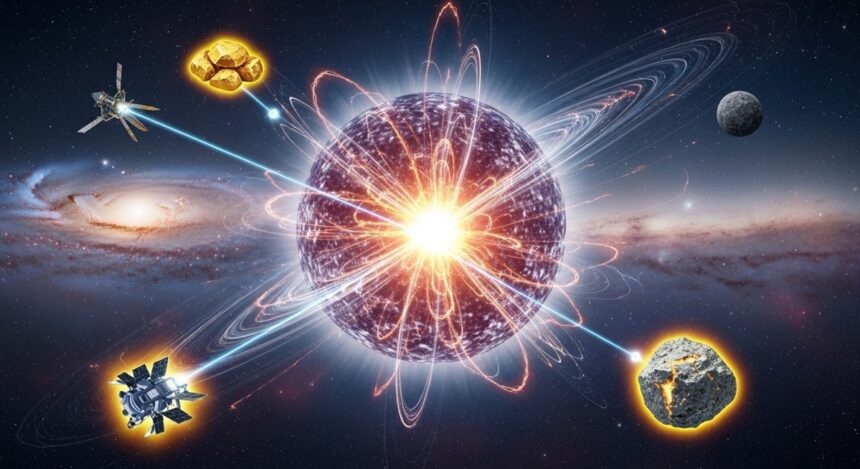
From guiding spacecraft through the cosmos to unraveling the origins of precious elements like gold and uranium, neutron stars, those enigmatic, ultra-dense remnants of massive stars, hold keys to both scientific discovery and real-world applications.
What Are Neutron Stars and Why Do They Matter?
The Cosmic Powerhouses
Neutron stars are the remnants of massive stars, generally those roughly 8 to 20 times the mass of our Sun, that have undergone a supernova explosion. Unlike our Sun, which will eventually become a white dwarf, these massive stars collapse into incredibly dense objects. Imagine compressing the Sun’s mass into a sphere the size of a city, about 20 kilometers across. The result? A neutron star, where the density is so extreme that protons and electrons merge into neutrons, creating matter so compact that a single teaspoon would weigh as much as a mountain.
What makes neutron stars extraordinary is their extreme physics. Their interiors reach densities levels surpassing the nucleus of an atom, where matter behaves in ways we can’t yet fully understand. Scientists are still unraveling the “equation of state” for this exotic matter, a puzzle that terrestrial labs can’t replicate. By studying neutron stars, we gain insights into the fundamental laws of physics, from quantum mechanics to general relativity.
Why Study Them in X-Rays?
Neutron stars emit radiation across the electromagnetic spectrum, but they shine brightest in X-rays due to their scorching temperatures, often reaching tens to hundreds of millions of degrees. These temperatures arise when matter, such as stellar wind from a companion star, is captured by the neutron star’s immense gravity. As this matter spirals inward, it accelerates, heats up, and emits high-energy X-rays. Unlike optical or infrared light, which may be absorbed by surrounding material, hard X-rays can pierce through, revealing the star’s presence.
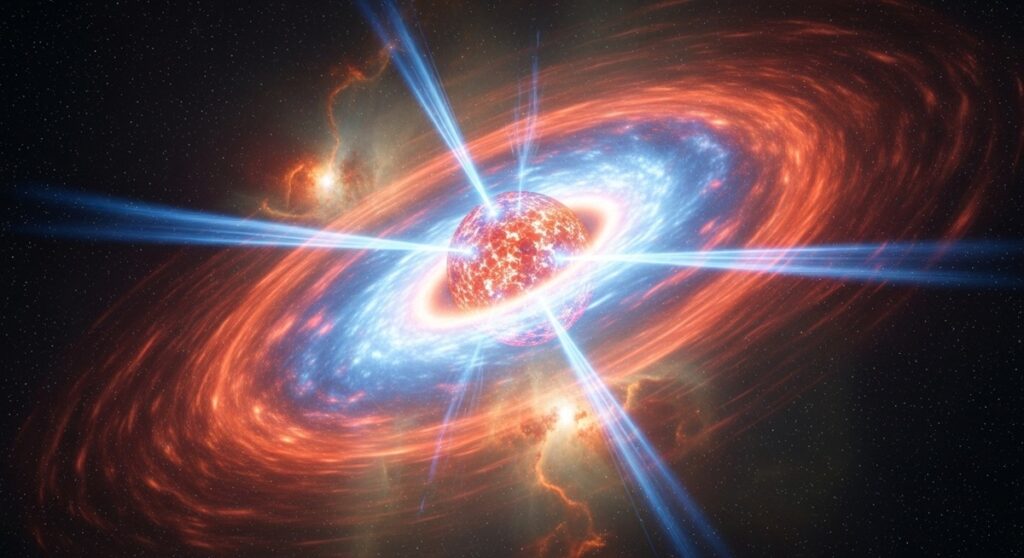
Observing neutron stars in X-rays, alongside radio, gamma, and other wavelengths, allows scientists to piece together a fuller picture of these objects. Each wavelength provides a different piece of the cosmic puzzle, much like opening letters in a word game to guess the whole word. This multi-wavelength approach helps us understand not just neutron stars, but the broader mechanics of the universe.
Neutron Stars as Cosmic Beacons for Navigation
Pulsars | The Universe’s Lighthouses
One of the most practical applications of neutron stars lies in their role as pulsars, rapidly rotating neutron stars that emit beams of radiation like cosmic lighthouses. Some pulsars spin at astonishing speeds, up to 600 revolutions per second, compared to Earth’s leisurely 24-hour rotation. Their signals are so precise that their stability rivals atomic clocks, making them ideal for navigation.
In 1972, the Pioneer 10 spacecraft carried a metal plaque with a map using pulsars to pinpoint Earth’s location in the galaxy. By encoding the periods and positions of several pulsars, the plaque served as an “interstellar letter” to potential extraterrestrial finders. This early use of neutron stars for navigation has evolved into a cutting-edge concept | X-ray pulsar navigation.
Navigating Deep Space with X-Ray Pulsars
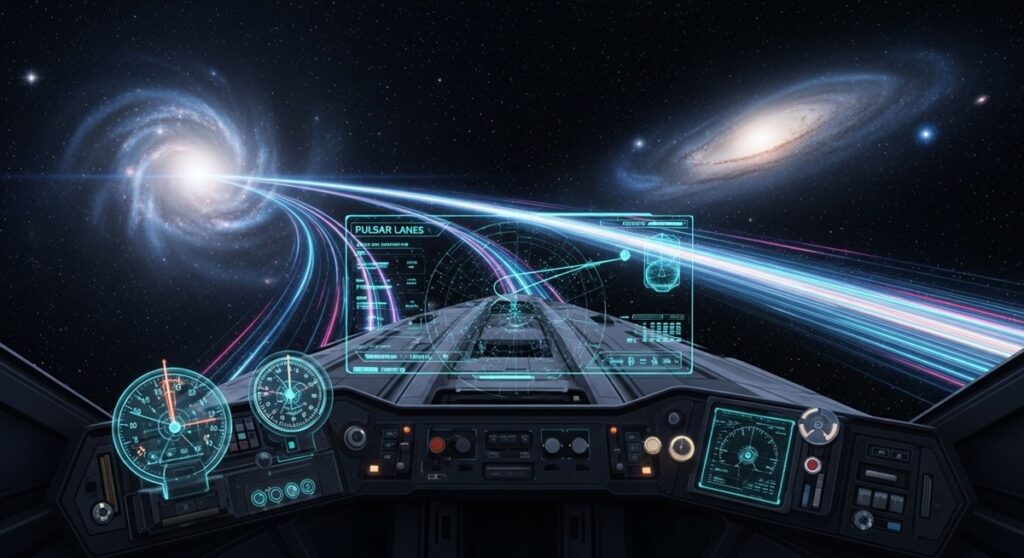
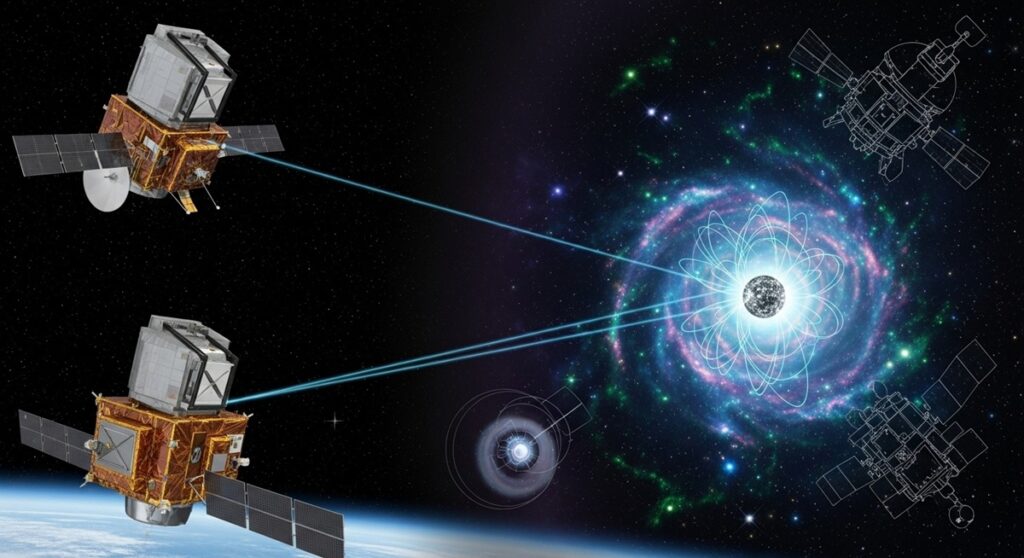
Unlike GPS, which relies on Earth-based satellites and is limited to near-Earth orbits, X-ray pulsar navigation offers a universal solution for deep space exploration. Pulsars’ stable, periodic signals act as natural beacons, allowing spacecraft to triangulate their position anywhere in the solar system with pinpoint accuracy. This technology is actively being developed, with NASA and other space agencies exploring its potential for missions to Mars, the outer planets, and beyond.
Imagine a future where spacecraft navigate the cosmos using the rhythmic pulses of neutron stars, much like ancient mariners used the stars to cross oceans. This not only reduces reliance on Earth-based systems but also opens the door to autonomous exploration in the farthest reaches of space.
Cosmic Factories | The Origins of Gold and Uranium
The Limits of Stellar Fusion
The Sun powers itself through thermonuclear fusion, converting hydrogen into helium and eventually heavier elements like carbon and oxygen. In massive stars, this process continues up to iron, the element with the highest binding energy. Beyond iron, fusion becomes energetically unfavorable. Light elements fuse, but heavy elements like gold and uranium tend to decay rather than form.
So, where do these heavy elements come from? For decades, scientists believed supernova explosions provided the conditions for their creation. During a supernova, a flood of neutrons could rapidly attach to atomic nuclei, a process called rapid neutron capture (or the “r-process”). However, calculations revealed that supernovae alone couldn’t account for the abundance of heavy elements in the universe.
Neutron Star Collisions | The True Gold Mines
Enter neutron star collisions, cataclysmic events where two neutron stars merge, releasing a torrent of neutrons. These collisions, detected through gravitational waves and gamma-ray bursts, create the perfect environment for the r-process. In a fleeting moment, neutrons bombard atomic nuclei, building heavy elements like gold, silver, and uranium. Recent observations, such as the 2017 neutron star merger detected by LIGO, confirmed that these events are the universe’s primary factories for heavy elements.
This discovery has profound implications. The gold in your jewelry, the uranium powering nuclear reactors, all trace their origins to ancient neutron star collisions. Our planet, formed from a protoplanetary cloud enriched by such events, owes its wealth of heavy elements to these cosmic crucibles.
Powering the Future | Neutron Stars and Energy Solutions
The Challenge of Space Energy
Space exploration demands reliable energy sources. Near Earth, solar panels suffice, but in deep space or on the Moon, where sunlight is scarce or absent for weeks, alternative solutions are critical. The Voyager spacecraft, launched in 1977, continue to transmit data nearly 50 years later, powered by radioisotope thermoelectric generators (RTGs) fueled by plutonium. These “almost eternal” power sources highlight the potential of nuclear energy for long-term missions.
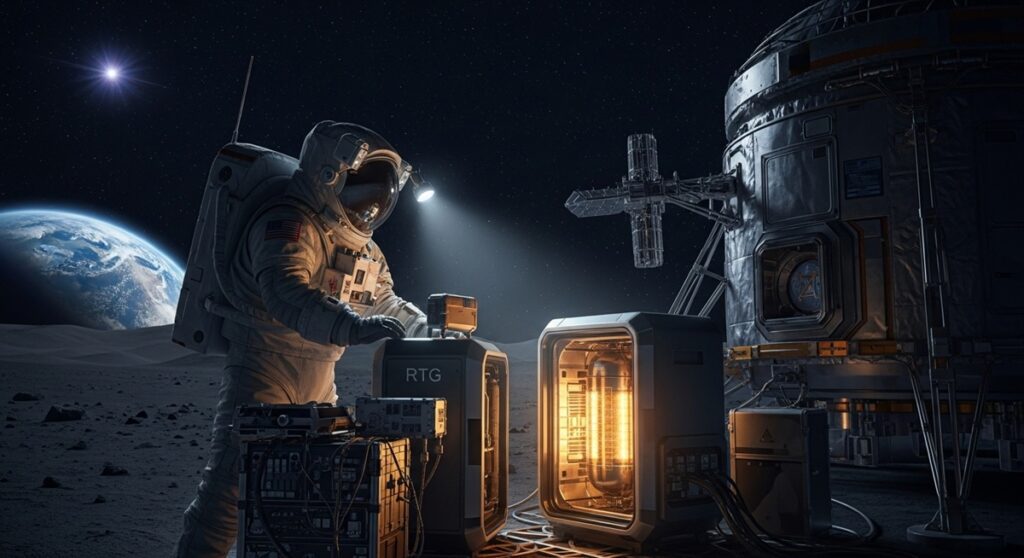
Neutron stars, while not directly powering spacecraft, inspire similar innovations. Their extreme conditions, high gravity, magnetic fields, and temperatures, push the boundaries of physics, informing the development of compact, long-lasting energy systems. For lunar bases, where the two-week lunar night rules out solar power, RTG-like systems could keep equipment running, preventing freezing and ensuring continuous operation.
Toward Perpetual Motion?
While true perpetual motion machines defy the laws of physics, neutron stars and nuclear-powered systems come tantalizingly close for practical purposes. The longevity of Voyager’s RTGs demonstrates the potential for nuclear energy to sustain missions for decades. Future advancements, inspired by the study of neutron stars’ extreme physics, could lead to even more efficient energy sources, powering humanity’s expansion into the solar system and beyond.

The Real 2017 Discovery That Confirmed the Theory
The event that transformed the r-process theory from a strong hypothesis into confirmed observation deserves expanding on. On August 17, 2017, LIGO and its European counterpart Virgo detected gravitational waves from two neutron stars spiraling into each other roughly 130 million light-years away, an event designated GW170817. This was a historic moment in astronomy: within hours, dozens of telescopes worldwide, coordinated in real time, pointed toward the source and captured the electromagnetic afterglow of the collision, a kilonova, marking the first time an event was ever observed in both gravitational waves and light across the entire electromagnetic spectrum. Spectroscopic analysis of that kilonova’s light showed direct evidence of freshly synthesized heavy elements, providing solid observational confirmation that neutron star mergers produce roughly the right quantities of gold, platinum, and other heavy elements to account for their observed abundance throughout the universe. This single historic event effectively settled a decades-long open question in nuclear astrophysics research.
The Real X-Ray Pulsar Navigation Milestone
The already-achieved milestone in pulsar-based spacecraft navigation deserves detail, since this technology has moved beyond concept into working demonstration. In 2018, NASA’s Station Explorer for X-ray Timing and Navigation Technology, SEXTANT, mission aboard the International Space Station successfully demonstrated autonomous X-ray pulsar navigation in orbit for the first time, using the precise timing of pulsar signals to determine the station’s position in real time with accuracy comparable to GPS, without relying on any Earth-based signal. This built on NASA’s Neutron Star Interior Composition Explorer, NICER, instrument, which was simultaneously conducting its own dedicated scientific mission studying neutron star interiors. This is demonstrated, flight-tested technology, not a theoretical proposal, representing a significant step toward fully autonomous deep space navigation independent of Earth-based tracking networks entirely.
The Universe as a Laboratory
Unraveling Fundamental Physics
Neutron stars serve as natural laboratories for studying physics under conditions impossible to replicate on Earth. Their ultra-dense cores, super-strong magnetic fields, and intense gravitational fields test theories of quantum mechanics, general relativity, and nuclear physics. For example, understanding the equation of state for neutron star matter could unlock new insights into the behavior of matter at extreme densities, with applications in fields like material science and energy production.
Practical Benefits for Humanity
The study of neutron stars extends beyond theoretical physics. Their applications in navigation and energy solutions have direct implications for space exploration. Moreover, the heavy elements they produce are critical to industries on Earth, from jewelry to nuclear power. By deepening our understanding of the universe, neutron star research drives technological innovation, much like how studying the Sun led to advances in solar energy.
The Future of Neutron Star Research
Advancing Observational Technology
To unlock more secrets of neutron stars, scientists rely on advanced observatories like NASA’s Chandra X-ray Observatory and the European Space Agency’s XMM-Newton. These telescopes capture X-ray emissions, revealing details about neutron stars’ behavior and environments. Future missions, such as the proposed Lynx X-ray Observatory, promise even greater resolution, enabling us to probe deeper into these cosmic enigmas.
Inspiring the Next Generation
Neutron star research also captures the public’s imagination, inspiring young scientists to pursue careers in STEM. By connecting the dots between cosmic phenomena and practical applications, we can foster a new generation of innovators who will push the boundaries of science and technology.
Magnetars | Neutron Stars With Extreme Magnetic Fields
A particularly extreme subclass of neutron star is worth knowing about on its own terms. Magnetars are neutron stars possessing magnetic fields trillions of times stronger than Earth’s own, among the strongest magnetic fields known to exist anywhere in the universe. These extreme objects occasionally produce enormous bursts of gamma and X-ray radiation called starquakes, thought to result from sudden reconfigurations of the neutron star’s rigid crust under the strain of its own extreme magnetic field, not unlike how tectonic stress builds and releases in earthquakes on Earth, though at vastly greater energy scales. A 2004 magnetar flare from an object called SGR 1806-20, located roughly 50,000 light-years away, released more energy in a fraction of a second than the Sun produces in 250,000 years, and was powerful enough to measurably affect Earth’s upper atmosphere despite the enormous intervening distance. Magnetars are also now considered strong candidates for the source of at least some fast radio bursts, another still-mysterious class of brief, intense radio signals detected from distant galaxies, an active and ongoing area of astrophysical research today.
A Cosmic Legacy for Humanity
Neutron stars are beacons, factories, and laboratories that shape our understanding of the universe and our place within it. From guiding spacecraft through the void to forging the elements that power our world, these cosmic powerhouses offer practical benefits that resonate on Earth. As we continue to explore their mysteries, neutron stars will undoubtedly inspire new technologies, deepen our scientific knowledge, and fuel humanity’s quest to reach for the stars.
A pulsar’s rhythm gets forced into the same interpretive stretch here, a DNA signal story built on a claimed body temperature that basic physics rules out for a neutron star entirely.