Deep in the sands of Upper Egypt, the ancient necropolis of Adaima, dating back to 3300–2700 BC, has long captivated archaeologists. Among its countless burials, one tomb stands out, a striking and thought-provoking discovery that offers a rare glimpse into the origins of Egyptian religion.
The remains of a teenage girl, her right hand deliberately severed, tell a story of ritual, cosmology, and a profound connection to the stars. This is a window into the spiritual world of predynastic Egypt, where the seeds of one of history’s greatest mythologies were sown.
The Mystery of the Severed Hand

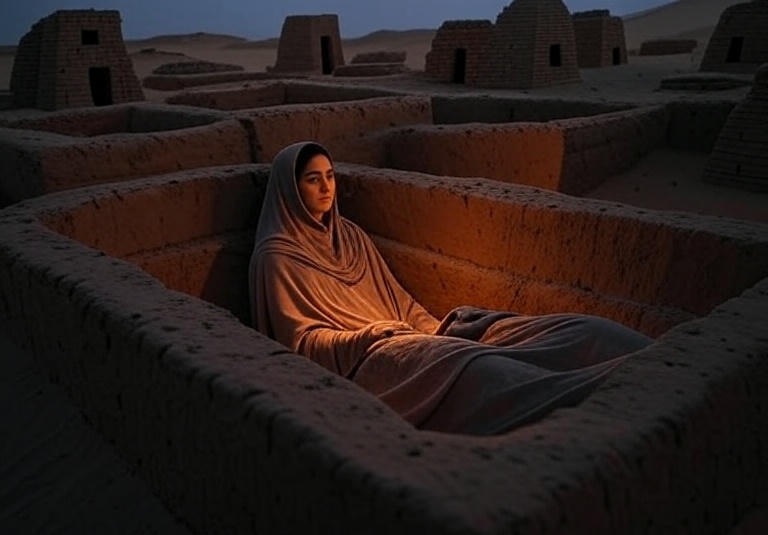
The tomb in question, unearthed in the sprawling Adaima necropolis, revealed something extraordinary. The skeletal remains of a young girl, likely in her teens, were meticulously arranged, but her right hand was missing. Evidence suggests it was intentionally amputated after death, likely with a forceful axe blow that severed the bones of her lower shoulder and forearm. The precision involved in the process didn’t end there either. Using a sharp flint blade, a common tool of the era, the muscles were carefully sliced, ensuring a clean separation.
What makes this burial truly remarkable, however, is not just the amputation but the care taken afterward. The girl’s severed forearm and hand were thoughtfully placed beside her body, positioned to appear intact, mimicking the natural alignment of her left arm. This wasn’t an act of violence or desecration. It was a deliberate, reverent ritual, steeped in meaning. The right arm was sharply bent at an angle beyond 90 degrees, pressed tightly against her body, a pose that archaeologists believe held deep symbolic significance.
A Celestial Connection

The burial’s peculiarities extend beyond the severed hand. The girl’s body was oriented with striking precision, facing the setting sun on the day of the winter solstice, an event that ancient cultures, including the Egyptians, revered as a turning point in the cosmic cycle, marking the transition from death to rebirth. Her coffin, meanwhile, was aligned toward the rising of Sirius, the brightest star in Egypt’s night sky, known to the Egyptians as Sothis.
Sirius was far more than a celestial beacon. Its heliacal rising, the moment it first appeared before sunrise after a period of invisibility, heralded the annual flooding of the Nile, the lifeblood of ancient Egypt. This alignment suggests the predynastic Egyptians possessed an advanced understanding of celestial cycles, weaving them into their rituals to connect life, death, and the cosmos.
Decoding the Necropolis with AI
To unravel the broader significance of this burial, researchers turned to cutting-edge technology. In a 2025 study published in the Journal of Archaeological Method and Theory, led by researcher Ameline Alcouffe of the University of Toulouse, the team used machine learning algorithms to analyze the orientation, chronology, and cultural traits of more than 500 tombs across Adaima’s cemetery. The results were striking. Far from a chaotic scattering of graves, the necropolis revealed a deliberate pattern, a map of evolving burial customs that spanned centuries.
Patterns in the Tombs

The girl’s remarkable burial was not an isolated case within the cemetery. Nearby, archaeologists uncovered other tombs with similarly intricate rituals. One contained a woman adorned with lavish jewelry and pottery, her coffin positioned to catch the rays of the winter sun. Another held a woman of apparent high status, buried with a ceremonial staff and a wig crafted from plant fibers, her body oriented toward the summer sunset.
The analysis revealed a further pattern: later burials were often intentionally placed near older graves aligned with cardinal points or celestial events. These earlier tombs likely held sacred significance, perhaps serving as ancestral or familial shrines. The presence of ivory boat models and elegant coffins in some graves further underscored the spiritual and social importance of these burials.
Evolving Rituals
Over time, the rituals at Adaima grew more complex. In one grave, a child’s bones were found resting on an adult’s chest, a poignant symbol of familial bonds or spiritual protection. Another woman was buried clutching a fragment of a bracelet, possibly a cherished heirloom or a token of her journey to the afterlife. These artifacts suggest that the predynastic Egyptians held sophisticated beliefs about death, ancestry, and the afterlife, ideas that would later crystallize into the grand mythology of pharaonic Egypt.
The Myth of Osiris and Isis | A Prehistoric Origin

The severed limb, the celestial alignments, and the careful arrangement of the girl’s body have led the study’s researchers to propose a ritual that may be one of the earliest expressions of a story central to Egyptian religion, the myth of Osiris and Isis, a serious academic hypothesis worth engaging with on its own terms.
The Myth in Brief
In Egyptian mythology, Osiris, the benevolent king, was murdered and dismembered by his jealous brother, Set. Isis, his devoted wife and sister, scoured the land to collect his scattered body parts, using her magic to briefly resurrect him. Their union produced Horus, who avenged his father’s death. Central to this myth is Sirius, known as Sepdet, the celestial embodiment of Isis. Its heliacal rising was believed to mark the moment when Isis gathered Osiris’s body, symbolizing rebirth and the eternal cycle of life.
The annual flooding of the Nile, critical to Egypt’s survival, was poetically attributed to the “tears of Isis,” shed for her slain husband. An ancient Egyptian astronomical papyrus captures this vividly: “The annual flood on the Nile is caused by the tears that Isis sheds after her brother Set killed her husband Osiris.”
Echoes in Adaima
The parallels between the Adaima burial and the Osiris myth are uncanny. The girl’s severed hand, carefully arranged to appear whole, mirrors Isis’s act of reassembling Osiris’s dismembered body. The coffin’s alignment with Sirius evokes the moment of Osiris’s resurrection under the star’s watchful gaze. The body’s orientation toward the winter solstice sunset, a symbol of death followed by the sun’s “rebirth,” further ties the ritual to the themes of renewal and cosmic order.
The study’s researchers propose that this burial and others like it may represent early expressions of themes that would later develop into the Osiris-Isis myth, a significant hypothesis worth taking seriously, though it remains one interpretation of the archaeological evidence rather than a directly proven textual lineage, since no written account of the myth itself survives from this early period to confirm the connection definitively. The rituals of amputation, precise astronomical orientation, and symbolic gestures were not the inventions of royal priests but the creations of ordinary farmers living along the Nile.
The Excavation History Behind This Discovery
The decades-long archaeological effort behind this specific finding is worth understanding. Adaima was first explored in 1908 by Henri de Morgan and surveyed again in 1973 by Fernand Debono, but the extensive, systematic modern excavation that produced the detailed record this recent study draws on was carried out from 1989 to 2005 under the direction of Béatrix Midant-Reynes, a senior CNRS researcher, working within the framework of the French Institute for Oriental Archaeology, IFAO. This makes Adaima one of the most thoroughly, professionally documented Predynastic sites in Egypt, with an extensive published record spanning multiple monographs. The 2025 machine learning analysis builds directly on this decades-deep foundation of careful, traditional excavation rather than representing an isolated or hastily conducted study.
What the Machine Learning Analysis Actually Did
The study’s actual methodology deserves precision, since machine learning applications in archaeology deserve accurate description rather than vague gesturing at “AI.” The 2025 paper, published in the Journal of Archaeological Method and Theory, describes testing several supervised machine learning algorithms specifically to predict the chronological phase of burial for individual graves based on their associated cultural traits, comparing results across defined chronological categories spanning the site’s occupation from the southern sector’s earliest graves through the Third Dynasty. This is a legitimate and increasingly common application of statistical and machine learning methods in modern archaeology, helping researchers identify patterns across large datasets that might be difficult to spot through manual analysis alone, applied here to excavation data gathered over more than a decade of fieldwork.
Similar Ritual Practices at Other Predynastic Sites
Adaima’s unusual burial practices are not entirely isolated within the archaeological record, which strengthens rather than diminishes their significance. Published archaeological research has documented comparable ritual treatments, including scalping, decapitation, deliberate manipulation of bones, and partial mummification through resin-soaked linen applied to heads and hands, at other Predynastic Egyptian sites including HK43 at Hierakonpolis, a comparably sized cemetery of over 450 burials studied by archaeologists including Dougherty and Friedman. This broader pattern of deliberate, ritualized body modification across multiple independent Predynastic communities suggests these practices reflected shared, developing religious and cosmological beliefs across Upper Egypt during this formative period, rather than representing an isolated eccentricity at a single site. This comparative context is exactly the kind of evidence that gives archaeologists confidence they’re observing an established early religious tradition rather than a one-off anomaly.
The Roots of Egyptian Religion

This kind of finding matters for an ongoing debate within Egyptology about how much of pharaonic religious ideology was invented wholesale by a centralizing state apparatus, versus how much was inherited and formalized from beliefs that already existed among ordinary people well before any pharaoh ever ruled. The Adaima evidence, gathered through decades of careful excavation and now reanalyzed through rigorous statistical methods, offers a data-driven contribution to that scholarly question, suggesting the latter interpretation deserves serious weight alongside the former.
The discoveries at Adaima, grounded in this decades-long excavation and recent peer-reviewed analysis, challenge long-held assumptions about the origins of Egyptian spirituality. Far from emerging solely in the opulent temples of the later, unified state’s first dynasties, the complex beliefs surrounding death, rebirth, and the cosmos appear to have taken meaningful shape much earlier, in the everyday lives and burial customs of ordinary predynastic villagers. These early rituals, rooted in the rhythms of the Nile and the cycles of the stars, laid the foundation for the mythology that would unify Egypt under the pharaohs.
A Legacy in the Stars
The alignment of graves with celestial events like the rising of Sirius or the winter solstice reflects a worldview that saw humanity as part of a greater cosmic order, a well-documented feature of ancient Egyptian religious thought that persisted and developed for millennia after Adaima’s own time. The careful placement of the girl’s severed limb, the intricate orientation of coffins, and the inclusion of symbolic artifacts all point to a belief in an afterlife where the deceased would join their ancestors in a cycle of eternal renewal, a substantive religious worldview reconstructed through the patient, credentialed work of archaeologists and careful statistical analysis of the excavated remains, rather than through speculation alone.
The Osiris-Isis Myth Is Older Than the Pyramids
The tomb of the teenage girl in Adaima is a portal to the dawn of Egyptian religion. The severed limb, the alignment with Sirius, and the echoes of the Osiris-Isis myth reveal a society already grappling with profound questions of existence, long before the pyramids rose. Through the lens of peer-reviewed research and meticulous excavation spanning decades, we see not just a burial but a story of faith, rebirth, and the enduring human connection to the cosmos. As researchers continue analyzing the wealth of data preserved at Adaima, our understanding of the roots of one of history’s greatest civilizations, and the universal questions that bind us all, will continue to develop through exactly this kind of careful, credentialed, and continually refined archaeological scholarship.