In the 1840s, the first Assyrian palaces were dug out of the mounds of northern Iraq, and with them came clay tablets by the tens of thousands, covered in wedge-shaped marks no one alive could read. When the script was deciphered, in the 1850s, the tablets began to speak. They told of a flood and a man who built a boat, of a hero who searched for eternal life, of gods who made humans out of clay to do their work. And behind the Babylonian and Assyrian texts, scholars found an older language still, unrelated to any other on Earth. It belonged to the Sumerians.
Sumer, the land of the first cities in the south of Mesopotamia, between the Tigris and the Euphrates, gave the world some of its earliest writing, its first named poet, its oldest epics and a sky full of gods. It also gave the modern world one of its most persistent legends, the idea that those gods were astronauts. The space between what the tablets say and what has been said about them is where these case files live.
This page gathers the Sumer and Mesopotamia files into one path. Each file goes back to the tablets, the excavation or the scholarship, and each ends with a verdict. Some of the most famous claims fall apart on the first tablet. Some of the oldest stories are stranger than anything added to them later.
The Resonance Archive · Sumer
The Sumer Archive at a Glance
Three paths through the files, from the first cities to the Anunnaki. Every tile is a case file, marked with its verdict.
21Sumer case files
1 Documented2 Disputed8 Unresolved7 Debunked2 Invented1 Unstamped
The First Cities and the Flood
5 filesGods, Myths and Demons
6 filesThe Anunnaki, Sitchin and Nibiru
10 filesHow every stamp is given is set out in the Verdict Index.
Who Were the Sumerian Gods?
The Sumerian gods were the deities worshipped in the cities of southern Mesopotamia from before 3000 BCE, many of whom lived on, under Akkadian names, in the religion of Babylon and Assyria until the first centuries CE. Each city had its own patron god and temple. The greatest were An, the sky, Enlil, king of the gods at Nippur, and Enki, god of fresh water and wisdom at Eridu, with Nanna the moon, Utu the sun and Inanna, the goddess of love, war and the planet Venus. Together the great gods were called the Anunna, or Anunnaki, the gods who decided the fates of humanity.
The Resonance Archive · Who’s Who
The Gods of Sumer
Each god by Sumerian name, with the Akkadian name used by the Babylonians and Assyrians beneath it. From the second millennium BCE, Babylonian scholars ranked the great gods by number, and An, the highest, took 60, the base of their counting.
The Great Gods
Ranked by number, highest first, in the Babylonian schemeEarth, Birth and the Dead
The Later Lords
The First Waters and the Many
Gods and their cities shifted over three thousand years, and many had more than one name and more than one home. Marduk later took Enlil’s number, 50, and in the Enuma Elish he is praised by fifty names.
The First Cities and the Flood
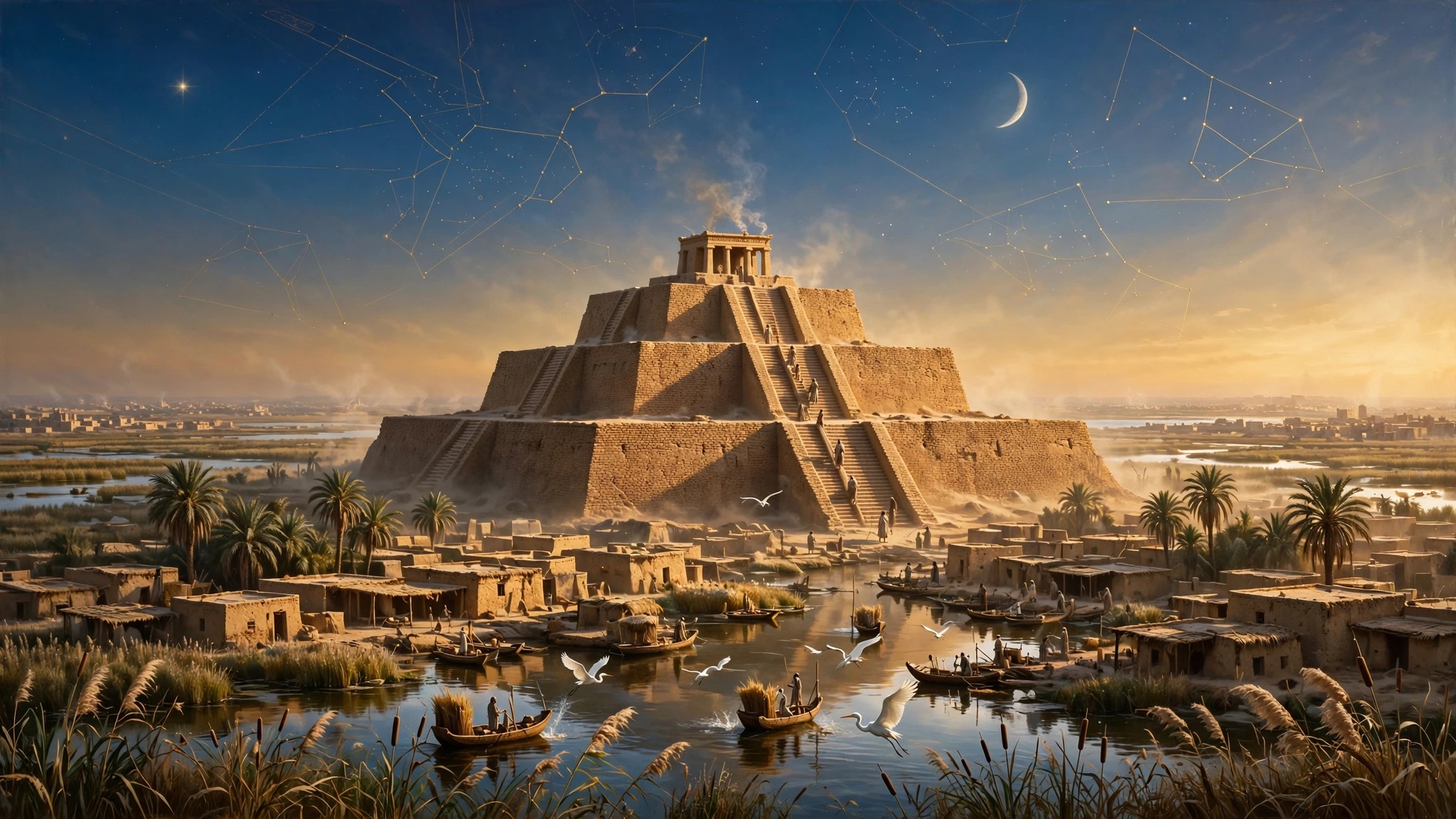
Sumerian cities grew out of the marshes of the far south, at Eridu, Uruk, Ur and Lagash, and by around 3200 BCE the accountants of Uruk were writing on clay. The Sumerians believed that kingship had come down from heaven, and that a great flood had once swept everything away. Their own lists of kings divide history into the time before the flood and the time after.
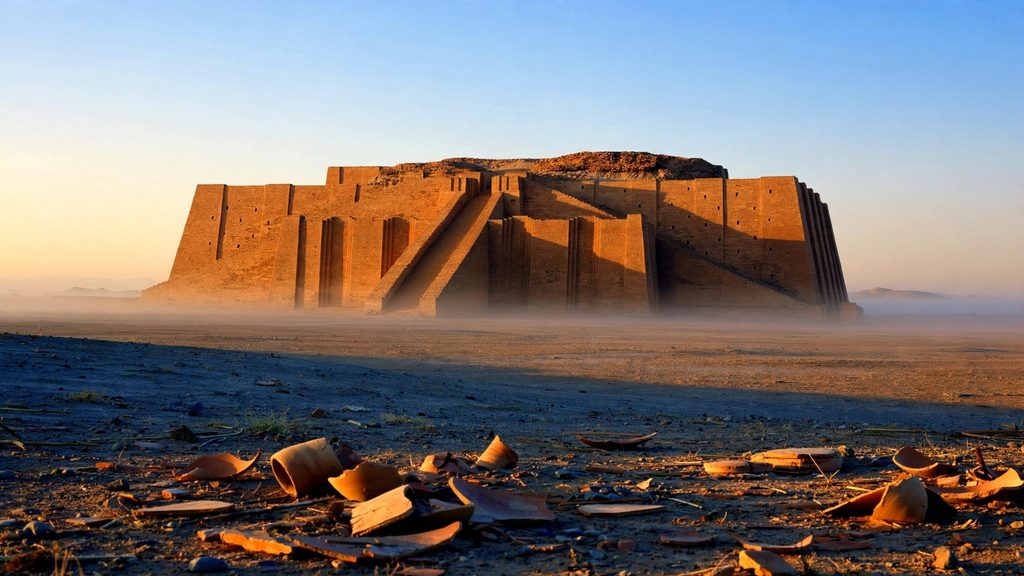
The tides that built Sumer. A study published in PLOS One in 2025 argues that the twice-daily tides once reaching far up the Tigris and Euphrates gave the first farmers a natural irrigation system. The link to the flood myths is still a theory.
The Sumerian King List. Eight kings ruled before the Flood for a total of 241,200 years, according to the oldest copy. Six of their reigns divide evenly by 72, the number tied to the precession of the equinoxes. Two do not, and a later Greek version fixes all of them.
The fish-people from the sea. The Babylonian priest Berossus told of Oannes, a being half fish and half man who came out of the Persian Gulf to teach humanity writing and the arts. The Indian Mahabharata tells of an underwater race the gods sent a hero to destroy. The file shows why they are not the same story.
The scorpion-men. Scorpion-men guard the mountain of the sunrise in the Epic of Gilgamesh and fight for Tiamat in the Enuma Elish. A viral story of a serpent queen leading them in a war before the Flood has no tablet behind it.
Mesopotamian mermaids. Fish-tailed figures appear in Mesopotamian art thousands of years before the mermaids of Europe. The “Queensland skeleton” shared as modern proof traces to a 2012 television mockumentary.
Gods, Myths and Demons
The Sumerians and their heirs wrote down the lives of their gods in hymns, epics and laments, and they feared a crowded world of demons, which they fought with spells. Some of the stories in these tablets were later retold in the Bible. Others have been retold, much less faithfully, on the internet.
Inanna. The Lady of Heaven, goddess of love, war and the planet Venus, went down through seven gates to the land of the dead, died on a hook and came back. The oldest story of a deity who dies and returns, and what the tablets say about it.
The Tablet of Destinies. In a Sumerian and Akkadian myth, the bird-demon Anzu steals the tablet that gives the king of the gods his power. The modern retelling renamed the thief and added comets and genetics that appear on no tablet.
Adam and Eve before Genesis. In the Akkadian epic of Atrahasis, around 1700 BCE, the mother goddess mixes clay with the flesh and blood of a slain god to make the first humans, who are created to do the work the gods are tired of. The file traces the road from those tablets to the garden of Eden.
Lilith. Genesis tells the creation of woman twice. Medieval Jewish writers filled the gap with Lilith, Adam’s first wife, whose name goes back to the lilitu demons of Mesopotamia. The file separates the demon, the legend and the modern myth.
The Master of Animals. A figure standing between two animals, holding them in check, appears on Sumerian seals and on objects from Turkey to Denmark across five thousand years. Why the image travelled so far is still argued over.
The epilepsy demon. An Assyrian tablet of about 650 BCE, written by a family of exorcists, holds a remedy for seizures and, faintly drawn at its foot, the demon blamed for them. An Assyriologist at the University of Copenhagen was the first to notice the drawing in a century.
The Anunnaki, Sitchin and Nibiru
In the tablets the Anunnaki are the great gods, and in the Descent of Inanna they are the judges of the dead. In 1976, in The Twelfth Planet, Zecharia Sitchin claimed they were astronauts from a hidden planet called Nibiru, who came to Earth to mine gold and engineered humans as their workers. Assyriologists rejected his translations from the start, and his ideas went on to inspire a whole literature of ancient astronauts, doomsday planets and reptilian rulers. These files follow each claim back to the tablet it rests on.
The Anunnaki creation myth. What the Sumerian and Akkadian texts say about the making of humanity, and how a chain of books, documentaries and cable television turned it into a story of genetic engineering.
Engineered against the Neanderthals. Modern humans replaced the Neanderthals over tens of thousands of years, ending around 40,000 years ago. The claim that the Sumerian texts describe our species being designed for that purpose is set against the genetics.
The key in the clock. The sixty-minute hour and the 360-degree circle descend from the base-60 counting of Mesopotamia. Where that system came from, and why the Sumerians credited their gods with it.
Nibiru in the Enuma Elish. The word Nibiru appears in the Babylonian creation epic as the star of Marduk. Sitchin read it as a planet. Babylonian astronomers seem to have meant something else, most likely Jupiter or a point in its path.
The search for Nibiru. Astronomers have spent a century calculating where an undiscovered planet beyond Neptune might be, from Percival Lowell to the Naval Observatory’s Robert Harrington. None of those calculations found Nibiru.
Planet Nine. In 2016 the Caltech astronomers Konstantin Batygin and Mike Brown proposed a giant planet far beyond Neptune to explain the clustered orbits of distant objects. It has not been seen, and it is not Nibiru.
The Coricancha and Nibiru. A gold plate in the Inca temple of the Sun at Cusco is said to show a tenth planet. What the drawing of it records, and how it was drawn into the Nibiru story.
The Tuatha Dé Danann. The divine race of Irish myth has been called a branch of the Anunnaki, a lost tribe of Israel and the source of Tolkien’s elves. The file follows the name back through the medieval manuscripts.
The reptilian hypothesis. How David Icke built a theory of reptilian rulers out of Sitchin’s Anunnaki and the archons of Gnostic texts, and why serpent gods appear in so many mythologies without needing either.
The gold that would not melt. In 2025 physicists at SLAC reported in Nature that gold stayed solid at 19,000 kelvin for a fraction of a second. The Anunnaki gold-mining story attached to it needs no help from physics.
How to Read the Files
Every case file carries a verdict. Documented means the claim holds up against the primary record. Disputed means serious evidence points in more than one direction. Debunked means the story does not survive its own sources. Unresolved means the record runs out before the question does. Invented marks a story told on purpose, kept apart so a legend is never mistaken for a lead. The Verdict Index shows how the stamps add up across the whole archive.
If you are new to Mesopotamia, start with Inanna, whose story is told on the tablets themselves. If you came for the Anunnaki, read the creation myth file and the Enuma Elish file side by side. One sets out what the texts say about the making of humanity, the other what one word in them has been made to carry. The neighbouring civilisation of the Nile has its own path, in our Ancient Egypt case files.
Quick Answers About Sumer
Who was the chief Sumerian god? Enlil, god of wind and air, worshipped at Nippur, was the king of the gods for most of Sumerian history. An, the sky, ranked above him as father of the gods but played a more distant role. In Babylon, Marduk later took Enlil’s place.
Who were the Anunnaki? In Sumerian and Akkadian texts, the Anunnaki, or Anunna, are the great gods, the offspring of An who decree the fates. In some texts they are the judges of the underworld. The idea that they were astronauts from another planet comes from Zecharia Sitchin’s books, from 1976 on.
Will the Anunnaki return? Nothing in the Sumerian texts predicts a return of the Anunnaki. The idea, and the predicted dates for the arrival of their planet Nibiru, come from modern books and websites, and every date set so far has passed.
Is Nibiru real? No planet called Nibiru has been found, and astronomers say a planet on the orbit claimed for it would have been seen long ago. In Babylonian astronomy, Nibiru was a name for the star of Marduk, probably Jupiter or a point in its path.
What is the difference between Sumerian and Babylonian gods? Largely language and time. The Sumerians worshipped the gods first, under Sumerian names. The Akkadian-speaking Babylonians and Assyrians who followed kept most of them under Akkadian names, An as Anu, Enki as Ea, Inanna as Ishtar, and raised their own city gods, Marduk and Ashur, to the top.