



Does the Maya Long Count calendar reset after thirteen baktuns, or does it continue to twenty like every other cycle within it? This is a genuinely contested debate among Maya epigraphers, not settled by the popular “end of the world” reading that made December 21, 2012 into a global media event.
This piece covers what the actual inscriptions say, what real scholars on both sides of the debate argue, and where a popular reading of King Pakal’s tomb inscriptions gets ahead of what the stone actually supports.
What the Long Count Actually Is
The Long Count is a genuinely sophisticated calendar system used by the Maya and predecessor Mesoamerican cultures to track dates across spans far longer than any single human lifetime, built from nested cycles: the kin, a single day, the uinal, twenty days, the tun, eighteen uinals making 360 days, the katun, twenty tuns, and the baktun, twenty katuns, roughly 394 years. Its starting point, corresponding to August 11, 3114 BCE in the proleptic Gregorian calendar, marks a mythological creation date described in the Popol Vuh, the K’iche’ Maya creation narrative, rather than any claimed historical event.
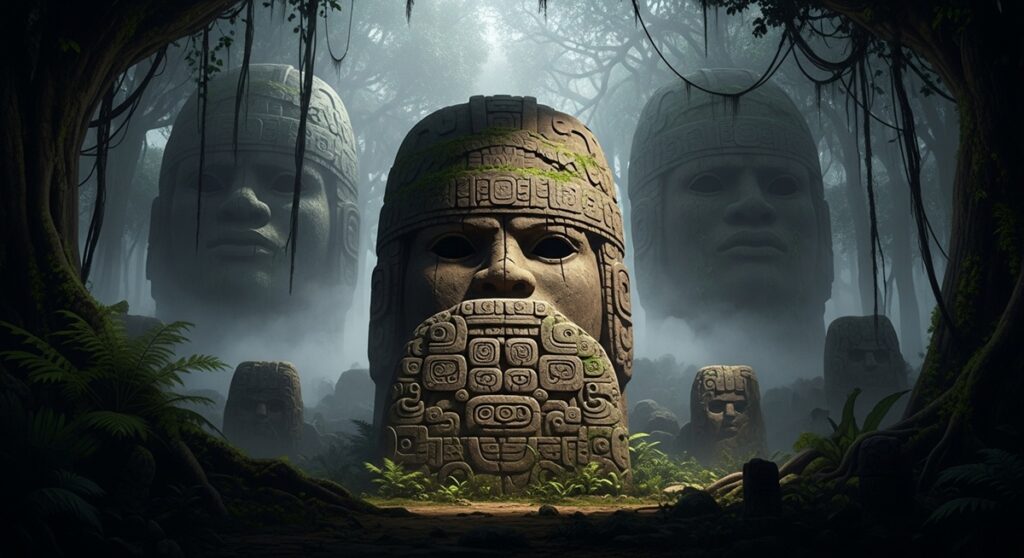
The system’s origins predate the Classic Maya period. The earliest known Long Count inscriptions appear on Olmec-adjacent monuments at Tres Zapotes and Chiapa de Corzo, dated to 36 BCE and 31 BCE respectively, well before the earliest confirmed Maya Long Count date at Tikal in 292 CE. The system’s use continued through the Classic period until the last confirmed Long Count monument, a stela at Ixlu, Guatemala, dated to 910 CE.
The Scholarly Debate | Thirteen or Twenty?
The popular understanding of the 2012 phenomenon treated 13.0.0.0.0, thirteen baktuns from the creation date, as the calendar’s built-in endpoint. This is genuinely disputed among Maya epigraphers, and the dispute predates 2012 by decades. Sir J. Eric S. Thompson, one of the most influential 20th-century Mayanists, argued that the underlying vigesimal, base-twenty structure of the calendar’s higher units, the pictun at twenty baktuns, the calabtun at twenty pictuns, and so on, implies the baktun count should also continue to twenty rather than resetting at thirteen, and that thirteen’s earlier significance was likely an artifact of the system’s origins rather than a hard endpoint for the baktun cycle specifically.

Surviving inscriptions support the continuity case. At Palenque’s Temple of the Inscriptions, a monument built for King K’inich Janaab’ Pakal, a text beginning with his birth date, 9.8.9.13.0, projects forward to a date written as 1.0.0.0.0.8, a full pictun’s distance from Pakal’s era, and concludes with a calculated future date corresponding to October 13, 4772 CE. This calculation only produces such a clean, zero-aligned result if the baktun count continues past thirteen to twenty, exactly as Thompson’s model predicts. If the system reset at thirteen baktuns, the same arithmetic would land on a considerably less elegant figure. Related inscriptions at Palenque’s Temple of the Cross reference full Long Count dates for mythological events both before the 3114 BCE creation date and in the centuries following it, treating the count as a continuous, unbroken system rather than one bounded by the thirteenth baktun.
Tortuguero Monument 6
Only one known Classic Maya inscription explicitly references the 13.0.0.0.0 date corresponding to December 21, 2012: Tortuguero Monument 6, from a site in the Mexican state of Tabasco. This is worth being precise about, because it’s the sole textual basis for the entire 2012 phenomenon. The inscription is authentic, and it is also badly damaged: erosion has destroyed the portion of the text that would describe what, if anything, was expected to happen on that date. What survives references the god Bolon Yokte’ K’uh in connection with the date, but the specific verb and context describing the god’s expected action are lost. Popular treatments of this inscription filled that gap with apocalyptic language the surviving stone simply does not contain. The honest archaeological position is that the inscription’s actual content on this point is unknown, not that it predicted catastrophe.

The Mythological Dates at the Temple of the Cross
The Temple of the Cross, part of the same Cross Group complex at Palenque as the Temple of the Inscriptions, contains further inscriptions worth covering in their own right. A panel there describes the birth of a mythological figure often called Muwaan Mat, sometimes identified in scholarly literature as a maternal or foundational figure in the Palenque Triad’s mythology, dated to 12.19.13.4.0, corresponding to December 9, 3121 BCE, seven years before the standard 3114 BCE creation date. From this figure’s mythological account, the text describes the birth of GI, the first of the three deities comprising the Palenque Triad, on a date corresponding to October 23, 2360 BCE, calculated using a full Long Count notation rather than an abbreviated distance number.
This detail matters for the continuity debate discussed above: Palenque’s scribes used complete Long Count notation, not shorthand, to record dates both well before and well after the 3114 BCE creation point, treating the calendar as a single, unbroken mathematical system extending in both directions rather than a cycle bounded by any particular baktun count. Modern readers, accustomed to calendars that reset, sometimes project that expectation onto a system that Palenque’s own scribes appear to have treated as genuinely continuous.
The Aztec Comparison
It’s worth briefly noting how a related but culturally distinct tradition, the Aztec creation narrative, handled similar themes of cyclical world-ages, since it’s sometimes confused with Maya cosmology despite substantial differences between the two systems. Aztec accounts describe a sequence of prior worlds, or “suns,” each ending in a specific kind of catastrophe, jaguars, wind, fire, flood, with the current, fifth sun destined to end in an earthquake at an unspecified future date. Unlike the Maya Long Count, the Aztec calendrical system did not produce a single, precisely calculated end date analogous to December 21, 2012, and conflating the two traditions, as popular 2012 coverage sometimes did, obscures meaningful differences between two separate Mesoamerican cultures with their own distinct cosmological frameworks.
What Baktun Endings Actually Correlated With Historically
Several historical transitions in Mesoamerican history do line up, at least loosely, with baktun endings, and this is worth reporting accurately rather than as coincidence-hunting. Around 830 CE, near the tenth baktun’s close, the Classic Maya collapse saw dozens of major cities depopulated over a period of decades, an extensively studied event whose causes, drought, warfare, political fragmentation, and resource overreach among the leading explanations, remain an active area of archaeological research. Around 1224 CE, near the eleventh baktun’s close, Chichén Itzá’s political dominance waned as Mayapán’s influence grew in the Yucatán. In 1697, following the twelfth baktun’s close in 1618, the last independent Maya kingdom, the Itza at Nojpetén, fell to Spanish conquest.
These correlations exist but should be read cautiously. Given how many centuries of Mesoamerican history exist to draw from, and how broadly “political transition” can be defined, some correlation between baktun boundaries and major historical shifts is close to statistically inevitable rather than necessarily meaningful, and no rigorous, quantified study establishing these correlations as significant beyond chance has been published. They’re genuinely interesting historical bookends. They aren’t established evidence that baktun transitions caused or predicted the events near them.
The Itza Kingdom’s Actual, Well Documented End
The 1697 fall of Nojpetén deserves a fuller, more precise account than a passing mention, since it’s a well documented historical event with its own considerable significance independent of any calendrical framing. The Itza Maya kingdom, centered on an island capital in Lake Petén Itzá in what is now northern Guatemala, was the last independent, unconquered Maya polity in Mesoamerica, having successfully resisted Spanish conquest for roughly 175 years after the fall of the last major Aztec and other Maya centers. Spanish forces under Martín de Ursúa finally took the city in 1697, following decades of diplomatic contact and earlier failed conquest attempts, ending the last politically independent Maya state and completing the Spanish conquest of Mesoamerica in the strict political sense, even as Maya cultural and linguistic continuity has persisted unbroken to the present day across millions of Maya people living in the region.
The proximity of this documented conquest to a baktun boundary is a genuine historical curiosity worth noting honestly, the same way the other correlations discussed above are worth noting honestly, without inflating it into evidence of calendrical causation the historical record itself doesn’t support. The Itza rulers’ own decision to eventually negotiate rather than continue resisting had well documented political and military causes, sustained Spanish pressure, dwindling resources, and shifting regional alliances among them, not a passive submission to cosmic timing.
Pakal’s Sarcophagus Lid

Pakal’s sarcophagus lid, discovered in Palenque’s Temple of the Inscriptions, is famous partly because of a claim popularized by Erich von Däniken in his 1968 book Chariots of the Gods?, that the carved imagery depicts Pakal operating a rocket ship or spacecraft. This interpretation is not accepted by any credentialed Maya archaeologist or epigrapher and has been thoroughly addressed in the mainstream scholarly literature: the lid depicts, in imagery and symbolism consistent with well-documented Maya cosmology found across many other Maya sites, Pakal falling into the open jaws of the underworld at the base of the World Tree, the axis mundi connecting the underworld, earthly, and celestial realms in Maya belief, with the tree’s branches rising toward the celestial bird associated with the sky above him. This is a coherent, independently attested piece of Maya religious iconography, not an ambiguous image requiring an exotic explanation.
What the lid’s actual inscriptions do describe, accurately, is Pakal’s lineage, his conquests, and his connection to Palenque’s patron deities, GI, GII, and GIII of the Palenque Triad, whose own mythological birth dates the temple’s texts calculate using the same continuous Long Count system discussed above. This is a king asserting dynastic and cosmological legitimacy through calendar mathematics, a genuinely sophisticated form of royal propaganda common across Classic Maya rulership, not a coded prophecy of personal vengeance or literal return.
What Actually Happened After 2012

December 21, 2012 passed without the catastrophe popular media had speculated about, which is consistent with the archaeological reality that no actual Maya inscription ever predicted one. Subsequent global events, including the COVID-19 pandemic, continued development of artificial intelligence, and ongoing climate change, have no established connection to the Long Count calendar or to Pakal’s inscriptions specifically. These are significant events with their own well documented, entirely separate causes, epidemiological, technological, and environmental respectively, and connecting them to a seventh-century Maya king’s tomb inscription requires no more than the very general human tendency to find pattern and meaning in a coincidence of timing, a tendency worth naming honestly rather than treating as its own evidence.
What remains genuinely unresolved is the scholarly question this piece opened with: whether the Long Count’s baktun count continues past thirteen to twenty, as the evidence from Palenque’s own monumental inscriptions suggests, or whether some other logic governed its higher cycles that current scholarship hasn’t fully reconstructed. That’s a live, active question in Maya epigraphy, worth far more attention than the popular doomsday reading that displaced it in public conversation for the better part of a decade. Answering it properly would require more of exactly the kind of careful, comparative epigraphic work Thompson and his successors have already begun, checking additional inscriptions across other Maya sites for further examples of continuous versus resetting notation, rather than treating any single monument’s mathematics as the final word.
What the actual archaeological record supports, clearly and without needing embellishment, is this: a genuinely sophisticated ancient calendrical system, built by mathematically capable cultures who tracked dates spanning millions of years in both directions from their own present, used by actual kings for actual dynastic purposes, and interpreted by scholars who continue to disagree, in good faith and on the surviving textual evidence, about exactly how far its largest cycles were meant to extend. That’s a substantial enough mystery on its own terms. It doesn’t need a vengeful returning king or a coded 21st-century prophecy to be worth taking seriously.