



Before Genesis there was clay.
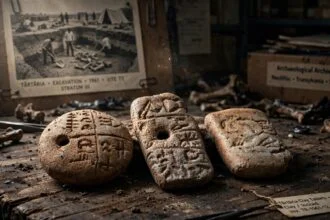
Not metaphorically. In the Akkadian epic Atrahasis, dated to approximately 1700 BCE and therefore predating the composition of the relevant Genesis chapters by roughly a thousand years, the creation of humanity is described with material precision: a lesser deity is sacrificed, his flesh and blood mixed with clay by the mother goddess Nintu, and from this mixture human beings are formed. The text is explicit about purpose: humans were made to labor, to carry the work that the lesser gods had grown too exhausted to continue.
With his flesh and blood, let Nintu mix clay, so that god and man may be thoroughly mixed in the clay.
The Hebrew text of Genesis 2:7 describes God forming Adam from the dust of the ground, the Hebrew adamah, and breathing life into him. The structural elements are the same: a divine creator, raw earth as the medium, and the infusion of something divine into the material substance that transforms it into a living human being.
The question of whether this parallel reflects Genesis borrowing from Atrahasis, both texts independently encoding a genuinely ancient belief about how humanity was made, or something whose character the recorded parallel between them raises without either text fully resolving, is the analytical question that comparative mythology has been arguing about for a century without conclusion.
What is not argued about is the parallel. It is there. It is precise. It predates Genesis by a millennium in its written form.
The Babylonian Exile and the Transmission Mechanism
The documented historical context for the Genesis-Mesopotamian parallel is the Babylonian Exile, the period beginning in 597 BCE when Nebuchadnezzar II deported significant portions of the Judean population to Babylon, where they remained for approximately seventy years before Cyrus the Great’s documented 539 BCE conquest of Babylon allowed their return.
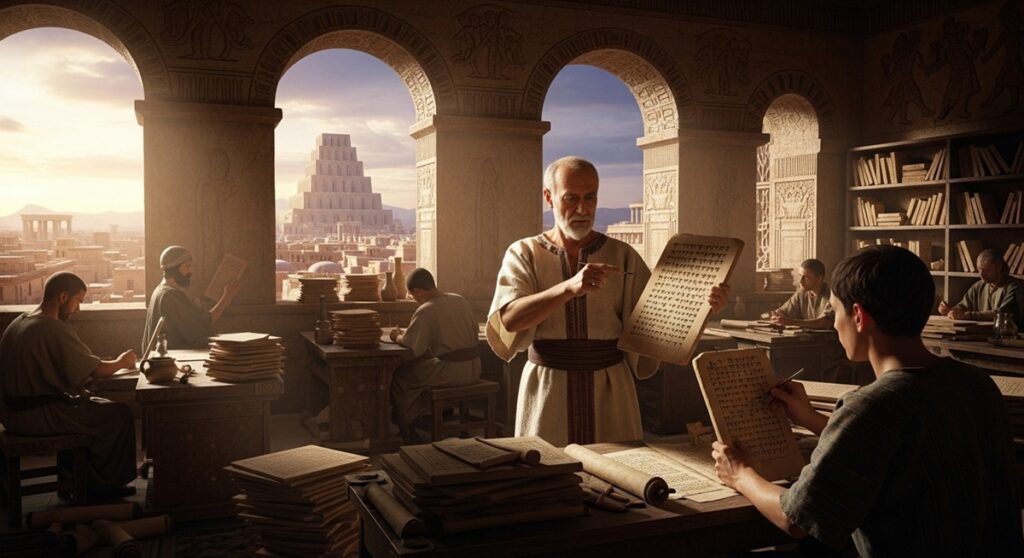
Babylon in the sixth century BCE was the intellectual center of the ancient Near East. Its libraries contained the accumulated cuneiform literature of three thousand years of Mesopotamian civilization, including the Atrahasis epic, the Epic of Gilgamesh, and the Enuma Elish creation narrative. The exiled Judean community’s documented encounter with this literary corpus during the Exile period is the historical mechanism that the mainstream scholarly consensus identifies as the transmission pathway for the structural parallels between Genesis and its Mesopotamian predecessors.
Whether the Genesis authors consciously adapted Mesopotamian narratives into a monotheistic theological framework, inherited a common oral inheritance that the Mesopotamian texts had written down first, or were recording the same genuinely ancient knowledge that the Mesopotamian texts preserved in different cultural encoding, is the question that the transmission mechanism does not fully resolve.
The documented scholarly consensus stops at cultural transmission. The library’s framework motivates asking what both were transmitting from.
The Ninti Pun and What It Preserves
The single most precisely significant parallel in the entire Genesis-Mesopotamia comparison is not the clay creation, not the garden paradise, not the flood. It is a Sumerian pun.
In the Sumerian language, the word ti means two things simultaneously: rib and life. The Sumerian myth Enki and Ninhursag, dated to approximately 2000 BCE, describes Enki eating forbidden plants in the paradise of Dilmun and being cursed with illness in multiple body parts including his rib. Ninhursag heals him by birthing a goddess for each afflicted part. The goddess born to heal the rib is Ninti, whose name contains the pun: Nin-ti means both Lady of the Rib and Lady Who Makes Live.
In Genesis 2:21-22, Eve is created from Adam’s rib. In Genesis 3:20, Adam names her Eve, meaning mother of all living.
The Hebrew language has no rib-life pun. There is no word in Hebrew that means both rib and life. The Genesis narrative includes both elements, the rib origin and the life-giving name, but without the linguistic foundation that makes the Sumerian version a unified wordplay. The Genesis text preserves the narrative elements of the Sumerian pun without the pun itself.
This is the documentary signature of a text that has inherited material it no longer fully understands. The Genesis authors preserved the rib and the life but lost the linguistic key that connected them. The Sumerian text preserves the key. This relationship between the two texts is more precisely diagnostic of literary inheritance than any of the more general thematic parallels, because it is not a parallel that could arise from independent invention: two independent cultures do not independently produce the same connection between rib and life unless one of them inherited it from the other or both inherited it from a common source.
Whether the common source was the oral inheritance of the ancient Near East transmitted through the Babylonian Exile’s cultural encounter, or something whose antiquity predates the Sumerian writing system that first recorded it, is the question the pun preserves without answering.
Enkidu Before the Fall
The Epic of Gilgamesh’s Enkidu is the oldest documented literary figure whose narrative function parallels Adam’s most precisely, and the parallel has elements whose character the standard comparative analysis does not fully develop.
Enkidu is created from clay by the goddess Aruru, lives in the wilderness in harmony with animals, is clothed by nature rather than by civilization, and exists in a state of innocent integration with the non-human world. He does not know what he is. He does not know he is different from the animals he runs with. He has not yet encountered the knowledge that will separate him from that integration.
The harlot Shamhat’s encounter with Enkidu and their subsequent seven days of intimacy is the event that initiates the separation. When it is done, the gazelles flee from him. The animals of the field that had been his companions will not approach him. He has gained something whose character the text describes as wisdom and human consciousness, and he has lost something whose character the text describes as the wild, the direct integration with the non-human world that he had before.
The text then states: he has become wise, he is like a god.
Genesis 3:5 records the serpent’s promise: you will be like gods, knowing good and evil. Genesis 3:22 records God’s subsequent statement: the man has become like one of us, knowing good and evil.

The phrase, has become like a god or like gods, appears in both the Gilgamesh narrative describing Enkidu’s post-innocence transformation and in the Genesis narrative describing Adam and Eve’s post-fruit transformation. In both cases the transformation involves the acquisition of a kind of knowledge. In both cases it produces separation from the integration that preceded it.
Whether this parallel reflects the documented transmission of Gilgamesh material into the Genesis text through the Babylonian Exile, or whether both texts are encoding something about a genuine ancient event in the history of human consciousness, in which a kind of knowledge was acquired that permanently altered the relationship between human beings and the non-human world they had previously been integrated with, is the question that the parallel raises at a level the standard comparative mythology framework does not fully address.
The Serpent’s Function
The serpent in Genesis is one of the most analyzed figures in the history of religious interpretation, and its Mesopotamian parallels add a dimension whose development the standard comparative analysis consistently underemphasizes.
In the Epic of Gilgamesh, Gilgamesh obtains the plant of rejuvenation from the bottom of the sea after considerable effort and cost. While he sleeps near a pool on his return journey, a serpent smells the plant and steals it, shedding its skin in renewal as it disappears. Gilgamesh weeps. The serpent has taken the thing that would have made him immortal.
The serpent’s recorded symbolism in ancient Near Eastern iconography is not simply deception: it is specifically associated with transformation through the documented image of shed skin, with wisdom through its association with the god Enki whose symbol in Mesopotamian iconography includes serpents, and with the knowledge of things hidden or forbidden.
In Ugaritic material recorded in texts from Ras Shamra in modern Syria, serpent figures are associated with the boundary between human and divine knowledge in ways whose character parallels both the Mesopotamian and Genesis versions without being reducible to either.
Whether the serpent in Genesis inherits this accumulated Near Eastern symbolism, in which serpents represent the guardians or thieves of transformative knowledge at the boundary between human and divine, or whether all of these cultures independently arrived at the same serpent symbolism because something about serpents, their skin shedding, their sudden appearance, their association with the earth’s interior, produced the same symbolic content in multiple independent cultural contexts, is the question that the cross-cultural distribution of the motif raises.
The serpent in Genesis does what serpents do across the entire documented Near Eastern record: it offers transformative knowledge at a cost. The cost in Genesis is mortality. The cost in Gilgamesh is immortality. The reversal between the two versions is itself analytically significant: in one version, the serpent’s intervention costs the human protagonist eternal life; in the other, the serpent’s intervention gives human beings the knowledge that makes them aware they will die.

Whether this reversal is a deliberate theological inversion by the Genesis authors, encoding a critique of the Mesopotamian understanding of the serpent’s role, or whether both are describing the same ancient event from different perspectives whose difference reflects genuinely different theological conclusions about what the event meant, is the question the comparison motivates without the available evidence resolving.
What Was Being Written Down
The Atrahasis epic, the Epic of Gilgamesh, the Myth of Adapa, and Enki and Ninhursag are not the origins of the material they record. They are the first written versions of stories whose oral antecedents extend significantly further back than the writing systems that first captured them.
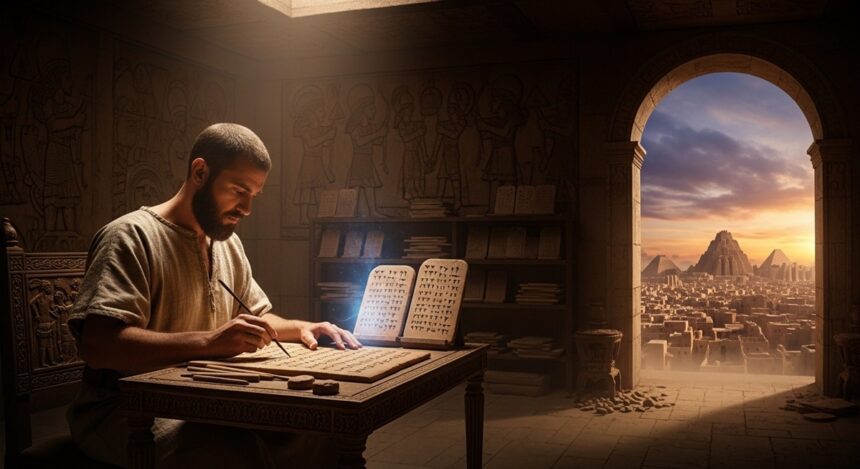
The Sumerian writing system developed approximately 3200 BCE. The Atrahasis composition in its surviving written form dates to approximately 1700 BCE. But the stories Atrahasis recorded were not invented by the scribes who wrote them. They were the oral inheritance of a civilization that had been asking questions about human origins, divine creation, and the nature of the knowledge that separates humans from both animals and gods for as long as there had been humans asking questions.
Genesis was written during or after the Babylonian Exile, approximately 600-500 BCE. Its scribes absorbed the accumulated Mesopotamian literary corpus and reformatted it within a monotheistic theological framework. The result was a narrative whose structural elements, clay creation, paradise garden, forbidden knowledge, serpent, expulsion, preserved the essential architecture of the Mesopotamian source material while replacing its polytheistic cosmology with a single divine creator whose moral demands on humanity were different from the capricious gods of Atrahasis.
What both were writing down, and what neither of them fully explains, is where the original question came from.
Someone, before Atrahasis and before Genesis and before any writing system existed to record it, looked at the nature of human consciousness and asked why it was the way it was. Why did humans know they would die when the animals did not. Why did humans experience the world as separated from it rather than integrated within it. Why was there a knowledge that, once acquired, could not be returned from.
The answer both preserved, in different languages and different theological frameworks but with the same narrative elements, was that something was done to human beings. Something was mixed into the clay. Something was eaten. Something was taken.
The Ninti pun survived the translation. The rib survived the translation. The serpent survived the translation. The knowledge and its cost survived the translation.
The answer both preserved, across three thousand years of independent cultural development, is that humans are not simply what they appear to be, and that the nature of what they are involves something that happened at a moment whose memory both texts kept alive in clay and ink long after the moment itself passed beyond the reach of any living witness.