



Mermaid mythology is ancient and deserves serious treatment as cultural history spanning thousands of years and multiple continents, from Mesopotamia to medieval Europe to Edo-period Japan.
The specific “modern evidence” that gets attached to it today, a Queensland skeleton, drone footage of a mermaid school, is a different matter entirely, and this piece will separate the two clearly rather than blending them into a single, undifferentiated case.
The Ocean We Haven’t Mapped
Oceans cover roughly 71 percent of Earth’s surface, and the commonly cited estimate that only a small fraction of the ocean floor has been mapped in detail deserves a precise framing rather than the vaguer, more dramatic version that usually circulates: as of the mid-2020s, roughly a quarter of the seafloor has been mapped at modern high resolution through international efforts like the Seabed 2030 project, a significant improvement over the low single digits often quoted from older estimates, though still leaving most of the deep ocean unmapped in detail. A widely cited 2011 estimate published in PLOS Biology by Camilo Mora and colleagues proposed there are likely around 8.7 million total species on Earth, with roughly 2.2 million of those in the ocean specifically, and that the large majority remain formally undescribed by science. This is peer-reviewed marine biodiversity research, and it does mean the ocean holds many undiscovered species, mostly smaller organisms like invertebrates, deep-sea fish, and microorganisms rather than large, undiscovered humanoid populations.
The Water Locked in Solid Rock, Not a Hidden Ocean
This needs a direct correction, because it’s the piece’s most seriously misrepresented claim. In 2014, a team led by geochemist Graham Pearson at the University of Alberta, along with related work by geophysicist Steven Jacobsen at Northwestern University, confirmed the presence of a mineral called ringwoodite in a diamond that had been carried to the surface by a volcanic eruption, containing water bound within its crystal structure at depths of roughly 410 to 660 kilometers in Earth’s mantle transition zone. This is significant, peer-reviewed geology, published in the journal Science, and it does suggest the total water locked in this layer could be comparable to or exceed the volume of Earth’s surface oceans combined.
What this discovery does not describe, and what needs to be stated plainly, is a hidden liquid ocean anyone or anything could swim in, let alone a habitat for a civilization. The water in ringwoodite exists as hydroxide ions chemically bound within solid rock, at pressures and temperatures that would be instantly lethal to any known biological organism, hundreds of kilometers beneath any liquid water an organism could actually inhabit. Treating this discovery as evidence for an “underwater empire” or a habitable “hidden expanse below” fundamentally misrepresents what the researchers actually found. It’s a fascinating discovery about the deep water cycle that shapes plate tectonics and volcanism. It has no bearing on where any organism, mermaid or otherwise, could live.
Oannes and the Mesopotamian Tradition
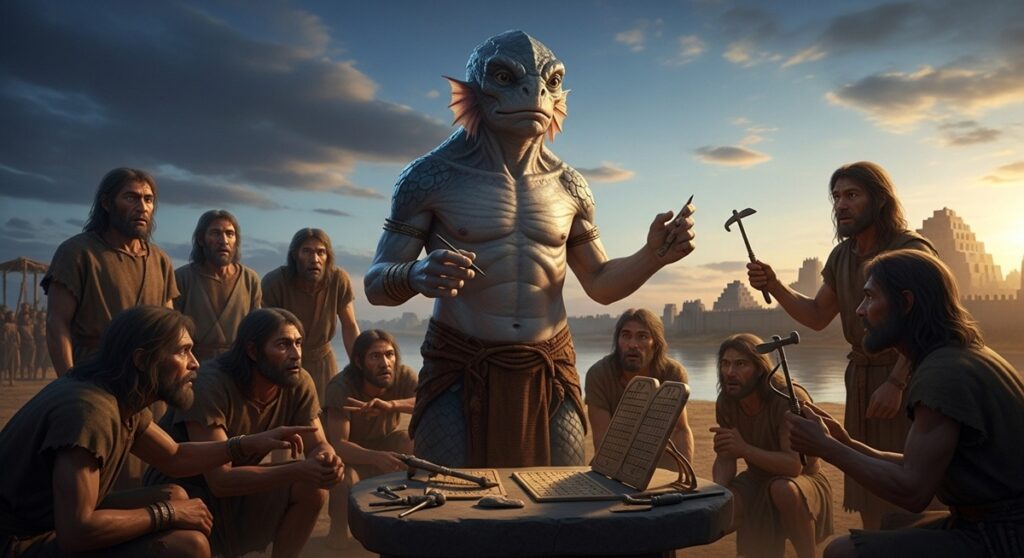
The ancient mythological material here deserves serious engagement on its own terms, as cultural and religious history rather than as literal biological testimony. Berossus, a Babylonian priest-historian writing in the 4th to 3rd centuries BCE, described in his History of Babylonia a figure named Oannes, part fish and part man, who emerged from the Persian Gulf to teach early Mesopotamians writing, agriculture, and civic organization. This account survives today only through later summaries by Alexander Polyhistor and the Christian historian Eusebius, since Berossus’s original text has been lost, a limitation worth acknowledging rather than glossing over. Berossus’s own term for these figures, often rendered as “Annedotus,” has been interpreted by different scholars in different ways, and the framing of them as literal amphibious beings versus a symbolic or ritual figure representing accumulated Mesopotamian religious and scientific knowledge remains a subject of scholarly discussion rather than a settled question.
Derketo, the Gorgon, and Pausanias’s Preserved Bodies
The 2nd-century Greek writer Lucian’s On the Syrian Goddess describes a fish-tailed idol at the temple of Hierapolis, associated with the goddess Derketo. The connection some modern commentators draw between Greek “Gorgona” and the Russian word for mermaid is a linguistic coincidence across unrelated language families rather than evidence of shared ancient observation, Russian and Greek belong to entirely separate branches of the Indo-European language family and this kind of surface phonetic similarity between words in different languages is common and not, on its own, meaningful evidence of a shared origin.
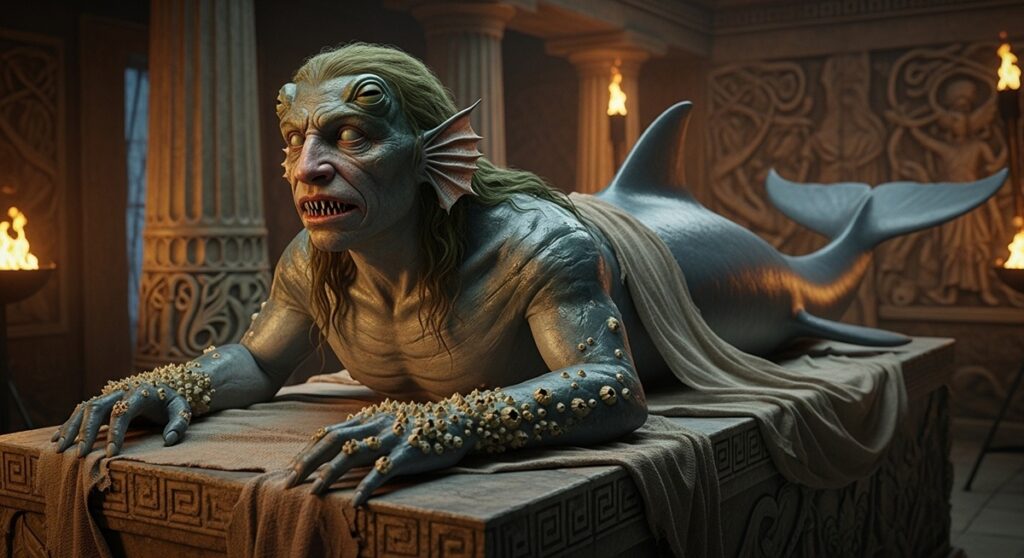
Pausanias, the 2nd-century Greek geographer, did describe preserved “triton” specimens displayed in temples in his extant work Description of Greece. This is ancient testimony that deserves to be read as testimony, meaning as evidence of what people in antiquity claimed to see and display, without requiring the displayed objects themselves to have been authentic hybrid creatures. The ancient world had a well established tradition of composite curiosities, often assembled from actual animal parts, fish tails, monkey torsos, and other components combined and preserved to represent mythological beings, displayed in temples and later in early modern “cabinets of curiosities” across Europe and Japan for exactly this purpose. The most famous surviving example, the 19th-century “Fiji mermaid” exhibited by P.T. Barnum, was explicitly confirmed to be a composite of a monkey torso sewn to a fish tail, and this general practice of constructing composite curiosities has a long, well recorded history independent of any hybrid creature ever existing.
The Kappa and Global Water-Spirit Folklore
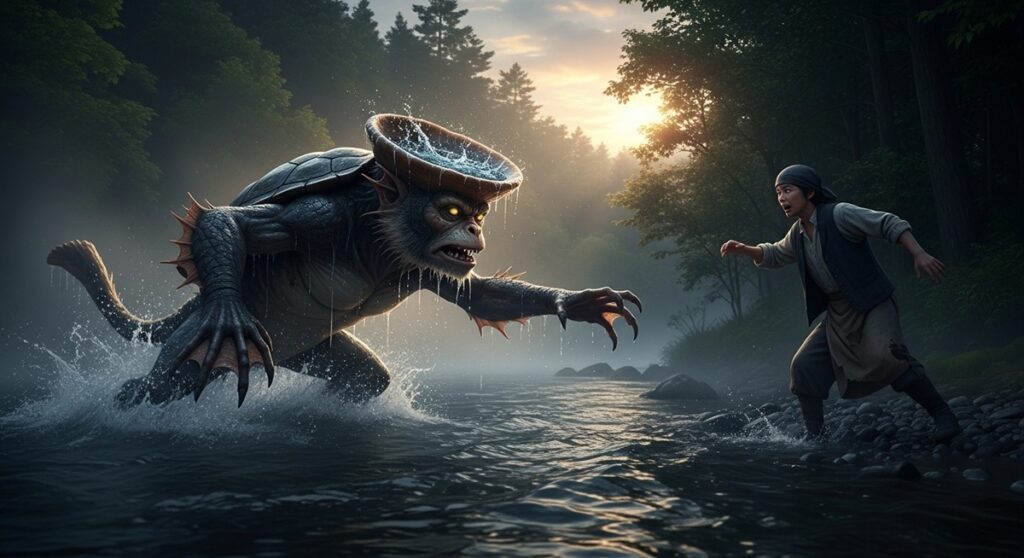
Japan’s kappa, Scotland’s selkies, and Ireland’s merrows are extensively studied folkloric traditions, and their cross-cultural recurrence is worth appreciating as exactly what it is: a pattern in human storytelling about water, danger, and the boundary between the human and non-human world, not evidence that a single biological species inspired all of them independently. Folklorists have long studied why water-associated hybrid beings recur so consistently across unconnected cultures, and the leading explanations center on universal human experiences, drowning deaths, the danger and unpredictability of open water, and the psychological power of boundary crossings between land and sea, rather than on any shared biological encounter.
Sirens | A Different Creature Entirely
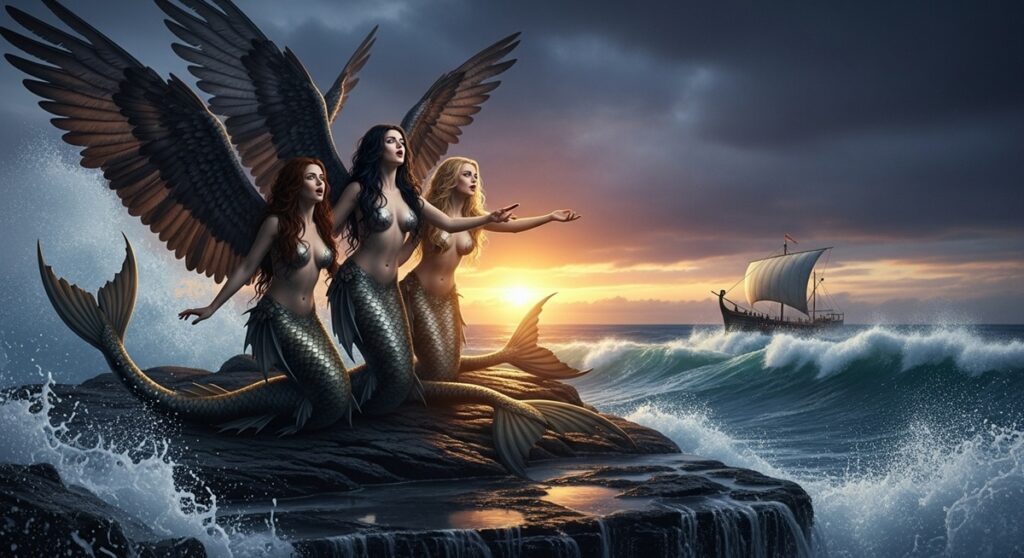
It’s worth being precise about a point of confusion in how these traditions get discussed: in Homer’s Odyssey, one of the oldest and most influential sources for this whole cluster of myths, the sirens are explicitly described and depicted in surviving ancient Greek art as bird-women, part woman and part bird, not fish-tailed beings at all. The later shift toward depicting sirens as fish-tailed, more mermaid-like figures happened gradually over centuries, particularly in medieval and Renaissance European art, as the siren and mermaid traditions blended together in popular imagination even though they began as separate mythological categories in ancient Greek sources. This kind of gradual conflation between originally distinct mythological figures is itself a well studied, ordinary process in the history of folklore, and it’s a more interesting and more accurate explanation for why sirens and mermaids look so similar today than treating their convergence as evidence of a shared biological origin.
Historical Sightings | Sincere Testimony, Not Confirmed Creatures
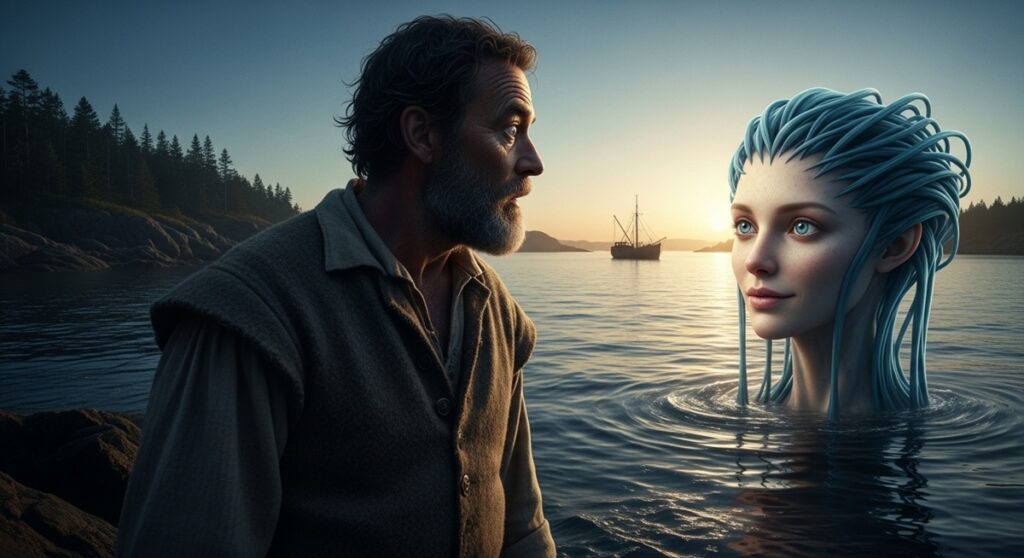
Richard Whitbourne’s 1620 book A Discourse and Discovery of New-found-land is an authentic historical document, and it does include an account of an unusual sighting in St. John’s harbor. This deserves to be reported as exactly what it is: a primary source recording one man’s claimed observation, not independently verified physical evidence. Whitbourne was an experienced mariner, which makes his sincerity plausible, but sincerity is not the same as accuracy, and 17th-century sailors’ accounts of unfamiliar marine life, before modern taxonomy and with limited underwater visibility, commonly misidentified known animals like seals, manatees, dugongs, and large fish. This is a well established pattern in the history of sea-monster and mermaid sightings generally, one that doesn’t require deception on the observer’s part to explain.
The Modern “Evidence” Traces to a Known Hoax
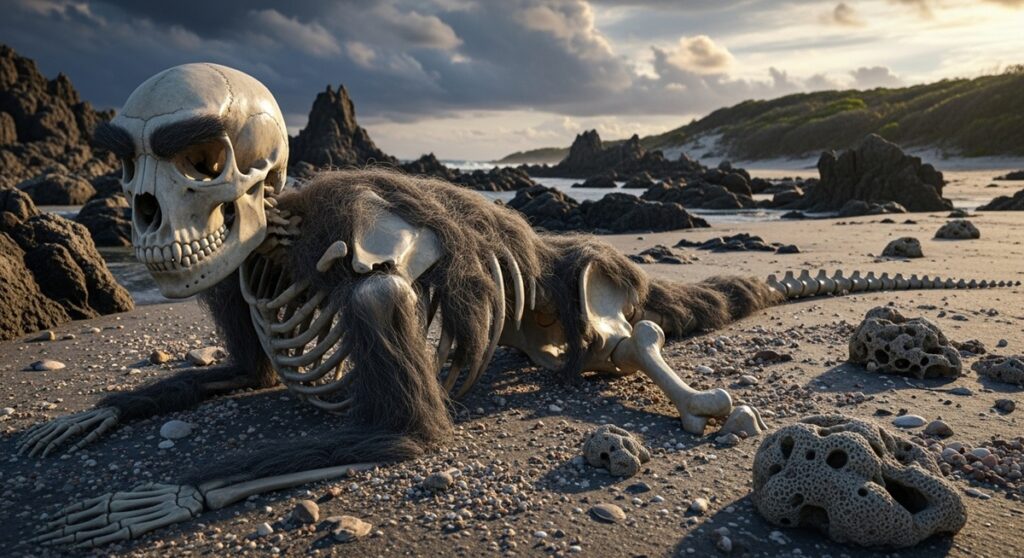
This is where the piece needs its most direct correction. Claims of a mysterious skeleton found on an Australian beach and drone footage of synchronized humanoid swimmers, circulating without named researchers, dated publications, or institutional sourcing, match the pattern of, and in some cases trace directly to, a well known media event: Animal Planet’s 2012 program Mermaids: The Body Found and its 2013 follow-up. Both were explicit mockumentaries, scripted fiction using paid actors playing scientists, with a brief disclaimer buried in the closing credits. Despite the disclaimer, the programs caused significant public confusion, well recorded in contemporaneous social media reaction, serious enough that the United States’ National Oceanic and Atmospheric Administration issued an official public statement clarifying that no evidence of aquatic humanoids has ever been found. Marine biologists who reviewed the programs at the time described them, accurately, as scripted entertainment presented deceptively as factual programming. Any modern claim about skeletal remains or video footage of mermaid-like beings that cannot be traced to a named researcher, a dated publication, or an identifiable institution should be treated with this history in mind.
What the Coelacanth Actually Shows
The coelacanth’s 1938 rediscovery is remarkable, a fish long believed extinct for roughly 66 million years was found alive off the coast of South Africa, caught by a local fishing trawler and identified by museum curator Marjorie Courtenay-Latimer, whose name the species now partly honors, and this stands as one of the most celebrated findings in the history of ichthyology. A second, genetically distinct living population was later confirmed off Indonesia in the late 1990s, adding further peer-reviewed weight to how much modern science still had to learn about this specific lineage. It’s worth being precise about what this demonstrates, though: it shows that a specific, already-known lineage of deep-sea fish persisted undetected far longer than assumed, not that any and all cryptid claims deserve equal credibility by association. The coelacanth’s rediscovery involved a physical specimen, examined, dated, and formally described by credentialed ichthyologists in the peer-reviewed literature, exactly the kind of evidence that remains entirely absent from every modern mermaid claim.
What’s Actually Worth Taking From This
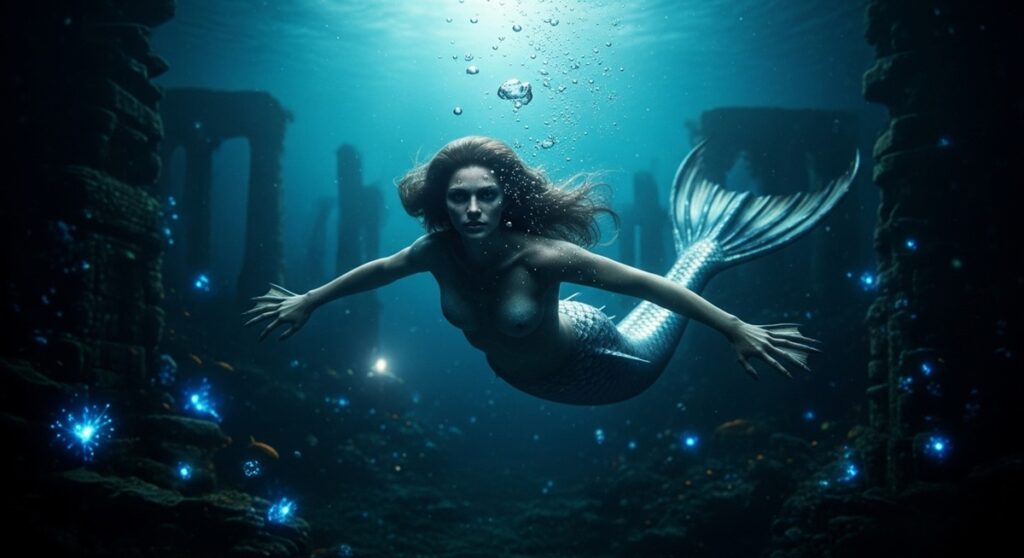
Mermaid mythology’s true value isn’t as a suppressed biological truth waiting for confirmation. It’s as a remarkable, cross-cultural pattern in human storytelling, spanning Mesopotamian priest-historians, Greek geographers, Japanese folklore, and 17th-century mariners, that reveals something consistent about how humans across unconnected cultures have processed the ocean’s danger, mystery, and boundary with the unknown. That’s a substantial, well established body of cultural history on its own terms. It doesn’t need a fabricated Queensland skeleton or misread geology to earn that seriousness, and attaching those fabrications to it only makes the actual history easier to dismiss.
The honest version of this story is, in its own way, more interesting than the fabricated one. It doesn’t require a hidden species evading detection across every ocean expedition of the modern era. It requires only what’s already well documented about human beings: that separated cultures, facing the same vast, dangerous, and genuinely undersurveyed ocean, independently reached for remarkably similar imagery to describe what they didn’t understand, and that a large enough, old enough body of storytelling eventually accumulates the internal consistency that can look, at a glance, like corroborating evidence. The real mystery isn’t whether mermaids exist. It’s why this particular shape, half human, half fish, kept recurring across cultures that had no contact with one another, and that’s a genuinely worthwhile question for folklorists and anthropologists, answerable without ever needing an actual fish-tailed body to wash ashore.
The Hafgufa describes a similar creature in a thirteenth century Norse text, this time framed as a strategic fisher rather than a temptress.