The scorpion-men are ancient. The serpent queen is another story. In the Babylonian Enûma Eliš, a scorpion-man appears among the eleven monstrous beings created by Tiamat for her war against the younger gods. In the Standard Babylonian Epic of Gilgamesh, scorpion-beings guard the gates of Mount Mashu, the cosmic mountain associated with the daily journey of the sun. Those creatures are genuinely part of the surviving Mesopotamian record, real as figures in ancient literature and art, not as historical creatures that once walked the earth. What the tablets do not give us is a serpent queen leading naga, dragons and hybrid armies against a prehistoric kingdom in the Iraqi desert, a lost fortress preserving their history, or a war later erased from civilization’s memory.
That distinction matters because the invented story is built from pieces that sound ancient precisely because some of its pieces actually are. Mesopotamia really did produce terrifying hybrid guardians. Tiamat really did raise an army of monsters. Baghdad really was catastrophically sacked by the Mongols in 1258. Serpent beings really are prominent in South Asian religious traditions. But those facts do not automatically belong to one continuous narrative. Once the seams are separated, the result is stranger than the conspiracy version: the ancient sources already contain monsters, cosmic warfare, underworld gates and a journey through darkness. They simply do not contain the particular war modern retellings have assembled from them.
The Scorpion-Men Come From a Real Mesopotamian Tradition
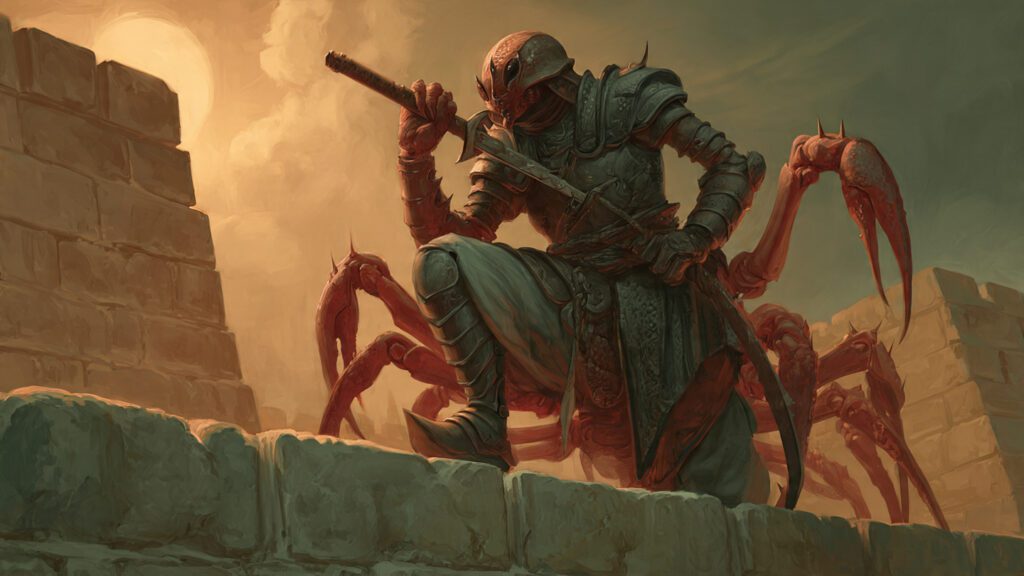
The first thing to rescue from the mythology is the creature itself. The Akkadian girtablullû, commonly translated as “scorpion-man,” appears in ancient Mesopotamian literature and imagery, though its visual details vary across surviving art and texts rather than following one fixed anatomy. In the Enûma Eliš, the Babylonian creation epic, Girtablullû is one of eleven extraordinary beings created by Tiamat for battle. The list includes several serpentine and hybrid creatures, along with the fish-man and bull-man, making clear that Tiamat’s army belongs to the supernatural architecture of the poem rather than to a catalogue of historical animals. The scorpion-man is therefore not a modern invention pasted onto an otherwise realistic ancient story. He is genuinely part of the cuneiform tradition.
Then the creature appears in a very different role in the Standard Babylonian Epic of Gilgamesh. When Gilgamesh reaches the twin mountains of Mashu, he encounters scorpion-beings guarding their gate. The poem describes their terror and deadly gaze and associates them with the passage of the sun, which they guard at sunrise and sunset. The male scorpion-being recognizes that Gilgamesh possesses divine ancestry, while his female counterpart identifies him as two-thirds divine and one-third human. Rather than attacking him, they ultimately permit him to pass into the mountain’s darkness. Assyriologist Andrew George’s standard modern scholarly edition, The Epic of Gilgamesh: The Babylonian Epic Poem and Other Texts in Akkadian and Sumerian, remains the authoritative English translation used by researchers working directly from the surviving Akkadian tablets.
That change of role is one of the most interesting details in the entire tradition. The same broad class of supernatural being can appear in Tiamat’s monstrous army and elsewhere as a guardian at a cosmic threshold. Mesopotamian mythology does not require every supernatural creature to belong to one tidy moral category. The scorpion-man is frightening because he occupies a dangerous boundary: the gate of a mountain associated with the movement of the sun, the darkness beyond ordinary human experience and the route Gilgamesh must take in his search for Utnapishtim.
The Ancient Story Is Stranger Than the Internet Version
Modern retellings often flatten these sources into a single chronology: Tiamat creates monsters, the monsters survive, a serpent civilization inherits them, a queen commands them, a fortress is built, and later civilizations supposedly preserve fragments of the same conflict. The tablets do not tell that story. They give us separate literary contexts separated by centuries of textual development and different narrative purposes. Connecting them requires an argument, and the argument has to be demonstrated rather than assumed simply because the creatures look similar.
This is especially important with the word “scorpion-men.” A name is not a chain of custody. Finding a scorpion-human hybrid in one Mesopotamian text and another serpent-related tradition elsewhere does not establish that both traditions describe the same historical population. It establishes something much safer and much more interesting: that composite supernatural beings were a recurring part of ancient religious imagination, especially around dangerous, sacred or liminal spaces.
The “Lost Library” Story Has a Real Disaster Buried Inside It
Another piece of the modern story borrows its credibility from a real historical catastrophe but moves it to the wrong place. The event usually being invoked is the Mongol sack of Baghdad in 1258, when Hulagu’s forces captured the Abbasid capital and devastated the city. Baghdad really was an extraordinary center of scholarship, translation and intellectual life, and the destruction associated with the Mongol conquest became one of the most famous episodes in the history of intellectual loss in the medieval Islamic world. Tehran, however, was not the city that was destroyed in that episode. The geographical error is not cosmetic: it tells us that the story has already begun to drift away from history before the supposed ancient tablets even enter the picture.
There is an additional reason to be careful here. The famous image of books thrown into the Tigris until its waters turned black with ink has become one of the defining images of the sack of Baghdad, but historians have warned against treating every version of that image as a literal eyewitness measurement. Historian Michal Biran has specifically argued the book-and-river imagery was likely a literary trope developed to demonstrate Mongol barbarity, with the tale in its familiar form seeming to originate centuries after the actual siege rather than from a contemporaneous account. The sack itself is historical, the most cinematic details surrounding it belong to a more complicated transmission history.
That distinction is exactly the one the serpent-queen story needs. A historical catastrophe can become legendary without becoming imaginary. A literary image can become famous without being a forensic report. And a genuine ancient myth can be surrounded by modern inventions without those inventions inheriting the authority of the original text.
There Is No Identifiable Tablet for the Serpent Queen’s War
This is where the evidentiary trail stops. No identifiable Akkadian, Sumerian or Babylonian composition currently provides the claimed story of a serpent queen leading a coalition of naga, feathered serpents, dragons and other hybrid beings against an early Sumerian civilization in the Iraqi desert. There is no named tablet, excavation number, museum catalogue entry, published cuneiform edition or standard scholarly translation establishing the alleged siege. That absence does not prove such a text could never exist somewhere unexamined. It means the burden remains exactly where it belongs: show the tablet, the manuscript, the excavation record, the museum catalogue, or the scholarly edition.
The same problem applies to claims that Greek or Roman authors independently preserved the same conflict. Classical writers certainly wrote about serpents, monsters, strange peoples and legendary creatures. But a claim of continuity requires more than pointing out that both cultures had serpent imagery. It requires an actual ancient passage that can be located, translated and placed in its historical context. Without that, “Greek and Roman writers remembered the same war” is a conclusion without the textual bridge needed to support it.
The Nāgas Are Real Mythology. They Are Not Automatically Mesopotamian.
The appearance of nāgas in these stories creates another seductive shortcut. Nāgas are genuine and important figures in South Asian religious traditions, appearing as serpent or serpent-associated beings across Indian religious literature, art and later Hindu and Buddhist traditions. Their roles can involve guardianship, water, fertility, sacred places and other religious functions, and the tradition developed and changed across centuries.
But “serpent beings exist in Indian mythology” is not evidence that a Mesopotamian scorpion-man narrative and a nāga tradition describe the same people. Similar mythological motifs can emerge independently, travel through cultural contact, or be transformed by later storytellers. To establish an actual historical connection, researchers would want linguistic evidence, datable texts, archaeological transmission, identifiable borrowing or some other mechanism capable of carrying the tradition from one cultural setting to another.
Without that evidence, the resemblance remains a resemblance. It may be interesting. It may even raise legitimate questions about cultural exchange. It does not establish a prehistoric serpent empire.
Why the Scorpion-Man Belongs at the Edge of the World
The ancient material becomes much more coherent once we stop asking where the monster “really lived” and ask what the monster was doing in the story. Scorpions were familiar and dangerous animals in the Near Eastern environment. A hybrid that combined the threat of the scorpion with the intelligence and agency of a human being was therefore an effective supernatural image. It could embody danger while also functioning as a guardian, exactly the kind of figure appropriate to a boundary that ordinary humans were not supposed to cross.
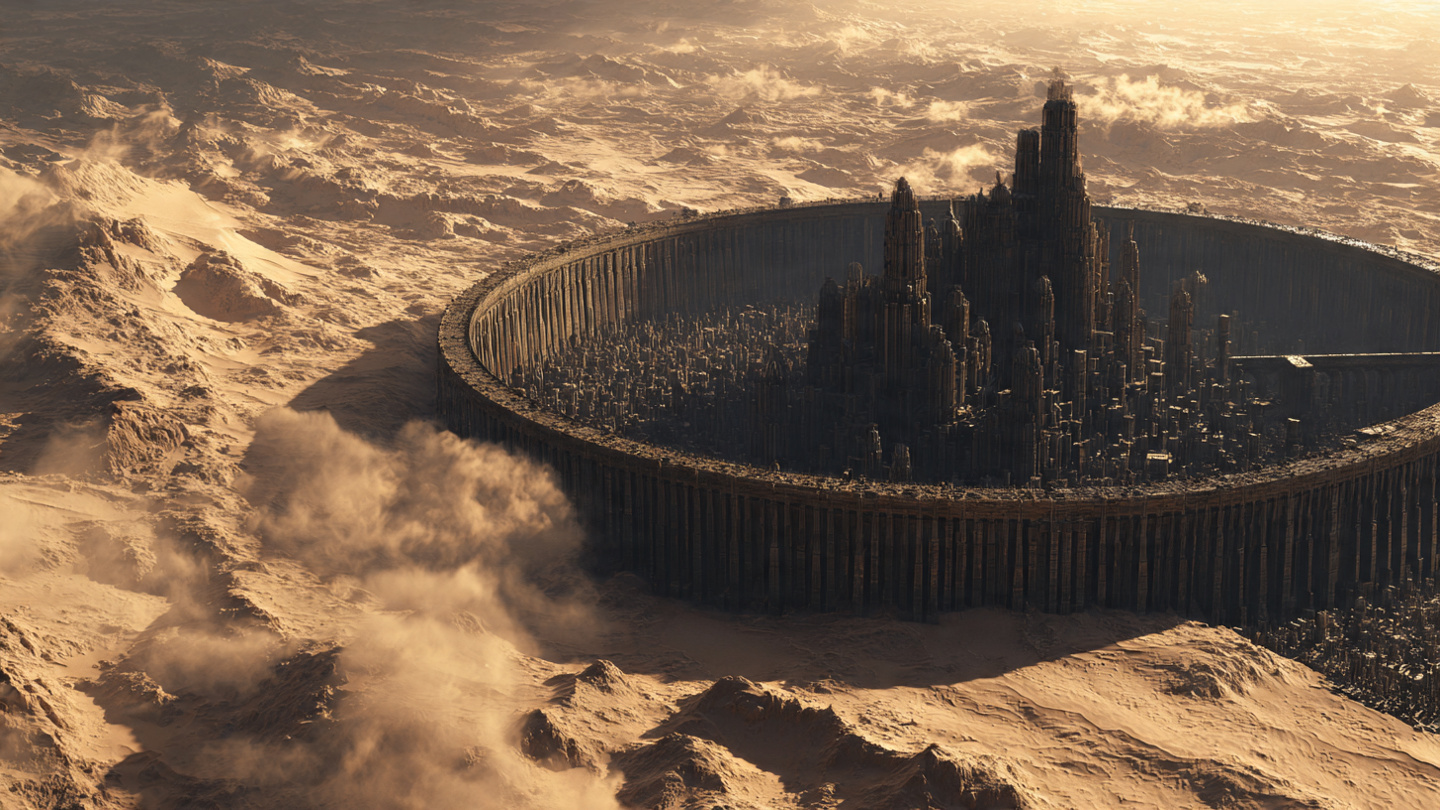
Mount Mashu is not presented in Gilgamesh as an archaeological fortress waiting to be excavated. It belongs to the poem’s mythic geography. Its twin peaks reach toward heaven while its base reaches toward the underworld, and the scorpion-beings stand at its gate as Gilgamesh approaches the passage associated with the sun’s journey. The twelve double-hours of darkness that follow turn the episode into something much closer to a cosmic initiation than a military expedition.
That is why the invented fortress actually makes the ancient story smaller. It takes a symbolic landscape that stretches between heaven, earth, darkness and the underworld and converts it into a claim about a physical installation somewhere beneath the Iraqi desert. The original is stranger because it was never trying to be an archaeological field report.
Tiamat’s War Needs No Sequel
If the goal is to find an ancient war involving monstrous armies, there is no need to invent one. The Enûma Eliš already gives us an extraordinary cosmic conflict. Tiamat, associated with the primordial waters, becomes the enemy of the younger gods after the death of Apsu. She assembles a force of eleven monstrous beings, elevates Kingu and prepares for battle. Marduk is eventually chosen as the champion of the gods, defeats Tiamat and uses her body in the ordering of the cosmos. The scorpion-man is already there, inside the story, where the surviving text actually puts him.
There is no missing chapter in which Tiamat’s monsters escape into historical Iraq and establish a dynasty. There is no need to convert the cosmic war into a prehistoric military campaign. The story is already complete on its own terms: primordial waters, divine generations, rebellion, monstrous armies, a champion god, a cosmic battle and the construction of an ordered universe from the defeated body of the enemy.
And that is precisely what makes the surviving tablets valuable. They do not merely preserve a collection of strange creatures. They preserve a civilization’s attempt to explain why the cosmos has boundaries, why gods possess power, why dangerous spaces require guardians and how order emerges from conflict.
The Standard of Proof Is the Same for Every Lost Civilization
A lost civilization is not established because its story contains a real ancient creature. A vanished kingdom is not authenticated because its supposed enemies resemble beings from another culture. And a secret war does not become historical because a real library was destroyed centuries later.
The standard is brutally simple: show the source. Give the tablet number. Give the museum catalogue. Give the excavation record. Give the original-language text. Give the scholarly edition. Give the archaeological context. If the evidence exists, it can be examined. If it does not, the responsible conclusion is not that the story is impossible, it is that the story has not been established.
That distinction protects the genuinely mysterious material from being buried underneath invented certainty. The scorpion-men do not need to be historical animals to be historically important. Tiamat does not need to have fought a real prehistoric army for the Enûma Eliš to be one of humanity’s great surviving mythological compositions. The Mongol sack of Baghdad does not need every later legend about it to be literally true for the catastrophe itself to matter.
The Tablet Is Stranger Than the Invention
The seductive version of the story says an ancient secret was almost lost: serpent queens, scorpion guardians, forgotten kingdoms and a war erased from history. The surviving evidence tells a more disciplined story. Ancient Mesopotamian writers really did imagine scorpion-men. They really did place them at the threshold of a cosmic mountain. They really did populate Tiamat’s army with extraordinary hybrids. Ancient South Asian cultures really did develop rich traditions surrounding nāgas. Baghdad really was devastated in 1258, and enormous quantities of knowledge really were vulnerable to war, political collapse and the destruction of institutions.
But none of those facts supplies the missing tablet.
The scorpion-men are ancient. The war of Tiamat is ancient. The Mongol destruction of Baghdad is historical. The nāgas belong to genuine religious traditions. The serpent queen’s Iraqi war, however, remains a story without an identifiable ancient text behind it.
And perhaps that is the most important lesson in the entire investigation. History does not become less extraordinary when we remove the inventions. Sometimes the surviving tablet is already the strange thing.