




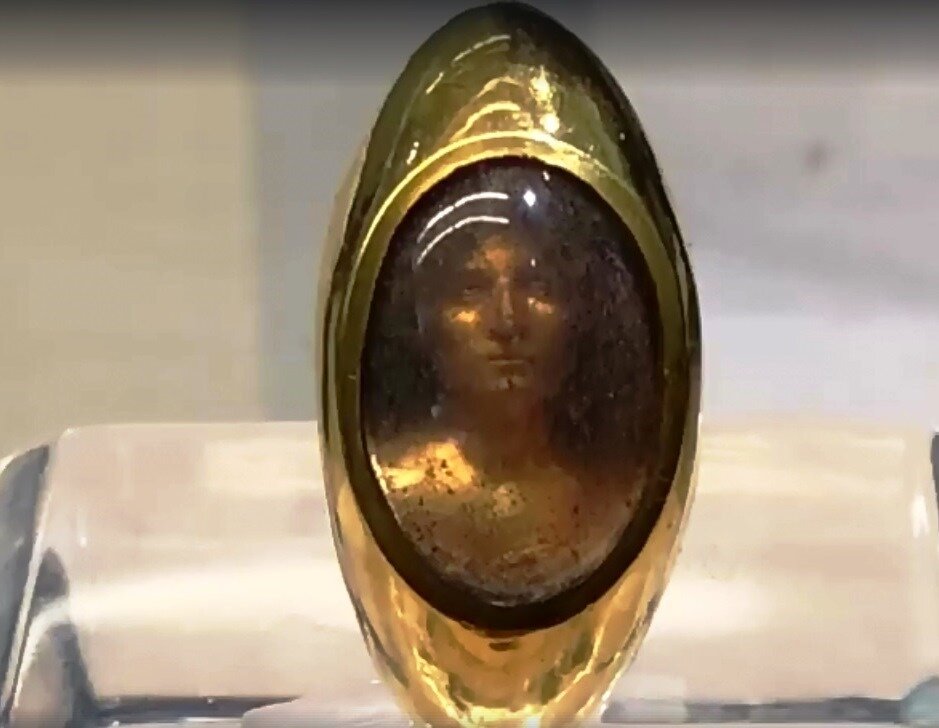
Aebutia Quarta buried her son when he was eighteen years and three months old.
The inscriptions on the sarcophagi record what grief cannot: his name was Carvilius Gemellus, he was her son from her first marriage, and she survived him. The tomb in which they were eventually buried together, discovered unlooted in 2001 near Palestrina forty kilometers east of Rome, preserved the material record of how a wealthy Roman woman in the first century CE processed the death of a young man whose face she could no longer see.
She commissioned a ring.
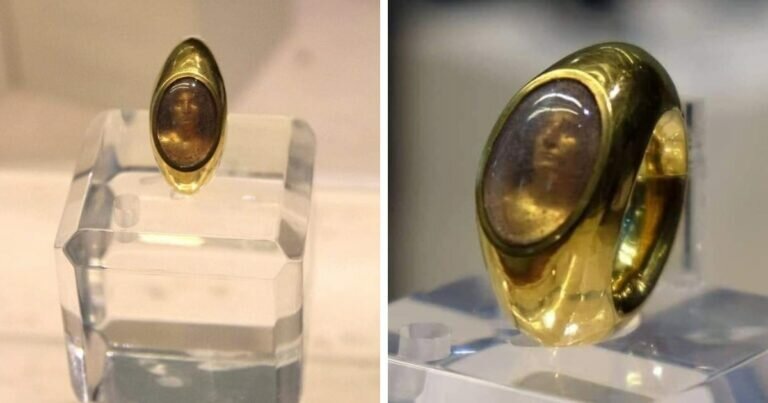
The ring is gold and rock crystal. The portrait of Carvilius is worked in gold at its center, his face rendered with the detail that Roman memorial portraiture achieved at its height. Over the portrait, the jeweler set a dome of polished rock crystal whose curvature was calculated, whether through theoretical understanding or empirical refinement, to produce an optical effect whose character a twenty-first century observer standing in the National Archaeological Museum of Preneste would still find remarkable.
The convex lens surface of the rock crystal alters the apparent depth of the portrait beneath it. The face does not appear flat. It appears to recede into the interior of the ring, the features at different apparent depths creating the impression of three-dimensional presence that a flat gold image without the lens does not produce. The borders of the portrait dissolve into darkness at the ring’s edges. The central face appears illuminated from within.
The effect is described as making the portrait appear as if a living person is looking at you from the depths of the ring.
Aebutia Quarta wore her dead son’s face on her hand, and the rock crystal made him appear to look back.
The Optical Knowledge Required
The technical achievement of the Carvilius ring is the element whose significance the library’s existing ancient optical technology framework makes most directly assessable.
A convex lens magnifies objects viewed through it and alters their apparent depth. This is established physics whose mechanism, the refraction of light at the curved glass-air boundary, is understood in the modern optical literature with mathematical precision. Whether the Roman jeweler who produced the Carvilius ring understood this mechanism theoretically, empirically, or not at all, is the question that the ring’s optical quality raises.
If the depth effect was accidental, the jeweler simply polished a dome of rock crystal over a portrait without intending the optical consequence, then the ring reflects skilled craftsmanship whose optical implications were not understood. But the character of the effect, the portrait’s apparent three-dimensional depth rather than simple magnification, requires a relationship between the lens curvature and the distance between the lens and the portrait beneath it. Whether this relationship was achieved by accident in a single object, or reflects a jeweler who understood through empirical refinement of the technique that curvature at distances produced visual effects, is the question that the ring’s confirmed optical precision motivates examining.

The relevant comparisons are worth noting. The Nimrud lens, a 3,000-year-old rock crystal lens recovered from the Assyrian palace at Nimrud and analyzed by Carl Zeiss AG, is confirmed as having optical quality equivalent to modern manufacture. Whether its optical quality reflects deliberate grinding to achieve a calculated focal length or skilled empirical polishing whose result happened to meet modern standards, is the question that the Zeiss analysis raised without fully resolving.
The Visby lenses, Viking-era rock crystal optical elements recovered from Gotland and dated to approximately 1000 CE, are described by ophthalmologist and historian of optics Ian Whisson as having near-modern focusing quality whose manufacture would require either advanced theoretical understanding of optics or extremely sophisticated empirical technique.
The Carvilius ring adds a Roman-era data point to this sequence: three separate ancient cultures, Assyrian, Roman, and Viking, producing rock crystal optical work of confirmed sophistication whose quality the conventional history of optics, which attributes the systematic understanding of lens behavior to the seventeenth century work of Galileo, Kepler, and Huygens, does not easily accommodate.
Whether the Nimrud lens, the Carvilius ring, and the Visby lenses represent isolated instances of empirically skilled craftwork whose optical quality exceeded the craftsmen’s theoretical understanding, or represent the known endpoints of an ancient optical knowledge tradition whose intermediate development is not preserved in the available historical record, is the question that the three cases’ convergence across cultures and millennia makes genuinely significant rather than coincidental.
The Tomb and Its Preservation
The archaeological context of the ring’s discovery is the element whose record establishes its evidentiary weight against the possibility of forgery or misattribution.
The tomb discovered in 2001 near Palestrina was confirmed as unlooted, meaning its contents had not been disturbed since the final interment. This is the archaeological condition that makes the associated artifacts most reliably attributable to their known context: an object found in an unlooted sealed Roman tomb of established first-century date is reliably dated as first-century Roman rather than as a later intrusion or modern fabrication.
The tomb’s preservation quality extended beyond the sarcophagi and their inscriptions. Archaeologists recorded remnants of flower garlands composed of roses, violets, and lilies, whose organic preservation across two millennia in the sealed tomb is the condition that the tomb’s design appears to have been intended to facilitate: the sarcophagi incorporated drainage holes specifically designed to remove moisture, and evidence of turpentine and myrtle suggests deliberate preservation treatment of the contents.
The Greek marble sarcophagi, the drainage engineering, the flower garland preservation, and the commissioned ring together reflect a level of resource investment in the funerary treatment of Aebutia Quarta and her son whose character is consistent with the inscription’s identification of her father as a governor of Africa, placing the family in the known upper stratum of Roman provincial aristocracy.

The ring is in the National Archaeological Museum of Preneste. It can be examined. The optical effect can be observed directly. The record is institutional rather than anecdotal.
The Memorial Purpose and What It Required
The Carvilius ring is not a scientific instrument or a practical tool. It is a memorial object whose intended function was to make a dead person’s face appear present to the person wearing it.
This functional purpose is the element that distinguishes the ring’s optical sophistication from the Nimrud lens’s and Visby lenses’ known cases. Whether those lenses were magnifying glasses, fire-starting tools, or decorative objects whose optical properties were incidental to their primary function, is genuinely debated in the history of ancient optics. The Carvilius ring’s function is not debated: it was made to preserve a dead boy’s face in a form that would appear to have living depth when worn by his mother.

The jeweler who made it therefore required not simply the ability to polish a convex rock crystal surface, but the understanding that a convex rock crystal surface placed at a distance over a portrait would produce the visual effect that Aebutia Quarta wanted. Whether she communicated this requirement to the jeweler by describing the desired visual outcome and the jeweler achieved it through knowledge, or whether the jeweler proposed the technique based on existing knowledge of what rock crystal lenses do to portraits placed beneath them, is a question the available record does not answer.
What the available record establishes is that the technique worked as intended. The portrait appears three-dimensional. The face appears to recede into depth. The borders dissolve. The observed effect is exactly what a modern optical engineer would predict from a convex lens of the curvature placed at the distance above a gold portrait in a gold ring.
The jeweler knew what would happen. The physics did not change between the first century and the seventeenth. The only question is whether the knowledge was recorded and transmitted, or achieved independently through a skill tradition whose optical understanding was never written down.
What Three Ancient Lens Cultures Establish
The Assyrian, Roman, and Viking optical cases together reveal a pattern whose character the conventional history of optics motivates examining rather than resolving through simple coincidence.
The conventional history of systematic optics begins with the recognized work of Ibn al-Haytham in eleventh-century Baghdad, whose Book of Optics is the first systematic known treatment of how lenses refract light and form images. The work of Kepler, Galileo, and Huygens in the seventeenth century produced the mathematical framework for calculating lens behavior. The industrial manufacture of precision optical instruments followed.
The Nimrud lens predates Ibn al-Haytham by approximately 2,000 years. The Carvilius ring predates him by approximately 1,000 years. The Visby lenses are roughly contemporary with him but were produced in Viking Gotland rather than in the Islamic optical research tradition.
Whether the convergence of confirmed high-quality ancient optical work across these three independent cultural contexts reflects a common ancient optical knowledge tradition whose transmission pathway is not preserved in the available historical record, the independent empirical development of similar techniques by skilled craftspeople in different cultures who discovered the same optical properties of rock crystal through experimentation, or the survival bias of rock crystal optical objects whose durability compared to glass or organic materials makes them overrepresented in the archaeological record relative to the broader ancient optical tradition, is the question that the comparative evidence motivates without fully resolving.
The Carvilius ring adds a dimension to the existing framework that the Nimrud and Visby cases do not provide: a confirmed intentional application of convex lens optics to create a deliberate emotional effect in a human being. The jeweler was not making a magnifying glass or a decorative stone. The jeweler was making a mother’s grief into something she could wear, and the optical knowledge embedded in the ring was the instrument of that transformation.
Aebutia Quarta wore her son’s face for the rest of her life. The rock crystal made him look back.
Whatever the jeweler understood about lenses, he understood enough to make a dead boy appear present.
That is the recorded fact. The conventional history of optics says it should not have been possible for another sixteen centuries.
That Roman ring did not need magic to work. It needed a jeweler who understood curved glass centuries before anyone wrote the optics down.