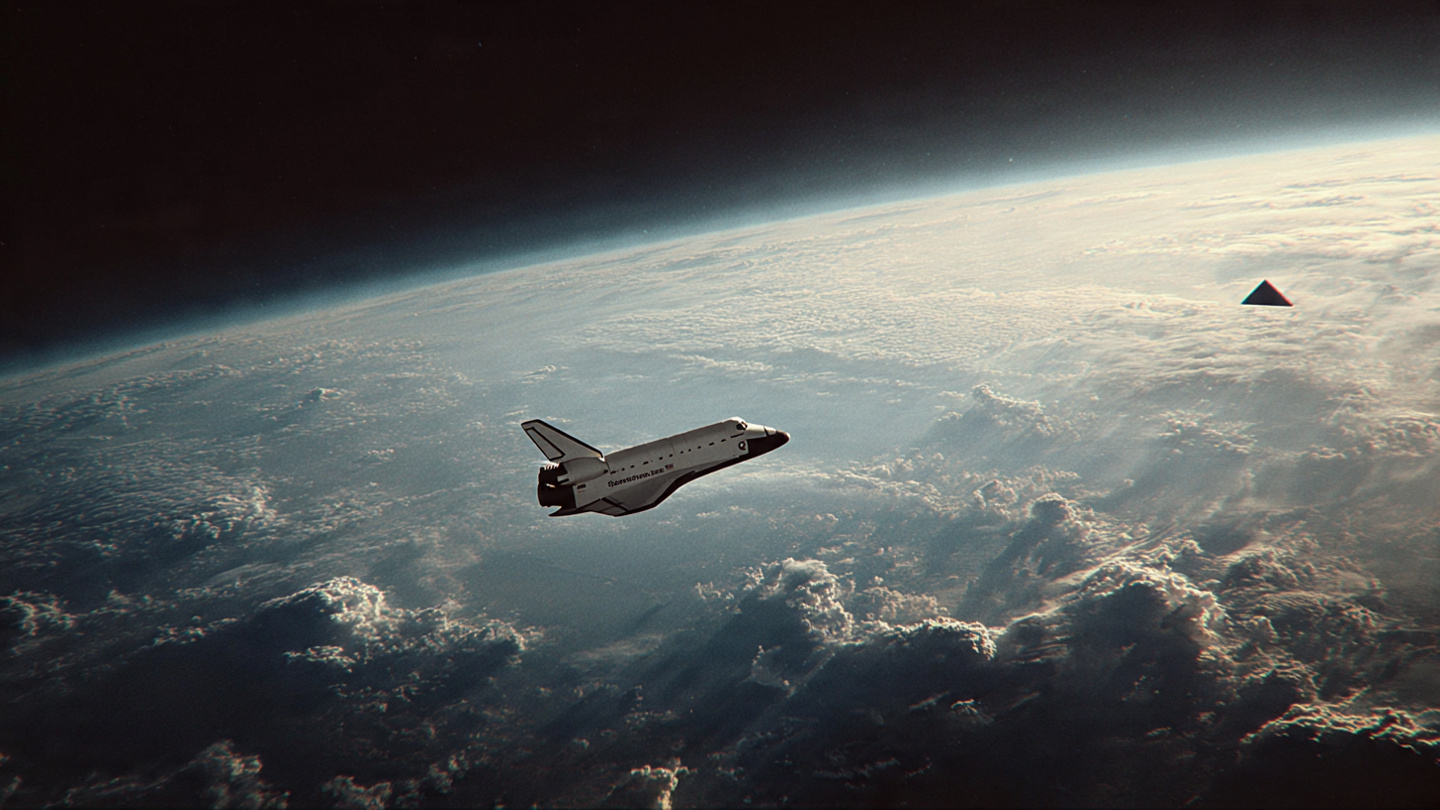
This needs a decisive correction before anything else. NASA’s own official archival record for this photograph, catalog entry 61C-31-003, directly and explicitly identifies the object: “Piece of thermal insulation tile floating in space near the orbiter Columbia,” with the official subject term “SPACE DEBRIS” attached to the record itself. This is not a later dismissal or a vague, unverified guess. It is the original, official description that has accompanied this photograph in NASA’s archive since the images were catalogued. The claim that NASA has “never produced a formal technical report” and maintains “official silence” is directly contradicted by NASA’s own publicly accessible catalog metadata.
In January 2013, online UFO research blogs, including exopolitics.org and several similar sites, “rediscovered” two photographs from the space shuttle Columbia’s STS-61C mission, flown January 12 to 18, 1986. The photographs exist in NASA’s public Gateway to Astronaut Photography archive.

The Photographs and Their Official Explanation
The STS-61C mission was the twenty-fourth Space Shuttle mission and the seventh flight of Columbia, carrying a crew that included commander Robert Gibson, pilot Charles Bolden, and mission specialists including Franklin Chang-Diaz, alongside payload specialist and future NASA Administrator Bill Nelson. Astronauts on shuttle missions were trained in the use of Hasselblad cameras, high-quality equipment that produced sharp, detailed film images.
The object appears in two consecutive frames, catalogued in NASA’s archive under mission roll 31. NASA’s own archival catalog entry for this exact photograph identifies it plainly as a small piece of thermal protection tile that had come loose from the orbiter and was floating nearby, officially tagged with the subject term “space debris” in the catalog record itself. This is a mundane, clearly recorded explanation, not an absence of one.

Object Size and Distance
The claim that the object’s size cannot be determined without special access to focal data ignores that thermal protection tiles used on the shuttle’s exterior are well established, standardized components of consistent, known dimensions, typically measuring roughly six inches square. A small, tumbling tile fragment photographed at relatively close range through a telephoto lens would appear as a dark, geometric shape against the bright Earth below, precisely matching NASA’s own official description of the image.
The “Low Albedo Stealth Material” Theory
This deserves direct correction too. Thermal protection tiles used on the shuttle were coated with a black, silica-based coating specifically designed to absorb and radiate heat during re-entry, a well established, mundane reason such a tile fragment would appear dark and non-reflective in a photograph, exactly the visual characteristic this piece attributes to speculative “stealth technology.” No exotic material or classified coating is required to explain a dark appearance. It’s the tile’s publicly known, standard thermal protection coating doing precisely what it was engineered to do.

The TR-3B “Black Manta”
The TR-3B is a name that circulates in aerospace conspiracy communities, but its origin traces to a single, unverified source: a self-described former intelligence figure named Edgar Rothschild Fouché, who first publicized the TR-3B concept in the late 1990s. No credentialed aerospace engineer, government agency, or independent journalist has ever verified Fouché’s specific background claims or produced independent evidence the TR-3B exists. The Pentagon has consistently and directly denied any such program.
The well established triangular UFO reports from the 1989-1990 Belgian UFO wave are documented historical sightings, extensively investigated at the time by the Belgian Air Force, which publicly stated it could not identify the objects involved using available radar and visual data. This unresolved case is separate from, and predates, the specific 1998 TR-3B claims, and connecting the two requires an inferential leap no credentialed investigator has verified.

“Electromagnetic Propulsion” and the Biefeld-Brown Effect
The historical Biefeld-Brown effect, discovered in the 1920s, is a well documented, verified electrical phenomenon, but physicists have thoroughly studied it and found the observed thrust results from ion wind, the movement of charged air particles, not from any exotic gravity manipulation. This effect works only in the presence of atmospheric air to ionize, and cannot function as a propulsion mechanism in the vacuum of space, directly undermining the claim that it explains a craft’s presence in orbit.
Why “No Launch Record” Is a Serious Problem for This Theory
The piece’s own skeptical section correctly identifies a decisive problem: any large craft reaching orbit in 1986 would have required a powerful launch vehicle, an event that would have been tracked by independent Soviet radar and satellite networks operating at the height of Cold War surveillance. No launch record, radar track, or independent sighting corroborates a secret American orbital vehicle from this specific period. This significant evidentiary gap, not merely a skeptic’s objection but a structural problem for the entire theory, is worth taking seriously as the decisive point it actually is, rather than a footnote balanced against speculation.

Comparable Cases: Space Debris Photography
NASA’s astronaut photography archive contains many similarly described images of debris, ice particles, and tile fragments floating near shuttle orbiters across the entire 30-year shuttle program, each individually catalogued with a specific, recorded explanation in the archive’s own metadata. This particular photograph is not uniquely mysterious. It is one ordinarily catalogued example within a large, publicly available archive of orbital debris photographs, most of which attract no online attention because they lack a geometric shape distinctive enough to be reinterpreted as something else.
Thermal Protection Tile Loss, a Documented Shuttle Phenomenon
It’s worth explaining how common tile loss actually was during the shuttle program, since it directly supports the mundane explanation NASA’s own archive already provides. NASA engineering reports confirm the shuttle’s thermal protection system used individually bonded silica tiles, numbering in the tens of thousands across each orbiter, and documented incidents of individual tiles detaching during launch or ascent were tracked throughout the entire program’s history. Post-flight inspections routinely catalogued missing or damaged tiles after nearly every mission, a well-known engineering challenge NASA engineers worked to address across the shuttle program’s three-decade lifespan. A single tile fragment separating during ascent and drifting near the orbiter, exactly matching NASA’s own official description of this specific photograph, is entirely consistent with this extensively documented pattern, not an unusual or unprecedented event requiring exotic explanation.

How Anyone Can Check the Archive Directly
This isn’t a case requiring special access or insider knowledge to verify, since NASA’s Gateway to Astronaut Photography archive remains publicly accessible today, and anyone can search the catalog directly using the mission and roll numbers referenced throughout this piece. Researchers and interested members of the public alike can pull up the exact same catalog entry, complete with its original 1986-era description, without needing to rely on secondhand summaries from any website, including this one. This direct public accessibility is itself worth noting: a genuine cover-up would not typically leave its own explanatory documentation sitting in a freely searchable public government archive for decades, available to anyone willing to look.
Why This Story Doesn’t Need a Secret Craft
The story here is interesting enough on its own terms: a 1986 photograph of ordinary orbital debris, officially recorded as such in NASA’s own archive at the time, was rediscovered by online UFO researchers in 2013, disconnected from its own original, archival description, and gradually reattached to an unverified, unconfirmed aerospace legend originating from a single, unverified source. That process, how a clearly explained, mundane photograph becomes an unexplained mystery through selective retelling, is worth understanding clearly, and it requires no secret triangular spacecraft to be worth examining.

The photograph, catalog number 61C-31-003, remains exactly what NASA’s own record has always said it was: a small piece of thermal protection tile, tumbling in orbit near Columbia, space debris photographed by an astronaut using a Hasselblad camera, on a mission that happened nearly forty years ago. That complete, verifiable story is available to anyone who checks the archive directly.
“The only true wisdom is in knowing you know nothing.”
Socrates
In this case, though, we do know something. NASA’s own archive tells us directly what the object was, and checking a primary source before speculating further is itself a form of the wisdom Socrates was pointing toward.
The Black Knight satellite followed an almost identical path into legend, a supposed 13,000 year old polar orbiter that on inspection turns out to be evidence stitched together from five unrelated stories rather than one real object.
The following year tells its own story. The entire Shuttle fleet was grounded for all of 1987, and no mission of any kind launched that year.
The NASA 1986 file was never classified, never hidden, and never anything other than what its own catalog number says it is.