




A pharaoh who called himself the only intermediary between humanity and god ordered his own artists to depict him with a swollen belly, wide hips, a jaw stretched long and narrow, and a skull shaped unlike any of his predecessors. Then his son tore his name out of the historical record so thoroughly that Egypt forgot he existed for over three thousand years. When archaeologists finally found a body that might be his, in a desecrated tomb in the Valley of the Kings, the argument over whether it actually was him started almost immediately and has never fully stopped.
Akhenaten’s religious revolution is the least contested part of his story. Around 1353 BCE, he abandoned Egypt’s traditional pantheon, elevated the sun disk Aten above every other god, moved the capital to a new city built from nothing, and set about erasing the names of Amun and the rest of the old order from temple walls across the country. His son reversed nearly all of it within a few years of taking the throne. What’s contested is everything about Akhenaten’s own body: what he actually looked like, whether the strange art from his reign reflects a real physical condition or a religious statement, and whether the mummy most textbooks now call his is actually him at all.
The Body in Tomb KV55
In 1907, archaeologist Edward Ayrton found a small, deliberately damaged tomb in the Valley of the Kings, designated KV55. Someone had ripped the gold mask from the coffin, chiseled the occupant’s name out of the inscriptions, and left the whole burial in a state that reads less like grave robbery and more like a targeted act of erasure, exactly what you’d expect if this were Akhenaten’s body and later generations wanted him gone from the historical and religious record.
For over a century, nobody could say for certain whose body it was. The skeleton’s estimated age at death has bounced between roughly 25 and 45 depending on which researcher examined it and which method they used, a range wide enough to include or exclude Akhenaten depending on whose numbers you trust, since separate historical evidence suggests he died in his late thirties or early forties. A 2010 DNA and CT-scan study, led by Egypt’s Supreme Council of Antiquities, established that the KV55 occupant was the son of Amenhotep III and the father of Tutankhamun, a lineage that fits Akhenaten specifically, and pushed the estimated age at death upward into a range consistent with him. That result was widely reported as settling the question.

It didn’t. A body of subsequent research has continued to argue for the alternative candidate, a shadowy and poorly documented figure named Smenkhkare who may have briefly ruled between Akhenaten and Tutankhamun, and disputes over the skeleton’s precise age have continued well past 2010. As of the most recent scholarship, mainstream Egyptology treats KV55 as most likely Akhenaten, but “most likely” is doing real work in that sentence. This is not a closed case, and describing it as settled science overstates where the field actually stands, in either direction.
What the Art Actually Shows, and What It Doesn’t Prove
The stranger problem is the art. Reliefs and statues from Akhenaten’s reign show him with an elongated, egg-shaped skull, a prognathous jaw, a thin neck, sloped shoulders, a pronounced belly, wide hips and thighs, and thin, spindly limbs, features so far outside the idealized, athletic convention of earlier Egyptian royal art that early Egyptologists assumed they were looking at a real medical condition rather than a stylistic choice.
The 2010 DNA and CT work ruled out the theory that dominated discussion for decades: Marfan syndrome, a connective tissue disorder that produces tall stature, long limbs, and skeletal abnormalities. The KV55 skeleton showed none of the markers Marfan syndrome would leave behind, no evidence of the skull elongation from premature suture fusion, no abnormal endocranial volume beyond the normal range. That’s a real, meaningful result. It closes off one specific explanation.
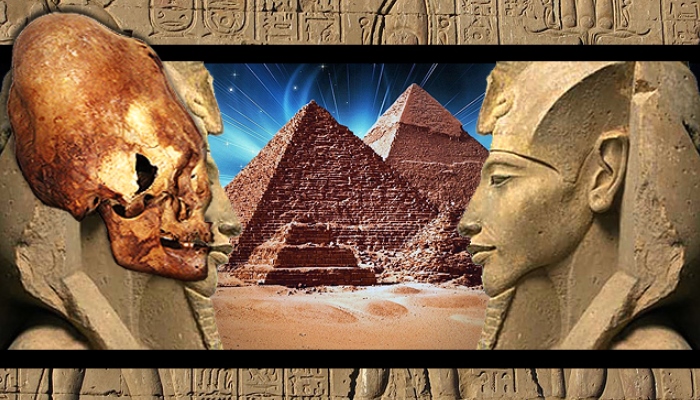
It does not close off the question generally, and treating it as though it does is where a lot of retellings go wrong. Serious research since has proposed several competing explanations, none of which has achieved consensus. A 2023 study published in the journal Cureus argues that Akhenaten’s skull shape is consistent with artificial cranial deformation, the deliberate binding of an infant’s head to produce a permanently altered shape, a practice recorded in multiple ancient cultures and proposed here as a real physical intervention rather than either disease or pure artistic license. Other researchers have pointed to aromatase excess syndrome, a hormonal condition that could account for the androgynous body shape and enlarged hips, though it doesn’t explain the cranial features on its own. A separate line of argument, associated with Egyptologist Nicholas Reeves, proposes that Akhenaten may have suffered from a condition affecting his corneas, leaving him with severely impaired vision, and suggests this could even help explain his religious fixation on visible light and the sun’s rays. And the position most Egyptologists still hold as the safest default is that none of this reflects Akhenaten’s actual body at all: that the androgynous, exaggerated Amarna style was a deliberate theological statement, presenting the king as an embodiment of the Aten, a god described in the era’s own hymns as both mother and father of all life.
No single theory accounts for every feature in the art. That’s the honest state of the research, not a settled diagnosis and not an unsolved total mystery, but a genuine, ongoing argument among several explanations that each account for part of the picture and none account for all of it.
What the Aten Actually Was
The disk itself deserves more attention than it usually gets in retellings focused on the mummy and the art. The Aten was not a new invention of Akhenaten’s, solar worship had been gaining prominence for generations before him, and his own father, Amenhotep III, had already begun closely associating himself with the sun disk in royal iconography. What Akhenaten did was more radical than continuing that trend: he stripped the Aten of the human or animal form every other Egyptian god had traditionally taken, representing it only as the disk itself, radiating down in lines that ended in small hands, offering the symbol of life to the royal family below. No temple statue, no anthropomorphic idol, just light itself as the object of devotion. Egyptologists still debate how strictly monotheistic this actually was in practice, since Akhenaten’s hymns to the Aten draw on language and imagery associated with older gods like Ra and Amun even while formally displacing them, but the break from tradition in both form and exclusivity was real and, for ancient Egypt, essentially unprecedented.

This is also the piece of the story that explains why Akhenaten’s family, not just Akhenaten himself, appears in the same elongated, androgynous style throughout Amarna art. Queen Nefertiti and their daughters share the same exaggerated features in surviving reliefs, which is difficult to reconcile with any theory pinning the look on a single inherited medical condition unique to Akhenaten’s own body, and easier to reconcile with a deliberate visual language applied to the entire royal family as an expression of their shared connection to the Aten.
That detail cuts against the disease theories more than it supports them, without fully resolving the question either, since a family-wide genetic condition remains theoretically possible even if it seems like the less likely explanation once every competing theory is weighed together.
Why the Erasure Happened
The one piece of this story that isn’t contested is what happened after Akhenaten died. His son abandoned the new capital, restored the old gods, and changed his own name from Tutankhaten to Tutankhamun to signal the break. Later pharaohs went further, striking Akhenaten’s name from official king lists entirely and referring to him in surviving texts only as “the enemy.” The damage to the KV55 tomb, the torn mask, the chiseled-out name, fits this pattern precisely: not random looting, but the same institutional erasure applied to monuments and temple walls across Egypt, applied here to a body as well.
That erasure worked well enough that Akhenaten’s name and city vanished from history until the nineteenth century, when archaeologists began piecing his story back together from what his successors had failed to destroy completely. Whether the body they eventually found in KV55 is actually his, and whether the strange art he commissioned reflects his real body, his religious symbolism, or some combination of both, remains an open argument conducted by people with far more expertise than the certainty of most retellings suggests.