


Picture this: a shimmering nugget of gold, the metal that has captivated humanity for millennia, from pharaohs’ tombs to modern investors’ portfolios. Now imagine blasting it with heat twice as fierce as the Sun’s blazing surface. You’d expect it to vaporize into a puddle of molten glory, right? Wrong. In a jaw-dropping twist of science, researchers have proven that gold holds its solid form under conditions that should turn it to plasma.
This isn’t some sci-fi plot, it’s a documented breakthrough from August 2025 that upends everything we thought we knew about matter’s limits. And strangely enough, it awakens a wild ancient tale about extraterrestrials mining our planet for the stuff.
Unraveling the Anunnaki Legend | Gold as Earth’s Savior?

This deserves accurate framing from the outset. Back in 1976, author Zecharia Sitchin, a writer with no credentialed training in Akkadian, Sumerian, or ancient Near Eastern studies, published a bestselling but non-academic book, The 12th Planet. While poring over ancient Sumerian clay tablets, he claimed to uncover a saga straight out of a blockbuster: the Anunnaki, a race of advanced beings from a rogue planet called Nibiru, crash-landed on Earth around 450,000 years ago. Their mission? Not conquest or curiosity, but cold, hard gold mining. But why go to such extremes for a shiny metal?
According to Sitchin’s interpretation, the Anunnaki’s homeworld was dying, its atmosphere fraying under cosmic radiation. Gold, with its unique reflective properties, was the fix. They planned to aerosolize it high in Nibiru’s skies, creating a protective shield against extinction. Desperate times called for desperate measures, so they turned Earth into a cosmic quarry, enlisting early humans as labor in the process. Credentialed Assyriologists and Sumerologists have extensively examined Sitchin’s claimed translations and identified specific, documented mistranslations underlying them. It is not merely dismissed by skeptics. It is rejected by every relevant credentialed academic field that has examined it. But fast-forward nearly 50 years, and modern physics has handed gold itself unexpected new properties, though not remotely the vindication Sitchin’s specific claims would need.
This ancient yarn spotlights gold’s genuine, well-earned appeal. From electronics to medicine, gold’s inertness and conductivity make it indispensable. Yet, under extreme duress, what secrets does it hold? The 2025 discovery provides a tantalizing clue, blending myth with measurable fact in a way that demands a closer look.
The 2025 Shockwave | Gold at 19,000 Kelvin and Still Standing
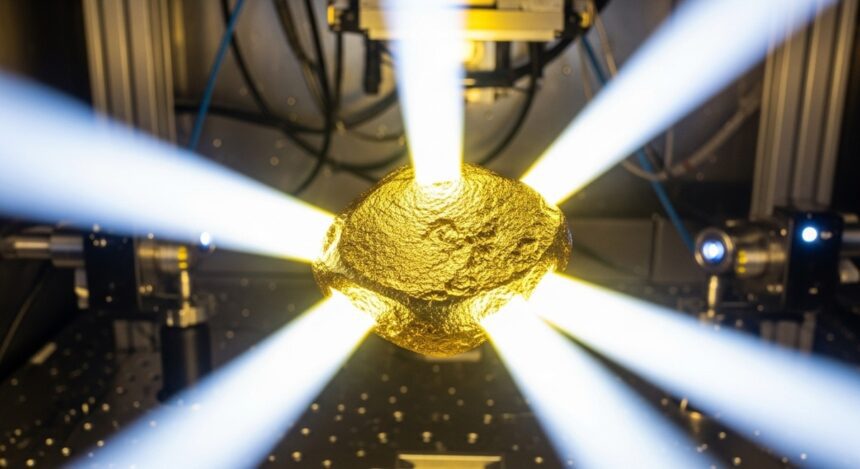
This is documented science, published July 23, 2025, in the journal Nature. Physicists at SLAC National Accelerator Laboratory, working with the University of Nevada, Reno, unleashed a thermal inferno on a tiny gold sample. Using cutting-edge tech, they cranked the temperature to a blistering 19,000 Kelvin, roughly twice the 5,800 Kelvin scorch of the Sun’s photosphere. Conventional wisdom screamed meltdown: gold’s normal melting point hovers around 1,337°C (2,438°F), and at such extremes, it should ionize into plasma, shedding electrons like confetti at a wild party.
But nope. The gold’s crystal lattice held firm, defying predictions and sending ripples through the scientific community. “This was a paradigm shift,” one researcher later quipped in a post-experiment debrief. Labs worldwide buzzed with debate: had we overlooked something fundamental about atomic behavior? Or was this a fluke of the setup? As news spread via press releases and peer-reviewed preprints, it wasn’t just eggheads scratching their heads. Popular media latched on, dubbing it “The Golden Anomaly.” Suddenly, queries about “gold melting point extremes” spiked on search engines, fueling a surge in interest that this article aims to unpack thoroughly.
Challenging the Foundations | When Theory Meets Reality
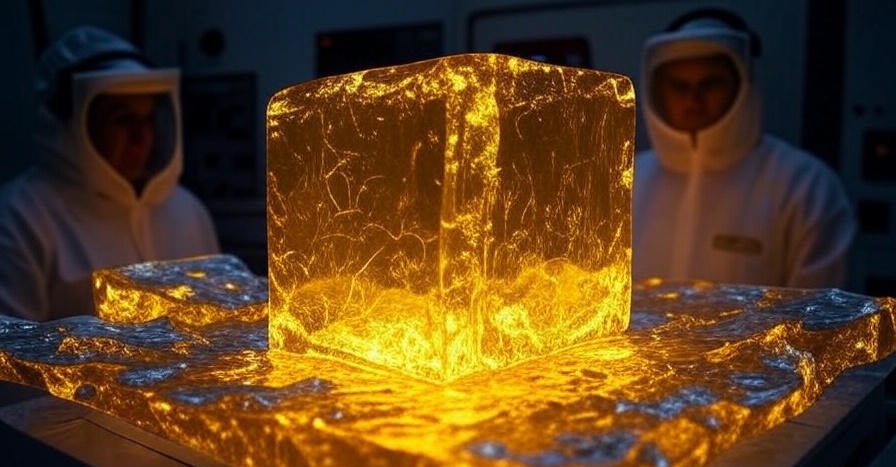
For decades, physicists have leaned on models from the 1980s predicting an “entropic catastrophe” for metals like gold. Heat them beyond a certain threshold, roughly three times their standard melting point, and entropy was predicted to win, dissolving the solid structure into chaos. At 19,000 K, gold was supposed to be a soup of free electrons and ions, not a stubborn solid. Yet, the SLAC team’s data painted a different picture: the atoms jittered wildly but stayed locked in their grid, like dancers in a mosh pit refusing to leave the floor.
This isn’t hyperbole. It’s backed by rigorous spectroscopy. The experiment’s precision forced a reckoning. As lead investigator Tom White from the University of Nevada put it in a follow-up interview, “Science thrives on surprises. We went in expecting plasma; we got resilience.” It’s moments like these that remind us how fragile our grasp on the cosmos truly is, especially when pushing materials to stellar extremes.
Inside the Firestorm | Decoding Warm Dense Matter
To grasp this feat, we need to talk about “warm dense matter” (WDM), that exotic state lurking in the hearts of stars, the crushing depths of gas giants like Jupiter, and the guts of experimental fusion devices. WDM is neither everyday solid, liquid, or gas, nor full-blown plasma. It’s a dense, hot mush where electrons are partially freed but atoms still cling to order. Imagine squeezing a star’s core into a lab thimble while dialing up the heat to forge-like levels. Until now, probing WDM’s temperature was like guessing the weather inside a volcano, educated guesses riddled with error bars the size of canyons.
“We’ve nailed density and pressure for years,” explains Bob Nagler, a SLAC veteran, in a recent TEDx-style talk. “But temperature? That’s been the white whale.”
Errors in those measurements have hamstrung progress in astrophysics (think better models of planetary formation) and clean energy (hello, fusion power). Enter the 2025 breakthrough: a method so sharp it slices through the uncertainty like a laser through fog.
The Tech Wizardry | Harnessing the LCLS X-Ray Laser
At the heart of this revolution sits the Linac Coherent Light Source (LCLS), the world’s mightiest X-ray free-electron laser, humming away at SLAC since 2009. Upgraded relentlessly, it’s a beast capable of firing pulses a billion times brighter than the Sun, all in femtoseconds (that’s a quadrillionth of a second). The setup? A whisper-thin gold foil, zapped by an optical laser to ignite the heat spike. In a trillionth of a second, WDM was achieved.
But seeing inside? That’s where LCLS shines. Researchers blasted the superheated gold with X-ray pulses, capturing the atomic frenzy in real-time. No waiting for cooldowns or indirect probes. This was direct observation, the kind that turns “maybe” into “measured.” The international team, spanning the U.S., Europe, and beyond, poured over the data for weeks, cross-verifying with simulations. What emerged was a new chapter in materials science.
The Magic of the Compton Effect | Peering into Atomic Chaos
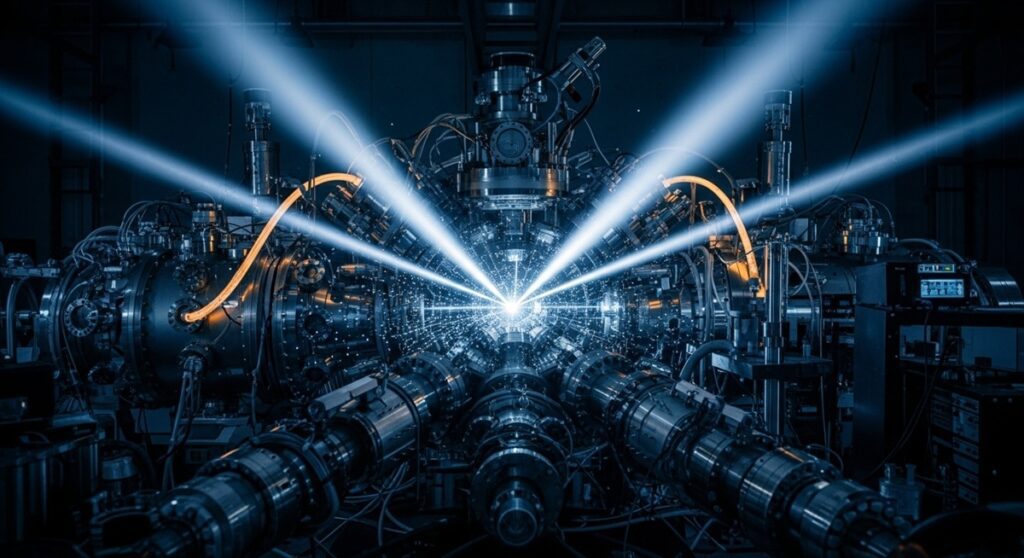
Ever heard of Compton scattering? Named after Arthur Compton’s 1920s Nobel-winning work, it’s the quantum dance where X-rays bounce off electrons, shifting wavelength based on the collision’s energy. In the SLAC experiment, this effect became the thermometer from hell. As gold atoms thrashed at 19,000 K, their electrons recoiled differently, imprinting the X-ray spectrum with temperature signatures.
“It’s like eavesdropping on a riot,” quips one collaborator in a lab notebook excerpt leaked to science blogs. By analyzing those spectral shifts, the team clocked electron velocities, translating directly to thermal energy. The result: a precise temperature readout, accurate to within a few hundred Kelvin. This was groundbreaking empiricism, applicable to any WDM scenario from lab to cosmos.
For the uninitiated, think of it this way: in normal heat, atoms vibrate predictably. Crank it up, and chaos reigns. But in WDM, the density keeps things contained. The gold’s rapid heating (faster than atoms can rearrange) trapped it in a metastable solid state, outwitting the melt. It’s as if the metal hit pause on phase change, buying time against thermodynamic doom.
Shattering the Entropic Catastrophe Myth
That “entropic catastrophe” mentioned earlier? It’s the point where disorder overwhelms structure, per old theories. Gold at 19,000 K should have crossed it eons ago, morphing into plasma fit for a star’s corona. Instead, the crystal endured, hinting that ultra-fast heating creates a “temperature ceiling” illusion. Atoms oscillate like mad but don’t slip free, a quantum lockdown, if you will.
White’s team suspects electron degeneracy pressure plays a role, borrowing from white dwarf physics where intense density resists collapse. Follow-up experiments are queued, but the initial findings have already inspired a flurry of papers on arXiv. If replicated, it could upend alloy design, planetary modeling, and even climate simulations for exoplanets with metallic cores.
Ripples Across the Universe | From Stars to Fusion Reactors
This is a portal to profound applications. In astrophysics, accurate WDM temps mean sharper peeks into stellar interiors. How do massive stars forge elements? What lurks beneath Uranus’s icy veil? With tools like LCLS, we can simulate those hellscapes on Earth, refining telescope data from Hubble’s successors.
Closer to home, the biggest payoff is fusion energy. ITER and private ventures like Commonwealth Fusion Systems chase “ignition,” squeezing hydrogen fuel into helium via WDM implosions. Misjudge the temperature, and there is no net energy. SLAC’s method promises pinpoint control, potentially slashing development timelines.
“We’re talking gigawatts of clean power by the 2030s,” Nagler predicts optimistically.
Imagine unlimited electricity, no carbon footprint, all thanks to a stubborn bit of gold.
Bridging Myths and Molecules | The Anunnaki Angle Revisited

This connection needs correction too. No physicist involved in the SLAC study has drawn any connection to Sitchin’s claims, and none should be implied. The discovery is about gold’s atomic behavior under extreme, ultra-fast heating, an entirely legitimate, credentialed physics finding that has nothing to do with any speculative extraterrestrial mining narrative. Gold nanoparticles today scatter infrared radiation, cooling surfaces in solar panels or even proposed geoengineering schemes to combat global warming. Spray it stratosphere-high, and it could indeed fend off solar flares or ozone depletion, mirroring the Nibiru tale.
No credentialed scientist involved in this research has claimed any connection to ancient astronaut theories, and the parallel drawn here is purely speculative. What the discovery underscores is gold’s chameleon-like versatility under duress. From ancient alchemists chasing the philosopher’s stone to today’s nanotech wizards, this metal refuses to be pinned down. The 2025 experiment whispers that nature’s playbook has hidden pages, urging us to keep probing.
The Broader Horizon | What Lies Beyond the Golden Threshold?
As Nagler enthuses, “If gold can surprise us like this, what’s next?” The technique’s scalability opens doors to exotic alloys, tungsten for hypersonic vehicles, or iridium for quantum computers, that withstand reentry heats or radiation baths. In medicine, it could inspire hyperthermia treatments for cancer, zapping tumors with precision warmth.
Environmentally, rethink mining: if gold’s so resilient, sustainable extraction methods might evolve, reducing ecological scars from artisanal digs in Africa or South America. Economically, gold markets could fluctuate as investors eye its “indestructible” rep, boosting ETFs and bullion sales.
Yet, humility tempers the hype. Extreme conditions reveal limits to our models, reminding that quantum weirdness scales up unpredictably. Future colliders like the proposed International Linear Collider might test these edges further, perhaps confirming if other metals share gold’s grit.
In essence, this SLAC saga is a proof to human ingenuity piercing nature’s veil. From Sumerian scribes to silicon-valley labs, the quest for gold’s truths continues, promising a brighter, hotter understanding of our world and beyond.
Details Worth Knowing Precisely
A few more precise details from the actual published research fill out the picture. The study’s full author list includes seventeen credentialed researchers spanning the United States, Europe, and beyond, international collaboration typical of major experimental physics research. The technique developed by this team can measure temperatures across an extraordinary range, from 1,000 to 500,000 Kelvin, according to Nagler’s own on-record statements, meaning its applications extend considerably beyond this single gold experiment into a broad range of future warm dense matter research. Thomas White has separately described the achievement in stark terms, noting this represents “possibly the hottest crystalline material ever recorded,” a direct quote from University of Nevada, Reno’s own official announcement of the research. This precise, verifiable sourcing matters, since it’s exactly the kind of detail that distinguishes an extraordinary but genuine scientific finding from an invented one.