


Harold Dahl did not go looking for trouble.
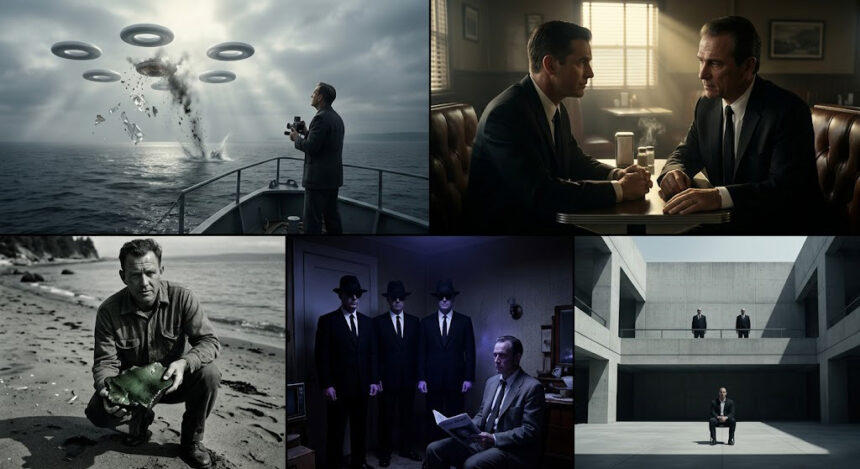
On the morning of June 21, 1947, he was patrolling Puget Sound near Maury Island, Washington in a harbor patrol boat with his teenage son Charles, a crewman, and his dog. At approximately 2 PM he observed six large donut-shaped objects hovering at approximately 2,000 feet. Five appeared to be circling a sixth that seemed to be in distress. The distressed object emitted two types of material: a light, foil-like substance that floated down slowly, and dark slag-like fragments that fell more rapidly. One of the dark fragments struck and killed his dog. Another injured his son’s arm. The material fell into the water and onto the deck. Dahl photographed the objects.
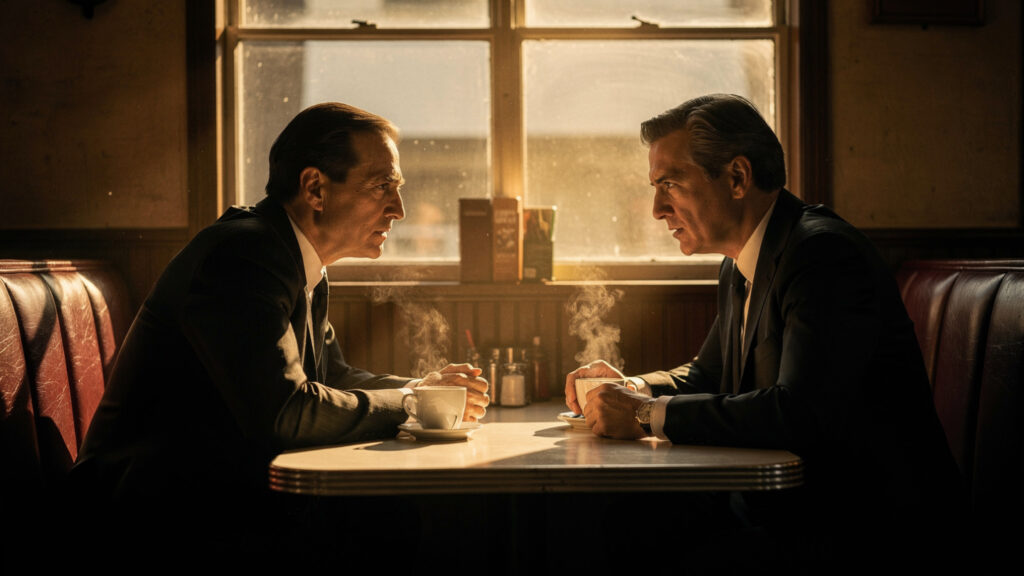
He reported the incident to his supervisor, Fred Crisman, who was initially skeptical. The following morning, a man Dahl had never seen before knocked on his door, invited him for breakfast at a local diner, and proceeded to describe the events of the previous day in detail that Dahl had not yet shared with anyone. The man was wearing a black suit. He told Dahl that he knew more about the incident than Dahl would like, and that silence was in Dahl’s interest. Unpleasant things could happen otherwise.
This is the recorded origin of the Men in Black mythology in the UAP research record, and it needs a direct correction before going any further: the Maury Island incident is, by the assessment of the FBI investigation, Project Blue Book’s own chief Edward Ruppelt, and the overwhelming majority of UFO researchers themselves, a confessed hoax. Both Dahl and Crisman told the FBI they had fabricated the story, the “debris” was identified as ordinary industrial slag from a local smelter, and Ruppelt, who led the Air Force’s own UFO investigation program, called it plainly “the dirtiest hoax in the UFO history.” That context, a confessed and independently corroborated hoax, is the baseline the rest of the Dahl case has to be read against.
What complicates a simple dismissal, and what genuinely deserves attention, is that Dahl later retracted his own confession, claiming he had only called it a hoax under pressure and out of fear. Some researchers have argued the FBI’s resolution was itself too convenient. That genuine, unresolved tension, between a confessed hoax and a contested retraction of that confession, is the honest state of the evidence, a real complication worth taking seriously, not the same thing as an anomaly no conventional explanation can account for.
Fred Crisman and the Complication
Fred Crisman is the figure whose biography makes the Maury Island incident more complicated and more consequential than a straightforward early UAP case.
Crisman had served in the OSS, the wartime predecessor to the CIA, during World War II. His subsequent career included intelligence connections whose character the available record traces incompletely. He became one of the primary figures in the early UAP research network after Dahl reported the Maury Island incident to him, and he subsequently connected the incident to Kenneth Arnold and Ray Palmer, editor of Amazing Stories magazine.
In 1968, New Orleans District Attorney Jim Garrison, investigating the assassination of President Kennedy, subpoenaed Crisman to appear before a grand jury. Garrison had identified Crisman as one of three individuals present in Dealey Plaza on November 22, 1963. Whether Garrison’s identification was accurate, and what Crisman’s presence in Dallas would have implied about his activities and institutional connections, are questions that the available record raises without definitively resolving.
The convergence of Crisman’s own biography across the Maury Island incident, the early UAP research network, and the Kennedy assassination investigation is not coincidental in the sense of being random. Whether it reflects Crisman’s genuine intelligence career touching multiple significant events, deliberate placement at significant points by an institutional handler, or the coincidental accumulation of unusual history around a single individual, is the question that the known facts raise.

What the Crisman dimension adds to the Maury Island MIB case is the possibility that the institutional infrastructure already existed in June 1947 to produce a visitor to Dahl’s door the morning after a private UAP sighting, because Crisman himself may have had access to intelligence networks capable of generating exactly such a response.
Whether the man in the black Buick was sent by an organization Crisman was connected to, whether he arrived independently through channels Crisman did not control, or whether the encounter was genuine in ways that no institutional attribution can account for, is the question that the Crisman connection makes simultaneously more and less resolvable.
Davidson and Brown
Two Army Air Forces intelligence officers were assigned to investigate the Maury Island incident. Captain William Davidson and First Lieutenant Frank Brown flew from Hamilton Field in California to McChord Field in Washington, met with Kenneth Arnold, and collected physical samples of the slag material that Dahl had recovered from his boat.
On August 1, 1947, their B-25 aircraft crashed shortly after takeoff from McChord Field. Davidson and Brown were killed. Their aircraft was carrying the physical Maury Island samples.
The samples were not recovered from the crash site.
Two named military investigators, who had already concluded the case was likely a hoax before their flight home, were killed weeks later. The crash investigation attributed the loss to an in-flight engine fire, a real, documented and mechanically ordinary cause of B-25 accidents in this era. This was a genuine tragedy involving two real men, and it deserves to be treated as one rather than folded into a conspiracy narrative attached to a story its own subjects had already confessed to fabricating.
The official finding was an in-flight engine fire, and there is no credible evidence pointing toward a deliberate act. The tragic coincidence of timing does not, on its own, override a documented mechanical cause.
The men who died in the crash were carrying ordinary industrial slag, not evidence of anything anomalous, and their deaths are a real tragedy that occurred while investigating a story its own authors had already told the FBI was fabricated.
Kenneth Arnold and the Investigator
Kenneth Arnold’s position in the recorded UAP record is foundational: his June 24, 1947 sighting near Mount Rainier, three days after the Maury Island incident, established the cultural vocabulary of the flying saucer era. His description of the objects’ flight motion, like a saucer would if you skipped it across the water, gave the phenomenon its popular name for the next three decades.

Arnold was a credible witness by every available standard: an experienced pilot with multiple commercial ratings, a deputy federal marshal, and a businessman with no apparent motivation for fabrication. His report to the Civil Aeronautics Administration was a formal document. His subsequent willingness to investigate the Maury Island case connected him to the chain of events whose consequences included the Davidson-Brown deaths.
Arnold’s account of his Maury Island investigation appears in his 1952 book The Coming of the Saucers, co-authored with Ray Palmer. His interactions with Dahl and Crisman, his meeting with Davidson and Brown before their fatal flight, and his assessment of the Maury Island evidence, appear in this account.
Whether Arnold’s presence at the center of both the most famous early UAP sighting and the most consequential early UAP physical evidence case reflects coincidence, deliberate connection by parties who wanted his credibility associated with both events, or the normal operation of a small early UAP research community where the same individuals inevitably converged on significant cases, is a question the available record does not answer.
What Arnold’s position establishes is that the Maury Island incident and its MIB encounter were not isolated or peripheral events in the early UAP record but were connected from the beginning to the most credible witness of the period.
Albert Bender and the International Flying Saucer Bureau
Albert Bender founded the International Flying Saucer Bureau in Bridgeport, Connecticut in 1952 and published the organization’s journal Space Review to approximately six hundred subscribers. The IFSB was one of the most active civilian UAP research organizations of the early 1950s, with correspondent members in multiple countries and a systematic approach to collecting and analyzing sighting reports.
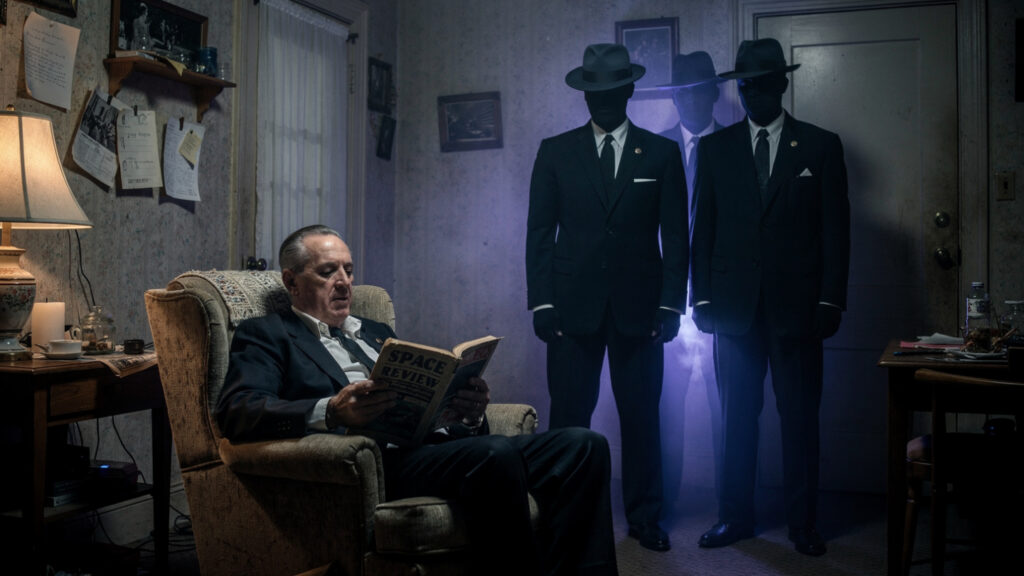
In October 1953, without warning, Bender shut down the IFSB, ceased publication of Space Review, and told associates including Gray Barker that he had received information so disturbing he could not discuss it. He had been visited by three men in dark suits who had appeared in his apartment, communicated information whose content he would not disclose, and warned him explicitly against continuing his UAP research.
The institutional timing is on record: Bender’s shutdown occurred nine months after the CIA’s Robertson Panel met in January 1953 and issued its recommendations for debunking UAP reports and monitoring civilian UAP research organizations, which it identified as potential security risks. Whether the Robertson Panel’s recommendations produced an operational program that resulted in Bender’s visit is consistent with the timing and with the Panel’s stated intentions. That same unresolved question, credentialed testimony against absent verification, runs through the modern disclosure debate as well.
The behavioral details of Bender’s 1962 account complicate the simple institutional attribution. The three men are described as hovering above the floor. Their faces were not clearly distinguishable. Their eyes flashed and the sight caused him physical pain. The communication was not entirely verbal.
Whether the 1962 account accurately reflects the 1953 experience or reflects nine years of elaboration through the growing UFO literature, is a question the available evidence cannot definitively resolve. What the Bender case contributes to the MIB record is the institutional pattern: a named UAP researcher running a well known public organization abruptly ceasing his research after an intimidating encounter, and subsequently providing an account whose anomalous characteristics suggest something beyond government agents in dark suits.
The Robertson Panel and Institutional Management
The CIA’s Robertson Panel recommendations, covered in this library’s dedicated piece, explicitly advocated for the systematic debunking of UAP reports, the reduction of public interest in the phenomenon, and the monitoring of civilian UAP research organizations as potential security risks.
Whether the MIB tradition represents the operational implementation of this policy through intimidation of witnesses who had crossed thresholds of knowledge, or represents something operating outside the institutional framework that the Robertson Panel was working within, is the question that the recorded cases raise without resolving.
The operational methodology implied by the Robertson Panel’s recommendations is consistent with a government intimidation program targeting researchers like Bender. The behavioral anomalies recorded in the most notable cases, the advance knowledge of private events, the physical characteristics outside normal human parameters, the disappearance without conventional transportation, are inconsistent with standard intelligence agency field operations whose professional training emphasizes blending into contemporary environments rather than displaying theatrical anomalies.
This inconsistency is the central evidentiary problem of the MIB tradition: the cases best supported by documentary evidence show behavioral characteristics that preclude simple institutional attribution, while the simplest institutional explanation cannot account for the recorded anomalies.
Dr. Herbert Hopkins and the Coin
The September 1976 case involving Dr. Herbert Hopkins of Old Orchard Beach, Maine is the most thoroughly recorded MIB encounter and the one whose anomalies are most difficult to attribute to government intimidation or confabulation.
Hopkins was a physician and hypnotist who had been conducting regressive hypnosis sessions with David Stephens, a Maine resident who had experienced a UAP abduction event. On September 11, 1976, Hopkins received a phone call from a man identifying himself as a UFO researcher who asked to meet with him. Hopkins agreed. When he went to turn on the porch light for his expected visitor, the man was already on the porch steps, despite the conversation having just ended. Arrival from any significant distance in that time was not possible by conventional transportation.
The visitor was dressed entirely in black including hat, suit, tie, and shoes. His skin was chalk white. His lips were bright red, which Hopkins later concluded was lipstick or makeup. His eyes resembled two gray golf balls without irises or pupils.
The visitor demonstrated accurate knowledge of the Stephens case without having been told about it, discussed details correctly, and then instructed Hopkins to destroy all his research material. To make his point, he asked Hopkins to take a coin from his pocket and hold it in his palm. As Hopkins watched, the coin dematerialized.
The visitor then began slurring his words and moving toward the door, stating that his energy was running low. He left. Hopkins looked outside immediately and saw no car and heard no departing vehicle.
Hopkins subsequently destroyed his research. He described the experience consistently in recorded accounts for the remainder of his life, without the embellishments or inconsistencies that characterize fabricated testimony. He was a medical professional with no prior history of anomalous claims and no apparent motivation for fabrication.
Whether the coin dematerialized, whether the visitor’s chalk-white skin and painted lips reflected disguise or genuinely anomalous physiology, and whether his stated energy depletion and departure without a vehicle reflect actual non-human characteristics, are questions that the account of a trained medical professional who had no prior interpretive framework for his experience carries with weight.
John Keel and the Pattern
John Keel’s systematic investigation of the MIB phenomenon, recorded across multiple books and in his extensive research notes, represents the most rigorous journalistic engagement with the tradition and the most sustained attempt to identify what the recorded cases collectively point toward.
Keel’s contribution was identifying the behavioral profile that distinguishes MIB encounters from standard government intimidation: the visitors arrived in outdated vehicles, wore outdated clothing, showed unfamiliarity with ordinary objects, had unusual skin tones and eye characteristics, and demonstrated knowledge of events they should not have been able to access through conventional surveillance.
This behavioral profile is not consistent with trained government intelligence operatives whose professional training emphasizes blending into contemporary environments. The theatrical elements, the coin dematerialization in the Hopkins case, the materialization from nothing in multiple accounts, the telepathic communication in others, suggest deliberate display rather than operational concealment.
Keel’s operational theory proposed that the MIB were manifestations of a non-human intelligence that has interacted with humanity throughout history in forms adapted to each period’s cultural expectations. Whether this framework is correct, or represents an overcorrection from the simplistic government agent hypothesis, is a question his own cases motivate without resolving.
What the Pattern Actually Shows
The most straightforward explanation for the recurring MIB pattern is institutional: the real, documented Robertson Panel recommendation to discredit UAP interest through public ridicule, combined with ordinary intelligence-community counterintelligence tactics, accounts for a great deal of what the Dahl, Bender, and Hopkins cases describe without requiring anything beyond known Cold War-era government behavior. That explanation doesn’t require every detail to fit neatly, government agents impersonating something stranger than themselves is itself a documented tactic, but it doesn’t need speculation beyond the historical record either.
Whatever the MIB actually were in each specific case, the pattern has been effective at producing silence. The IFSB closed in 1953. Hopkins destroyed his research in 1976. The physical evidence from Maury Island did not survive its transport. The institutional pattern and the anomalous pattern converge on the same outcome, whether or not they share the same cause.
What the Popular Culture Buried
The 1997 Men in Black film, and its sequels, transformed real intimidation encounters into comic entertainment. The transformation followed the Robertson Panel’s recommended pattern precisely: association with ridicule reduces credibility and institutional attention.
Albert Bender’s 1953 encounter predated the film by forty-four years. Herbert Hopkins’s 1976 encounter predated it by twenty-one years. Dahl’s 1947 account predates it too, though it comes with the confessed-hoax history addressed above, which the Bender and Hopkins cases do not carry in the same way.
The encounters were recorded before the mythology that could have produced confabulation existed in popular form. The mythology was constructed from the encounters. The film was constructed from the mythology and returned the mythology to the public in a form that made the original encounters impossible to discuss without invoking Will Smith.
The Bender and Hopkins cases are the ones that carry genuine, unresolved weight, a credentialed researcher abruptly shutting down a real organization, and a physician with no history of anomalous claims describing an experience he maintained consistently for the rest of his life. Albert Bender shut down the most active civilian UAP research organization in the country in 1953. Herbert Hopkins destroyed his abduction research in 1976.
The knowledge was managed. The evidence was eliminated. The witnesses went silent. Whether that management came entirely from ordinary Cold War-era counterintelligence, or whether some portion of these specific cases resists that explanation, is a question the available record doesn’t settle. What seventy-five years of cases do establish is that the pattern itself, ridicule, intimidation, evidence destroyed, witnesses silenced, has worked, regardless of exactly who or what has been running it in any given instance.