



Joseph Saint-Yves d’Alveydre did not invent Agartha.
He claimed to have received it.
In 1886, d’Alveydre published Mission de l’Inde en Europe, a work that he subsequently attempted to suppress after its publication, destroying most of the print run before its distribution was complete. The work contained the most detailed Western account of the subterranean civilization known in Theosophical belief as Agartha, described as an underground realm accessible through passages in the Himalayan region, governed by a being d’Alveydre called the Sovereign Pontiff or King of the World, and maintaining a library of accumulated human knowledge extending back beyond the beginning of recorded history.
His account included governance structures, population estimates, technological capabilities, and geographic details that went significantly beyond the vague underground paradise of generic esoteric belief. He claimed the information came from Hadji Scharipf, an Indian teacher he described as having been brought to France for the purpose of transmitting knowledge to Western esotericism.
Whether d’Alveydre received this information from a genuine transmitter of ancient knowledge, constructed the account from existing esoteric materials including Bulwer-Lytton’s recently published Vril, or accessed the information through the astral projection methods that the esoteric community of his period practiced, he could not subsequently say. He destroyed most of the print run because he said he had revealed more than he had been authorized to reveal.
The few copies that survived his suppression effort were the primary source for every subsequent Western esoteric account of Agartha.
René Guénon, the French metaphysician whose systematic reconstruction of perennial philosophy is the most rigorous in Western esoteric literature, examined d’Alveydre’s Agarthan account in his 1927 work The King of the World and concluded that despite the errors and distortions in d’Alveydre’s account, it pointed toward something real whose elements could be traced across multiple independent sources. Guénon’s contribution was to connect d’Alveydre’s Western esoteric account to the Buddhist Kalachakra teaching’s Shambhala, Hindu Patala belief, and Islamic geographical accounts describing hidden centers of spiritual authority.
The convergence Guénon identified was not perfect. The names differed. The geographic claims differed. The governance structures differed. But the core structure, an advanced civilization in an inaccessible location maintaining knowledge that surface civilizations had lost, accessible only to individuals through means, governing the spiritual development of surface humanity from a position of superior knowledge and capability, was consistent across the independent accounts he traced.
What Guénon Connected
The Kalachakra teaching in Tibetan Buddhism is the most extensively recorded surviving account of the inner world civilization in any living religion. The Kalachakra Tantra, one of the most esoteric texts in the Tibetan Buddhist canon, describes Shambhala as a realm accessible from geographic locations in the Himalayas or Central Asia, governed by a lineage of kings whose succession appears in the text, and whose military and spiritual function includes the eventual intervention in surface history at a moment of civilizational crisis.
The details of Shambhala in the Kalachakra teaching are not vague esoteric allegory. They include the current regnal year in Shambhala’s king list, which can be correlated with surface historical chronology. The geographic characteristics of the Shambhala realm, including mountains, rivers, and a capital city. And the conditions under which surface individuals can access the realm.
Whether these details reflect a genuine geographic hidden civilization, an internal consciousness realm accessible through the meditative practices the text prescribes, or a theological framework whose literal geographic claims are not intended as cartography, is a question that the teaching itself does not uniformly resolve: some Tibetan masters have described Shambhala as an external geographic reality accessible to physical travelers who approach it through the correct preparations, while others have described it as an internal realm accessible only through states of consciousness.

The ambiguity between external and internal access is consistent across these inner world accounts more broadly. D’Alveydre’s Agartha has geographic entry points. Guénon’s treatment emphasizes its spiritual rather than geographic reality. Bulwer-Lytton’s fictional Vril world is reached by physical descent through a cave system. Hollow Earth belief in its various forms proposes physical polar entrances. This body of esoteric thought consistently refuses to resolve this ambiguity, which may reflect genuine uncertainty about the nature of the phenomenon or may reflect a deliberate preservation of both the literal and the allegorical interpretations for different audiences.
Bulwer-Lytton and the Vril Reception
Edward Bulwer-Lytton was one of the most widely read novelists in the Victorian English-speaking world, whose works including The Last Days of Pompeii and The Coming Race were bestsellers in their period. His Masonic and Rosicrucian affiliations were well recorded and his interest in the transmission of occult knowledge through fictional form was consistent across his literary career.
The Coming Race, published in 1871, describes a subterranean civilization whose members have mastered a universal energy they call Vril, an all-pervasive fluid or force that can be directed by trained practitioners to heal, to destroy, to power technology, and to transmit consciousness across distances. The Vril-ya, as Bulwer-Lytton called them, have developed through millennia of Vril mastery into a civilization whose psychological, physical, and technological capabilities so exceed those of surface humanity that contact between the two civilizations would inevitably result in the surface civilization’s destruction.
The reception of The Coming Race in the Theosophical community was immediate and specific. Helena Blavatsky cited the novel as encoding genuine esoteric knowledge transmitted through fictional form, identifying Vril with the Akashic or astral light of the Theosophical cosmology. Rudolf Steiner accepted the same identification. The claim made by both Blavatsky and Steiner was not that Bulwer-Lytton had invented an interesting fictional concept but that he had transmitted genuine knowledge through the protective covering of fiction, a practice they identified as consistent with esotericism’s method of preserving dangerous knowledge in forms that would not attract institutional suppression.
Whether Bulwer-Lytton was transmitting genuine esoteric knowledge, had absorbed the Vril concept from esoteric circles through his Rosicrucian connections and embedded it in a novel, or had simply invented a compelling fictional idea that the esoteric community subsequently retroactively identified as genuine transmission, is a question whose answer depends on whether Vril describes a genuine subtle energy or force whose properties he was accurately characterizing.

The Lovecraft piece in this library examines the parallel case of a fictional author whose dreams were claimed as genuine esoteric transmission by the occult community that engaged with his work. The structural parallel between the Lovecraft and Bulwer-Lytton cases is significant: both produced fiction whose content the contemporary esoteric community received as genuine transmission rather than invention, and both had documented connections to esoteric circles that make the transmission hypothesis less implausible than it would be for a random fiction writer without such connections.
Hyperborea and the Arctic Account
The Hyperborean account in Greek sources describes a people living beyond the north wind, in a land of perpetual sunshine and spring, free from disease and old age, devoted to the worship of Apollo. This account appears in Pindar, Herodotus, and Diodorus Siculus, among others, and is consistent enough across independent classical sources to represent something more than a single literary invention.
The geographic identification of Hyperborea with the Arctic region appears in classical geographical thought: Herodotus places it at the northern limit of the known world, beyond the Riphaean Mountains and the land of the Scythians. The claim that this Arctic location was once temperate enough to support the civilization described requires either a geological pole shift of the type that Charles Hapgood proposed, or a climate condition in the Arctic during a previous epoch that modern paleoclimatology might partially corroborate.
The Arctic was in fact significantly warmer during the Holocene Thermal Maximum, approximately 9,000 to 5,000 years ago, when Arctic temperatures were several degrees warmer than at present and the region was more habitable than it is today. Whether this climatic period is the one the Hyperborean account refers to, and whether any civilization developed in the Arctic during this period, is a question that the archaeological record of the Arctic, which is sparse compared to more accessible regions, has not definitively resolved.
The Apollo connection in the Hyperborean account is the element that connects most directly to this esoteric geography’s broader framework. Apollo is the Greek deity most specifically associated with knowledge, prophecy, and the transmission of divine wisdom to humanity. The Hyperboreans as Apollo’s chosen people, living in perpetual access to divine light and wisdom, are in the esoteric reading the surface world’s connection to the source of the transmitted wisdom that the hidden civilizations of Shambhala, Agartha, and the inner Earth preserve.
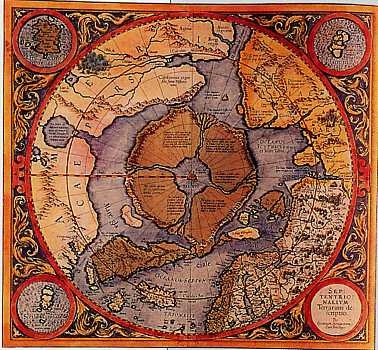
Whether Hyperborea and Shambhala and Agartha describe the same reality from different cultural perspectives, different historical phases of the same civilization’s location, or genuinely different hidden realms serving similar functions, is a question this esoteric geography discusses without resolving.
The Akashic Records and the Method of Access
The esoteric tradition’s source raises the Akashic records as the mechanism through which the hidden worlds’ knowledge remains accessible despite the civilizations’ physical inaccessibility.
The Akashic records concept, developed by Blavatsky and elaborated by Charles Leadbeater within Theosophy, proposes that all events, thoughts, and knowledge that have ever existed are preserved in a dimension of reality that trained practitioners can access through the same consciousness expansion that the astral projection and remote viewing practices develop through different methodological approaches.
The remote viewing piece in this library covers the consciousness state that Stargate program viewers used to access information about distant locations. The oneironaut piece covers the consciousness state that lucid dreamers access the same non-ordinary information through. The Greek underworld piece covers the consciousness state that the mystery religion initiations produced through the katabasis experience.
Whether these different methods of consciousness expansion, remote viewing, lucid dreaming, mystery initiation, meditative practice, and astral projection, access the same territory through different entry points, is the question that the Akashic records concept poses in explicitly geographic metaphorical terms: there is a dimension of reality that contains preserved information, and multiple methods of accessing it have been independently developed by independent cultures.
The hidden worlds of esoteric geography, whether they are external physical civilizations in geographic locations or internal dimensions of reality accessible through consciousness practices, share the characteristic of containing knowledge that surface civilizations do not have and cannot access through ordinary means. Whether the geographic framework is literal, pointing at physical locations that physical expeditions could in principle reach, or metaphorical, describing consciousness states as if they were geographic locations because the spatial metaphor is the most intuitive framework for describing non-ordinary experience, is the question that these accounts have consistently refused to resolve in favor of either interpretation.
What These Accounts Share
Hyperborea, Atlantis, Shambhala, Agartha, and the Vril civilization share five characteristics across their independent accounts.
First: inaccessibility to ordinary surface civilization through ordinary means. The hidden world cannot be reached by standard geographical exploration. It requires either preparation of consciousness or geographic knowledge of concealed entry points.
Second: superior knowledge and capability. The civilization in the hidden world possesses knowledge and capability that surface civilization lacks. This superiority is specifically in the domains of consciousness development, energetic manipulation, and knowledge of natural and cosmic law rather than in military or economic power.
Third: deliberate separation from surface civilization. The hidden world is hidden by choice. The beings who inhabit it are aware of surface civilization and have chosen not to make themselves visible or accessible to it except through channels.
Fourth: active influence on surface history. Despite the deliberate separation, the hidden civilization maintains an active influence on surface history through individuals who receive transmitted knowledge and transmit it to their surrounding cultures. The individuals identified across these accounts include the founders of major religious and philosophical movements, historical figures whose sudden access to advanced knowledge is unexplained by their documented development, and the initiates of esoteric orders.
Fifth: a moment of emergence. Every account that describes the hidden civilization also describes a future moment when the separation will end and the hidden civilization will become accessible or visible to surface civilization. The Kalachakra teaching’s Shambhala war, the Vril-ya’s eventual emergence to surface, d’Alveydre’s Synarchic governance system’s potential application to surface civilization, and Guénon’s description of the end of the Kali Yuga, all describe a transition in the relationship between the hidden and the surface worlds.
Whether this transition corresponds to the current period of accelerating disclosure that the UAP cluster in this library covers, or to the convergence of catastrophic indicators that the Prophecy and Cyclical Time cluster covers, or to something else entirely, is the question that this shared future-orientation raises.
The hidden worlds are on record. Their consistency across independent accounts is on record. The methods of accessing them appear in the consciousness and remote viewing research. The transition moment that every account describes is not recorded as past.

If these accounts are accurate about the consistency of the hidden world’s existence, they may be accurate about the consistency of its eventual emergence.
The ice is melting. The archives are opening. The disclosure hearings are ongoing.
The King of the World is still in Agartha. The question is how much longer he chooses to stay there.