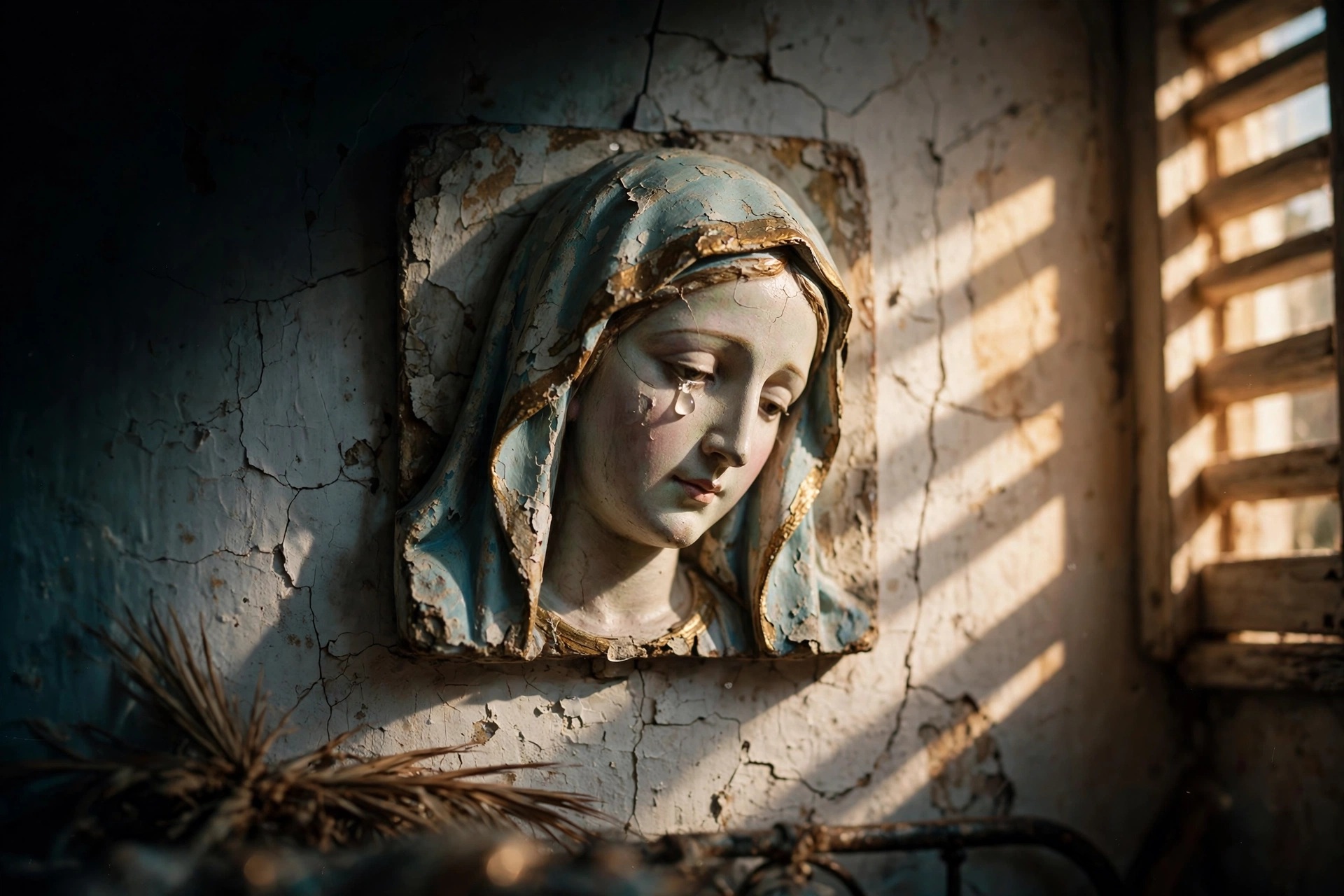
The plaque had hung above the bed for only a few months. It was a wedding present, a cheap plaster relief of the Virgin Mary with her hand on her heart, mass-produced in a factory in Tuscany and sold in shops all over Italy. Angelo and Antonina Iannuso had married in March 1953 and moved into a small house in Syracuse, on the east coast of Sicily. By the summer Antonina was pregnant, and very ill.
On the morning of 29 August 1953 she opened her eyes, looked up at the wall, and saw that the Madonna was crying.
The tears ran down the plaster cheeks and dripped onto the bed. Over the next four days they came and went, while the neighbours crowded in, then the street, then half the city. People caught the drops on cotton and handkerchiefs. A local priest arrived with a team of experts, among them a doctor named Michele Cassola, a declared atheist, who watched the plaque weep in front of him and helped collect the liquid for analysis. Late in the morning of 1 September, the tears stopped. They have never returned.
The liquid was analysed and found to match human tears in appearance, alkalinity and composition, a watery salt solution with traces of protein. On 9 September the commission published its report. In December 1953 the bishops of Sicily declared unanimously that the image had wept.
The Syracuse Madonna is one of a very small number of weeping images the Catholic Church has ever accepted. It is also the beginning of a pattern that has repeated itself, on every continent, for more than seventy years. A statue or an icon begins to cry, sometimes water, sometimes oil, sometimes blood. Crowds gather. And then, sooner or later, someone asks to take a sample.
The Oldest Trick in the Temple
Statues that seem to come alive are older than Christianity. In the Book of Daniel, in a short story known as Bel and the Dragon, the king of Babylon believes that the idol of the god Bel eats and drinks the enormous offerings left before it every night. Daniel is not convinced. He has fine ash scattered across the temple floor before the doors are sealed. In the morning the food is gone, and the ash is covered with footprints, men, women and children, leading to a secret door beneath the altar. The priests and their families had been eating the god’s dinner.
The story was told as a warning more than two thousand years ago, and it describes exactly the problem every weeping statue still poses. The miracle happens when no one is watching closely. The question is always who has access to the room.
Sometimes there is no trick at all, only physics. On 21 September 1995, word spread from a temple in New Delhi that statues of the god Ganesha were drinking milk. Within hours, crowds were lining up with spoons at temples across India and then in Britain, Canada and Nepal, and the milk did seem to vanish. A team of scientists from India’s Ministry of Science and Technology went to a temple with milk mixed with food colouring. As the spoon emptied, a coloured film spread down the front of the statue. Surface tension was drawing the milk out of the spoon and onto the stone, where it ran away unseen. Within days, the gods had stopped drinking.
How to Make a Madonna Cry
In 1995 the Italian chemist Luigi Garlaschelli, of the University of Pavia, published a short note in the journal Chemistry in Britain explaining how to make a statue weep. The method needs no pumps, no tubes and no holes near the eyes.
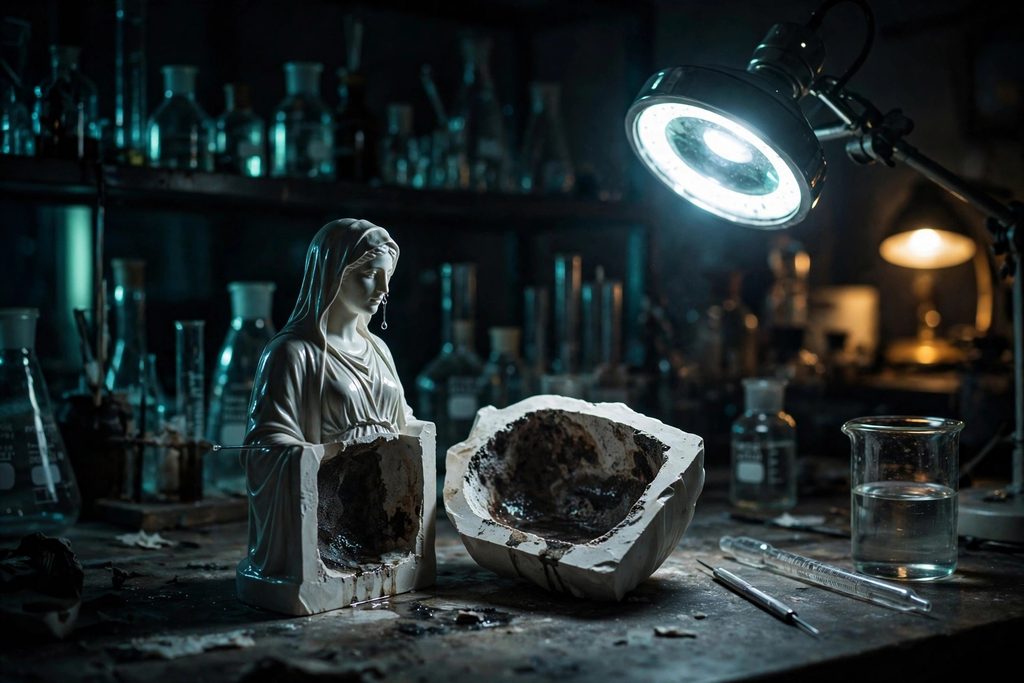
Take a hollow statue made of a porous material, plaster or ceramic, and covered in an impermeable glaze or paint. Fill the hollow with liquid. The porous body soaks it up, but the glaze keeps it in. Then, with a fine point, scratch away a tiny patch of glaze at the corner of each eye. Drops begin to form there, swell and roll down the cheeks. If the cavity behind the face is small, the liquid soon runs out and leaves almost no trace. Garlaschelli tried it and reported that the effect was “very satisfactory,” baffling everyone who watched.
He then turned to Syracuse. He obtained an identical plaque from the same Tuscan manufacturer and found that it was made of glazed plaster with a cavity behind the face. That does not prove the Iannuso plaque was tampered with. Nobody has ever been allowed to examine the original that closely. It does show that a statue of exactly that kind can be made to cry by someone with a little knowledge and a few minutes alone with it.
The Blood of Civitavecchia
In February 1995, in the port town of Civitavecchia, north of Rome, a little plaster statue of the Virgin outside the home of Fabio Gregori, an electrician, was seen with red streaks running from its eyes. The statue had been brought back from the shrine at Medjugorje. Over the following weeks it was reported to weep blood again and again, and around sixty people said they had witnessed it, among them the local bishop, Girolamo Grillo, who had arrived as a sceptic.
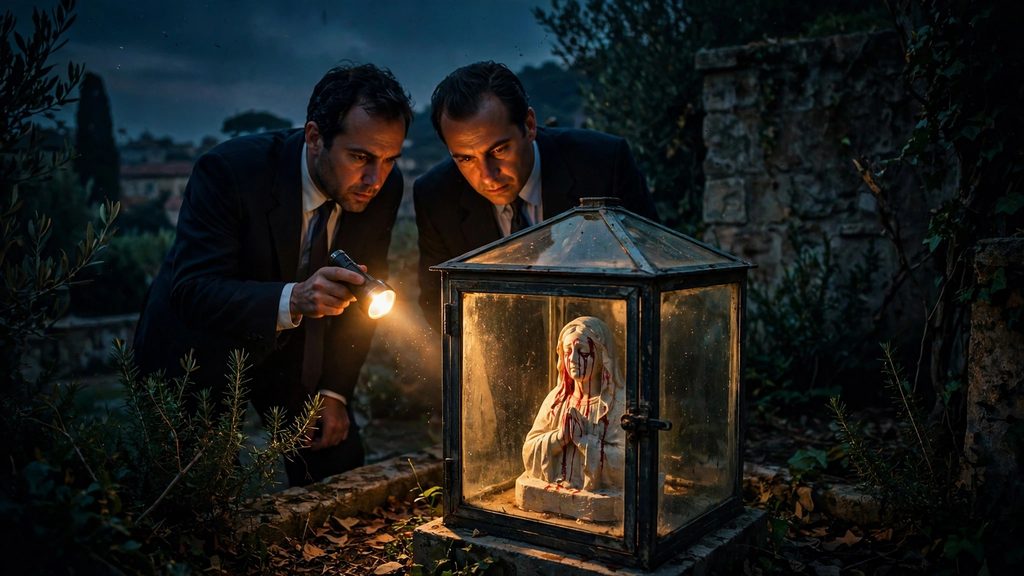
Laboratory tests showed that the red substance was human blood, and that it came from a man. That might have been the beginning of a straightforward investigation. Instead, the Gregori family refused to give samples for DNA comparison. A magistrate had the statue seized and locked away. An X-ray found it was hollow, with nothing hidden inside. While it was in official custody, it did not weep once.
The Civitavecchia statue was later returned to a parish church, where it is still venerated. The question of whose blood ran down its face has never been answered, because the people who could answer it declined to be tested.
When the Blood Has a Name
Civitavecchia started a wave. In the months that followed, dozens of statues across Italy were reported to cry, and almost all of them turned out to involve blood, red paint or water put there by human hands. Since then, DNA testing has made the question much easier to settle, and the answers have not been kind to the miracles.
In 2002, the blood on a weeping statue of Padre Pio in Messina was tested and found to belong to a woman. In March 2006, a statue of the Virgin in the church of Santa Lucia in Forlì, in northern Italy, began to bleed. The blood matched the DNA of the church’s former custodian, Vincenzo Di Costanzo, who went on trial in 2008 accused of putting it there. He denied it, and a match alone shows whose blood it is, not whose hand placed it. The prosecutor called it “a case of high sacrilege.”
The most recent case ended only in 2024. Since 2016, Gisella Cardia, a woman from Sicily living in Trevignano Romano near Rome, had drawn pilgrims to her town, where a statue of the Virgin, also bought in Medjugorje, was said to weep blood on the third day of every month. She also reported that a few leftover portions of gnocchi had fed fifteen people. An investigation in 2020 reported that the blood on the statue was a genetic match to Cardia herself. In March 2024 the local bishop, Marco Salvi, ruled that the events were not supernatural, and in June the Vatican’s Dicastery for the Doctrine of the Faith upheld the ruling.
Not every exposure involves blood. In Mumbai in 2012, water began dripping from the feet of a crucifix outside a church, and people collected it as holy. The rationalist Sanal Edamaruku traced it to a blocked drain nearby, the water creeping up through the porous wall and out at the statue’s feet. He was accused of blasphemy for saying so. In 2018, the tears of a statue of the Virgin in Hobbs, New Mexico, were analysed for the local diocese and found to have “the chemical composition of rose-scented olive oil.”
What these cases share is worth noticing. When the liquid was tested properly, it always led somewhere ordinary. And the same handful of things kept recurring: a statue in a private home or garden, a single family or custodian with constant access, and reluctance about the one test that would settle it.
Myrrh From Mount Athos
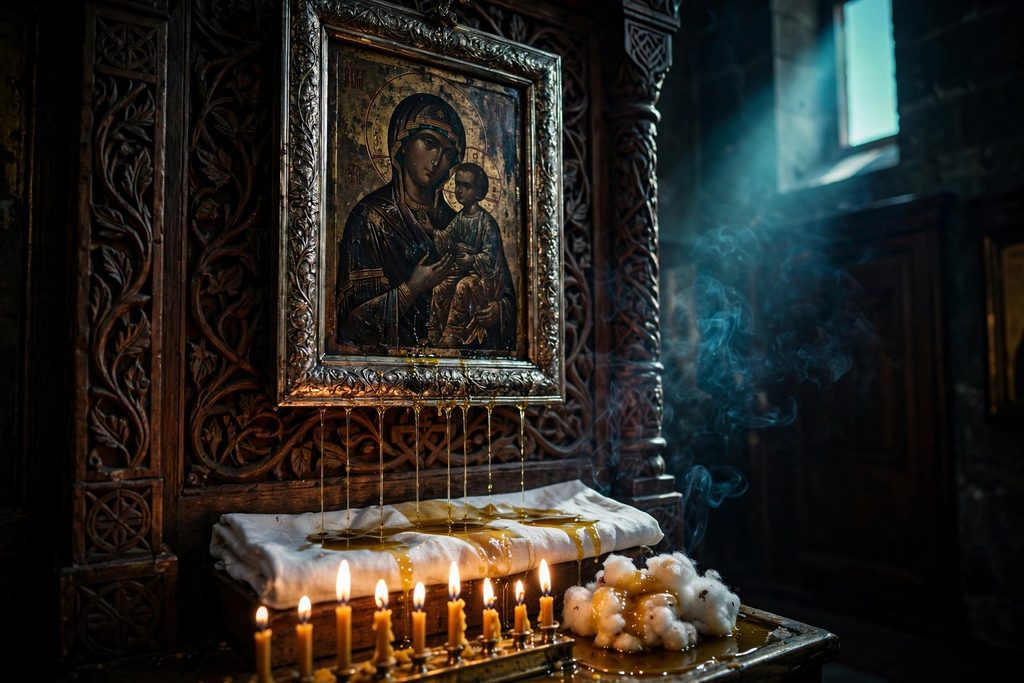
In the Orthodox world the tradition takes another form. Icons are said to stream myrrh, a fragrant oil that seeps from the painted wood, and Greek churches have honoured such icons for centuries.
The most famous modern case began in Montreal in 1982. A Chilean-born convert, José Muñoz-Cortés, had brought home a painted copy of the Panagia Portaitissa, the great icon of the Virgin kept at the Iviron monastery on Mount Athos. In his apartment, he said, the copy began to stream a sweet-smelling oil, and for fifteen years he travelled with it to churches around the world, where thousands of believers were anointed with the myrrh. As far as the record shows, it was never handed to a laboratory.
The story ended in Athens. On the night of 30 to 31 October 1997, Muñoz-Cortés was tortured and murdered in a hotel room in the city. The icon was gone. A Romanian man was charged with the killing and acquitted the following year for lack of evidence. Years later it emerged that Muñoz-Cortés had sent the icon to a Greek monastery for safekeeping before his death, and the monks say it is there still.
Not every myrrh-streaming icon has been so lucky in its keepers. A painting of the Virgin at the Christ of the Hills monastery near Blanco, Texas, drew pilgrims through the 1980s for its weeping myrrh. In the 2000s it was exposed as a fraud.
The Statue That Wept on Television
The case that still troubles sceptics most comes from a small convent outside Akita, in the north of Japan. Between 4 January 1975 and 15 September 1981, a carved wooden statue of the Virgin in the convent chapel was reported to weep 101 times. The witnesses included the nuns, local people, visiting clergy and, in December 1978, a television crew whose footage was broadcast across Japan. The central figure was a nun, Sister Agnes Katsuko Sasagawa, who also reported visions and messages.
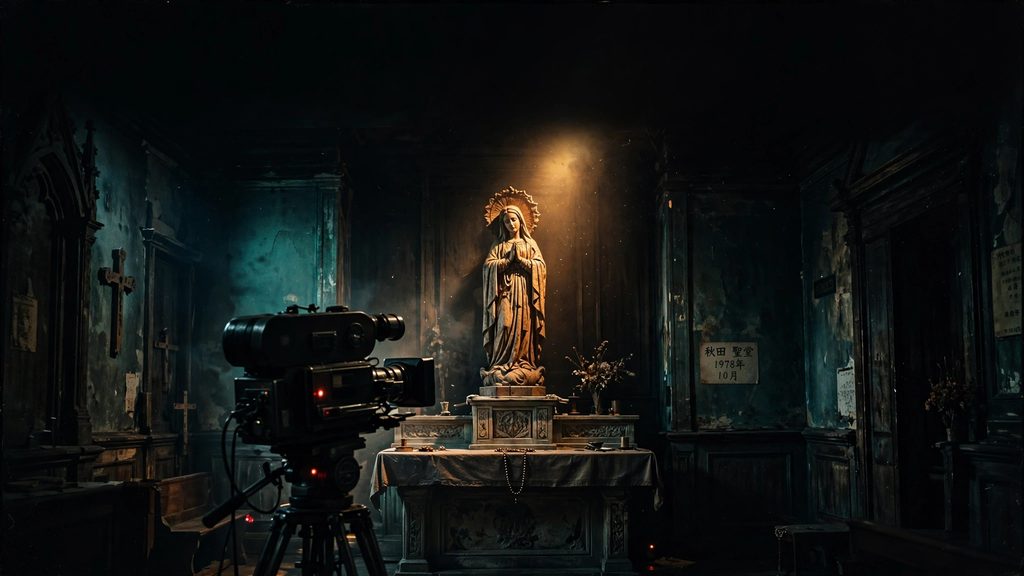
Samples were tested by doctors, who reported that the blood on the statue was human blood of type B and that the tears and sweat were type AB. In 1984 the local bishop, John Shojiro Ito, recognised the supernatural character of the events and allowed the statue to be venerated in his diocese.
And yet the official record pulls in more than one direction. A diocesan commission in 1976 concluded that it was “not in a position to prove the supernatural events.” In 1981 the Vatican’s doctrinal office declined to open a new examination. In 1990 the head of the Japanese bishops’ conference said the events “are no longer to be taken seriously.” The Holy See has never issued a final judgment either way. Sister Agnes died in 2024, at the age of ninety-three, and the statue still stands in the convent chapel. It has never been examined the way Garlaschelli examined his plaster copy.
What the Church Itself Says
It would be easy to tell this story as believers against sceptics. The record is more interesting than that. Some of the sharpest scepticism about weeping statues has come from inside the Church.
Church authorities set a very high bar for these claims and reject most of them. Bishops have ordered blood tests, called in police and, as in Trevignano, declared phenomena flatly not supernatural. In 2024 the Vatican issued new rules for judging alleged supernatural events, and they are cautious by design. In most cases the strongest verdict a bishop is now expected to give is a nihil obstat, a statement that nothing stands in the way of private devotion, not a declaration that a miracle has taken place.
The Church’s concern is not only about truth. A false miracle draws money, crowds and sometimes vulnerable people seeking cures. It also makes faith look foolish when the DNA results arrive. Believers have their own reasons for wanting the fakes found.
The Verdict | Debunked
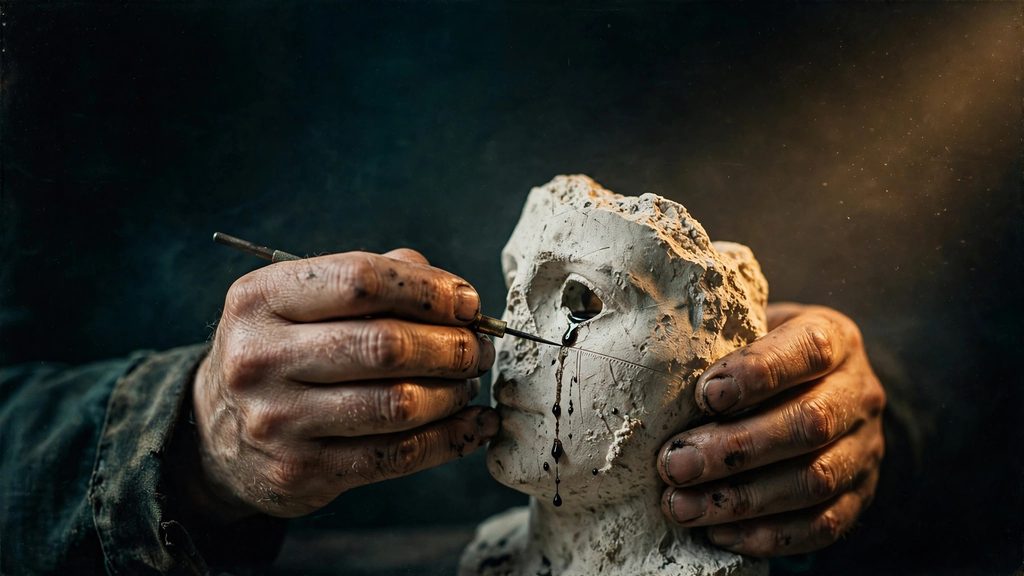
The claim at the heart of this file is that statues and icons weep tears, oil or blood by themselves, with no human hand involved. Wherever that claim has been tested, it has failed. The blood has matched the people around the statue, the owner in one case, a custodian in another. The water has come from a drain, the oil from a bottle. A chemist has shown how to make a plaster Madonna cry with nothing more than a scratch. And in Civitavecchia, where the family refused the one test that would settle it, the weeping stopped the moment the statue left their care.
Not every case ends in a confession or a match. Some were exposed, some were explained by plumbing or physics, and a few were never tested at all. None of those three outcomes is evidence of a miracle.
The stamp judges that claim, not the people who knelt in front of these images, many of whom found comfort there. Nor can it reach the two most famous cases. The plaque from Syracuse has rested behind glass for decades, unexamined by scientists, and the statue in Akita has never been handed to an independent laboratory. For those two, the record simply runs out.
On 17 October 1954, Pope Pius XII spoke by radio to a Marian congress in Sicily about the tears of Syracuse. “Will humanity,” he asked, “understand the mysterious language of those tears?” Seventy years of cases suggest an answer he did not intend. The tears have always spoken most clearly about the people around the statue: about grief and longing, about faith, about the hunger for a sign, and now and then about someone alone in a room with a little blood and a plaster face.
The pattern is as old as the footprints in Daniel’s ash. The weeping happens when no one can see how. It stops when someone looks closely enough.
Other relics of faith that seem to defy nature have their own files, among them a monk’s body that would not decay. And as the case of two sisters who confessed to faking the spirit knocks that launched a religion shows, an exposed miracle rarely ends the faith built around it.
To see how this file’s stamp compares with the rest of the archive, visit the Verdict Index.