



The forensic scientists who examined the remains in September 2002 knew what a body dead for seventy-five years should look like.
Decomposition begins within minutes of death. The processes that reduce a body to bone on a conventional timeline are well-characterized in forensic science: autolysis first, the body’s own enzymes breaking down cellular structures, followed by putrefaction as bacteria colonize the tissues, followed by the systematic reduction of soft tissue that soil conditions and insect activity accelerate or slow depending on the burial environment. A body buried in 1927 and exhumed in 2002 should be skeletal, or close to it, in almost any burial environment.
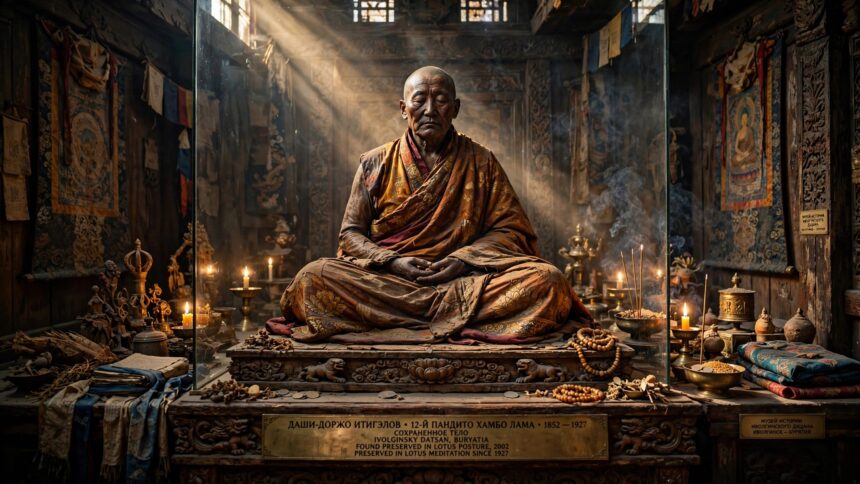
The body that the scientists examined in September 2002 at the Ivolginsky Datsan monastery in Buryatia, Russia, was not skeletal. The joints were flexible. The skin was intact. The tissue showed no decomposition. The body sat in the lotus position in which it had been placed at the time of death, and the posture had been maintained for seven decades in soil.
The body belonged to Dashi-Dorzho Itigilov, the twelfth Pandito Khambo Lama of Russia, the head of the Buddhist religious hierarchy in the Russian Empire, who had died in 1927 at the age of 75 after instructing his disciples to read the prayers for the dead over him while he sat in meditation. He had told them to exhume him after a period of time and to examine what they found. They did. Twice, in 1955 and 1973, Buddhist monks exhumed and reexamined the body and reburied it without publicizing what they found.
The 2002 formal exhumation, attended by scientists, forensic experts, and religious authorities, produced findings that the Russian medical establishment examined formally in 2004 through the Russian Federal Centre of Forensic Medicine.
The Scientific Findings
Victor Zvyagin, a leading specialist at the Russian Federal Centre of Forensic Medicine whose professional specialty was the forensic analysis of human remains, led the 2004 formal examination. His published findings in the Russian medical literature addressed the question that the 2002 exhumation had raised: what was the physical state of the tissues, and how could that state be explained within the framework of known biological processes?
The tissue samples taken from Itigilov’s body showed protein structures consistent with a person who had died recently rather than with a person who had been dead for 77 years. Protein degradation is one of the most reliable indicators of post-mortem interval in forensic pathology: proteins begin to degrade through chemical pathways immediately after death, and the degree of degradation can be used to estimate the time since death with reasonable accuracy. Itigilov’s proteins had not undergone the degradation that 77 years of post-mortem interval should have produced.
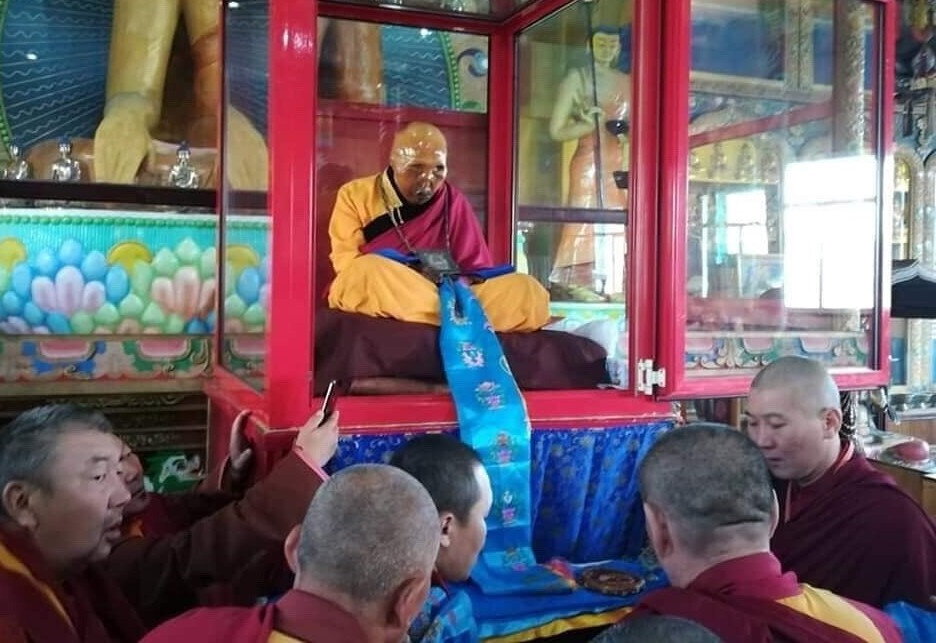
The body temperature, maintained at approximately 23 degrees Celsius under normal conditions and rising to approximately 34 degrees during prayers and religious services, represents a deviation from the surrounding environment that passive preservation does not explain. A preserved body maintains the temperature of its environment. A body whose temperature rises in response to activities in its vicinity is not behaving as a preserved body.
The joint flexibility, the intact skin, and the reported slow heartbeat of approximately one beat every two to three minutes and the slow respiration of one to two breaths per minute appear in the accounts of monks who have examined the body over the decades. Whether these vital sign observations are accurate in their measurements, or represent the perceptual interpretation of subtle movements in an exceptionally well-preserved body, is not definitively established. What Zvyagin’s protein analysis establishes at the molecular level is harder to interpret as perceptual error: the biochemistry of the tissues shows a preservation state that conventional post-mortem science cannot fully explain.
The Preparation
Itigilov spent years preparing for the state in which he died. The preparation the source describes, the deliberate ingestion of large quantities of coniferous needles, cones, and resin, appears in the accounts of his disciples and in the Buddhist monastery records. The preparation was not incidental to the samadhi state. It was a systematic biological program whose effects on the body’s chemistry were understood, at least in practical terms, by the practice that prescribed it.
Coniferous resins contain bioactive compounds whose properties have been characterized in the modern biochemistry literature. Rosin acids and related diterpene compounds have documented antibacterial and antifungal properties at concentrations achievable through sustained dietary intake. Terpenes, the aromatic compounds responsible for the characteristic scent of pine resin, have documented antioxidant properties and affect the biological processes that drive decomposition by reducing microbial activity and by cross-linking with protein structures in ways that increase their resistance to degradation.
A body whose tissues have been systematically loaded with high concentrations of rosin acids, terpenes, and phenolic compounds through years of deliberate dietary intake would have a different chemical environment than an unprepared body. The compounds would be distributed through the tissue structures, potentially creating a natural embalming effect that differs from conventional embalming in that it operates from the inside of the cellular structures rather than being applied externally.
The biochemistry does not fully explain Zvyagin’s protein findings. It explains the absence of external decomposition more plausibly than it explains the maintenance of protein structures at a state consistent with recent death rather than extended post-mortem interval. The resin preparation may be a component of the mechanism rather than its complete explanation.
What Buddhist practice has preserved, and what the scientific examination has partially characterized, is a biological state that the conventional binary of alive or dead does not adequately describe.
The Practice’s Scope
Itigilov is the most extensively recorded case of what Buddhist practice calls samadhi, the state of deep meditative absorption in which the practitioner’s consciousness is described as having withdrawn from but not entirely separated from the physical body. This practice, recorded across multiple Buddhist lineages in Tibet, Thailand, Myanmar, China, and Japan, claims approximately 600 recorded cases of practitioners who entered samadhi and whose bodies remained in exceptional states of preservation.
The range of documented cases varies in their evidentiary quality. The most extensively recorded, in addition to Itigilov, include several Thai forest tradition masters whose preserved bodies are maintained in temples where they have been examined by medical professionals. Luang Phor Daeng, a Thai forest tradition monk who died in 1983, has a preserved body at Wat Khunaram on Koh Samui that shows minimal decomposition decades after death.
The Japanese practice of sokushinbutsu, self-mummification through a multi-year program of dietary restriction and the ingestion of substances, represents a related but distinct discipline in which the preservation mechanism is more fully understood as a deliberate chemical process. The Yamagata prefecture’s collection of sokushinbutsu mummies, some over a thousand years old, demonstrates that the intentional preservation of the human body through systematic preparation and the biological state at death is a reproducible result rather than a miraculous exception.
Catholic belief in incorruptibility offers a cross-cultural parallel that appears independently of Buddhist practice and without the chemical preparation that the Buddhist cases involve. The bodies of Catherine of Siena, Teresa of Avila, Padre Pio, and dozens of other Catholic saints have shown exceptional preservation documented in official church investigations conducted over centuries. The church’s formal process for investigating incorruptibility, which requires medical examination by qualified physicians before the preservation is officially recognized, has produced a documented record of preserved bodies across multiple centuries and multiple geographic locations.
The convergence of Buddhist samadhi, Japanese sokushinbutsu, and Catholic incorruptibility, each documented independently, each producing preserved bodies in institutional collections where they have been subjected to varying degrees of professional examination, suggests that the phenomenon is real, distributed across multiple independent cultural contexts, and not fully explained by either the miraculous framework or the conventional biochemical framework.
The Consciousness Question
The samadhi claim is not primarily about physical preservation. The preservation is a consequence or a side effect of the primary achievement: the practitioner’s consciousness has entered a state in which its relationship to the physical body is different from the ordinary living state and different from the ordinary dead state.
The near-death experience research provides the closest documented scientific parallel to this claim. Pim van Lommel’s prospective study of cardiac arrest patients, published in The Lancet in 2001, followed 344 patients who were successfully resuscitated after cardiac arrest. Of these, 62 reported near-death experiences whose content, including out-of-body perception of the resuscitation from above, encounters with deceased relatives, and the light-at-the-end-of-the-tunnel phenomenology, was documented and analyzed. The study’s methodological rigor, prospective design, consistent findings, and peer-reviewed publication in one of medicine’s most respected journals placed it in a different evidentiary category from anecdotal near-death experience reports.
Van Lommel’s conclusion was that consciousness appeared to be functioning when the brain was clinically non-functional, producing accurate perceptions of the environment that could not have been generated by a brain in cardiac arrest. The conclusion is contested in the mainstream neuroscience literature, where researchers have proposed various mechanisms by which residual brain activity could produce the experienced content. The contest has not been resolved.
The samadhi teaching describes a practitioner who has developed sufficient mastery of consciousness to withdraw it from the ordinary relationship with the body without the emergency conditions of cardiac arrest, in a deliberate and prepared sequence, maintaining the body in a state that is neither conventional life nor conventional death because the consciousness that ordinarily mediates between the biological processes and the external world has not fully departed.
Whether this description corresponds to a real biological state, to a philosophical framework without physical correlate, or to something in between, is the question that Zvyagin’s protein findings place in a scientific context. The proteins in Itigilov’s tissues showed a preservation state that the biochemical explanation for the preservation does not fully account for. Samadhi teaching provides an explanation for this gap that the biological sciences do not currently have the framework to evaluate.
The 600 and What They Chose
The Buddhist teaching that documents approximately 600 practitioners who entered samadhi treats the state not as death in the conventional sense but as a deliberate transition. The practitioner who enters samadhi has made a choice about the relationship between their consciousness and their physical body that differs from both the ordinary living relationship and the ordinary dying relationship.
In this account, the practitioner who has achieved sufficient development has exhausted the purposes that their current incarnation can serve. They have nothing remaining to accomplish in this body and this life. The choice to enter samadhi rather than to die in the ordinary way is an expression of that completeness: the practitioner’s final act is not passive death but the active establishment of a relationship between consciousness and matter that the body’s preservation demonstrates.
This teaching also holds that practitioners who enter samadhi are not simply waiting. The account of body temperature rising during prayers and religious services at Itigilov’s monastery suggests a continuing responsiveness to the external environment that the preservation framework does not explain but that the consciousness framework does: the practitioner’s consciousness, not fully separated from the body, responds to conditions in its vicinity in ways that produce measurable physiological effects.
Whether this is accurate, whether Itigilov’s body temperature actually rises during services and falls during ordinary conditions, appears in the accounts of the monks who maintain the monastery but has not been formally characterized in a controlled scientific study that would distinguish physiological response from coincidental environmental temperature variation.
This body of practice has maintained approximately 600 such cases across its documented history. The scientific examination of the most formally studied case has produced findings that the conventional framework does not fully explain. Its own framework provides an explanation whose claims about consciousness cannot be evaluated with current instrumentation.
The body is in the monastery in Buryatia. Scientists examined it. The proteins had not degraded in the way that 77 years of death should require.
What accounts for the protein state is the question that Victor Zvyagin’s published findings raise and that the conventional framework has not resolved.
Buddhist teaching says the monk is not fully dead. The proteins suggest that teaching may be describing something real.