



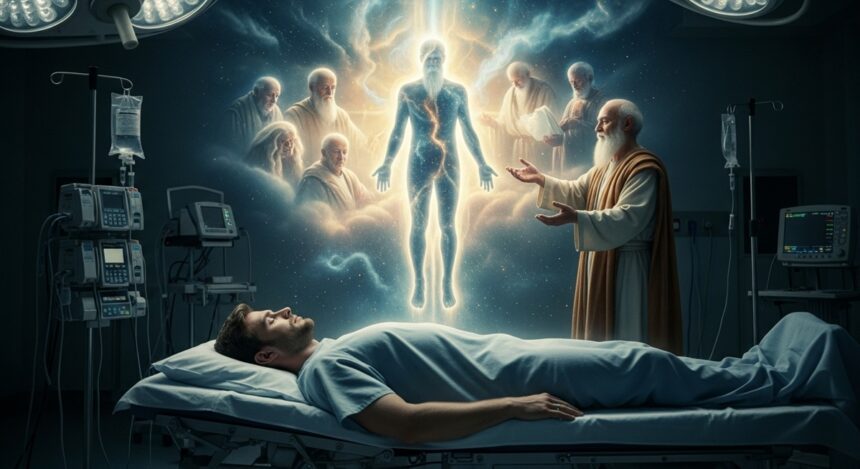
A man dies for eight minutes. When he is brought back, he does not describe darkness. He describes a place filled with light, encounters with beings he understands as saints and healers, communication that seems to happen without speech, and something resembling a review of his life, not as a courtroom scene but as an almost unbearable awareness, arising from within, of what he had done to other people. He returns believing that the soul can be purified, that compassion outweighs achievement, and that death is not the end of the story.
It sounds like an answer to one of humanity’s oldest questions. There is only one problem: the experience may be genuine without its explanation being established. The man may have experienced something extraordinary. His memory may be sincere. The transformation that followed may be real and lasting. None of that, by itself, demonstrates that he literally travelled to an independently existing afterlife.
What makes that distinction interesting rather than merely cautious is what sits beside it: several decades of prospective medical research showing that a measurable minority of people who survive cardiac arrest report remarkably vivid experiences at the boundary between life and death. The testimony that opens this investigation cannot be independently verified in the form it’s told, there’s no reason to accuse the man of fabricating it, and no reason to promote his theological interpretation to established fact either. The honest position sits between those two temptations: take the account seriously as testimony, and treat the science of near-death experience as its own, separately answerable question.
The Experience and the Interpretation Are Not the Same Thing
This distinction runs through the entire subject, and it’s worth stating plainly before anything else: an experience can be sincere, psychologically powerful, and historically fascinating without proving the explanation attached to it. Someone experiences light and describes heaven. Someone encounters a presence and understands it as God, an angel, a deceased relative, or a saint. Someone undergoes a life review and interprets it as divine judgment, karma, or evidence of an afterlife’s structure. Science has real, if imperfect, tools for investigating the first half of each of those sentences. It has far less direct access to the second half, and pretending otherwise, in either direction, is where this subject usually goes wrong.
Then Researchers Started Following Cardiac-Arrest Survivors Before They Knew Who Would Report Anything
For a long time, near-death experiences occupied an awkward territory between religion, anecdote, and popular culture: extraordinary stories that were nearly impossible to measure. That changed once researchers began following cardiac-arrest patients prospectively, before anyone knew who would later report an experience, rather than only collecting accounts after the fact from people who had already decided their story was worth telling.
The landmark study came from the Netherlands. In 2001, cardiologist Pim van Lommel and colleagues published a prospective study in The Lancet involving 344 consecutive patients successfully resuscitated after cardiac arrest across ten Dutch hospitals. Sixty-two patients, 18 percent, reported a near-death experience, while 41 percent of those experiences met the study’s criteria for what the researchers classified as a core experience. The significance wasn’t that 18 percent of patients had proven an afterlife exists. It was that the phenomenon could finally be studied systematically: the researchers compared patients who reported NDEs against those who didn’t, tracking demographic, medical, pharmacological, and psychological factors, and found that whether someone reported an NDE was not simply explained by how long the arrest lasted, how long the patient was unconscious, medication, or fear of death beforehand. They also documented substantial psychological changes persisting for years afterward in people who reported deeper experiences.
Later prospective research has produced different percentages depending on the population studied, the definition used, and the timing of the interview. A 2024 scoping review of prospective cardiac-arrest studies found reported NDE rates ranging from 6.3 percent to 39.3 percent across eleven interview-based studies. That range isn’t a reason to dismiss the phenomenon. It’s a reminder that researchers aren’t measuring something as simple as body temperature; they’re trying to reconstruct an intensely subjective event, through memory, after an episode in which the person’s physiology was profoundly disturbed. Change the questionnaire, the timing, the population, or the threshold for classifying an experience, and the percentage moves.
A Recurring Architecture, Not a Fixed Script
Despite the methodological differences, researchers keep encountering a recognizable cluster: an overwhelming sense of peace, altered perception of time, unusual clarity, movement through darkness or space, encounters with light or a presence, apparent separation from the body, meetings with beings or deceased relatives, a sense of reaching a boundary, and sometimes a panoramic, emotionally intense review of one’s life. Not everyone reports all of it. Some remember only fragments. Some describe frightening or confusing experiences rather than peaceful ones. Popular culture has quietly flattened all of that variability into a standardized script, tunnel, light, dead relative, heavenly landscape, life review, return, and real accounts are considerably messier than that template suggests.
Psychiatrist Bruce Greyson did the most important work turning that recurring architecture into something researchers could systematically assess, developing the standardized Near-Death Experience Scale so investigators could ask about specific features of an experience rather than relying on whether someone spontaneously reached for the phrase “near-death experience” themselves. Greyson’s own 1983 cardiac-arrest study at the University of Virginia examined 116 patients; 11 reported an NDE under the study’s principal criterion, with the proportion running somewhat higher depending on how the responses were classified. None of that existence of recurring phenomenology proves a spiritual realm, and the possibility of a neurological mechanism doesn’t make the experience meaningless either. A dream is generated by the brain and can still change a person’s life. Grief is mediated by biology and can still be sacred to the person living through it. That a process has a neural substrate has never, by itself, settled what the experience means to the person who had it.
Do People Everywhere Report the Same Thing?
Near-death experiences have been documented across different societies and religious traditions, and comparative research has identified recurring elements across cultures without finding a perfectly identical experience everywhere. Cultural background, language, education, religious concepts, and individual expectation all shape how an experience is perceived, remembered, and described. That doesn’t reduce the phenomenon to simple cultural conditioning, the evidence is more interesting than that: broad features recur while imagery and interpretation vary, which is closer to a recurring architecture than a universal script. Research among Iranian Muslim survivors, for instance, has documented pleasant states, light, a sense of movement beyond ordinary reality, out-of-body experiences, and life review, while also showing how Islamic concepts shaped the way those experiences were understood and told. Studies like that matter precisely because they complicate the assumption that the Western popular image of an NDE is the universal form, and the same caution applies to any claim that a particular religious population simply has no NDEs: absence from the published literature is not the same thing as absence of the experience, and publication patterns, access to research infrastructure, language, and cultural attitudes toward reporting extraordinary experiences can all shape what ends up in a database.
The Hardest Question Isn’t What People Saw. It’s When They Saw It.
This is where the popular debate usually goes wrong in both directions at once. It is sometimes claimed that an NDE proves the brain was completely inactive at the time; that isn’t an established scientific conclusion. Cardiac arrest is a dynamic physiological process, not a single instantaneous switch cleanly separating “functioning” from “not functioning.” Blood flow falls dramatically, oxygen availability changes, electrical activity shifts, resuscitation begins, circulation can return intermittently, and the brain moves through several distinct physiological states across the whole event.
There’s a deeper problem underneath that one: memory doesn’t arrive with a timestamp. A person may later remember an experience as having happened during the arrest itself, but it might instead have occurred during the earliest stages of recovery, or during the transition between physiological states, or as fragments from different moments later woven by memory into one coherent narrative. Some of these possibilities have real neurological support behind them; others remain hypotheses. But the timing problem alone means the confident claim that “this person was conscious while the brain was completely offline” goes well beyond what current evidence can actually establish.
Then Researchers Stopped Waiting for the Story and Started Watching in Real Time
The next stage of the investigation didn’t rely on interviewing survivors afterward. It tried to observe what was happening during resuscitation itself. Sam Parnia and colleagues conducted AWARE II, a prospective, multicenter study across 25 hospitals combining audiovisual testing with continuous EEG and cerebral-oxygenation monitoring during CPR. Of 567 in-hospital cardiac arrests recorded in the study, 53 patients survived and 28 completed the post-resuscitation interviews. Eleven of those 28, about 39 percent, reported memories or perceptions suggestive of consciousness during the cardiac-arrest period, sorted by the researchers into several categories including consciousness emerging during CPR, dream-like experiences, and what the authors termed a transcendent recalled experience of death.
The study also produced one of the most genuinely fascinating findings in the modern NDE literature: patterns of EEG activity associated with organized, conscious brain function emerged in some patients as long as 35 to 60 minutes into CPR, despite severe cerebral ischemia. That is extraordinary, and it does not mean what some headlines about the study made it mean. AWARE II did not demonstrate that consciousness leaves the brain, or that it survives death, or that every reported experience occurred during a period in which the brain was incapable of supporting experience at all. The study’s audiovisual hidden-target tests didn’t produce a dramatic confirmation of perception either: nobody identified the visual target, and only one participant identified the auditory stimulus. What the study did demonstrate is more scientifically defensible, and in its own way more intriguing: consciousness and cognitive activity around cardiac arrest are considerably more complicated than the old picture of an instantaneous transition from normal awareness to total silence.
Is the Brain Simply Creating the Experience?
Several plausible mechanisms are on the table. Extreme changes in oxygen and carbon dioxide levels can affect perception and cognition. Altered blood flow can disrupt normal brain networks. Neurochemical shifts may influence emotion, memory, and the sense of self. Temporal-lobe and other network-level processes have been investigated as contributors, alongside REM-related mechanisms, dissociation, and the unusual conditions created by anesthesia and resuscitation themselves. None of these is a complete, universally accepted explanation covering every reported feature of every NDE, and that’s not a failure of the field so much as a description of what an incomplete but active area of science actually looks like from the inside.
There are good reasons to keep investigating the brain here, since consciousness is deeply dependent on brain function under ordinary conditions: injury to specific regions can change personality, memory, language, and the sense of self; drugs and anesthesia can radically alter or suppress consciousness; electrical stimulation can modify experience directly. All of that is powerful evidence that brain function matters enormously to consciousness. It is not the same thing as having solved the philosophical problem of consciousness itself, why physical processes should be accompanied by subjective experience at all, why there is something it feels like to be a person rather than merely a functioning biological system. That unresolved problem doesn’t prove an immortal soul. It does mean that “we haven’t fully explained it yet” shouldn’t quietly become either “therefore it’s supernatural” or “therefore we already know exactly what it is” — the question of what happens to consciousness when the biological system that produces or carries it stops is still genuinely open.
The Brain May Stay Active Longer Into Dying Than We Assumed
AWARE II is not the only recent work complicating the old picture of an instantaneous shutdown. A 2024 review in Anesthesiology examined emerging evidence on neurophysiological activity around cardiac and respiratory arrest, describing organized electrical activity and shifts in brain connectivity that have been reported in some circumstances around the time of death, while explicitly cautioning that much about the mechanism remains unresolved. That review reframes the central question. It is no longer simply “the brain stopped, so how could anyone experience anything.” It has become a harder question: how much organized activity can a human brain generate during the extreme physiological conditions surrounding death, and precisely when, within that sequence, does the remembered experience actually occur.
The Life Review May Matter More Than the Tunnel
Popular retellings of NDEs tend to fixate on tunnels, lights, and floating above the body. The more consequential feature may be the plainer one: the life review. People sometimes describe seeing episodes from their own lives with extraordinary clarity, not necessarily as a chronological film but as a sudden, total understanding of the emotional weight of their choices, what another person felt, whom they helped, whom they hurt, and what motive sat underneath an apparently ordinary decision. That is precisely what the anonymous testimony that opened this piece describes: judgment arriving not from an external authority but from an unbearable clarity about his own life, arising from within. Whether that is metaphysical truth or a psychologically constructed narrative built at the edge of death, it carries the same message either way: perhaps what a life is ultimately measured by isn’t what it accumulated, but what it became.

Why So Many People Come Back Changed
Perhaps the most overlooked part of the NDE literature is what happens afterward. People frequently report reduced fear of death, altered priorities, greater compassion, deeper appreciation of relationships, and a lasting sense that status and material achievement matter less than they once believed, changes that researchers have tracked persisting for years rather than fading as a short-lived emotional reaction. That doesn’t tell us whether an afterlife exists. It tells us something independently important about the psychological weight the experience carries. One person can emerge convinced that consciousness is larger than the individual self, perhaps even glimpsing what some describe as a larger plan behind clinical death itself; another can conclude the experience was a profound neurological event; a third may simply refuse to choose between those framings. All three, remarkably often, return with the same practical lesson: life suddenly feels more consequential than it did before.
What Near-Death Experiences Actually Tell Us
If the question is whether near-death experiences have scientifically proven an afterlife exists, the answer is no. No current study can take us from a person’s reported experience to the conclusion that they literally travelled to an independently existing realm inhabited by deceased people or spiritual beings. But if the question is whether NDEs have been documented well enough to take seriously as a genuine human phenomenon, the answer is just as clearly yes. That distinction is the entire story. The evidence supports the existence of recurring, sometimes extraordinarily vivid experiences associated with proximity to death and resuscitation. Prospective research shows these reports occur in a measurable minority of survivors. Cross-cultural research suggests both recurring features and meaningful variation. Longitudinal studies show the experiences can produce durable psychological change. And modern resuscitation research has begun investigating consciousness during CPR through direct physiological monitoring rather than relying solely on stories remembered afterward.
What remains genuinely unresolved is the deeper interpretation. Are NDEs entirely generated by altered brain function during dying and resuscitation? Assembled from several distinct physiological and psychological stages stitched together by memory? Formed partly during the recovery process and misremembered as occurring during the arrest itself? Does current monitoring technology simply fail to capture something real about consciousness under these extreme physiological conditions? Or is there something about consciousness that today’s model of the brain doesn’t yet adequately describe? The evidence available right now doesn’t let us choose confidently among those possibilities, and any account that claims otherwise, in either direction, is telling you more about its author’s certainty than about the actual state of the science.
The Testimony and the Evidence Belong in Different Categories
The anonymous account that opened this piece should therefore be treated as neither proof nor something to dismiss. It belongs to the category of testimony: a person’s own account of an extraordinary experience and the meaning he eventually gave it. The Dutch cardiac-arrest study belongs to clinical research. The Greyson scale belongs to standardized measurement. AWARE II belongs to experimental resuscitation science. Theological interpretations involving saints, judgment, purification, or reincarnation belong to religion and metaphysics. These categories can inform one another, but confusing them is exactly what turns a genuine mystery into an argument nobody can actually win. Keeping them separate doesn’t make the mystery smaller. It’s what keeps the mystery honest.
A Mystery Smaller Than Heaven, and Stranger Than Nothing
There’s a temptation, whenever an extraordinary claim survives this much scrutiny, to assume the only remaining outcomes are belief or debunking. Near-death experiences show why that’s the wrong frame. Remove the unsupported claim that a particular person returned with a verified map of the afterlife, and something genuinely remarkable is still standing: people approaching biological death sometimes report experiences of extraordinary clarity, peace, presence, separation from the body, encounter, life review, and lasting psychological transformation, and these experiences can be studied, compared, measured indirectly, and investigated in their physiological context. The more carefully that happens, the less satisfying the old binary becomes. “It was heaven” goes beyond the evidence. “It was nothing but a hallucination” goes just as far beyond the evidence when it’s treated as a complete explanation rather than a hypothesis still being tested. The honest position is more demanding than either: separating what was experienced from what was inferred, what was measured from what was remembered, and what a study actually demonstrated from what a headline later claimed it demonstrated.
That may sound less dramatic than proving the afterlife. It isn’t, because the deepest mystery here may not be whether anyone saw heaven. It may be that as the body approaches the boundary we call death, consciousness turns out to be one of the last things we realize we don’t yet understand. Perhaps the answer will eventually be entirely neurological, and today’s puzzling cases will look obvious in retrospect. Perhaps some feature of consciousness will force science to rethink assumptions that currently seem fixed. Perhaps the real answer sits somewhere between categories our current language doesn’t yet handle well. For now, the most extraordinary honest conclusion is also the most defensible one: near-death experiences don’t give us a scientific map of heaven. They give us something harder to hold, a window onto the genuinely unexplored territory between life, death, memory, and consciousness itself.
Sources: Pim van Lommel et al., “Near-death experience in survivors of cardiac arrest: a prospective study in the Netherlands,” The Lancet (2001). Bruce Greyson, “Near-death experiences in a cardiac care unit,” General Hospital Psychiatry (1983). Sam Parnia et al., “AWAreness during REsuscitation II: A multi-center study of consciousness and awareness in cardiac arrest,” Resuscitation (2023). Joshua G. Kovoor et al., “Near-death experiences after cardiac arrest: a scoping review” (2024). John Belanti, Mahendra Perera, and Karuppiah Jagadheesan, “Phenomenology of near-death experiences: a cross-cultural perspective,” Transcultural Psychiatry (2008).
This article discusses death and near-death experiences. If you are dealing with bereavement, serious illness, or thoughts about death that feel overwhelming or difficult to carry, consider speaking with someone you trust or a qualified mental-health professional.