



The story arrived at exactly the right moment to do maximum damage.
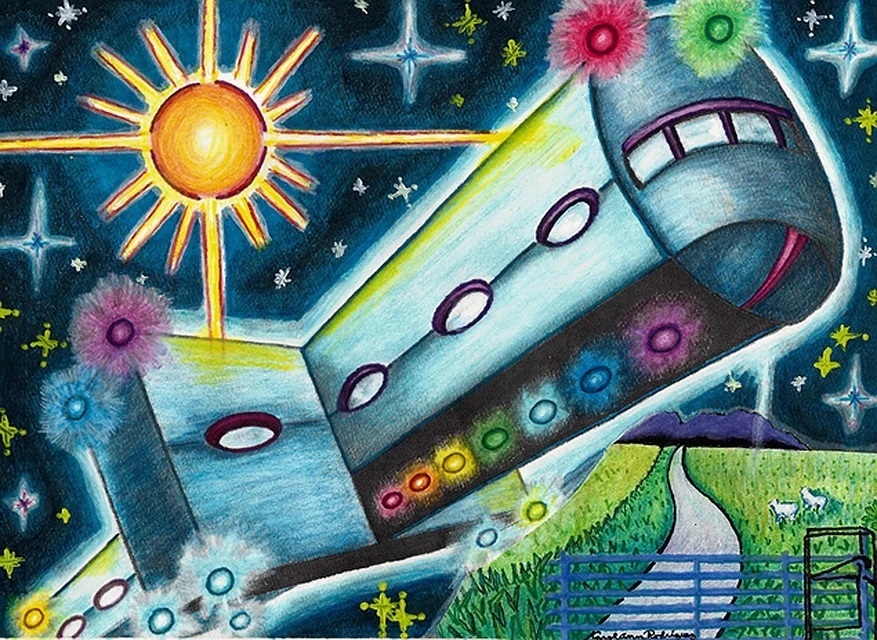
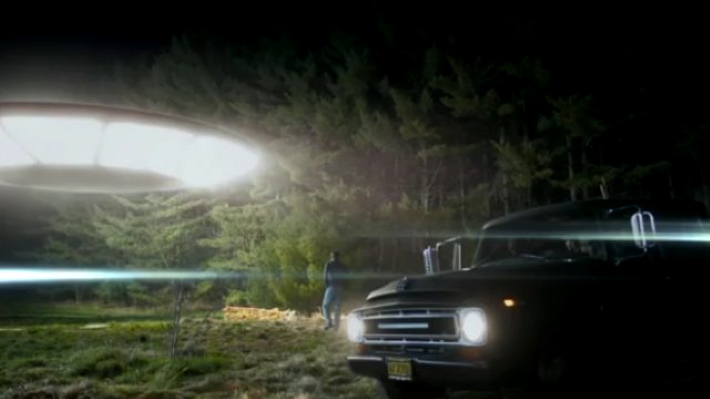
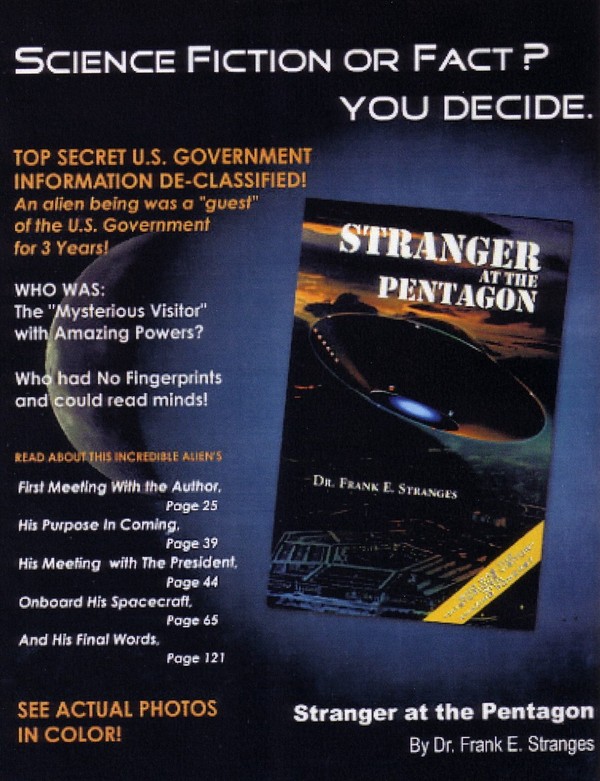
In 1967, as the United States Congress was funding Project Blue Book’s final years and the Robertson Panel’s systematic debunking program had been operating for fourteen years, a Californian evangelical minister named Frank E. Stranges published Stranger at the Pentagon, a book claiming that a six-foot Venusian named Valiant Thor had landed his craft in an Alexandria farm field in March 1957, walked into the Pentagon, met with President Eisenhower, and lived as a VIP guest in the Department of Defense for three years before departing without achieving his stated goal of nuclear disarmament.
Whether any of this happened is not the most interesting question the story raises.
The most interesting question is what the story’s content, its timing, its propagation, and its extraordinary resilience across six decades of UFO culture reveal about the mechanisms through which the UAP information environment was shaped during the Cold War period.
The Robertson Panel’s Problem
The CIA’s Robertson Panel of January 1953, covered in this library’s dedicated piece, identified civilian UAP research organizations as potential security risks and recommended a two-part strategy for managing the phenomenon’s public profile: systematic debunking of UAP reports through association with ridicule, and reduction of public interest in the phenomenon to prevent civilian organizations from clogging intelligence reporting channels with noise.
The problem with the Robertson Panel’s debunking strategy was the quality of the evidence it was trying to debunk. The Navy pilot encounters recorded in the FLIR, GIMBAL, and GOFAST videos. The Condon Report’s astronaut sightings chapter, recovered from the DTIC’s official version by The Black Vault. The Tehran F-4 intercept. The Belgian military’s F-16 radar data. The cases whose evidentiary quality was sufficient to resist simple debunking required a different management approach.
The alternative to debunking credible evidence is contaminating the broader category with incredible evidence. If the UAP research space is populated with enough clearly absurd claims, the credible evidence is tarred by association. An academic researcher, a journalist, a congressional staffer, or a Pentagon official who begins investigating serious UAP evidence quickly encounters Valiant Thor living in the Pentagon, contactees being taken to Venus in silver craft, and Nordic aliens delivering cosmic wisdom to evangelical ministers in Alexandria farm fields. The contamination operates regardless of whether the absurd claims are believed: the association is sufficient.
Whether this contamination was deliberately engineered by intelligence agencies using figures like Stranges as witting or unwitting assets, or whether the contactee movement developed organically as a genuine cultural response to Cold War anxiety and was subsequently exploited rather than created by intelligence programs, is the question that the Robertson Panel’s recorded recommendations and the contactee tradition’s timing raise together.
Frank Stranges and the Contactee Tradition
Frank E. Stranges is a recorded figure whose institutional affiliations are worth examining in the context of the Robertson Panel’s recommendations.
Stranges was ordained as an evangelical minister and founded the National Investigations Committee on Unidentified Flying Objects, a civilian UFO research organization, and the International Evangelical Crusades. His combination of evangelical Christianity and UFO research placed him in the ideological territory where the contactee tradition and Protestant millennialism overlap: Valiant Thor’s narrative explicitly identifies Venus as the morning star of biblical tradition and describes the visitor as operating under the orders of the entity humans recognize as the Master.
The theological framing of the Valiant Thor story, a benevolent supernatural being from the heavens who comes to warn humanity about its self-destructive path, is not a UAP research narrative. It is a secularized Second Coming narrative in which the divine messenger arrives by spacecraft rather than by cloud. Whether this theological framing reflects Stranges’s genuine interpretation of an anomalous experience, his deliberate construction of a mythologically resonant narrative for evangelical audiences, or his operation as an asset in an intelligence program designed to make UAP research look theologically rather than scientifically motivated, is the question whose answer would require access to his private correspondence and to intelligence files that have not been declassified.
What is on record is the narrative’s effect on the UAP research community of the period: serious researchers including Donald Keyhoe, whose well established NICAP organization was producing credible institutional-quality UAP research, found their work consistently lumped together with Stranges’s Venusian diplomat story in public and academic discourse. The contamination was operationally effective regardless of its origin.
The Sociological Content of the Myth
The content of the Valiant Thor narrative, examined as a cultural artifact rather than as a factual claim, maps the psychological pressures of the Cold War era with remarkable precision.
The nuclear terror context. The story is set in 1957, two years after the Soviet Union tested its first hydrogen bomb and four years before the Cuban Missile Crisis that would bring the nuclear exchange scenario to its closest historical proximity. The framing of Valiant Thor’s mission, convincing the United States to abandon its nuclear trajectory before a nuclear war creates a ripple effect throughout the local sector of the galaxy, is the anxiety of the late 1950s civilian population encoded in mythological form. The benevolent external authority who arrives to prevent humanity from destroying itself is the fantasy that the nuclear age produced: an intelligence that can see what human leadership cannot and that has both the authority and the capability to stop the self-destruction.

The institutional access fantasy. Valiant Thor does not petition from outside the system. He walks through the Pentagon’s checkpoints, meets the President, lives in the Department of Defense for three years. The appeal of this narrative is the powerlessness it addresses: civilian populations in the nuclear age had no access to or influence over the decisions about weapons development whose consequences they would bear. Valiant Thor’s narrative inverts this: an outsider with superior capabilities penetrates the most secure institution in the world and speaks directly to its leadership. Whether or not the leadership listens, the myth establishes that the power differential can be overcome.
The rejection narrative’s function. The story does not end with disarmament. Valiant Thor fails. The American government chose the shadow over the light, the weapon over the word. This ending serves a precise psychological function in the Cold War context: it explains why nuclear weapons still exist, why the anxiety has not been resolved, and why the benevolent intervention failed without requiring its audience to accept that no such intervention occurred. The failure is attributed to institutional corruption and militarism rather than to the intervention’s non-existence. This is a more emotionally satisfying explanation than simple non-occurrence.
The Intelligence Misdirection Hypothesis
The question of whether the Valiant Thor narrative and the broader contactee tradition were deliberately introduced into the UAP research space by intelligence operatives following Robertson Panel recommendations is a testable question in principle but not confirmed in the currently available declassified record.
What is on record is the operational utility of the contamination. The Air Force’s recorded handling of civilian UAP researchers during the Project Blue Book period included instances of discrediting, monitoring, and in recorded cases, direct interference with research organizations that were producing credible evidence. Whether the Air Force or CIA actively seeded the contactee tradition with narratives designed to make UAP research as a whole look theologically motivated and epistemologically naive is a question that the operational incentive structure clearly supports without the smoking-gun evidence of a program.
The figure of Harley Byrd, claimed in the Valiant Thor tradition to be a Project Blue Book officer who confirmed the Venusian visitor’s treatment as a high-level asset, is instructive. If this claim is false, it represents the contamination of a real institutional program with false corroboration, making the real program’s actual activities harder to separate from fabricated association. If it is true, it would represent genuine institutional confirmation that has somehow avoided appearing in any Project Blue Book declassified file across sixty years of UAP researchers examining those files.
The absence of any Project Blue Book documentation of Valiant Thor, despite the story’s claim that he lived in the Pentagon for three years during the period when Project Blue Book was operating and was treated as a high-level asset, is the evidentiary gap that both the fabrication hypothesis and the suppression hypothesis can accommodate. Whether the absence reflects genuine non-occurrence or systematic removal is the question that the available record cannot resolve.
The Venusian Problem and What It Means
The choice of Venus as Valiant Thor’s origin planet deserves examination as a narrative decision whose consequences for UAP research credibility were significant.
Venus’s surface conditions are among the most hostile in the solar system: surface temperature approximately 465 degrees Celsius, atmospheric pressure ninety times Earth’s, sulfuric acid clouds, and no liquid water. These conditions appear in the Mariner and Venera probe data whose collection began in 1962, five years after the Valiant Thor landing is claimed to have occurred.
In 1957, Venus’s surface was genuinely unknown. The choice of Venus as origin planet in 1957 was not obviously falsifiable in the way it became after the Mariner 2 flyby of 1962 established the surface’s extreme temperature and pressure. Whether the 1967 publication date of Stranges’s book reflects his knowledge of the post-1962 Venus data and his decision to proceed with the Venus narrative despite its falsification, or reflects his genuine belief in an account that preceded the astronomical data, is a question whose answer would clarify whether the narrative was constructed before or after Venus’s surface conditions became known.
The contactee tradition’s subsequent handling of the Venus problem is instructive: it shifted to claiming that Venusian civilizations exist in dimensional or subterranean spaces not accessible to surface probes, preserving the mythological framework by making it unfalsifiable rather than abandoning it in response to the astronomical data. This epistemic move, shifting the narrative’s claims to avoid falsification rather than updating them in response to evidence, is one of the clearest examples of unfalsifiable reasoning anywhere in the contactee tradition.
What the Story’s Resilience Reveals
The Valiant Thor narrative has circulated continuously for more than half a century. It has been reproduced in UFO books, websites, YouTube documentaries, and alternative research communities across six decades without any independent institutional corroboration emerging in that period and without its falsification by the Venusian surface data reducing its circulation in the communities that maintain it.
This resilience is itself a significant datum, not about Venus or about 1957, but about the psychological functions that the mythology serves and the communities whose needs it addresses.
The nuclear anxiety that produced the original narrative has not resolved. The powerlessness of civilian populations in relation to weapons whose development and deployment decisions are made by institutions they cannot access has not resolved. The desire for an external benevolent authority with sufficient capability to override institutional corruption and prevent self-destruction has not resolved.
The story persists because the anxiety it addresses persists. Whether the story was engineered to contaminate UAP research or developed organically from genuine Cold War psychology, its continued circulation reflects the failure of the institutional trust frameworks that would make such mythology unnecessary.
The Robertson Panel wanted the public to stop paying attention to the skies. The Valiant Thor story gave them a reason to pay attention to the skies that made serious researchers look away.
Whether that was the story’s purpose or only its effect is the question that the intelligence misdirection hypothesis raises and that the available record has not answered.
The Venusian is recorded as a myth. The anxiety that made the myth necessary is recorded as a reality. The institutional program that may have created or exploited the myth is on record as having recommended exactly this kind of exploitation.
The gap between those three established facts is where the most interesting question lives.