



Auguste Mariette knew he had found something significant when his workers broke through the desert sand south of Memphis in 1850 and revealed a tunnel entrance that had been sealed for centuries.
Mariette was a French Egyptologist whose subsequent career would include founding the Egyptian Museum in Cairo, but in 1850 he was a relatively young researcher following a reference in the ancient geographer Strabo, who had written in approximately 25 BCE about a temple at Memphis where sphinxes lined the entrance to a subterranean complex. Mariette found the sphinx avenue buried in the sand and followed it to the entrance of what became the most enigmatic underground structure in Egyptian archaeology.
The Serapeum of Saqqara was cut into the bedrock approximately 12 meters below the desert surface. Its main gallery extends approximately 68 meters in length, 3 meters wide and 4.5 meters high, with 24 side chambers cut into the rock on either side, each between 6 and 11 meters long and 3 to 6 meters wide. The complex had been sealed by the Romans and buried by the desert. Nothing had disturbed it for approximately 1,800 years.
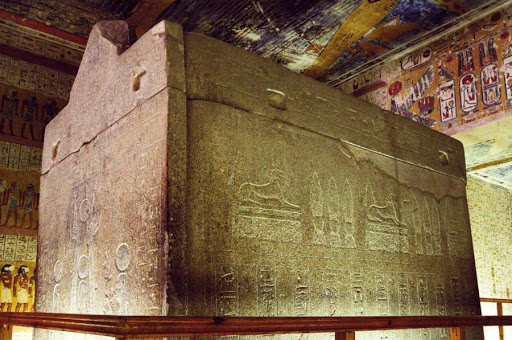
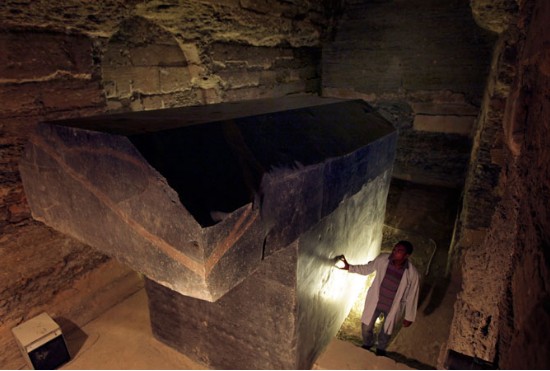
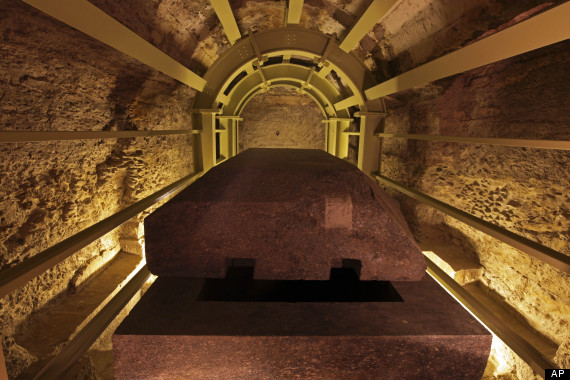
In each side chamber sat a granite sarcophagus.
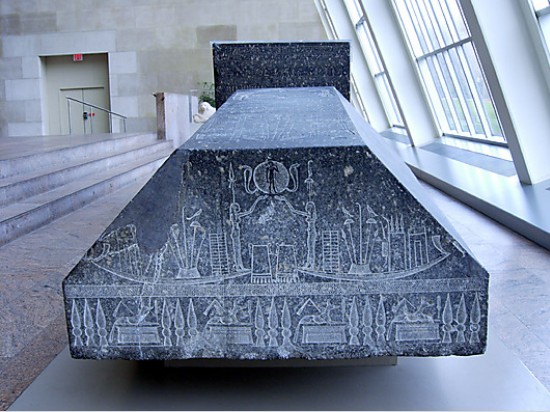
The sarcophagi average approximately 70 to 80 tons each. Their lids average approximately 15 tons. They are made from single blocks of Aswan red granite and black basalt quarried approximately 960 kilometers south of Saqqara. Their external surfaces are precisely cut with sharp right-angle edges. Their internal surfaces are polished to a finish that multiple researchers have described as mirror-smooth, with flatness tolerances that engineer Christopher Dunn measured at less than 0.00025 inches across surfaces several square meters in area.
When Mariette opened them, with the exception of a few fragmentary bones in some cases and a single mummified bull in the entire complex, they were empty.
The Transport and Placement Problem
The Serapeum’s primary engineering mystery is not the precision of the sarcophagi’s surfaces, remarkable as that precision is, but the logistics of their transport and placement.
The Aswan quarries where the granite was extracted sit approximately 960 kilometers south of Saqqara by river, following the Nile’s course. Transporting 70 to 80 ton granite blocks by river barge is within the well established capabilities of ancient Egyptian engineering: other large granite objects of comparable or greater weight, including the obelisks at Luxor and the colossal statues of Ramesses II at Abu Simbel, were transported from Aswan by river in recorded construction projects.
The problem with the Serapeum sarcophagi is what happened after the river transport ended.
The chambers that contain the sarcophagi are cut into bedrock with dimensions: the main gallery is 3 meters wide and the side chambers range from 3 to 6 meters wide. The sarcophagi fit within these dimensions with clearances that in some cases measure less than one meter on any given side. Whether the sarcophagi were placed in the chambers before the chambers were cut to their current dimensions, or whether the sarcophagi were moved through the tunnels and positioned in the chambers through the main gallery, is the question that the dimensional relationship between sarcophagus and chamber raises.
If the sarcophagi were moved through the main gallery to their final positions, the logistics of moving an 80-ton granite block through a 3-meter-wide tunnel using ancient Egyptian mechanical means, copper tools, wooden sledges, and organized labor teams, have not been demonstrated experimentally or recorded as part of an ancient construction sequence. The galleries show no evidence of the ramp systems, counterweight mechanisms, or infrastructure that would be expected if this method was used.
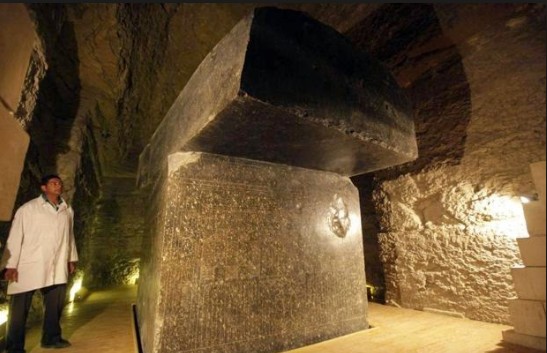
If the chambers were cut around already-positioned sarcophagi, the granite blocks were placed in the open desert or in shallow excavations before the tunnels were cut downward around them, which is a different and equally undemonstrated construction sequence.
The Egyptological literature acknowledges this engineering challenge without providing a fully satisfying solution.
The Empty Sarcophagi and the Mummification Anomaly
The conventional identification of the Serapeum as the burial place of the Apis Bulls, the sacred bulls associated with the god Ptah at Memphis, is established through Mariette’s discovery of votive stelae in the complex’s antechambers, identifying bulls by name and the pharaoh’s regnal year during whose reign the bull died. The stelae appear in the archaeological record and provide the primary evidence for the Apis Bull identification.
The anomaly is the contents of the sarcophagi against the broader context of Egyptian sacred animal burial practice.
Ancient Egypt’s mummification of sacred animals is extensively recorded. The ibis mummies at Saqqara’s animal necropolis number in the millions, recorded in multiple archaeological surveys. Crocodile mummies, cat mummies, falcon mummies, baboon mummies, and the mummies of multiple other sacred animal categories appear in multiple Egyptian sites. The practice of mummifying sacred animals reflects the Egyptian theological principle that the physical body needed to be preserved for the soul’s eventual return.
The Apis Bull was the most sacred animal in Egyptian religious practice, directly associated with Ptah, the creator deity of Memphis, and later with Osiris-Apis, the syncretic deity recorded in the Ptolemaic period as Serapis. Whether the most sacred animal in the Egyptian tradition would have been treated differently from other mummified animals, receiving only fragmentary bone deposition in extraordinarily elaborate 80-ton granite containers, is the question that the sarcophagi’s near-empty state raises.
The single mummified Apis Bull that Mariette found in the entire complex, from 24 sarcophagi representing a period of use spanning centuries, is the recorded evidentiary basis for the anomaly. Before treating this as a deep unresolved mystery, the most mundane and well documented explanation deserves stating plainly: ancient tomb robbery. Looting of Egyptian burial sites for wrappings, amulets, jewelry, and any material of value is one of the best documented phenomena in Egyptian archaeology, and the vast majority of ancient Egyptian burials, royal and animal alike, were found disturbed or emptied by robbers active in antiquity, long before any modern excavation. Several of the Serapeum’s chambers show physical evidence consistent with ancient forced entry rather than never having been used. This does not resolve every open question about the complex, but it is a far more ordinary explanation for empty sarcophagi than the ritual or “stargate” framings this piece goes on to raise, and it should be weighed first rather than last.
The Pyramid Texts and the Journey Framework
The Pyramid Texts, first inscribed in the burial chamber and antechambers of the pyramid of Unas at Saqqara approximately 2375-2345 BCE, and subsequently in other Old Kingdom pyramids including the pyramid of Teti, located approximately 800 meters from the Serapeum, are the oldest known religious texts in the world and the primary documentary source for the Egyptian conception of what the underground burial complex was supposed to accomplish.
The texts are explicit: the physical structure of the burial complex is not a final resting place but a portal for the soul’s journey. The language recorded in multiple utterances describes the king’s departure from the body, the obstacles and challenges encountered in the Duat, the Egyptian underworld and stellar realm simultaneously, and the eventual arrival in the presence of Osiris-Orion in the celestial domain.
Robert Bauval’s published work on the Pyramid Texts’ stellar orientation, published in The Orion Mystery co-authored with Adrian Gilbert, established the correspondence between the Duat’s described geography and the Orion constellation’s position relative to the Milky Way. His argument, that the air shafts of the Great Pyramid were oriented to stars important in the Pyramid Texts’ journey framework, has been recorded and partially corroborated in the archaeoastronomical literature, though the orientation measurements have been contested.
Whether the Serapeum’s 24 sarcophagi, placed in underground chambers cut into the same Saqqara necropolis where the oldest Pyramid Texts were inscribed, were intended as burial containers for sacred animals or as ritual objects in the Pyramid Texts’ journey framework, is the question that the texts’ content and the sarcophagi’s engineering precision together raise.
The Pyramid Texts begin with the words recorded in the piece: oh king, you have not gone dead, you have gone alive.
Whether the 80-ton granite containers were built to hold what was dead or to facilitate what was still alive is the question that the empty chambers and the Pyramid Texts’ framework leave specifically open.
The Osiris Shaft Connection
The library’s existing piece on the Osiris Shaft at Giza covers another underground Egyptian complex whose anomalies include impossible sarcophagi in subterranean chambers, empty against expectations, cut with precision that the conventional tool inventory does not readily account for.
The Saqqara Serapeum and the Giza Osiris Shaft represent the two most specifically recorded underground Egyptian complexes with impossible engineering characteristics. Whether they reflect the same tradition, the same builders, the same technology, or the same purpose, is the question that their convergence at opposite ends of the Memphis-Gizan archaeological zone raises.
Both complexes are underground. Both contain granite sarcophagi cut with precision that exceeds what copper tools and human manual labor are recorded as producing at this level of finish. Both were found largely empty against the expectations of the conventional burial interpretation. Both are within the same Memphite necropolis whose use spans the period from the Old Kingdom through the Ptolemaic era.
What was being built underground at Memphis, and for what purpose the most precisely engineered stone containers in the ancient world were placed in sealed underground chambers, is the question that neither the conventional Apis Bull explanation nor the alternative stargate hypothesis fully resolves with the available evidence.
The surface of the granite is still mirror-smooth after three thousand years.
Whatever made it that smooth, and whatever it was meant to contain, the evidence for the answer is in the stone itself and in the empty chambers where something was expected to be found and was not.