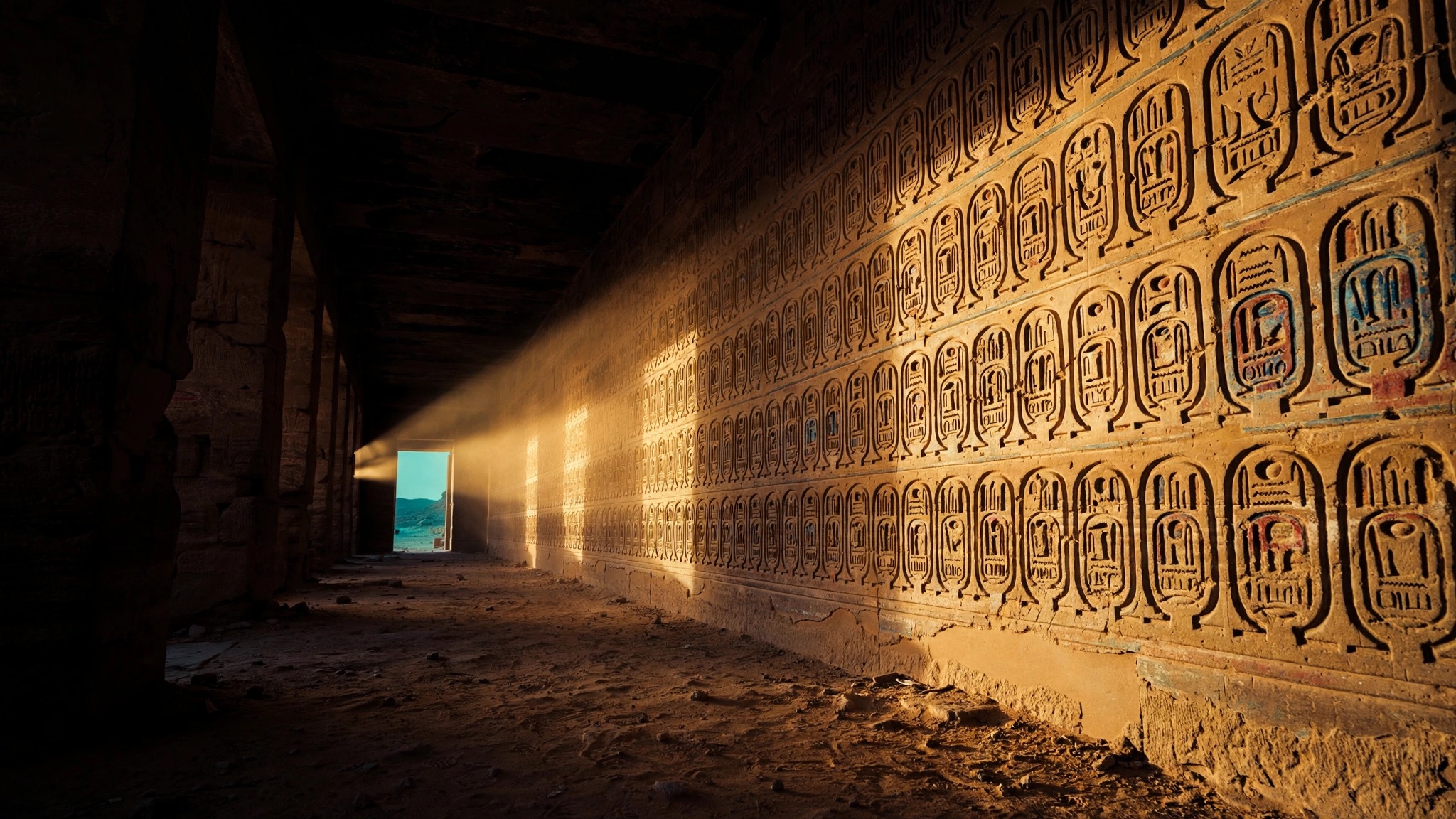
In a corridor of his temple at Abydos, around 1290 BCE, the pharaoh Seti I had himself carved beside his young son Ramesses. Father and son face a wall of cartouches, row after row of royal names running back to a founder the Egyptians called Meni. There are seventy-six names. Some kings are missing on purpose. Hatshepsut is not there, nor Akhenaten, nor the boy Tutankhamun. Even in its own time, the history of the pharaohs was something to be edited.
Three thousand years of rulers, more than thirty dynasties and several competing systems of dates make Egyptian history hard to hold in the mind at once. This page sets it out in one place, from Narmer to Cleopatra, period by period and dynasty by dynasty. Each age carries the names that matter most, the dates scholars use, and the case files in this archive that belong to it.
The Timeline | Every Period and Dynasty
Upper and Lower Egypt under one crown, and the first royal tombs at Abydos.
Shaw counts Narmer as the last king of Dynasty 0. Radiocarbon dates put the start of the First Dynasty closer to 3100.
The age of the pyramids, from the Step Pyramid to Giza.
Djoser’s Step Pyramid at Saqqara is the first pyramid.
The Bent, Red and Giza pyramids.
Unas is the first king with the Pyramid Texts carved inside his tomb.
Many short reigns as central power fades.
Rival courts in the north and at Thebes.
Egypt reunited from Thebes, then ruled from a new capital near the Faiyum.
Mentuhotep II reunites the country.
Sobekneferu is the first woman known to rule with the full titles of a king.
Dozens of brief reigns.
The Hyksos rule the north from Avaris while Theban kings hold the south.
Kings of West Asian origin.
The war against the Hyksos begins.
Empire. Egyptian armies reach the Euphrates and the Fourth Cataract.
Hatshepsut rules alongside the young Thutmose III, which is why their dates overlap.
Ramesses III fights the Sea Peoples.
Kings at Tanis, Libyan dynasties in the Delta, then the pharaohs of Kush.
Kings of Libyan descent.
Rulers from Nubia, south of Egypt.
A last Egyptian revival at Sais, two Persian conquests, and the last native king.
From here on, dates are close to exact.
Nectanebo II is the last native Egyptian pharaoh.
Macedonian kings and queens rule as pharaohs from Alexandria.
Egypt becomes a Roman province in 30 BCE.
Dates follow Ian Shaw, The Oxford History of Ancient Egypt (2000). They are close to exact from 664 BCE onward and uncertain by up to a century or more for the earliest dynasties. Overlapping dates mark rival or shared rule.
How Egypt Counted Its Kings
The Egyptians kept lists of their own kings, and those lists are the backbone of every modern timeline.
The Palermo Stone is a fragment of royal annals carved in the Fifth Dynasty. Year by year it records events of the earliest reigns and the height of the Nile flood, which governed every harvest in the country.
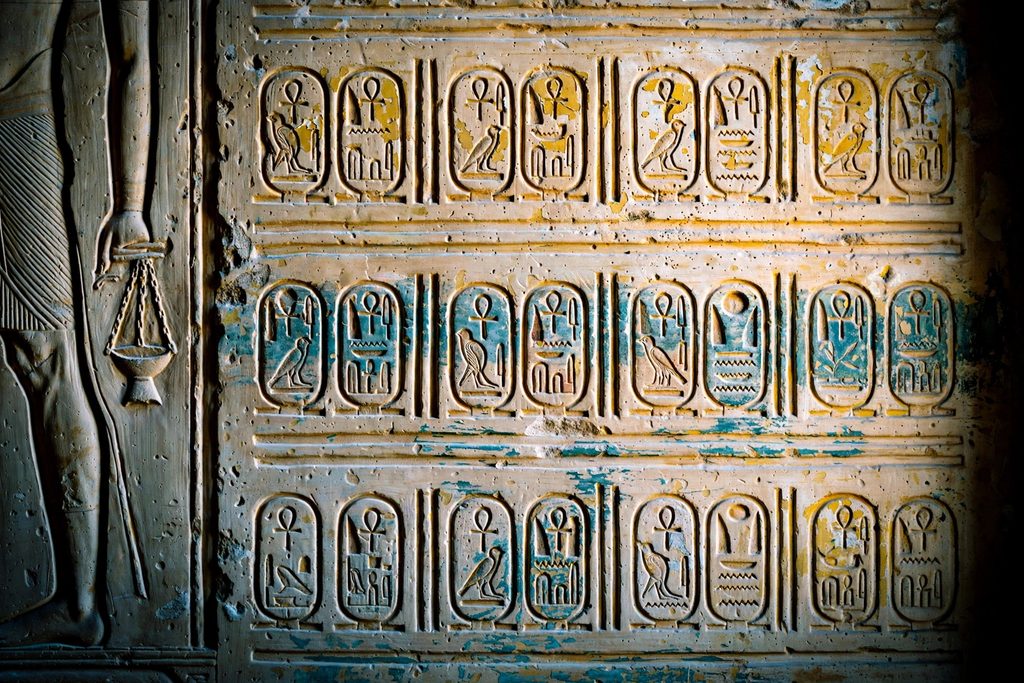
The Abydos King List is the one in Seti I’s corridor. Its seventy-six names run from the founder to Seti himself, and its gaps are as telling as its entries. The Hyksos kings of the north are left out, and so are the rulers of the Amarna years, whose religious revolution later kings preferred to forget.
The Turin King List is a papyrus written in the reign of Ramesses II and now in the Museo Egizio in Turin. It once named rulers of all periods with the lengths of their reigns, down to months and days. It survives in many fragments, and reassembling it has occupied Egyptologists for two centuries.
Manetho, an Egyptian priest writing in Greek in the third century BCE, gave the pharaohs the structure everyone still uses. His history of Egypt grouped the kings into thirty dynasties. A thirty-first, for the second Persian conquest, was added by later writers. His book is lost and survives only in quotations by later authors, but his dynasty numbers outlived it by more than two thousand years.
Why the Dates Move
Open two books on ancient Egypt and the dates for the same pharaoh may differ by a decade, or for the earliest kings by more than a century. The reason is that the Egyptians did not count years from a fixed point. They counted the years of each reign and started again with the next king. Turning those reigns into dates before Christ means joining them end to end and anchoring the chain somewhere.
The firm anchor is 664 BCE, the first year of Psamtik I, whose reign can be tied to Assyrian and Greek records. From there forward, the dates in the timeline are close to exact. Further back, scholars lean on records of the star Sirius rising at dawn, on synchronisms with kings in Mesopotamia and Anatolia, and on the reign lengths in the king lists. A large radiocarbon study published in Science in 2010 tested more than two hundred samples from dated contexts and found that the conventional order and the broad dates hold, with some reigns sitting slightly earlier than certain chronologies place them.
This page follows the chronology of Ian Shaw’s Oxford History of Ancient Egypt, one of the most widely used. It places the start of the First Dynasty around 3000 BCE and counts Narmer as the last king of Dynasty 0. Radiocarbon dates from the tombs of his successor point closer to 3100 BCE, which is why the file on Narmer uses the earlier figure. Both are honest estimates. The disagreement is the width of the uncertainty, not an error in either.
Kingdoms and the Years Between
Egyptologists divide the pharaohs into three great kingdoms and the periods between them.
The Old Kingdom built the pyramids. The Middle Kingdom reunited the country after a century of rival courts and ruled it from a new capital near the Faiyum. The New Kingdom turned Egypt into an empire, with garrisons in the Levant and gold mines far up the Nile in Nubia.
Between them come the three intermediate periods, when power split between rival lines of kings in different cities. They are often described as dark ages, which is unfair. Temples, tombs and trade carried on under local rulers, and the Third Intermediate Period saw kings of Libyan and Nubian descent rule the country as pharaohs in every traditional sense.
After the last revival at Sais came the Late Period, with two Persian conquests and three short native dynasties, and then the Ptolemaic Period, when Macedonian Greeks ruled as pharaohs from Alexandria for three hundred years.
Queens Who Ruled as Kings
Egyptian kingship was a male office, and a handful of women held it anyway.
Merneith governed during the First Dynasty, probably as regent for a young son, and was buried among the kings at Abydos. Sobekneferu, at the end of the Twelfth Dynasty, is the first woman known to have taken the full titles of a king. Hatshepsut began as regent for her stepson Thutmose III and then crowned herself, ruling for about fifteen years and sending a famous trading expedition to the land of Punt. Twosret closed the Nineteenth Dynasty. Cleopatra VII closed the whole story.
Foreign Pharaohs
Being pharaoh was never a matter of birth inside Egypt. It was a matter of taking the role, its titles and its duties to the gods.
The Hyksos of the Fifteenth Dynasty were of West Asian origin and ruled the north from Avaris. The kings of the Twenty-Second Dynasty descended from Libyan settlers. The Twenty-Fifth Dynasty came from Kush, in what is now Sudan, and its kings Piye and Taharqa ruled from the Fourth Cataract to the Mediterranean. Persian kings held the title twice. Alexander the Great was welcomed as pharaoh in 332 BCE, and his general Ptolemy founded the last dynasty. Even the Roman emperors who followed were carved on temple walls in the dress of pharaohs, as they still are at Dendera.
Where the Case Files Fit
Many of the mysteries in this archive attach to a particular age, and placing them on the timeline changes how they read. The claims about the Great Pyramid and the Sphinx belong to the Fourth Dynasty and a world of copper tools and organised labour. The labyrinth at Hawara belongs to Amenemhat III and the Middle Kingdom. Akhenaten is the king the Abydos list left out. The relief behind the Dendera light belongs to a temple built in the last years of the Ptolemies and finished under Rome, more than two thousand years after the pyramids.
Each period in the timeline above links to the files that belong to it. The full collection, sorted into six eras with a verdict on every file, is in the Egypt case files, and the places themselves are pinned on the Atlas.
Quick Answers About the Pharaohs
Who was the first pharaoh of Egypt? Narmer, around 3100 to 3000 BCE, is the first king whose name heads the official seal lists of the First Dynasty. The Egyptians remembered a founder called Meni, who may be Narmer or his successor Aha.
Who was the last pharaoh? Cleopatra VII, who died in 30 BCE. Her son Ptolemy XV, known as Caesarion, was nominally her co-ruler and was killed the same year on the orders of Octavian. The last native Egyptian pharaoh was Nectanebo II, who lost the country to Persia in 343 BCE.
How long did the pharaohs rule Egypt? About three thousand years, from around 3000 BCE to 30 BCE.
How many dynasties were there? Thirty-one in the traditional count, plus the Macedonian and Ptolemaic lines and a Dynasty 0 of kings before the First Dynasty.
Who reigned the longest? Ancient tradition gives Pepi II of the Sixth Dynasty more than ninety years, though many scholars now think about sixty-four is likelier. The longest reign beyond doubt is Ramesses II, at sixty-six years.
Was Cleopatra Egyptian? She was of Macedonian Greek descent, from a family that had ruled Egypt for nearly three centuries. According to Plutarch, she was the first of her line to learn the Egyptian language.
Why do the dates differ between books? Each book follows a chosen chronology. The differences are small after 664 BCE and grow larger the further back the timeline goes.