


They broke both his legs and he still said nothing.
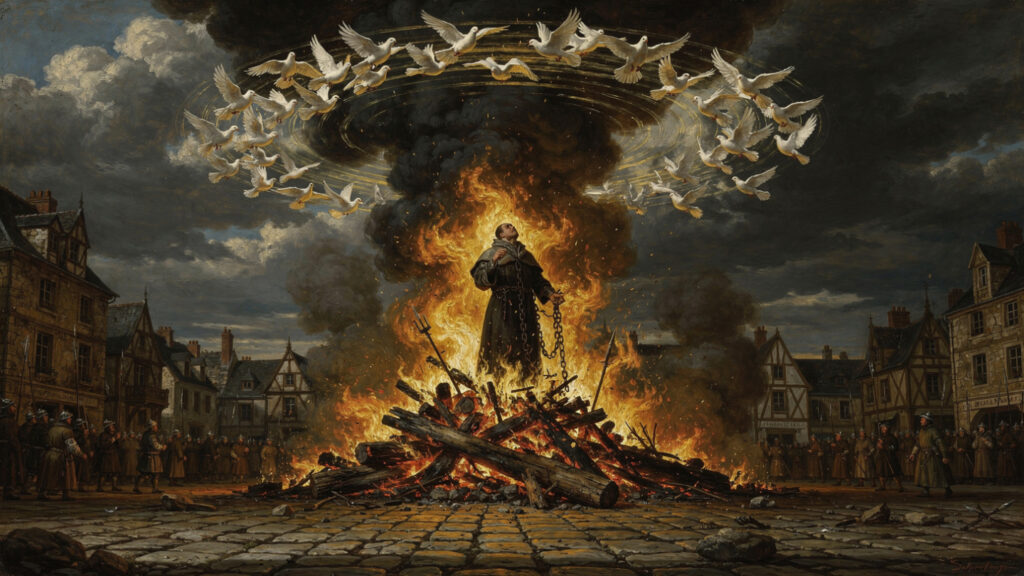
Father Urbain Grandier, parish priest of Saint-Pierre-du-Marché in Loudun, France, was subjected to the standard judicial torture of the seventeenth century with the objective of producing a confession that his trial required. The torture method applied to his legs was the brodequins, wooden boards tightened by wedges around the lower limbs until the bones fractured. Grandier endured the procedure without producing the confession. He endured his subsequent burning at the stake without producing it. The executioner attempted to strangle him before the flames reached him, as was customary, but the rope caught fire and Grandier fell alive into the burning bundles.
He died without confessing.
A contemporary witness recorded that a flight of doves or white birds circled the stake throughout the execution. His supporters said they came as witnesses to his innocence. His prosecutors said they were demons attending the death of a great magician. The birds are recorded by multiple independent observers and mentioned in several contemporaneous accounts.
Whatever they were, within a month of the execution the man who had presided over Grandier’s torture was dead.
The Convent and the Prioress
The Ursuline convent at Loudun had been established in 1626 and was led by Jeanne des Anges, a woman described in contemporaneous accounts as powerful, well-connected, and possessed of an intensity that her religious vocation concentrated rather than subdued. The convent’s troubles began in 1632 with nocturnal visitations reported by Jeanne and other nuns, a figure appearing in their cells at night, seemingly male, commanding obscene acts and producing a quality of supernatural dread that the nuns’ accounts distinguished from ordinary nightmare.
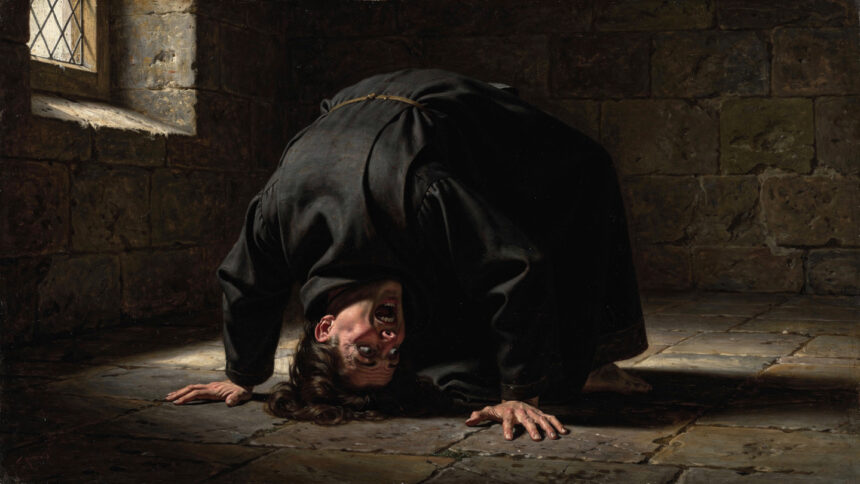
The visible symptoms followed. Convulsions. Contortions described in detail by the physician-chronicler Des Niau, whose account specifies that the nuns bent backward until their heads touched their feet without apparent structural damage, that they extended their legs to seven feet though the women themselves stood four feet tall, that Jeanne des Anges was suspended in the air with only her elbow touching the floor, the suspension maintained for a duration sufficient for witnesses to record and sign depositions about it.
A total of twenty-seven nuns from the convent displayed these symptoms. The Sorbonne, the preeminent medical and theological institution of France, sent a commission. The commission produced a formal report signed by physicians, priests, and ecclesiastical authorities attesting to phenomena they had witnessed directly. The Sorbonne’s institutional judgment was that hellish possession had been proven.
Jeanne des Anges identified the demons responsible: Asmodeus, the demon of lust, and Zabulon as primary actors, with Isacarron and a hierarchy of lesser entities supplementing them. She also identified the human agent responsible for sending them: Father Grandier.
The Political Architecture
Aldous Huxley, who spent three years researching The Devils of Loudun, published in 1952, argued that the possessions cannot be understood without their political context, and that the political context cannot be understood without Cardinal Richelieu.
Richelieu was in the process of consolidating royal authority over the French nobility and the Huguenot Protestant communities that maintained military and political independence in several towns, including Loudun. He had ordered the demolition of Loudun’s fortifications as part of this consolidation. Grandier had publicly opposed the demolition order. Grandier had also written a satirical pamphlet on clerical celibacy that had circulated in the early 1620s with embarrassing effect on several ecclesiastical reputations, one of them Richelieu’s.
When the possession claims began generating institutional momentum, Richelieu appointed Jean-Martin de Laubardemont as royal commissioner to oversee the investigation and subsequent trial. Laubardemont was Richelieu’s man. His appointment came with instructions that removed the normal judicial safeguards. Defense witnesses were not permitted. When Jeanne des Anges herself, during the trial, reversed her accusations and publicly defended Grandier, flogging herself and placing a noose around her neck in a theatrical recantation, the court interpreted her defense as demonic manipulation and proceeded.
Evidence that the nuns had failed tests for genuine supernatural knowledge, that they had been coached on their symptoms by a priest named Mignot, that their physical examinations showed no possession markers, that the pact with the devil appeared to be in Jeanne des Anges’s own handwriting, was presented to the court and dismissed on the grounds that the devil would naturally arrange for exculpatory evidence to appear.
Only witnesses against Grandier were permitted to speak. Those who attempted to speak in his defense fled France or were arrested.
Grandier was convicted on August 18, 1634. He was burned the same day.
The Pact in the National Library
The document that convicted Grandier is preserved in the Bibliothèque nationale de France.
It is written in Latin, backward, in a style consistent with the demonic contract conventions that demonological literature specified. It is signed by Grandier. It is countersigned, in a different hand, by Lucifer, Beelzebub, Satan, Elimi, Leviathan, and Astaroth. Modern graphological analysis has compared the handwriting of the signatures attributed to Grandier with authenticated samples of his correspondence and found inconsistencies that suggest the Grandier signature may be forged. The same analysis has found similarities between the countersignatures attributed to the demonic parties and authenticated samples of Jeanne des Anges’s own writing.

The document is a physical artifact. It has been physically examined. It sits in one of the world’s major research libraries. Whether it represents a genuine demonic contract, a forgery produced by Grandier’s enemies, or a document produced during the genuine dissociative episodes of a woman who believed she was channeling demonic entities, its physical existence is not in question.
The French state has been storing the written agreement between a dead priest and Lucifer in its national library for nearly four hundred years.
The exorcism sessions themselves included behavior that contemporaneous accounts describe as sexually explicit and directed at the officiating priests, obscene gestures and language that the nuns’ defenders attributed to demonic possession and that skeptical observers attributed to performance and suggestion within a public, crowded spectacle. Jeanne des Anges herself named the demons she believed responsible for this specific behavior as chief among the entities occupying her.
The Exorcisms
Father Jean-Joseph Surin was a Jesuit assigned to perform exorcisms on Jeanne des Anges. He was intellectually distinguished, psychologically sensitive, and unsuited by temperament for the public theatre that the Loudun exorcisms had become. By 1634 the public exorcism sessions were attracting audiences of up to seven thousand people. Father Tranquille, Father Lactance, and Surin performed sessions before crowds that had traveled to Loudun specifically to witness the spectacle, some from considerable distances.
Surin performed his exorcisms with a theological seriousness that distinguished him from the other exorcists. He sought direct engagement with the entities he believed were present rather than the performative confrontation that satisfied the crowds. In 1635, after a period of sustained exorcism work, Surin reported that the demons had transferred from Jeanne des Anges to himself.

His subsequent condition lasted twenty years. He lost the ability to perform basic functions independently. He could not eat, dress, read, or write without assistance for extended periods. His published account of the experience, written during his eventual recovery in the 1660s, describes an internal presence that he experienced as distinct from his own consciousness, capable of acting through his body against his will, producing physical sensations and perceptual distortions that he could observe but not control.
The clinical literature on dissociative identity disorder describes a comparable phenomenology in contemporary patients. Whether this represents a reclassification of what Surin experienced, or whether Surin experienced something that the dissociative framework is inadequate to fully describe, is a question that neither the theological nor the clinical framework has resolved.
Surin recovered. His account of the recovery describes a gradual reassertion of unified consciousness and a final departure of whatever had been present. He died in 1665, his final years described as peaceful.
The Deaths
Father Lactance presided over Grandier’s torture. He was present at the execution. He died within a month of August 18, 1634. The contemporaneous accounts of his death describe symptoms identical to those the possessed nuns had displayed: demonic visions, physical torment, loss of cognitive function. The accounts attribute his death directly to demonic revenge.
Father Tranquille died in 1638. The Des Niau chronicle’s description of his final period is detailed: convulsions, involuntary blasphemy, the demons making him stick out his tongue and whistle, a crushing sensation in his chest, alternating periods of vision and blindness. The language used to describe his death is the language used to describe the possessions. The same framework was applied by the same chronicler to both sets of events.
Civil Lieutenant Louis Chauvet, who had been responsible for administrative aspects of the Grandier proceedings, experienced a mental breakdown during or shortly after the trial from which he never recovered. The contemporaneous record attributes this to demonic attack. Modern historical analysis has attributed it to psychological trauma and guilt. The outcome is the same in either account.

Surgeon Mannouri, who had examined Grandier’s body for the devil’s marks that were used as evidence against him, died within days of the execution. The account of his death preserved in contemporaneous records describes a man who spent his final days seeing Grandier’s apparition standing before him, speaking to it, attempting to ward it off, dying in a state of terror that his companions could not alleviate.
Four men central to Grandier’s prosecution. Four deaths in a recorded sequence following the execution. The shortest interval was weeks. The longest was years. The manner of each death, as recorded by contemporaneous sources, shared characteristics: visions, physical symptoms of the kind the possessed nuns had displayed, and in multiple cases a final period in which Grandier himself appeared to be present.
Whether this represents demonic revenge in any literal sense, collective guilt producing psychosomatic illness, a contagious hysteria that the public exorcism culture had made available as a template for psychological collapse, or something that none of these frameworks adequately describes, the sequence is in the historical record.
Grandier said nothing at the stake. The rope caught fire. The doves circled. Within a month the first of his prosecutors was dead.
This was not the end of it. The exorcisms continued for years after Grandier’s death, still conducted as the same public spectacle before large crowds, still centered on Jeanne des Anges and eventually on Surin himself.
What the Frameworks Cannot Contain
Three standard interpretations exist for Loudun and each covers some of the evidence.
The authentic possession interpretation accommodates the physical phenomena witnessed by the Sorbonne commission, the deaths of the prosecution team, and the sustained quality of the disturbance that continued for years after Grandier’s execution and ultimately transferred to Surin. It requires accepting that the demonic entities the theology describes are real and operational.
The mass hysterian interpretation accommodates the contagious spread of symptoms through the convent community, the coaching evidence, the failed supernatural tests, and the sociological context of seventeenth-century Catholic France in which demonic possession was a culturally available template for psychological crisis. It requires explaining the Sorbonne commission’s signed attestations as the product of credulous educated men encountering skilled performers.
The political conspiracy interpretation, Huxley’s primary framework, accommodates Richelieu’s motivation, Laubardemont’s appointment, the procedural irregularities of the trial, the coaching evidence, and the targeting of Grandier. It requires explaining the deaths of the prosecution team as coincidence, natural attrition, or psychosomatic illness produced by guilt and stress.
None of the three interpretations accommodates all of the evidence simultaneously. The physical phenomena attested by the Sorbonne resist the hysteria and conspiracy explanations. The coaching evidence and procedural irregularities resist the authentic possession explanation. The deaths of the prosecution team are accommodated uncomfortably by all three.

The pact document is in the national library. Surin’s account of twenty years of internal occupation is in the published record. Mannouri died seeing Grandier standing over him. The rope caught fire at the moment it was meant to prevent his burning.
What was in that convent between 1632 and 1638 has not been explained by any single framework. What followed the execution into the lives of the men who conducted it has not been explained either.
Grandier maintained his innocence through the breaking of both legs and the burning of his body. The man who examined his body for devil’s marks died days later, seeing him standing at the foot of the bed.
Something followed those men home from Loudun.
Whether it had a name is the question that four centuries have not resolved.