



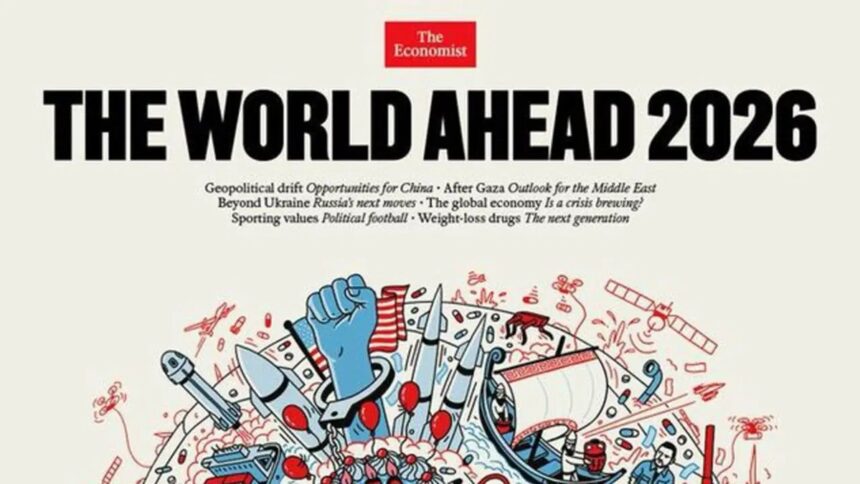
Every November, The Economist publishes a special issue called “The World Ahead,” previewing what its editors and correspondents expect to be the major stories of the coming year. The cover art for this issue has, for over a decade, been a dense, symbol-packed illustration referencing dozens of specific stories from inside the magazine.
This is worth explaining plainly, because “reading” these covers as coded prophecy has become a recurring internet phenomenon, when the actual explanation is simpler and, in its own way, more interesting: the cover is a preview, deliberately designed by the magazine’s own art department in direct collaboration with its editorial staff, of stories the magazine had already decided to publish.
The cover for The World Ahead 2026 was illustrated by Andrew Rae, a credited illustrator whose densely packed, satirical collage style has become a recognizable feature of these annual covers. It depicts a battered, stitched-together globe rendered as a soccer ball at the center of a chaotic arrangement of smaller scenes and symbols, each one a visual shorthand for a specific article or theme inside the issue. This piece walks through what the imagery actually references, based on the stories the magazine itself has published under this cover, rather than treating the illustration as a mystical or coded prediction.
America’s 250th Anniversary
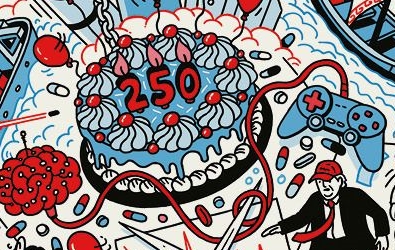
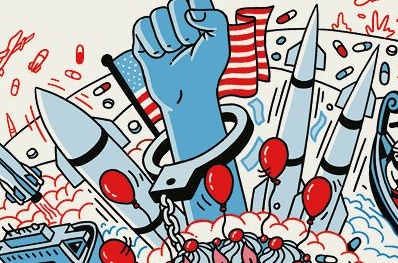
At the center of the cover sits a birthday cake marked “250,” a direct reference to July 4, 2026, the semiquincentennial of the United States Declaration of Independence, a scheduled anniversary that the magazine has previewed extensive coverage of, including planned reporting on the state of American political division heading into the milestone and the 2026 midterm elections later that year. The clenched fist rising from the cake and the warped, distorted flag nearby are the illustrator’s visual commentary on domestic political polarization, a real and extensively reported story rather than a hidden symbol requiring decoding.
The 2026 World Cup
The soccer player kicking the globe-as-ball is a direct, straightforward reference to the 2026 FIFA World Cup, co-hosted by the United States, Canada, and Mexico from June to July 2026, a scheduled event the magazine has covered extensively as both a sporting and geopolitical story, given the scale of cross-border coordination the tournament requires during a period of tension over trade and immigration policy between the host nations.
Technology, AI, and Biotech
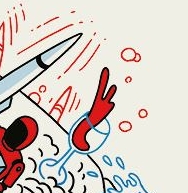
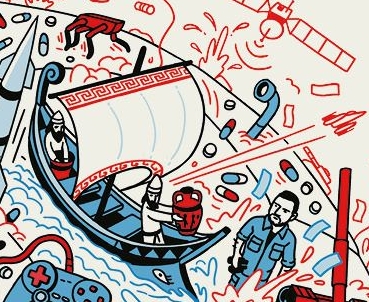
The imagery of a brain wired to a game controller, humanoid robots, and AI-themed icons reference the magazine’s extensive coverage of artificial intelligence’s continued economic and labor market disruption heading into 2026, a significant ongoing story across the technology and business press generally, not a coded warning specific to this cover. Concerns about attention, engagement, and algorithmic influence over daily behavior are also subjects of serious ongoing research and policy debate, covered extensively by outlets well beyond this one magazine, and the illustrator’s choice to render this as a literal wired brain is a visual metaphor for a genuine trend, not a hidden claim about literal neural implants or covert control.
The syringes and pills scattered through the illustration reference ongoing stories about weight-loss drugs, gene therapies, and biotechnology’s continued mainstream adoption, alongside an actually scheduled event: the Enhanced Games, a Las Vegas sporting competition explicitly permitting performance-enhancing substances, which drew significant media coverage as a notable departure from traditional anti-doping sports regulation. Questions about equitable access to expensive new medical technologies, and debates about the ethics of substance-enhanced athletic competition, are the actual substantive stories behind this imagery, discussed in the magazine’s own reporting in far more measured terms than the illustration’s dense visual shorthand might suggest on its own.
Real Geopolitical Conflicts
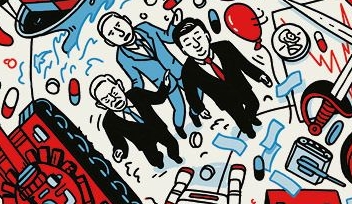
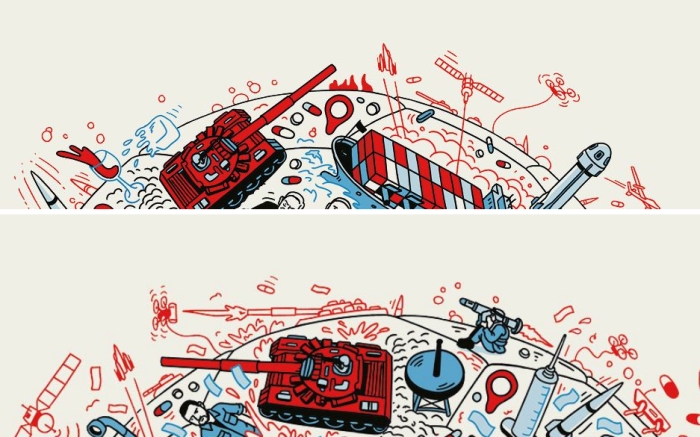
The military imagery scattered across the cover, tanks, drones, a container ship, references ongoing conflicts the magazine has extensively and directly reported on: the war in Ukraine, the conflict in Gaza, and broader concerns about maritime security given disruptions to global shipping routes. The named world leaders depicted in the illustration, including sitting heads of state and government whose identities the magazine’s own captions and accompanying articles make explicit, are shown because the magazine’s actual editorial coverage discusses their publicly reported policy positions and geopolitical roles heading into 2026, not because the cover is making any hidden claim about them beyond what its accompanying journalism states directly and on the record.
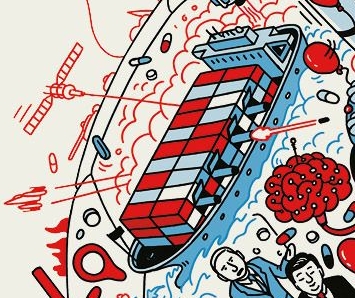
Russia’s landmass appears at the periphery of the illustration rather than centrally, which likely reflects a fairly mundane compositional choice, an illustrator working within a fixed frame has to decide where to place a large landmass, rather than any coded statement about the country’s global significance. The magazine’s actual coverage of Russia in “The World Ahead 2026” addresses the war in Ukraine and broader questions about European security directly, in ordinary prose, rather than through the cover art alone.
Global Economics
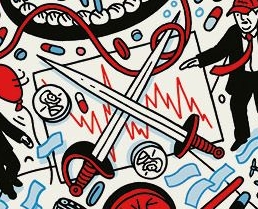
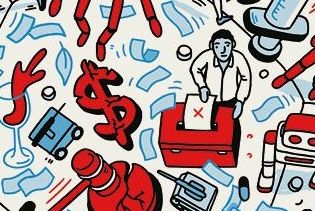
The cracked dollar symbol and scattered currency imagery reference substantive economic coverage in the issue: ongoing questions about the US dollar’s global reserve status amid rising multipolar economic competition, India’s continuing rise toward becoming the world’s fourth-largest economy, China’s strategic focus on semiconductor and rare-earth mineral production, and significant tariff policy shifts affecting global supply chains. These are all substantive economic stories the magazine’s actual reporting covers in detail, illustrated here in visual shorthand rather than hidden symbolism.
Additional Symbols and Their Likely References
Several smaller images throughout the cover likely reference specific, narrower stories: a printing press churning out currency or ballots plausibly nods to coverage of both monetary policy and elections scheduled across multiple countries in 2026, and a handcuffed hand raised in a fist gesture plausibly references coverage of political crackdowns or protest movements addressed elsewhere in the issue. A chalice and crossed swords are visually striking but, without a direct caption from the magazine identifying their specific referent, are ambiguous illustrative flourishes rather than confirmed symbols, and this piece won’t invent a specific meaning for them that the magazine itself hasn’t stated.
The Climate and Migration Story
The relative absence of prominent climate activism imagery on this year’s cover, compared to previous years, likely reflects an editorial judgment about which stories the magazine’s editors considered most newsworthy for 2026 specifically, rather than any suppression of the topic. The magazine’s actual World Ahead 2026 coverage does address climate-related migration directly, including reported concerns about Pacific island nations like Tuvalu facing displacement pressure and coordinated resettlement discussions with countries including Australia, alongside continued coverage of the gap between international climate commitments made under the Paris Agreement and the emissions reductions actually being achieved. This is a substantive editorial choice about story prioritization within a single cover’s limited visual space, not evidence of a hidden agenda.
The Real History Behind the “Prophecy” Claims
The Economist’s World Ahead covers, published under earlier names including “The World in [Year]” going back to 1986, have drawn conspiracy-theory attention for several years now, most prominently after commentators retroactively connected imagery on the 2019 cover to the COVID-19 pandemic that emerged the following year. The actual 2019 cover included a small image referencing a novel virus, which is unsurprising given that pandemic preparedness has been a recurring subject of serious policy journalism for decades, following genuine outbreaks including SARS in 2003, H1N1 in 2009, and Ebola in 2014, all of which prompted extensive coverage in exactly this kind of publication well before COVID-19 emerged. Public health researchers, epidemiologists, and government pandemic-preparedness offices had been publishing warnings about the likelihood of a novel respiratory pandemic for years prior to 2019, in reports that were entirely public and widely available to any journalist who went looking, which is exactly the kind of unglamorous groundwork that ordinary editorial forecasting draws on. A publication whose actual editorial mandate is identifying significant global risks will, unsurprisingly, sometimes reference risks that later materialize, precisely because credentialed journalists and policy analysts have been tracking those risks as plausible scenarios for years in advance.
This pattern, an institution’s genuine forecasting expertise being reinterpreted after the fact as hidden foreknowledge, is worth naming directly because it recurs constantly around any publication or institution whose actual job involves systematically tracking emerging risks and trends. Insurance companies, intelligence agencies, and specialized journalism outlets all do this kind of forecasting as their ordinary function, and all of them occasionally get individual predictions right for the same mundane reason The Economist’s cover artists do: because forecasting genuinely emerging trends, using expertise and information, sometimes produces correct forecasts. That is what forecasting is supposed to do. It isn’t evidence of anything hidden.
Reading a Forecast Versus Reading an Oracle
There’s a useful distinction worth drawing out explicitly between reading this cover as a forecast and reading it as an oracle, because the two produce very different relationships to the information involved. A forecast, correctly understood, is a set of probabilistic claims made by people with expertise, based on identifiable evidence, that can turn out right, turn out wrong, or turn out partially right in ways worth examining afterward to improve the next forecast. The Economist’s own record on this is, like any forecaster’s, mixed: some years’ covers reference events that unfold roughly as previewed, others reference stories that fizzle, shift direction, or get overtaken by developments nobody, including the magazine’s own correspondents, saw coming. That mixed record is exactly what honest forecasting looks like.
An oracle, by contrast, is treated as unfalsifiable by design. Every hit confirms its power. Every miss gets reinterpreted as a symbol that was simply misunderstood at the time. This is precisely the reasoning trap that makes “coded prophecy” readings of magazine covers so durable online, regardless of the publication: the framework can absorb any outcome as confirmation, which means it isn’t actually making testable claims about the future at all, just retroactively fitting whatever happens to whatever symbol seems closest. The Economist’s cover is a well-researched, professionally produced piece of editorial forecasting. Reading it as an oracle doesn’t make it more mysterious. It just obscures the actual, considerable skill involved in making an accurate one.
Why These Covers Get Read as Prophecy
The Economist’s World Ahead covers have circulated online for years as supposed evidence of hidden foreknowledge, in part because the covers genuinely do reference events that later occur, since that is their entire, explicit editorial purpose. A magazine whose actual job is credentialed journalists forecasting the coming year’s major stories will, naturally and by design, produce cover art that appears to “predict” the year that follows. This is the ordinary, transparent function of professional journalism and editorial forecasting, not evidence of concealed knowledge. The genuinely interesting story here isn’t a hidden code. It’s that a publication employing hundreds of subject-matter journalists, each tracking scheduled events, ongoing conflicts, and well-telegraphed political and economic trends, can produce a reasonably accurate preview of the coming year using nothing more exotic than professional expertise and careful editorial planning.
None of this means the cover isn’t worth looking at closely. It genuinely is, as a dense, cleverly constructed piece of editorial illustration summarizing dozens of stories in a single image, produced by skilled professionals under deadline pressure to compress an entire year’s worth of anticipated news into one frame. It just isn’t a mystery to be decoded. It’s a table of contents, drawn rather than typeset, and reading it that way, as a genuine preview of reporting rather than a riddle, gives it more credit for what it actually accomplishes, not less.