




No independent historical source confirms “Captain White” or “three African women” as a documented event. What circulates under that framing is a fictionalized retelling of a genuinely tragic historical event: the abandonment of enslaved Malagasy people on Tromelin Island in 1761.
What follows tells that story accurately, and with the gravity it deserves, since the original “ultimate male fantasy” framing badly misrepresents what actually happened to people.
The History Behind This Story
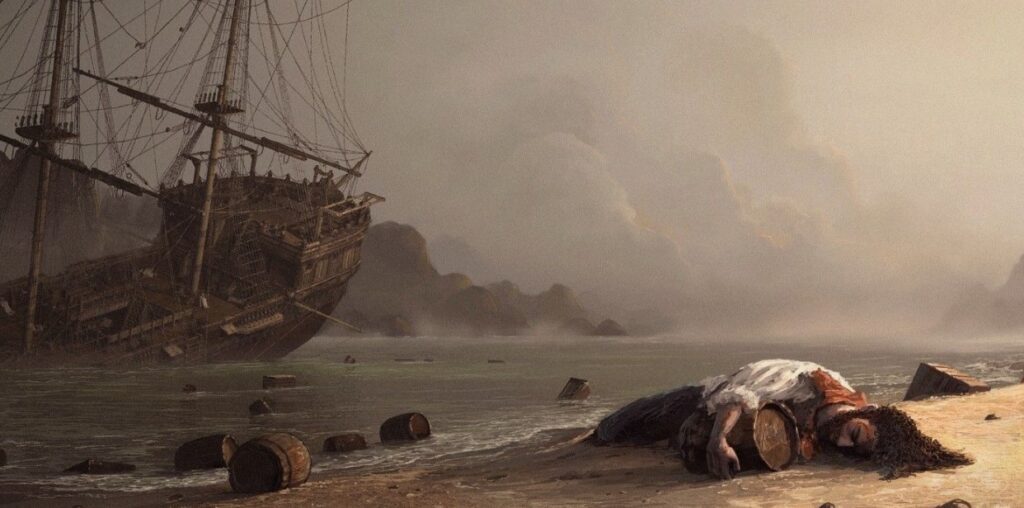
On July 31, 1761, the French East India Company frigate L’Utile, commanded by Captain Jean de Lafargue, wrecked on the reefs of an uncharted, uninhabited sandbank in the Indian Ocean, then called the Isle of Sand. The ship carried approximately 160 Malagasy men, women, and children, purchased in Madagascar days earlier and being transported illegally into slavery, in direct violation of colonial law at the time.
Survivors, both French crew and enslaved Malagasy people, made it to shore. Over roughly two months, the French crew built a makeshift boat from the wreckage and departed. Documented history holds they promised to send help. They did not honor that promise for fifteen years.
“Three Women,” Not Sixty
This needs direct, important correction. The number of enslaved people left behind was roughly 60 to 80, not three. Over the brutal fifteen years that followed, the overwhelming majority died from starvation, exposure, and despair. Archaeological excavations, led by former French naval officer Max Guérout beginning in 2006 under UNESCO patronage, uncovered physical evidence of the survivors’ extraordinary resourcefulness: coral-block shelters, a communal kitchen, copper cookware repaired repeatedly over the years, and a signal fire the survivors kept continuously burning for the entire fifteen-year span, fed by wreckage wood on an island with no trees of its own.
The Failed Rescues
This part of the history deserves correction too, since it is more complex, and more collective, than a single captain’s personal choice. A 1773 rescue attempt failed when the ship couldn’t safely approach the island. A second attempt in 1774, aboard a ship called the Sauterelle, also failed, but during this attempt a sailor swam ashore and was accidentally left behind when the ship withdrew in bad weather. This stranded sailor, whose name does not appear to survive in the historical record, helped the remaining survivors build a raft, and around 1775 he departed with three men and three women aboard. That raft disappeared at sea. No one aboard was ever seen again.
This detail, an unnamed sailor departing with three women among a small group, appears to be the closest historical anchor for “Captain White’s” fictionalized narrative, though the history describes a shared, collective escape attempt by six people together, not one man abandoning multiple wives and children behind.
The Final Rescue
On November 29, 1776, Captain Jacques Marie de Tromelin, commanding the corvette Dauphine, finally reached the island. Rescuers found eight survivors: seven women and an eight-month-old infant born on the island. The island was later renamed Tromelin in the rescuing captain’s honor. Upon arrival in Mauritius, a comparatively humane colonial governor insisted the survivors be recognized as free people, since they had been enslaved illegally in the first place.
Philosopher the Marquis de Condorcet cited the Tromelin castaways in his 1781 abolitionist writing, Reflections on the Slavery of Negroes, using their suffering as documented evidence against the slave trade. Their story then faded into obscurity for over two centuries before archaeological work in the 2000s recovered it.
This Was Never a “Male Fantasy”
This needs the most important correction of all. Framing this event, in any version, as “the ultimate male fantasy” fundamentally misrepresents what actually happened to people. The Tromelin survivors were enslaved individuals, illegally trafficked, marooned without food stores or shelter, and abandoned for fifteen years by people who had promised to return. The overwhelming majority died. Historians and archaeologists who have studied this site describe it accurately: a story of extraordinary human resilience and organization in the face of horrific abandonment and loss, not romance, not paradise, and not a fantasy for anyone involved.
Comparable Isolation Cases
The Anatahan incident is well established World War II history: a group of Japanese civilians and soldiers, stranded on the island of Anatahan from 1944, remained isolated for years after the war’s end, unaware fighting had stopped, and tensions within the group, centered around a woman named Kazuko Higa, did contribute to confirmed deaths before the group’s eventual 1951 surrender. This case, like Tromelin, involves genuine human tragedy under extreme isolation, not romanticized adventure.
The Archaeological Evidence, in Detail
This physical evidence is what actually grounds the story, far more than any fictional retelling could. The archaeological expeditions found precisely this: excavations conducted across four separate campaigns between 2006 and 2013 uncovered three buildings constructed from coral blocks, including a kitchen still containing copper containers that had been repaired multiple times over the years, physical evidence of careful resource management under extreme scarcity. Tools recovered included tinder lighters and flints the survivors used to maintain and relight their signal fire, and nails salvaged from the wrecked ship’s timbers, repurposed for construction on an island that had no trees or natural building material of its own. The expedition team, led by Max Guérout and supported by France’s National Institute for Preventive Archaeological Research, worked from an original 18th-century map drawn by the ship’s pilot indicating where the stranded survivors had settled, allowing modern researchers to locate this physical evidence with precision decades after the fact.
The Legal and Moral Reckoning
This legal dimension shaped the survivors’ fate in ways worth understanding fully. The 1761 voyage was explicitly illegal under existing colonial law: Captain Jean de Lafargue had not been authorized to trade in slaves at all, and the ship itself was a frigate, not equipped as a slave ship with the restraints typically used for that purpose. This legal detail mattered enormously fifteen years later. When the 1776 rescue finally reached Mauritius, a comparatively humane colonial governor used this illegality as grounds to declare the survivors free rather than continuing to treat them as enslaved property, a meaningful moral and legal distinction that shaped the rest of their lives. Condorcet’s later use of their story in his abolitionist writing further demonstrates how this specific case became part of the broader historical record documenting the inhumanity of the slave trade, precisely the kind of historical weight that an invented “castaway king” narrative erases entirely.
The Context | Madagascar’s Role in the Indian Ocean Slave Trade
The broader historical context surrounding this specific tragedy is worth explaining, since the Tromelin survivors were part of a much larger system of forced human trafficking. Historians studying the Indian Ocean slave trade have documented that Madagascar served as a major source of enslaved people transported to French colonial territories including Mauritius and Réunion throughout the 18th century, a trade that operated alongside, though distinct from, the more widely studied transatlantic slave trade. French East India Company records confirm the company’s direct economic dependence on this forced labor to sustain Mauritius’s developing plantation economy. The illegality of this particular 1761 voyage, Captain Lafargue lacked authorization to trade slaves at all, was not because the broader trade itself was illegal, but because of specific colonial trade regulations restricting who could conduct it, an important historical distinction that shaped how survivors were later treated, but does not diminish the systemic scale of forced trafficking Madagascar’s people faced throughout this period.
The Island Today
What Tromelin Island actually looks like today is worth closing with, since the contrast with its tragic history is genuinely striking. The island remains largely uninhabited, home only to a weather station monitoring cyclones bound for Madagascar, along with the seabirds and sea turtles that share its shores. Access remains genuinely difficult even now, with no proper harbor and only one poorly situated anchorage point, ongoing logistical challenges that made both the original rescue attempts and the later archaeological expeditions genuinely arduous undertakings. French administration classifies Tromelin among the Îles Éparses, the scattered islands administered separately from Madagascar and Mauritius, a contested territorial status that itself echoes the island’s long, complicated colonial history. Visited by almost no one, the island stands today as a quiet, remote memorial to the people who once kept a fire burning there for fifteen years, waiting for a rescue that took far too long to come.
Why This Story Deserves to Be Told Accurately
The Tromelin story doesn’t need fictional embellishment to be remarkable. People, illegally enslaved and then abandoned, organized themselves, maintained a signal fire for fifteen continuous years, and survived against odds that killed most of the group, a powerful testament to human resilience under horrific circumstances. Archaeologist Max Guérout, who led the excavations recovering this history, described the survivors precisely: people who worked together successfully in an orderly way, not people overwhelmed by their fate. That documented story, told with the seriousness it deserves, is considerably more powerful than any invented castaway king narrative built on top of it, and it honors the people who actually lived, and largely died, on that unnamed sandbank far more honestly than any romanticized retelling ever could.