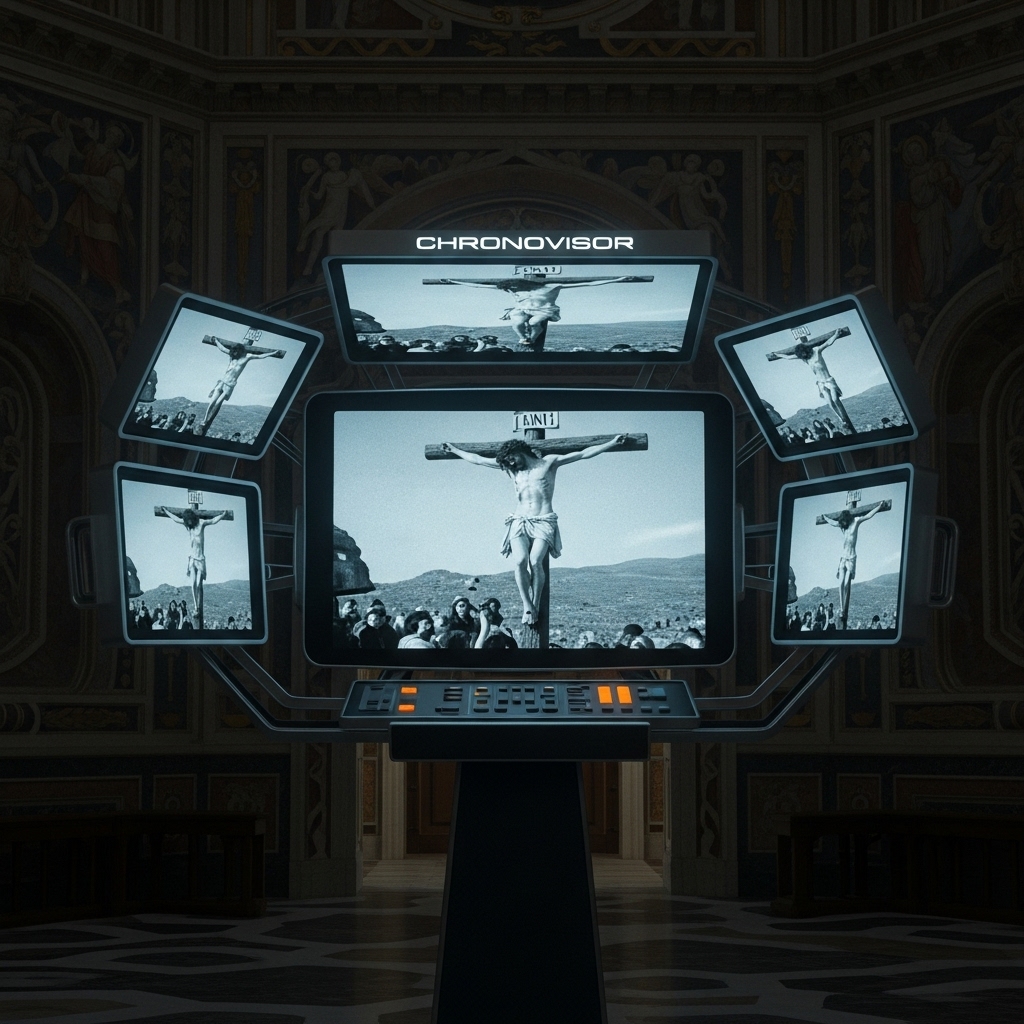
On May 2, 1972, the Italian magazine La Domenica del Corriere ran a photograph of a bearded man’s face, contorted in suffering, under a headline announcing that a machine capable of photographing the past had finally been invented. The man in the photo, readers were told, was Jesus Christ, captured at the moment of crucifixion by a device called the Chronovisor. The claim came from a Benedictine monk named Father Pellegrino Ernetti, and for over fifty years it has refused to fully die, resurfacing on new platforms every few years as though it had never been checked the first time.
It has been checked. Three separate lines of evidence, the photograph itself, the scientific team Ernetti claimed to have worked with, and a lost play he said he’d recovered, each collapse independently under scrutiny. That’s worth taking seriously as a story in its own right, because a legend that fails in three unrelated ways isn’t hiding a kernel of truth, it’s showing its seams.
What Ernetti Actually Claimed
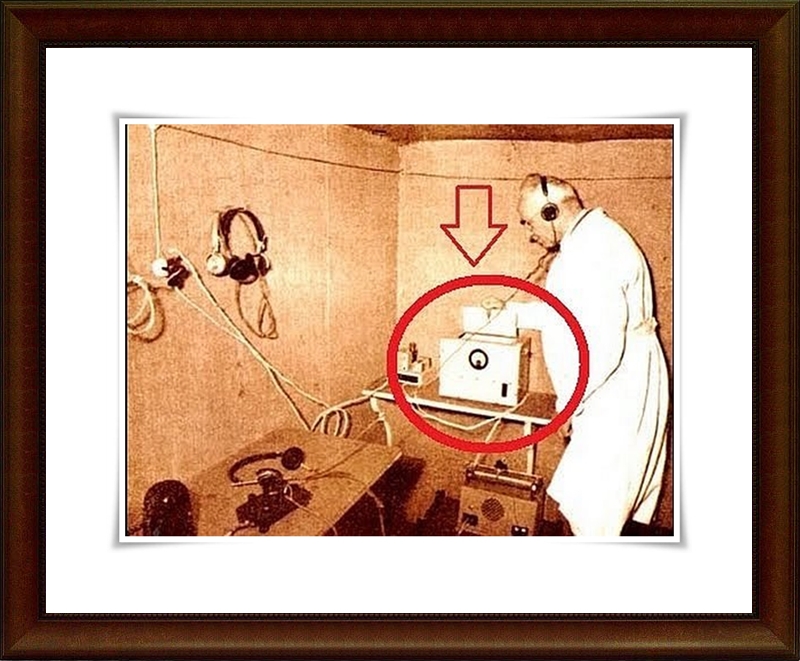
Ernetti was a real figure with real credentials, which is part of why the claim traveled as far as it did. He held a position in Gregorian chant studies at the Benedetto Marcello Conservatory in Venice, worked as a musicologist, and served the church as an exorcist, an unusual combination that made him a compelling messenger regardless of what he was delivering. According to his own account, later expanded by his friend and defender Father François Brune, Ernetti had spent years working in secret with a team of roughly twelve scientists, physicists, engineers, and mathematicians, to build a device capable of detecting the residual electromagnetic traces that past events supposedly leave behind. He called the resulting technology the Chronovisor. It was built, he said, from cathode ray tubes, antennas made from otherwise unremarkable metals, and a tuning mechanism he compared to a direction finder, letting an operator dial into a specific era the way a radio dials into a frequency. He was careful to describe it as a window rather than a vehicle. It let you see and hear the past. It did not let you travel there.
Through this device, Ernetti claimed to have witnessed Cicero addressing the Roman Senate in 63 BC, a performance of the lost tragedy Thyestes by the Roman playwright Quintus Ennius, speeches by Napoleon and Mussolini, and, most consequentially for his reputation, the crucifixion of Jesus Christ. He said Enrico Fermi, the Nobel Prize winning physicist, and Wernher von Braun, the rocket engineer, were both part of the founding team. Brune’s account, developed across decades and eventually published as a book-length treatment in 2002, remained the primary source defending the story after Ernetti’s death, and Brune himself died in 2019 still maintaining it was true.
The Photograph That Wasn’t a Photograph
The crucifixion image is the claim’s most vulnerable point, because it’s the one piece of physical evidence Ernetti actually produced, which means it’s the one piece that could actually be checked against something else. Skeptics compared it to religious artwork circulating in Italy and found a match: the image is a cropped, mirror-reversed reproduction of a wooden sculpture housed at the Sanctuary of Merciful Love in Collevalenza, a real crucifix venerated at a real Italian shrine, not a photograph of anything from the first century. Once researchers knew what to look for, the match wasn’t subtle. It was the same object, flipped left to right.
Ernetti’s defenders have offered a range of responses to this since, from arguing that the Chronovisor had somehow captured an image that happened to resemble the statue, to Sergio Conti’s theory, published in the Italian periodical Il Giornale dei Misteri, that Ernetti’s device might have projected a buried subconscious memory of the statue rather than an actual historical scene. Brune himself rejected that explanation, pointing out that witnesses to the supposed footage described people around the cross moving naturally, something a static memory of a statue wouldn’t produce. What none of these explanations do is account for why the one piece of physical evidence anyone produced turned out to be a known, identifiable object rather than something unexplainable. A device that photographs the deep past should not, on its first public outing, photograph a nineteenth or twentieth century Italian devotional statue instead.

The Scientists Who Weren’t Where They Needed to Be
The claimed twelve-person team is the second point that doesn’t survive a timeline check, and the problem is specific rather than vague. Enrico Fermi died in 1954. Multiple tellings of the Chronovisor story place its active development beginning around 1952, which leaves at most two years of overlap between Fermi’s life and a project that supposedly took a decade or more to reach the working prototype Ernetti described to Brune in the early 1960s. More damaging still, at least one careful reconstruction of the claim’s own history notes that Fermi’s name wasn’t attached to the Chronovisor at all until 1992, nearly forty years after his death and two years before Ernetti’s own death, precisely the kind of detail that gets added to a story late, once the person being named is no longer alive to confirm or deny it.
A separate figure sometimes credited with early foundational work, Father Agostino Gemelli, died in 1959. Some versions of the legend place a pivotal laboratory breakthrough, involving Gemelli directly, in the years after his death, an impossibility that exists in the story’s own telling, not something skeptics had to dig for. Wernher von Braun, meanwhile, was fully occupied with the American space program throughout the years he’s supposed to have been quietly collaborating on a Vatican time-viewing device in Italy. None of this requires outside evidence to falsify. It only requires reading the different versions of Ernetti’s own story against each other and against publicly available dates of death.
A Lost Play That Was Too New
The third collapse involves the Thyestes transcription, and it’s the most technical of the three, which is what makes it hard to fake convincingly. Ernetti claimed to have viewed a lost performance of Ennius’s tragedy Thyestes through the Chronovisor and to have transcribed what he saw. When classicists examined the text he produced, the problems were specific rather than a matter of taste: Katherine Eldred, a Thyestes specialist, found the transcription too short to represent a full ancient performance and noted it contained Latin vocabulary that would not have existed until roughly two centuries after Ennius wrote the original. A device capable of genuinely recording a performance from the second century BC should not produce a text written, however unconsciously, in the Latin of a later era. That’s not a stylistic quibble. It’s the kind of error that happens when a person reconstructs an ancient scene from imagination and later scholarship rather than transcribing it directly.
There’s also a literary precursor worth noting, though accounts differ on which one actually inspired Ernetti, if either did. One line of research points to a 1947 science fiction novella, “E for Effort” by T.L. Sherred, which describes a time-viewing device with clear similarities to the Chronovisor, published years before Ernetti’s claims went public. A separate researcher has instead proposed a different pulp story, “The Biography Project,” published under a pen name in Galaxy Science Fiction, as the more likely template. The two theories disagree on the specific source, but they agree on the underlying point: the concept of a machine that tunes into lingering traces of the past to reconstruct historical scenes existed in popular science fiction before Ernetti announced he’d built one.
The Decree That Doesn’t Exist
One detail recurs constantly in retellings and deserves direct correction: the claim that the Vatican issued a 1988 decree threatening excommunication for anyone who attempted to rebuild the Chronovisor. It’s a vivid detail, exactly the kind that makes a suppressed-technology story feel institutionally confirmed rather than merely alleged. Researchers who have gone looking for the actual decree have not found one. No Vatican archival record supports it, and no legal or canonical scholar has produced a citation for it beyond its repetition across secondary retellings. A decree that dramatic, if real, would be a matter of public canonical record. Its absence from that record is itself informative.
Why It Keeps Coming Back
None of this has stopped the Chronovisor from resurfacing every few years on new platforms, usually stripped of the debunking and framed as a suppressed truth rather than a checked and failed claim. Part of that is structural: the story offers a real, credentialed figure, a real magazine publication date, and a real institution, the Vatican, whose actual history of secrecy around unrelated matters lends borrowed credibility to an unrelated claim. It’s the same mechanism that let a satirical 1992 tabloid story get reprinted decades later as a genuine declassified government document, a real container makes a fake claim feel more solid than it is.

The other part is that debunking a claim like this takes three separate, technical investigations, a photo comparison, a biographical timeline check, and a classical philology review, while asserting the claim takes one sentence. That asymmetry favors the legend every time a new audience encounters it without the context. It also explains why treating the Chronovisor honestly means doing the unglamorous work of laying out all three failures together rather than picking the most dramatic one and calling the case closed.
What Ernetti Said Before He Died
Accounts of Ernetti’s final years include a disputed partial recantation, in which he reportedly acknowledged that the published photograph was not genuine Chronovisor output while still insisting the underlying technology had been real. How much weight that deserves is genuinely unclear. A partial confession, made privately, reported secondhand, and contested by the story’s own defenders, isn’t the kind of evidence that resolves anything cleanly. It sits alongside everything else here as one more piece that complicates the story without completing it.
Brune died in 2019 still defending the account he’d spent decades chronicling. No device has ever surfaced, been demonstrated, or been examined by an independent engineer. No institution, Vatican or otherwise, has ever confirmed funding or housing such a project. What remains is a photograph that matches a known statue, a scientific team with members who were dead or otherwise occupied during the years they’re credited with building the device, a recovered text written in the wrong century’s Latin, a decree nobody can find, and a monk who may or may not have taken back part of his own story before he died. Whatever the Chronovisor actually was, if it was anything beyond an idea borrowed from science fiction and given a Roman collar, it left behind a case built entirely out of the parts that don’t fit together.
The weeping statue and blood tests at Akita raise a comparable question of unresolved Church authority, a Marian case the Vatican itself has never issued a final verdict on