
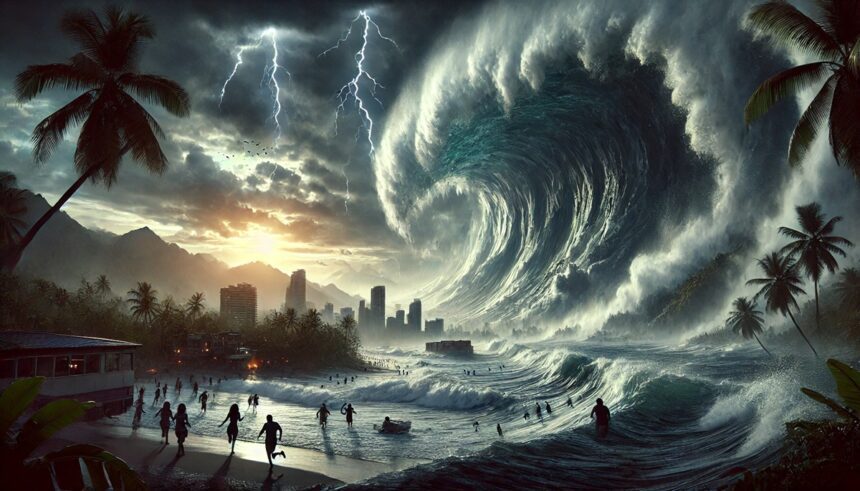
On July 5, 2025, millions of people across East Asia rebooked flights, refreshed tsunami trackers, and watched the waters south of Japan for a wave predicted by a retired manga artist and a diary she had kept since 1985. Airlines from Hong Kong quietly trimmed their Japan routes. Coastal hotels in Kagoshima and Okinawa saw cancellations climb through June. Japan’s Meteorological Agency issued a public statement calling the whole affair unscientific. Then the day arrived, and the ocean did nothing.
For most of the people who had spent the spring rearranging their summer around a single date, that was the end of it. A quiet exhale, a mild embarrassment, a story to be filed under internet hysteria and forgotten by autumn. But Ryo Tatsuki’s diary was never built to be read as a single date. It was built as a clock, one with a repeating interval, and clocks do not stop simply because a reader misunderstood which hour they were counting toward. Twenty five days after the date that failed to deliver a catastrophe, the sixth most powerful earthquake ever recorded by modern seismometers tore open the seafloor off the coast of Kamchatka, sent evacuation orders to nearly two million people across Japan, and pushed tsunami waves across the entire Pacific basin to Hawaii, California, Chile, and the Galapagos Islands.
That is not a claim. It is a sequence of dates, magnitudes, and government evacuation orders that can be checked against public seismic records. What Tatsuki’s diary actually says, what it got right, what it got wrong, and what remains unresolved on her ledger deserves a more careful accounting than either the panic of early July or the relief that followed it.
Most prophecy stories resolve in one of two directions and stop there. Either the predicted date arrives with the disaster attached, and the prophet is canonized, or the date arrives empty, and the prophet is forgotten within a news cycle. Tatsuki’s file refuses both endings. It contains entries that closed exactly as predicted, decades before the events they described. It contains at least one entry, the one everyone actually watched, that appears to have been distorted before it ever reached the public, then failed to resolve on the day people were told to fear. And it contains a seismic event large enough to reorder Pacific shipping lanes for a week, arriving close enough to the failed date and inside the right ocean that dismissing the whole sequence as coincidence requires just as much faith as believing in it outright.
The Instrument
Ryo Tatsuki was born on December 2, 1954, in Kanagawa Prefecture, and debuted as a working manga artist in the 1970s. In 1985, her mother gave her a notebook. Tatsuki had been experiencing dreams she found unusually vivid and unusually precise since around 1980, and the notebook became the place where she wrote them down the moment she woke, often in fragments, often barely legible, sometimes accompanied by a quick sketch of a face or a place she did not recognize.
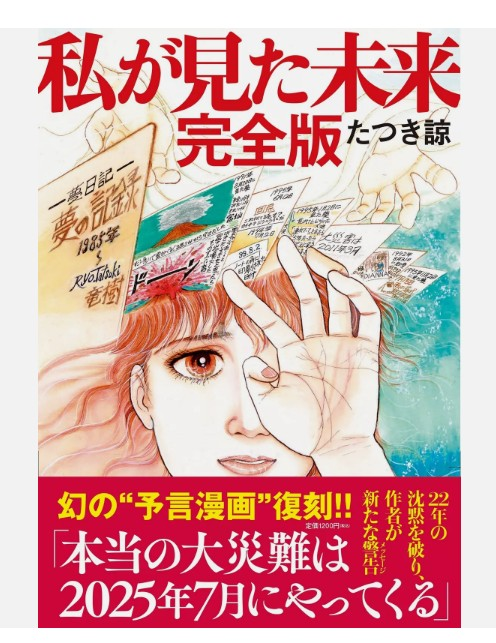
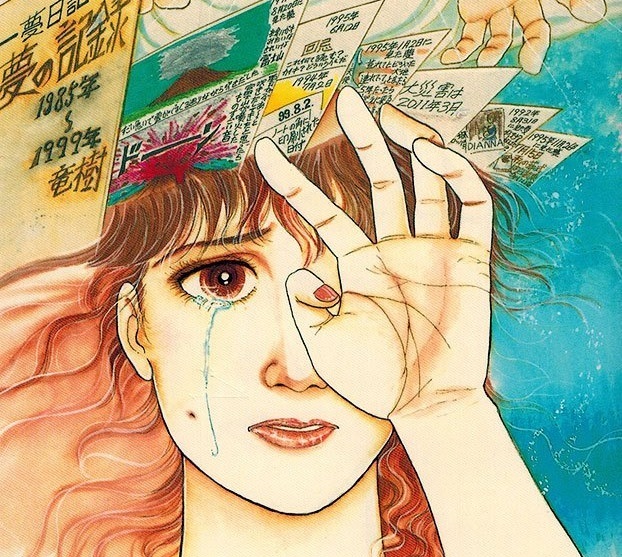
Most of these entries were unremarkable, the ordinary debris of a working artist’s subconscious. A handful were not. By her own account, a small number of the dreams carried a distinct quality, a kind of pressure or clarity that separated them from the rest, and it was these dreams she flagged for closer attention. In 1999, she compiled a selection of them into a manga titled Watashi ga Mita Mirai, “The Future I Saw,” published July 1 of that year. The cover showed a young woman, presumably Tatsuki herself, crying and covering one eye. Above her, six pages torn from the actual diary were reproduced in miniature, their scrawled titles legible if you looked closely: an eruption at Mount Fuji, a woman named Diana, a funeral that turned out to be her own.
The book did not sell. It sat in the discount bins of used bookstores for over a decade, one title among thousands, until March 2011 forced a second look at its cover.
The notebook itself contains far more than the handful of entries that eventually made her famous. By her own account and by the count kept on her fan-run website, roughly fifteen dreams across four decades were flagged as carrying that distinct predictive quality, out of what must be thousands of ordinary entries logged over the same period. Most of the fifteen concern private, unremarkable matters, deaths of people close to her, personal illness, the ordinary weather of a life. Only a small cluster line up with events large enough to be checked against the public record, which is itself a detail worth sitting with: whatever mechanism is or is not operating in Tatsuki’s sleep, it does not appear to distinguish between the trivial and the catastrophic. It simply records, and roughly once every few years, the record happens to intersect with something the rest of the world will later call history.
After 2011, Japanese media began referring to her as the country’s answer to Baba Vanga, the blind Bulgarian mystic whose own posthumous reputation rests on a similarly uneven mix of striking hits and quietly discarded misses. Tatsuki has never embraced the comparison. She gave a handful of interviews in the years immediately following the Tohoku earthquake, largely to clarify what she had and had not actually written, then withdrew from public life almost entirely as the 2025 attention cycle built around her.
The Arithmetic
Before examining what happened, it is worth understanding the rule Tatsuki herself has attached to her visions, because the rule is what turns a list of coincidences into something that behaves, structurally, like a prediction with error bars.
Tatsuki has stated that her dreams tend to resolve on a fifteen year interval. A vision recorded on a given date will manifest fifteen days later, or fifteen years later. If neither window closes, the count does not simply expire. It extends by another fifteen years, to thirty, then forty five, then sixty, indefinitely, according to Leo, the administrator of Tatsuki’s own website, who has described the mechanism directly: if a predicted event fails to occur in the first window, another fifteen years is added, pushing the date to thirty years out, then forty five.
This is a strange kind of prophecy. It cannot be falsified on any single date, because a miss simply resets the clock rather than closing the case. That is precisely the feature that should make a skeptical reader suspicious of the entire framework. It is also the feature that explains why July 5, 2025 passing without incident did not, in Tatsuki’s own system, mean anything had been disproven. It meant the count had not yet closed. What makes her case different from a garden variety unfalsifiable prophecy is not the rule itself but the fact that several of her dated windows already closed, on schedule, against events that had not yet happened when she wrote them down.
The Record Before Fame Arrived
Three entries in Tatsuki’s diary predate the fame that came in 2011, which matters because a claim made after the fact is worthless and a claim made and set aside for years, later matched against an unrelated global event, is a different category of evidence entirely.
On November 24, 1976, Tatsuki recorded a dream concerning the death of Freddie Mercury, the lead singer of Queen. She dreamed of him again a decade later, on November 29, 1986, this time seeing the surviving band members standing beside a statue of a man she could not identify. Mercury died of AIDS related complications on November 24, 1991, precisely fifteen years to the day after her first dream.
On January 2, 1995, Tatsuki wrote in her diary that the earth would crack in Kobe, adding the qualifier “fifteen days or fifteen years later.” Fifteen days after that entry, on January 17, 1995, the Great Hanshin earthquake struck Kobe directly. It was a magnitude 6.9 event, one of the deadliest earthquakes in twentieth century Japan, killing roughly six thousand people and leaving forty five thousand homeless. According to some accounts, a small number of people who had heard about Tatsuki’s entry chose to evacuate the area before the quake hit, though the scale of that claim is difficult to verify independently.
On August 31, 1992, Tatsuki had a dream she described as blurry, difficult to remember, built around a woman’s portrait and a voice repeating a name. She woke and scrawled a single fragmented note in Japanese: Diana? Died? Five years later, on August 31, 1997, Princess Diana died in a car accident in Paris. Tatsuki has since said, and this detail matters for anyone assessing her credibility rather than dismissing it, that she did not experience the original dream as an omen of death. She has said the connection to mortality was imposed afterward by readers, not something she felt at the time.
None of these three entries were public knowledge before the events they anticipated occurred. They existed only in a private notebook, unpublished until 1999, unremarked upon by anyone outside Tatsuki’s immediate circle. That is the detail a skeptic has to actually engage with, rather than wave away.
March 2011
The entry that made Tatsuki a household name in Japan was recorded on March 11, 1996, fifteen years, to the exact date, before the event it described. She wrote of “a catastrophe somewhere in eastern Japan in March 2011,” and felt strongly enough about the entry that she attempted to publish it in a magazine in 1996, well before the manga compilation existed, specifically so the warning would be on record ahead of time. Three years later it appeared as one of the dream sequences printed in The Future I Saw, its cover text visible to anyone standing at a bookstore shelf: a great disaster occurring in March 2011.
On March 11, 2011, a magnitude 9.0 to 9.1 earthquake struck off the coast of Tohoku, the most powerful earthquake ever recorded in Japan’s modern history. The resulting tsunami killed roughly sixteen thousand people, left thousands more missing, and triggered the meltdown of three reactors at the Fukushima Daiichi nuclear plant, an event whose consequences are still being managed today, fifteen years later.
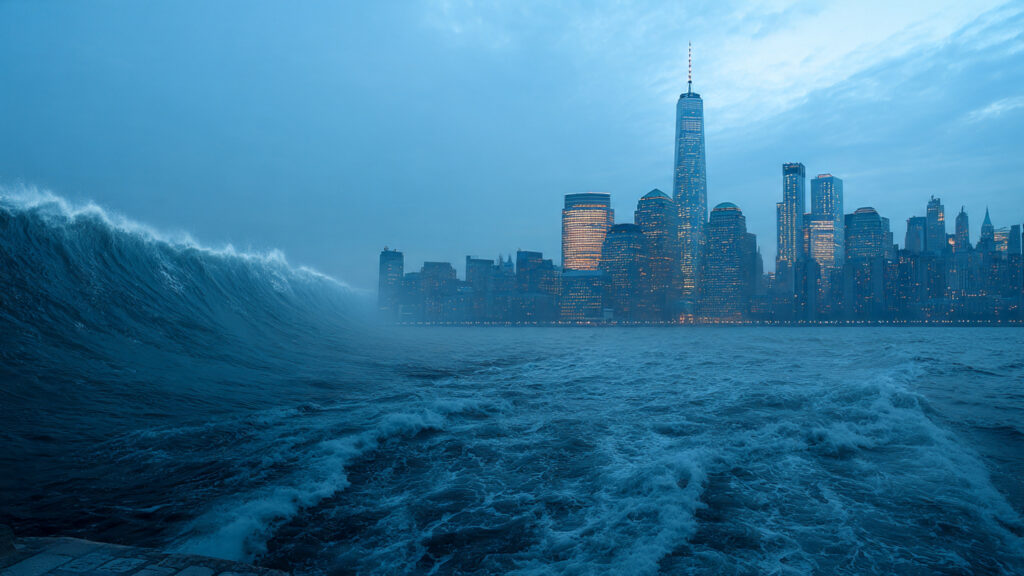
This is the entry that took a forgotten, out of print book and turned it into a cult object. Secondhand copies began selling for around one hundred thousand yen, close to one thousand US dollars, as collectors and the simply curious tried to hold a physical copy of a warning that had been sitting in plain sight for twelve years before anyone noticed it.
An Ambiguous Entry | 2020
A 1995 diary entry describes an unknown virus emerging around the year 2020, reaching its peak sometime in April of that year. The COVID-19 pandemic did emerge in that window, which is the part of this entry that gets repeated in every retelling of Tatsuki’s record. What gets left out more often is that the fit is not as clean as the earlier entries. Global case counts and mortality did not peak in April 2020 in most countries; several reporting sources place the actual peak of the pandemic’s worst wave closer to 2021. The entry also reportedly notes the virus returning around 2030 in a weaker form, a claim that remains outstanding and unverifiable until that year arrives.
This is worth stating plainly rather than smoothing over: the COVID entry is the weakest of Tatsuki’s celebrated hits. It gets the category of event right and the rough decade right. It does not get the exact month of peak severity right in the way the Kobe and Tohoku entries got their windows right. A fair accounting of her record has to hold both the strong entries and the weak ones in the same hand.
The Reprint, and the Date That Was Never Quite Hers
The Future I Saw went back into print twice after its original 2011 vindication. A full reprint arrived October 1, 2021, and a version with additional diary material followed on April 1, 2022. The 2021 reprint’s cover carried a new line, absent from the 1999 original: a warning that “the real disaster” would arrive in July 2025.
That is where the story leaves Tatsuki’s own hand and enters the machinery of internet amplification. Beginning in 2024, a rumor spread, built on the manga’s new cover text, that a single named day within that month, July 5, 2025, would bring the disaster. The manga itself, by most careful readings, never named a day. It named a month and a year. The narrower date appears to have crystallized somewhere in the space between fan interpretation, video commentary, and repetition, eventually hardening into a claim treated as gospel by outlets that had never opened the book. Tatsuki’s own publisher later stated she had not specified an exact date, and that the dramatic cover phrasing was added for effect rather than transcribed directly from her diary.

The consequences of that distortion were real regardless of its accuracy. Flights from Hong Kong to Japan were canceled through June 2025. Hotel bookings in coastal prefectures with histories of tsunami exposure, Kagoshima, Osaka, Okinawa, saw measurable drops. Reports of oarfish, a deep sea species tied in Japanese folklore to seismic disaster, washing ashore along Honshu and Shikoku added fuel that had nothing to do with Tatsuki’s diary at all. Japan’s Meteorological Agency issued public statements characterizing the entire episode as unscientific, noting correctly that no method exists for predicting earthquakes to an exact calendar date. Laura Miller, a professor of Japanese studies at the University of Missouri, offered a more measured read, drawing a comparison to the global anxiety around the 2012 Mayan calendar and suggesting that predictions like Tatsuki’s function as a kind of displacement, a way for diffuse cultural anxiety to attach itself to a legible date. And yet Japan’s tourism numbers for the same period tell a more complicated story than pure panic: the Japan National Tourism Organization reported a record 10.5 million visitors in the first quarter of 2025 alone, undercutting any simple narrative of a country gripped by fear.
The Day That Passed
July 5, 2025 arrived and left without a tsunami, without an earthquake of consequence, without a single confirmed event tied to the date that had dominated headlines and travel decisions for months. For a great many people, that was the whole story: a prophecy, tested, failed.
A retrospective published shortly afterward on the platform Medium argued for a different reading, one worth taking seriously precisely because it does not attempt to rescue Tatsuki’s reputation so much as correct the record. The piece pointed out that there is no solid evidence Tatsuki ever named July 5th specifically, that her language throughout referred only to July 2025 as a broader window, and that the internet’s compression of an entire month into a single twenty four hour span may have manufactured the very failure people believed they were witnessing. If the claim was always “sometime in July,” then July 5th passing quietly proved nothing at all about the rest of the month.
A commentator who goes by Lei, host of a YouTube channel focused on censorship and misinformation out of China, offered a version of the same correction during a livestream in the days after July 5th passed. Her read was that Tatsuki had written a conditional statement, one that only assigned the July 5th date to a future catastrophe if the anniversary of a particular dream happened to coincide with the disaster it described, and that this hedge was lost somewhere in translation and repetition, flattened into a flat prediction rather than the conditional it originally was. Whether that mechanism is the correct account of how the date spread or simply one plausible reconstruction among several, the broader pattern is not in dispute: something in the chain between a private diary, a publisher’s cover copy, and a global audience compressed ambiguity into certainty, and certainty is what got canceled flights and evacuation drills organized around it.
That argument would have remained a footnote, the kind of after the fact rationalization skeptics rightly distrust, if the month had simply ended without further incident. It did not end that way.
Nine days before the month closed, the Kamchatka Peninsula recorded two unusually large foreshocks, a magnitude 7.4 and a magnitude 6.6, the kind of activity seismologists flag as significant precursors but rarely treat as reliable forecasting on their own. Foreshocks of that size are rare. They are not unprecedented. And on their own, in the third week of July 2025, they drew barely any coverage outside specialist earthquake monitoring circles, overshadowed entirely by the countdown still running toward a date in a different ocean, along a different fault system, roughly two thousand miles to the south.
Twenty Five Days Later
At 11:24 in the morning local time on July 30, 2025, twenty three UTC hours after 23:24 on July 29, an earthquake measuring magnitude 8.8 struck roughly seventy four miles southeast of Petropavlovsk-Kamchatsky, on Russia’s Kamchatka Peninsula. It is tied, by magnitude, with the 1906 Ecuador-Colombia earthquake and the 2010 Chile earthquake as the sixth strongest ever recorded by modern instruments anywhere on Earth. It was the most powerful earthquake to occur anywhere in the world since the March 2011 Tohoku event that Tatsuki had named fifteen years in advance.
The Pacific Tsunami Warning Center issued warnings for hazardous waves across Russia and Japan within minutes. Japan’s Meteorological Agency, the same body that had spent the preceding weeks publicly dismissing Tatsuki’s readers as unscientific, issued its own tsunami warning covering the coastline from Hokkaido down through Wakayama Prefecture on Honshu, with advisories extended further south through Shikoku and into the Okinawa Islands. It was the first tsunami alert issued in Japan since 2024. Across one hundred thirty three municipalities, roughly nine hundred thousand people were advised to evacuate; CNN’s live coverage placed the number of people under evacuation advisories in Japan closer to two million as the warnings expanded through the day. Waves reached Japan within hours, ranging from thirty centimeters up to 1.3 meters at their highest recorded point, Kuji Port in Iwate Prefecture, the same general stretch of coastline devastated in 2011.
The tsunami did not stop at Japan. It crossed the entire Pacific. Hawaii issued evacuation orders as waves reaching nearly five feet struck Kaului on Maui, with traffic jamming Honolulu’s streets during evening rush hour. Tsunami advisories and warnings reached California, Oregon, Washington, Alaska, Chile, Ecuador’s Galapagos Islands, and Indonesia. In Russia itself, the fishing port at Severo-Kurilsk flooded, boats were torn from their moorings, and Kamchatka’s Klyuchevskaya Sopka, the tallest active volcano in Eurasia, erupted in the earthquake’s aftermath. Remarkably, the Kremlin reported no fatalities in Russia, and damage across the Pacific basin was far lighter than a quake of this magnitude would typically produce, a fact seismologists spent the following weeks trying to explain.
More than one hundred significant aftershocks followed the main shock within hours, three of them magnitude 6.0 or greater, the strongest a 6.9 that struck just forty five minutes after the initial rupture. In Petropavlovsk-Kamchatsky, video later released by regional health authorities showed surgeons continuing a tumor removal operation as the building shook around them, the attending anesthesiologist bracing the machine keeping the patient breathing rather than stopping the procedure. No one in the operating room was harmed. Remarkably, the Kremlin reported no fatalities anywhere in Russia despite the scale of the quake, and seismologists spent the following weeks publicly puzzling over why an earthquake this powerful, tied for sixth strongest ever measured, produced a tsunami far more modest than its magnitude would predict. Klyuchevskaya Sopka, the tallest active volcano in Eurasia, erupted in the hours after the earthquake, a detail that made front pages in Russia and barely registered anywhere else, buried beneath tsunami coverage from Hawaii to Chile.
None of this happened where Tatsuki’s diary said it would. Her 2025 entry described the seafloor cracking between Japan and the Philippines, not Kamchatka, roughly two thousand miles to the north. The date was twenty five days past the one the internet had fixated on, not the fifteen her own stated rule would predict. By the narrow standard of a single named date and a single named location, the Kamchatka earthquake does not fulfill Tatsuki’s prophecy, and any honest accounting has to say so directly rather than blur the geography to make the story neater than it is.
What it does establish, without any need for interpretation, is that the largest earthquake in fourteen years, the strongest since the exact event Tatsuki predicted in 1996, struck the same ocean basin during the same window of public attention her diary had generated, close enough in time and consequence that the distinction between prophecy and coincidence stopped being a comfortable one to make.
What Remains On The Clock
Tatsuki’s diary still has entries that have not closed. On August 20, 1991, she dreamed of a great eruption at Mount Fuji, dormant since 1707. The first fifteen year window, August 2006, passed without incident. The second, August 2021, also passed quietly, despite Japanese geologists having spent the preceding decade documenting shifts in pressure within Fuji’s magma chambers that keep the mountain firmly on the list of active volcanoes rather than extinct ones. By her own arithmetic, the next window opens in 2036.
A separate entry, recorded sometime between June and September of 1981, describes a tsunami striking Yokohama in Kanagawa Prefecture, with flooding reaching the Aokibashi area of the Kinko-cho district. Applying the forty five year increment, three cycles of fifteen years past the original dream, that window centers on 2026, one year from now, tied to fears already circulating among Japanese seismologists about a potential Nankai Trough megaquake along an entirely separate fault system from the one involved in either 2011 or the Kamchatkan event.

A third open item, the virus entry from 1995, includes a claim that whatever emerged around 2020 would return in a weaker form roughly a decade later, placing its next test around 2030.
The Yokohama window is the one worth watching most closely, and not because of anything in Tatsuki’s diary. The Nankai Trough, the subduction zone running along Japan’s Pacific coast from Shizuoka to Kyushu, is independently assessed by Japan’s own government seismologists as overdue for a major rupture, with published probability estimates placing roughly a seventy to eighty percent chance of a magnitude eight or nine event within the next thirty years, entirely apart from any dream diary. If Tatsuki’s forty five year window and the government’s own hazard modeling happen to overlap in the next few years, the overlap will mean nothing scientifically. It will still be difficult for anyone watching to experience it that way.
None of these have resolved. All three remain, by Tatsuki’s own framework, live.
Why One Date Travels And Others Don’t
Tatsuki is not the first private diary to become a public countdown, and the pattern her case follows is worth naming, because it explains why July 5th spread the way it did while the equally real Kamchatka earthquake, arguably the more extraordinary event of the two, generated headlines for barely a week before the news cycle moved on.
A named date does something a named month cannot. It gives an anxious public a discrete unit of time to organize behavior around: a flight to cancel, a hotel reservation to move, a single day to either dread or survive. The 2012 Mayan calendar phenomenon followed an identical shape, built around a specific December date lifted from a Long Count cycle that Mayanist scholars had, for decades, correctly described as marking a transition rather than an ending. The narrower, more dramatic reading traveled anyway, because narrow and dramatic is what travels. Baba Vanga’s own following performs the same compression every few years, taking a handful of vague, largely unverifiable statements attributed to her after her 1996 death and retrofitting them with exact years whenever a slow news cycle needs filling.
What makes Tatsuki’s case structurally different, and harder to dismiss with the same shrug, is that her diary contains verifiable dated entries that predate the events they describe, filed in a form, a published, purchasable, dated book, that cannot be quietly edited after the fact the way an oral prophecy or a social media post can. The 1996 magazine submission naming eastern Japan and March 2011 is a matter of public record fifteen years before Tohoku, not a claim assembled from memory after the earthquake had already happened. That distinction, between a prediction fixed in print ahead of time and a prediction reconstructed from memory afterward, is the entire difference between a genuine anomaly and a parlor trick, and it is why Tatsuki’s file stays open in a way most viral prophecies never earn.
None of that validates the mechanism. It only means the standard skeptical dismissal, that all of this is retrofitted pattern matching applied after the fact, does not fully account for the paper trail on at least three of her entries. A careful reader has to hold both facts without collapsing them into either total belief or total dismissal: the record contains verifiable advance claims that resolved on schedule, and the record also contains a viral date that Tatsuki, by the most careful readings available, never actually wrote down.
The Instrument Speaks For Herself
Tatsuki has never behaved like someone building a platform out of dread. She gives few interviews, runs no subscription service, sells no forecasts. She retired from manga entirely in 2020, five years after a dream she recorded as her own funeral, and now lives quietly, largely declining the surge of global attention her old diary keeps generating. When she has spoken publicly, her tone runs closer to caution than showmanship: she has said people should feel free to interpret her dreams as they wish, that the value in taking them seriously lies in preparedness rather than panic, and that any response should weigh expert scientific opinion alongside whatever personal meaning a reader assigns to her visions.
Skeptics have their own framework, and it deserves equal space here rather than a dismissive aside. Japan sits on some of the most seismically active geography on the planet; a country where earthquakes above magnitude six occur with regularity will, over a long enough diary, produce apparent hits by chance alone. Confirmation bias does the rest of the work, discarding the misses, in this case the 2006 and 2021 Fuji windows, the imprecise COVID timeline, the geography mismatch at Kamchatka, and elevating the hits into a pattern that feels designed rather than statistical. Some observers reach for Carl Jung’s concept of a collective unconscious to explain how a private notebook could brush against public catastrophe with this frequency. Seismologists reach for base rates and the simple fact that a fifteen year window, applied liberally enough, will eventually overlap with something.
There is also a quieter statistical objection worth stating directly. Tatsuki has kept the notebook since 1985, a span of roughly four decades, during which Japan alone has experienced dozens of earthquakes above magnitude six and the world has weathered multiple pandemics, several high profile celebrity deaths every year, and no shortage of natural disasters somewhere on the planet at any given time. A diary that logs enough dreams over four decades, and that assigns each one a fifteen year window capable of extending itself indefinitely on a miss, is playing a game with enormously favorable odds of eventually landing on something real. That is not proof the mechanism is fraudulent. It is a reminder that a favorable base rate and a genuine anomaly can produce identical looking evidence, and no amount of retrospective analysis fully separates the two.
Both explanations are compatible with everything laid out here. Neither one closes the file.
The Open Window
Ryo Tatsuki is in her seventies now, retired, largely silent, living in the same country whose coastline she has been drawing disasters onto for four decades. She has not published a new entry since the reprints. She does not need to. The clock she described does not require fresh input to keep running; it only requires the calendar to keep turning past the windows already written down.
Fuji’s next window opens in 2036, a full decade out, long enough that the current wave of attention around her name will likely have faded twice over before anyone checks it again. Yokohama’s window is closer, arriving in 2026, a single turn of the calendar from the date this is being written, layered uncomfortably over an entirely separate body of seismological concern about the Nankai Trough that has nothing to do with Tatsuki and everything to do with plate mechanics researchers have been tracking for decades. The seafloor between Japan and the Philippines, the place her 2025 vision actually named rather than the place the internet decided to watch, has not cracked. Kamchatka happened somewhere else, on a date her own fifteen day rule does not cleanly explain, at a distance from her stated geography wide enough that calling it fulfillment would be dishonest.
What is left is not a fulfilled prophecy and not a disproven one. It is a diary with three entries still open, sitting in a country that will keep having earthquakes regardless of what any dream diary says about them, kept by a woman who never asked to be believed and has spent every public statement she has made trying to talk her readers down rather than up. The ocean south of Japan has not started to boil. It knows, or does not know, exactly when it will, and the clock does not care which.