

Two belief systems, separated by the entire width of the Pacific Ocean, with no recorded historical contact before the fifteenth century CE, describe the same civilizational crisis in strikingly convergent terms.
Hindu cosmology describes the Kali Yuga, the fourth and final age of the cosmic cycle, as a period in which dharma, the cosmic moral order, progressively deteriorates until its complete collapse triggers the cycle’s renewal. Hopi cosmology describes the Fourth World’s ending through a sequence of nine signs whose completion will be followed by the Fifth World’s emergence. Both describe a period of social dissolution, moral inversion, environmental catastrophe, and the appearance of technological markers before the transition to a new cosmic era.
Whether this convergence reflects: independent human recognition of the same universal civilizational patterns, a common ancient source passed to both cultures through channels the conventional historical record does not trace, or the operation of genuine prophetic vision by individuals with access to information about future events through mechanisms the contemporary scientific framework does not explain, is the question that what both belief systems describe makes genuinely interesting rather than obviously dismissible.
What neither system describes as the endpoint is simple destruction without renewal. The Kali Yuga ends. The Fifth World begins. The cyclical framework both share is the element that sets them apart from the linear Abrahamic apocalypse, in which the end is a singular terminal event followed by judgment rather than by the continuation of the cosmic cycle.
The Hindu Kali Yuga Framework
The Yuga cycle is one of the most precisely recorded ancient astronomical frameworks to survive from any civilization. The Vishnu Purana, the Bhagavata Purana, and the Mahabharata all preserve the same basic structure: a cycle of four yugas of declining duration and declining moral order, from the Krita Yuga of 1,728,000 years through the Treta Yuga of 1,296,000 years and the Dvapara Yuga of 864,000 years to the Kali Yuga of 432,000 years. A complete Mahayuga of all four ages spans 4,320,000 years. A Kalpa, a day of Brahma, consists of a thousand Mahayugas.
The numbers encode an astronomical relationship: 432,000 is a number that appears in multiple ancient astronomical systems across independent cultures. The Babylonian king lists preserve pre-flood reigns totaling 432,000 years. Norse cosmology describes 432,000 warriors in Valhalla. Whether these independent appearances of the same number in widely separated cultures reflect a genuine ancient astronomical discovery whose significance passed from one culture to another, or reflect the number’s mathematical properties that make it a natural basis for large-number astronomy, is a question that the cross-cultural appearance raises.
The current Kali Yuga is calculated by Hindu astronomers to have begun at midnight between February 17 and 18, 3102 BCE, corresponding to the death of Krishna and the beginning of the age of dissolution. Whether this date was calculated backward from observed astronomical configurations, forward from a known historical reference point, or encoded a genuine prophetic vision of a transition moment, is a question that the Vedanga Jyotisha’s astronomical calculation methods do not definitively answer.
The Kali Yuga’s characteristics as recorded in the Puranas are not symbolic generalizations but social and institutional descriptions whose accuracy against the observable historical record of the past 5,000 years is the basis for why this framework still feels relevant today.
The Puranic descriptions include several distinct markers: rulers who are not qualified or righteous, whose authority derives from power rather than from virtue. The commodification of values, where money replaces dharma as the arbiter of social worth. The deterioration of natural systems, including water availability and agricultural productivity. The reduction of human lifespan. The proliferation of false religious teachers. And the progressive dissolution of family and social bonds.
Whether these descriptions match the observable trajectory of human civilization over the past five millennia is a question the historical record allows to evaluate with more specificity than the Puranas’ general language might suggest.
René Guénon and the Western Engagement with Kali Yuga
The French metaphysician René Guénon, whose Agartha and Shambhala analysis appears in this library’s dedicated piece, published The Crisis of the Modern World in 1927, whose central argument was that the Western world was in the final phase of the Kali Yuga and that the characteristics of modern Western civilization, its materialism, its quantification of all value, its rejection of inherited wisdom, and its progressive individualism, were the precise symptoms Hindu cosmology described as the Kali Yuga’s advanced phase.
Guénon’s argument was not a cultural critique borrowing Eastern vocabulary for rhetorical effect. It was a metaphysical analysis claiming that the Kali Yuga framework accurately described the underlying structure of civilizational decline and that the modern Western world’s trajectory confirmed Hindu cosmology’s diagnosis rather than representing progress.
Whether Guénon’s analysis is correct depends on whether the Kali Yuga framework is an accurate description of civilizational decline patterns, which in turn depends on whether this cosmology reflects genuine knowledge about the structure of time and civilizational cycles or reflects the standard human tendency to perceive the present as the worst period and the past as better.
The Puranic passage about the Kali Yuga’s social characteristics, whose descriptions map against the observable modern world with a precision that Guénon found remarkable in 1927 and that has not diminished since, is the primary evidence that the Kali Yuga framework offers more than cyclical nostalgia.
The Hopi Nine Signs and Their Character
The Nine Signs are usually said to have been given by a Hopi elder called White Feather, of the Bear Clan, to a minister named David Young during a roadside encounter in the summer of 1958, and the story is frequently presented as confirmed by Frank Waters’s 1963 Book of the Hopi. That specific sourcing claim does not hold up well under scrutiny and the library’s evidentiary standard requires saying so plainly rather than repeating it. Waters’s book does not appear to name a figure called White Feather at all. Researcher Jason Colavito, investigating the prophecy’s paper trail, found the earliest identifiable printed version of this specific Nine Signs text dates to 1980, more than two decades after the claimed 1958 encounter, with the strong Christian apocalyptic framing throughout suggesting Young himself shaped the content considerably rather than simply passing it along. Separately, anthropologist Armin Geertz, who has published extensively on Hopi prophecy, found evidence that Hopi prophetic material has been continuously recomposed to fit unfolding events, and that the signs identified as already fulfilled were, in the cases he examined, composed after the events they supposedly predicted rather than before them. None of this proves the Nine Signs are inauthentic in every respect, but it means the confident 1958 sourcing commonly attached to the story is itself one of the least reliable parts of it.
Whether White Feather was passing down something whose continuous oral history extended back before European contact, or was interpreting the Hopi cosmological framework against observed historical events in a way that produced the sign sequence that Young recorded, is a question the available record does not definitively answer. The 1963 publication date places the written record of the Nine Signs in a period when the interpretations of Signs One through Seven could have been post-hoc identifications of already-completed historical events rather than genuine predictions.
This is the methodological caution that honest treatment of the Nine Signs requires: when every fulfillment is a past event identified after the fact, the evidentiary standard for genuinely predictive content is lower than when a prediction is recorded before the event it describes occurs.
The claimed predictive interest of the Nine Signs is usually pinned on the eighth and ninth: the eighth sign, of young people with long hair joining indigenous communities to learn from them, is read as the counterculture movement of the 1960s and 1970s, which would have been in the future at the time of the claimed 1958 encounter. Given that the earliest printed version Colavito could actually locate dates to 1980, well after the counterculture had already come and gone, this specific claim to prediction is considerably weaker than it is usually presented. A sign identified in a text that only surfaces in print after the event it describes is not a prediction in any meaningful sense, whatever the internal date the text claims for itself.
The ninth sign, a dwelling place in the heavens falling with a great crash appearing as a blue star, is the sign whose fulfillment status remains actively discussed. The fall of the Soviet Mir space station on March 23, 2001, which produced a visible trail in the sky over the South Pacific, and the fall of the UARS satellite in 2011, have both been proposed as fulfillments. Whether either event matches this description, particularly the blue star appearance and the great crash, is a question the available record leaves genuinely open.
The Convergence of Decline Markers
The elements that both the Kali Yuga and the Hopi Nine Signs identify as markers of the transitional period before the cycle’s end are worth examining against the historical and contemporary record rather than simply listing them.
Environmental degradation: both describe the pollution of water and the deterioration of natural systems as markers of the final period. The Kali Yuga Puranic text’s description of being dry from water as the only definition of land, and the Seventh Hopi Sign’s description of the sea turning black, are rather than general environmental references. The seventh sign’s black sea has been interpreted as oil spills, most specifically the 1969 Santa Barbara oil spill and subsequent major spills including the 2010 Deepwater Horizon event.
Political corruption: both describe rulers who achieve authority through power rather than virtue, whose characteristics include greed, dishonesty, and the conflation of wealth with virtue. The Kali Yuga text’s statement that only money will confer nobility and power will be the only definition of virtue is an institutional description rather than a general moral complaint.
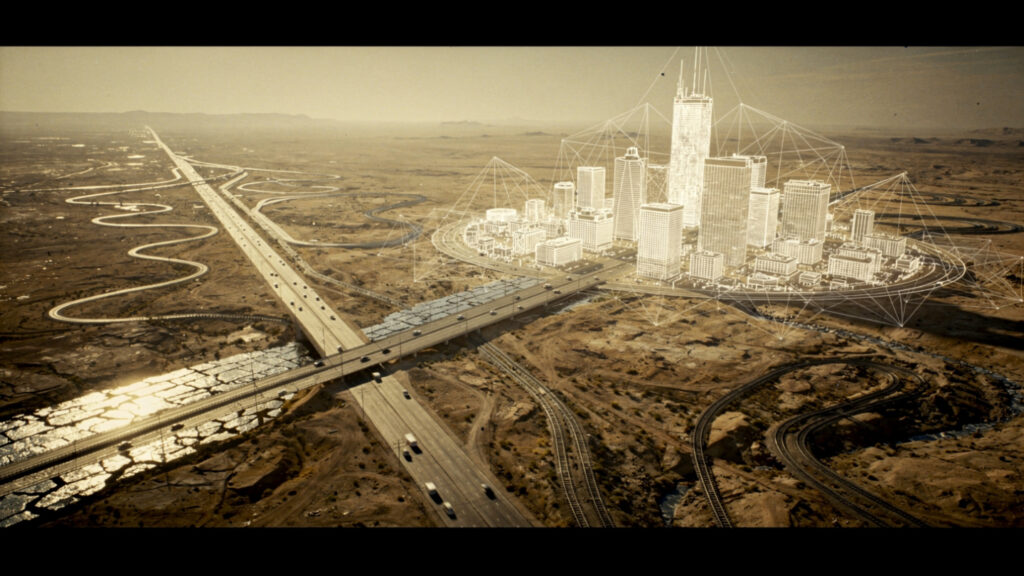
The technological markers: the Hopi signs are unique in their technological sequence. The signs describe railroads as iron serpents, power lines as giant spider webs, and highways as stone rivers that make pictures in the sun in terms that are simultaneously metaphorical and accurate. Whether this specificity reflects genuine prophetic vision of technologies whose operation would not have been imaginable to a pre-industrial Hopi storyteller, or reflects retrospective interpretation of technologies into general prophetic language, is the question that the signs’ internal coherence raises.
The Fifth World and the Yuga Renewal
The element both share beyond their diagnoses of civilizational decline is a cyclical rather than terminal framework for the end of the current age.
The Hindu Kali Yuga ends with the appearance of Kalki, the tenth and final avatar of Vishnu, who arrives on a white horse at the end of the age to destroy the wicked and restore dharmic order, initiating the new Krita Yuga. Kalki appears in the Kalki Purana and in the Bhagavata Purana, whose description of his appearance includes details that the Hopi figure of Pahana parallels in ways: both are figures of restoration rather than destruction, whose arrival follows the completion of the current age’s collapse rather than preventing it.
The Hopi Fifth World’s emergence follows the Fourth World’s destruction through a process described as the earth swinging from side to side, its imagery for a geographic or geomagnetic catastrophe, followed by the planting of new wisdom by Pahana, the lost white brother who returns with the missing piece of the sacred tablet.
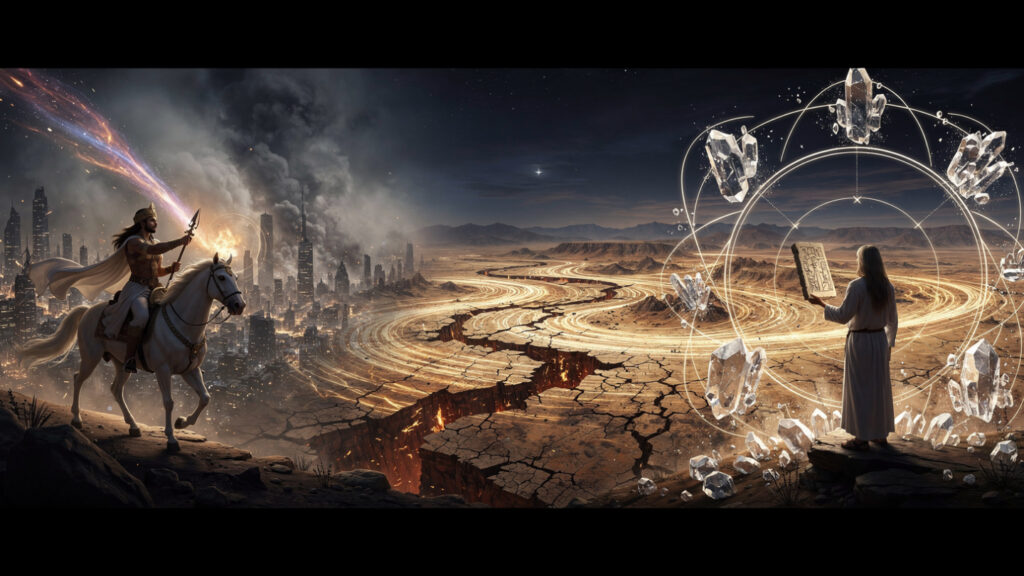
Whether Pahana represents a literal figure whose identity and arrival the Hopi Bear Clan still actively anticipates, a cosmic principle of restoration encoded in mythological form, or a genuine prediction of a future figure whose character has been preserved from ancient sources, is a question that the Hopi community’s continued active maintenance of the ceremonies tied to Pahana’s return makes more than academic.
What the Hopi maintain today is not an archived prophecy. It is a living ceremonial practice whose goal includes preparation for the transition between the Fourth and Fifth Worlds. Whether this preparation reflects genuine knowledge of the transition’s timing and character, or represents the ongoing maintenance of a cosmological framework whose predictions extend into a genuinely open future, is the question that the claimed 1958 encounter, Guénon’s 1927 analysis, and the Puranas’ ancient composition all approach from different directions.
The signs are on the record. Their interpretations are on the record. The ninth sign has not been definitively fulfilled.
Whatever is coming next in the sequence both describe has not arrived yet.
The preparation continues.