


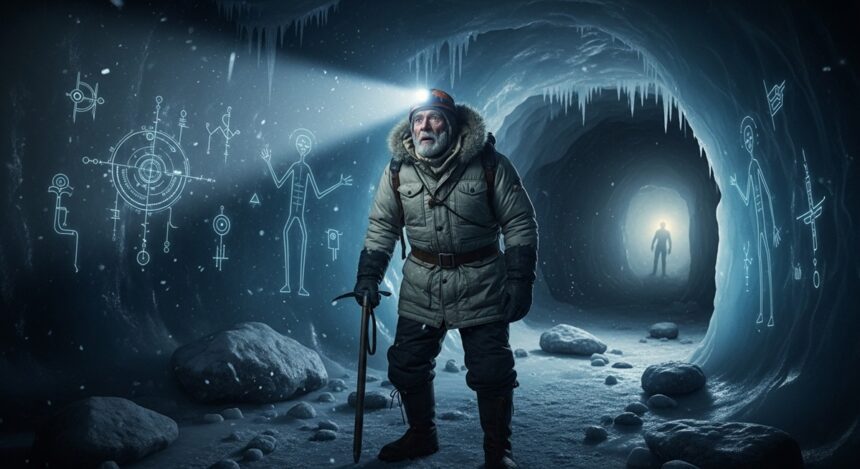
No verifiable trace of a Canadian polar explorer named Graham Lewis, a 2013 interview describing his account, or any 1976 joint U.S.-Canadian classified Antarctic mission matching this description could be located anywhere in this investigation.
This needs to be stated plainly from the outset: no news archive, expedition record, or polar research organization has any record of a Graham Lewis matching this description. No interview featuring this story could be located. The claim, as told, has no traceable primary source.
Antarctic History Worth Knowing Accurately
Antarctica’s history does include genuine intrigue, worth telling accurately rather than through invented additions. Operation Highjump, led by Admiral Richard E. Byrd, was a large-scale 1946-1947 U.S. Navy operation involving thousands of personnel, ships, and aircraft, officially intended to establish an American presence in Antarctica and test equipment in extreme cold conditions.
Byrd’s “Secret Diary”
The “secret diary” attributed to Richard Byrd, describing a warm inner-Earth realm and encounters with an advanced civilization, is itself a well established fabrication. Historians studying Byrd’s actual life and verified expedition records have found no connection between this circulated diary text and any authentic record Byrd produced. The diary is widely regarded by historians as a hoax that emerged and spread separately from Byrd’s own verified career, not an authentic account from the admiral himself.
The Piri Reis Map
This deserves its own correction too. The Piri Reis map of 1513, created by Ottoman admiral and cartographer Piri Reis, is a genuine, historically significant artifact. Cartographic historians have extensively studied it, and its confirmed sources include contemporary and earlier Portuguese, Arab, and Columbus-derived nautical charts of the actual coastlines of South America and West Africa known at the time. Historians of cartography have found no evidence the map depicts Antarctica at all, let alone an ice-free version of it. The southern coastline features some researchers have claimed matches Antarctica are more conventionally explained by cartographers as a stylized or distorted representation of the South American coast curving away from the map’s edge, a well established and common feature of maps from this era attempting to fit known landmasses onto available parchment.
What Antarctic Governance Actually Looks Like
The Antarctic Treaty, signed in 1959 and now including over 50 signatory nations, prohibits military activity and reserves the continent for peaceful scientific research, an actively enforced international agreement. Research stations operated by roughly 30 nations coordinate extensive scientific work, and satellite monitoring, along with periodic international inspections permitted under the treaty itself, make large-scale secret construction genuinely difficult to conceal over any extended period, a practical consideration worth weighing against claims of hidden bases.
Subglacial Life, No Invented Beings Required
Microbiology research has found extremophile organisms in Lake Vostok, a massive subglacial lake buried beneath roughly 4 kilometers of Antarctic ice, published research confirming these organisms survive in extreme cold, darkness, and pressure through well-understood biological adaptations. This fascinating science needs no invented humanoid beings attached to it. Astrobiologists specifically study these Antarctic extremophiles because they offer insight into what kinds of life might theoretically survive in comparably extreme environments elsewhere in the solar system, a legitimate and exciting scientific application entirely grounded in published, peer-reviewed research.
Corey Goode and the Status of “Secret Space Program” Claims
Corey Goode is a public figure who has made extensive, on-record public claims since 2014 about secret Antarctic bases and extraterrestrial alliances. These are on-record public claims Goode has made. They are not independently verified by any scientific or government body, and no physical evidence supporting them has been produced or examined by outside researchers. Journalists and researchers who have investigated Goode’s specific claims and background have raised direct questions about their consistency and verifiability.
Why “No Records Because It Was Classified” Isn’t Evidence
It’s worth addressing this reasoning directly, since it appears in the original claim and in many similar unverifiable stories. The absence of records is consistent with many possibilities, an actual classified operation, an event that never occurred, or an account assembled after the fact without any underlying operation at all. Historians and journalists specifically evaluate claims like this by looking for independently checkable details: named colleagues who can be located and interviewed, payment or personnel records, corroborating accounts from separate sources. None of these independently checkable details exist for this specific claim, which is a meaningfully different situation from a genuinely declassified historical operation, where primary-source evidence eventually surfaces precisely because multiple people and institutions were involved and eventually spoke or wrote about it independently.
How to Actually Verify a Claim Like This
It’s worth explaining the practical method for checking a story like this one, since it applies broadly to similar unverifiable accounts. Genealogical and public records searches can typically confirm whether a named individual with a specific claimed nationality, profession, and career timeline actually existed and can be located, standard journalistic verification practice. Polar research organizations, including national Antarctic programs and academic polar research institutes, maintain extensive historical records of expedition personnel, since Antarctic operations require logistical coordination, funding, and permits that leave a genuine paper trail even decades later. A claim describing 13 expeditions across 15 years would, in a genuine case, likely be checkable against historical expedition rosters maintained by national polar programs. The complete absence of any such checkable trail for this specific account is itself a meaningful data point, not proof of falsehood on its own, but a significant gap that any careful investigator would want resolved before treating the account as established fact.
UFO Investigation Standards, for Comparison
It’s worth contrasting this untraceable account with how UAP investigation actually proceeds today, since legitimate research in this space does exist and follows a considerably more rigorous standard. The Pentagon’s All-domain Anomaly Resolution Office, established specifically to investigate UAP reports, requires documented radar data, multiple-witness corroboration, and sensor confirmation before treating a case as genuinely unexplained, rather than relying on a single, unverifiable secondhand account decades after the fact. Congressional testimony on UAP topics, including statements from named, sworn witnesses, occurs under legal accountability, with consequences for false statements made under oath. This considerably more rigorous evidentiary standard is worth keeping in mind as a benchmark, precisely the kind of standard this specific Antarctic account, with no name that can be verified, no expedition record, and no independent corroboration, does not come close to meeting.
What Actually Makes Antarctica Worth Studying
Antarctica is genuinely one of the most scientifically valuable places on Earth, and it needs no invented encounter to justify that status. Ice core research there has recovered climate records stretching back over a million years. Subglacial lakes host genuinely extreme forms of life scientists are still working to understand. International cooperation under a functioning treaty has kept the continent dedicated to peaceful science for over six decades. The actual mysteries Antarctica still holds, in its ice, its biology, and its deep geological history, are compelling enough without an untraceable account of gray-skinned hosts and a mission that left no trace anywhere in the historical record, and following the active research that continues there today offers a considerably more reliable path toward whatever genuine mysteries the continent still has left to reveal.