



The expedition left Norfolk, Virginia in December 1946 with 4,700 military personnel, thirteen ships including an aircraft carrier, and an air component of thirty-three aircraft. Its stated mission was to establish the Antarctic research station Little America IV, to consolidate American territorial claims in Antarctica, and to train personnel and test equipment for cold-weather operations.
An initial six-to-eight-month estimate was floated before the ships departed. That number deserves honest treatment, because the framing “planned for six to eight months, lasted sixty-eight days” is the version repeated across conspiracy literature, and it does not hold up well against the operational record.
Antarctic surface and air operations are only physically possible during the austral summer, roughly late November through early March, when temperatures and daylight make flying and shipboard work survivable. Every credible operational history of Highjump, including the National Archives’ own account of the expedition and the Coast Guard’s contemporary operational logs, places the actual work inside that exact window: ships reached the ice pack in late December 1946, Little America IV was established in mid-January 1947, aerial mapping and a two-plane flight to the South Pole took place through mid-February, and by late February the weather had deteriorated to the point that flights were limited to three days for the rest of the month. The task force sailed for home in early March. That is not a mysterious forty- or sixty-eight-day curtailment of an open-ended eight-month mission. It is a fleet-scale expedition running its full course within the only window Antarctic conditions actually allow, which is what every other Antarctic summer operation before and since has also done.
Operation Highjump’s commander was Admiral Richard Byrd, the most experienced polar explorer in American history at that point, whose previous Antarctic expeditions in 1928, 1933, and 1939 had established the framework of American Antarctic activity. Byrd understood Antarctic operations in ways that no other American naval officer did. The expedition he commanded in 1946 and 1947 was the largest military operation ever conducted in Antarctica by any nation, and it also suffered genuine, well documented losses consistent with how dangerous that operation actually was: a PBM aircraft crash on December 30, 1946, killed three crewmen, and a fourth sailor died on January 21, 1947. Those deaths, and the operation’s real hazards, are part of the honest record and do not require any additional mystery to explain why an admiral with three prior Antarctic expeditions under his belt would bring his ships home before the ice closed in.
The official explanation for the operation’s conclusion, the approach of Antarctic winter combined with the completion of its primary objectives, establishing Little America IV and completing extensive aerial photography, is also simply the correct one by the operational timeline itself. The library’s evidentiary standard requires saying so plainly rather than treating a well documented seasonal constraint as an unexplained early termination.
Byrd returned from Antarctica and gave an interview to the Chilean newspaper El Mercurio in March 1947. The interview appears in the Chilean press record. Its content, whatever Byrd actually said, was subsequently amplified, distorted, and in some versions apparently fabricated across decades of conspiracy literature in ways that make establishing what Byrd actually told the Chilean journalists significantly more difficult than it should be for a recorded interview.
What appears in Byrd’s own diary and in his subsequent Congressional testimony is that Operation Highjump encountered conditions and findings that he considered significant enough to recommend continued and expanded American engagement with Antarctica. His advocacy for American Antarctic presence in the Cold War period, and the subsequent establishment of the Antarctic Treaty System in 1959 that placed Antarctica under a legal regime preventing military activity and territorial claims, appear in the public record.
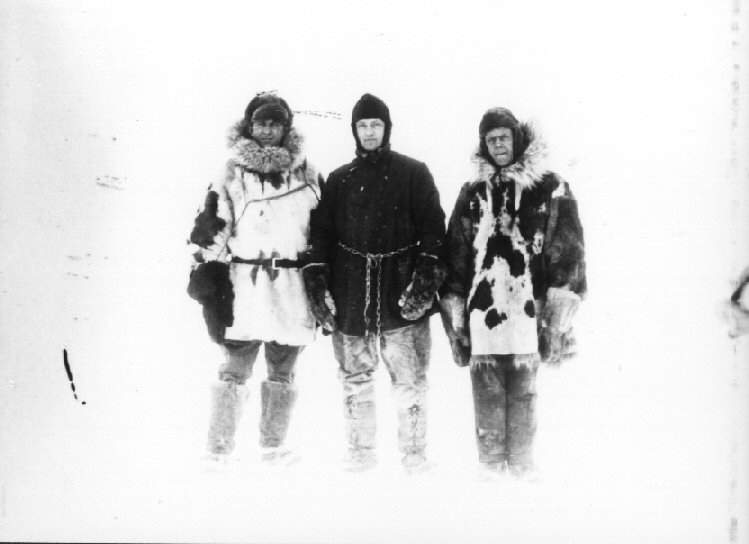
Whether Operation Highjump’s early termination reflects the completion of objectives, the approach of winter, an encounter with something unexpected, or some combination of these, is a question that the expedition’s classified operational records, which have not been fully released, would answer more definitively than the available public record permits.
The Foo Fighters and the Antarctic Record
The foo fighters appear in Allied military records from World War II. The phenomenon, balls of light or disc-shaped objects that followed Allied aircraft without attacking them but whose proximity sometimes correlated with equipment malfunction, was recorded by pilots across multiple theaters of operation and received sufficient institutional credibility to be formally investigated by Allied intelligence.
The investigation concluded that the foo fighters were not German or Japanese secret weapons, because they were observed by pilots on both sides and neither side claimed them as its own. The conclusion that Allied intelligence reached, that the phenomenon was unexplained but did not represent an enemy weapons system, appears in the declassified investigation reports.
Whether foo fighters appeared during Operation Highjump specifically is not recorded in the available public record with the specificity that the conspiracy literature attributes to it. Reports of unusual aerial phenomena during the expedition are in the conspiracy tradition but are not independently verified in the historical record accessible to researchers.

The broader recorded history of aerial phenomena in Antarctic operations extends beyond Operation Highjump. The Argentine, British, and Chilean naval and scientific expeditions to Antarctica in the same postwar period produced recorded reports of unusual aerial phenomena that are in the naval records of those countries. The Chilean and Argentine reports are particularly significant because those countries’ proximity to Antarctica meant they had more continuous operational presence in the region than the United States and more opportunity to accumulate observational records.
The International Geophysical Year of 1957-1958, which established the basis for the Antarctic Treaty System, involved multiple nations conducting simultaneous scientific programs in Antarctica. The recorded reports of unusual phenomena from this period are distributed across multiple national archives and have not been systematically collated in any published research.
The Wilkes Land Anomaly
The gravitational anomaly beneath the Wilkes Land region of East Antarctica appears in the published scientific literature and is one of the most anomalous features of the Antarctic geophysical record.
NASA’s GRACE satellite mission, which measured Earth’s gravitational field with unprecedented precision beginning in 2002, detected a significant positive gravitational anomaly in the Wilkes Land region. The anomaly is approximately 300 kilometers across and is located beneath approximately 1.6 kilometers of ice, meaning it cannot be directly observed or sampled with current surface technology.
Positive gravitational anomalies indicate regions of higher-than-average density in the subsurface. The Wilkes Land anomaly’s characteristics, its size, depth, and gravitational signature, are consistent with a large impact structure, approximately the size of the Chicxulub impactor that ended the Cretaceous period.
Ralph von Frese and Laramie Potts of Ohio State University, who published the analysis of the GRACE data revealing the anomaly in 2006, proposed that it represents a massive impact crater formed approximately 250 million years ago, roughly contemporaneous with the Permian-Triassic extinction event that killed approximately ninety percent of all species on Earth. Their proposal was that the Wilkes Land impact and the Permian-Triassic extinction event might be causally connected, with the impact triggering the volcanic activity and climate perturbation that drove the extinction.
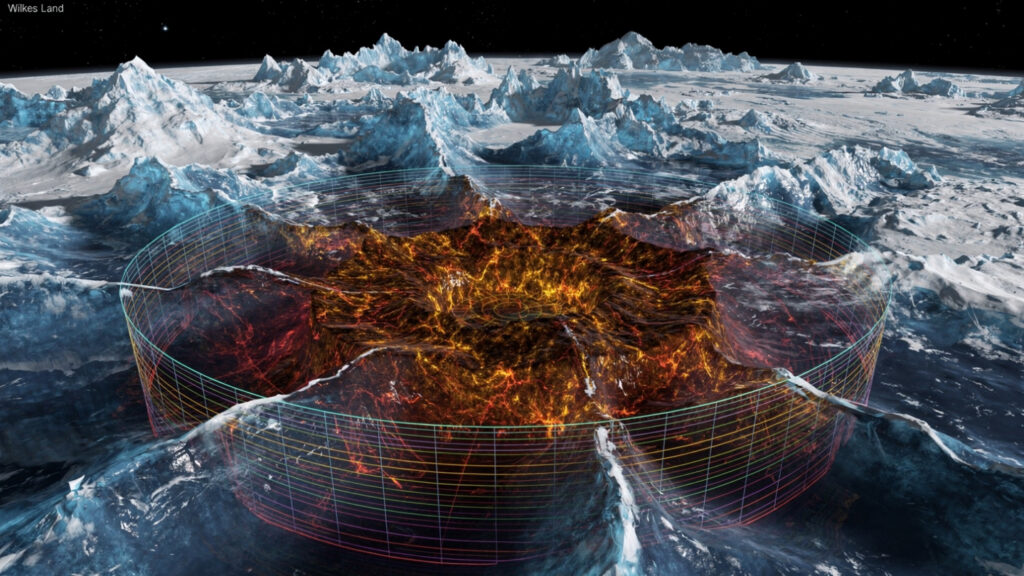
Whether the Wilkes Land anomaly is an impact structure, an ancient igneous intrusion, or something whose character the available data does not fully characterize, is not established. The anomaly is real and documented. Its interpretation is contested.
What makes the Wilkes Land anomaly interesting beyond its potential impact origin is its combination with the broader Antarctic geophysical context covered in this library’s dedicated pieces. The 138 subglacial volcanoes of the West Antarctic Rift System, the Lake Vostok isolation mystery, the extensive subglacial lake network, and the Wilkes Land gravitational anomaly together describe a continent whose subsurface is significantly more complex and more active than the conventional image of a static ice-covered land mass suggests.
The Nazi Antarctica Tradition
The claim that 250,000 Nazi officers escaped to Antarctica after World War II is not recorded in any credible historical source and is not consistent with the logistics of submarine transport, the known capacity of any conceivable Antarctic base, or the documented history of Nazi war criminal escape networks.
What is established is the following: the Ratlines, the escape networks that helped Nazi war criminals reach South America through Vatican and intelligence community channels recorded in the Vatican piece in this library, are real and their operations have been established through declassified intelligence records and historical research. The number of individuals who escaped through these networks appears in the hundreds or low thousands rather than in the hundreds of thousands.
The Nazi Antarctic base claim, known as New Swabia or Base 211, is a long-running conspiracy tradition whose origin appears to be in postwar German nationalist literature rather than in any historical record. The German Schwabenland expedition to Antarctica in 1938-1939 is real and well established: it was a German scientific and cartographic expedition that photographed and named portions of the Antarctic coast. The expedition did not establish a permanent base.
Whether the conspiracy tradition about a Nazi Antarctic base preserves a distorted version of some genuine classified program, or is purely a postwar fantasy that gained traction through the inherent mystique of Antarctica’s inaccessibility, is not established. The established history does not support the 250,000 figure or the Antarctic base claim. It does establish that the postwar intelligence community had reasons for interest in Antarctica that included both geopolitical territorial competition with the Soviet Union and whatever Operation Highjump actually found.
The distinction between what is established and what is claimed in the conspiracy tradition matters for the site’s credibility. The real elements of the Nazi-Antarctica connection are interesting on their own without the unverified elements, and presenting unverified claims as established facts would undermine the library’s evidentiary standard.
The Book of Enoch and the Geographic Correspondence
The Book of Enoch’s description of the location where the Watchers are imprisoned is the most genuinely interesting textual element in the source and the one that deserves the most careful development.
The First Book of Enoch, 1 Enoch, is the most extensively preserved of the Enochic texts and is canonical in the Ethiopian Orthodox Church. Its description of Enoch’s visionary journey to the place where the Watchers are imprisoned appears in chapters 18-19 and is elaborated in chapters 21-22.
The geographic description is worth examining against the Antarctic hypothesis carefully rather than asserting the correspondence as obvious.
Enoch describes a place where fire burns both day and night, suggesting continuous light or continuous fire. Antarctica during the austral summer experiences twenty-four hours of continuous daylight due to its position at the pole. This is the most correspondence between the text and the Antarctic hypothesis, and it is genuine: the only inhabited regions of Earth with continuous daylight are at high latitudes near the poles.
The seven mountains described in the text, three toward the east and three toward the south with one in the center described as the highest, have been proposed to correspond to the Ellsworth Mountains of Antarctica, where Mount Vinson is the highest peak in Antarctica at approximately 4,892 meters. Whether the orientation of three toward the east and three toward the south corresponds to the Ellsworth Mountains’ actual geographic arrangement requires topographic analysis that the conspiracy literature has not provided in any rigorous form.
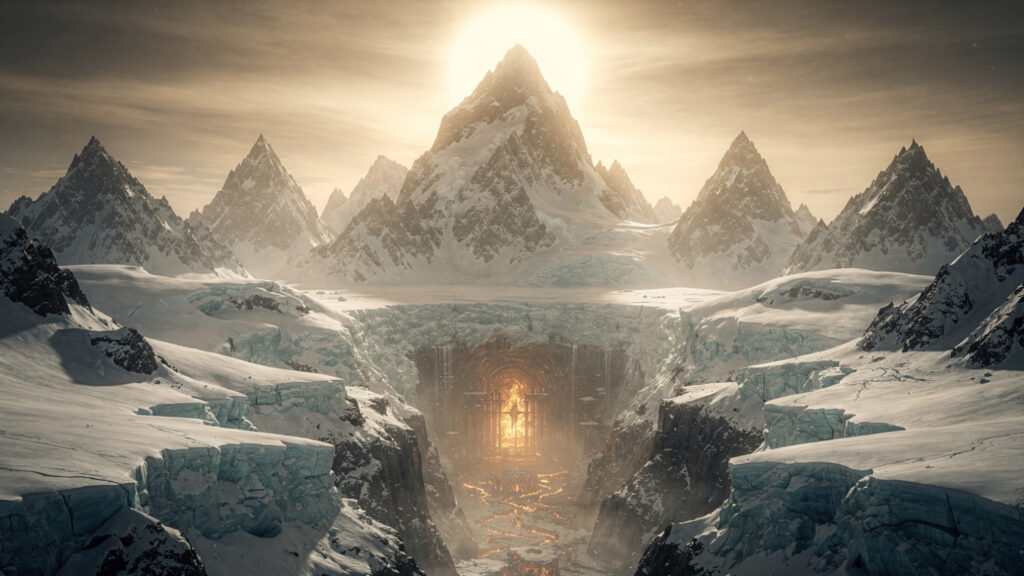
The pole shift hypothesis that the source invokes to explain the geographic misalignment, drawing on Charles Hapgood’s published work, is relevant here. Hapgood’s proposal, developed in his 1958 book Earth’s Shifting Crust, proposes that the Antarctic ice sheet’s accumulated mass could produce a displacement of the Earth’s outer shell relative to the rotational axis, moving Antarctica from a more temperate position to the polar position it currently occupies. His hypothesis was prefaced by Albert Einstein, who considered it worthy of serious examination though he died before it was fully developed.
Whether a pole shift of the magnitude Hapgood proposed occurred approximately 11,000 years ago, and whether the geographic displacements it would produce are sufficient to reposition a location matching Enoch’s description to Antarctica’s current coordinates, is a question that the physical evidence has not definitively answered. Hapgood’s hypothesis remains controversial in mainstream geology but has not been definitively refuted.
The Book of Enoch connection to the Watchers tradition appears in multiple existing pieces in this library. The Antarctic imprisonment hypothesis adds a geographic dimension to the Watchers framework that the existing pieces develop from different evidentiary directions. Whether the imprisoned Watchers of the Enochic tradition correspond to the physical anomalies buried under the Antarctic ice, the gravitational anomaly, the subglacial volcanic province, and the sealed lake systems, is a question that the convergence of textual description and physical anomaly raises without resolving.
The Antarctic Treaty and What It Protects
The Antarctic Treaty System, established in 1959 and entering into force in 1961, places Antarctica under a legal regime that is unlike the governance of any other region on Earth.
The treaty prohibits military activity, weapons testing including nuclear weapons, and territorial claims by any nation. It requires free exchange of scientific information among signatory nations. It designates Antarctica as a scientific preserve.
Whether the treaty’s provisions, particularly the prohibition on territorial claims and military activity combined with the requirement for scientific openness, were designed to protect Antarctica’s genuine scientific resources or to provide a legal framework for managing knowledge about what Antarctica contains, is a question that the treaty’s negotiating history partially illuminates but does not definitively answer.
The timing of the treaty’s negotiation, following immediately after Operation Highjump’s early termination and the subsequent International Geophysical Year programs that brought multiple nations simultaneously into Antarctica for the first time, suggests that whatever the nations involved learned about Antarctica during the late 1940s and 1950s produced a shared interest in establishing a common governance framework that would prevent competitive national exploitation of Antarctic resources or discoveries.
The Antarctic Treaty System is the most comprehensive international governance regime for any geographic region that was established in the absence of any prior human settlement or obvious resource competition. Whether this reflects genuine multinational idealism about preserving Antarctica for science, or reflects the management of knowledge about Antarctica’s contents that the signatory nations preferred to keep out of competitive national frameworks, is a question that the treaty’s historical context makes genuinely interesting.
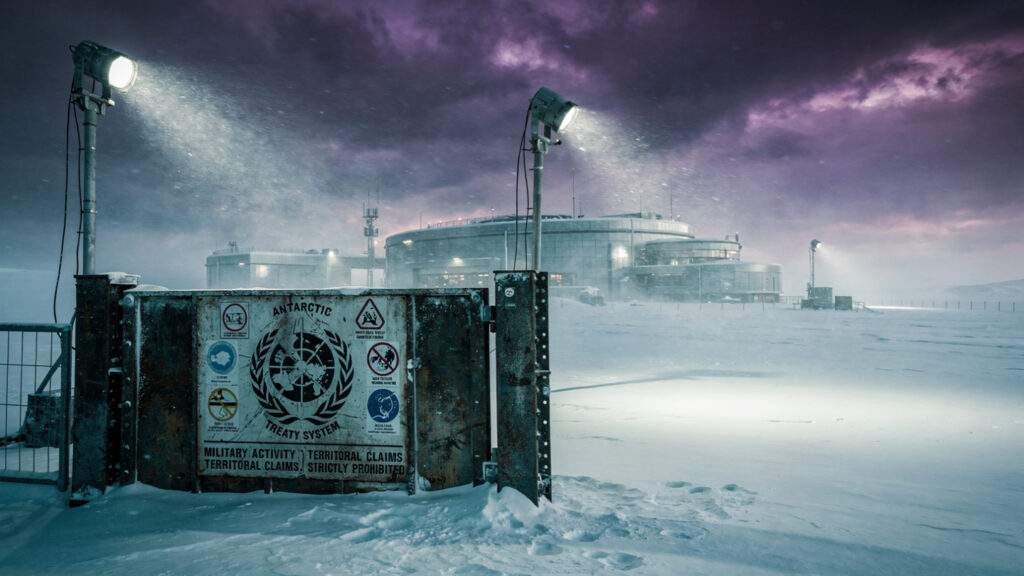
The subglacial lake systems recorded in the Lake Vostok piece, the volcanic province recorded in the 138 volcanoes piece, the Wilkes Land gravitational anomaly, and the ongoing inability of any nation to conduct independent research at several of the most geophysically significant Antarctic sites combine to produce a picture of a continent whose governance is more carefully managed than its scientific importance alone would require.
The Convergence
Operation Highjump ran its full operational course within the Antarctic summer window before returning home in early March 1947. The Wilkes Land anomaly is buried under two kilometers of ice and has not been directly investigated. The Lake Vostok drilling program’s communication went dark for five days at the moment of breakthrough. The Antarctic Treaty prevents independent military or national resource exploitation of the continent. The Book of Enoch describes a place of continuous light where the Watchers are imprisoned, surrounded by mountains whose description is consistent with Antarctic geography under a pole shift hypothesis.
None of these elements individually requires an extraordinary explanation. Operation Highjump’s timeline, once checked against the actual operational record rather than the conspiracy-literature framing, matches the ordinary seasonal constraint every Antarctic expedition operates under. The Wilkes Land anomaly is most likely an ancient impact structure. Lake Vostok’s communication interruption was most likely an atmospheric issue. The Antarctic Treaty is most likely genuine idealism about scientific preservation. The Book of Enoch’s geographic description is most likely metaphorical rather than literal cartography.
The convergence of all of them, at the same geographic location, with physical anomalies that current technology cannot fully investigate due to the ice barrier, produces the quality of unresolved question that the monkeyandelf library is built around.
Antarctica is the least investigated continent on Earth. Its subsurface is less understood than the surface of Mars. Whatever it contains beneath two to four kilometers of ice has not been examined by any instrument, and the legal framework governing the continent limits the conditions under which examination can occur.
The Watchers in the Book of Enoch were imprisoned until the appointed time. The text does not say what happens at the appointed time.
The ice is melting. The subglacial features are becoming accessible in ways they have not been for thousands of years. The appointed time, in whatever framework is used to define it, is not obviously far off.